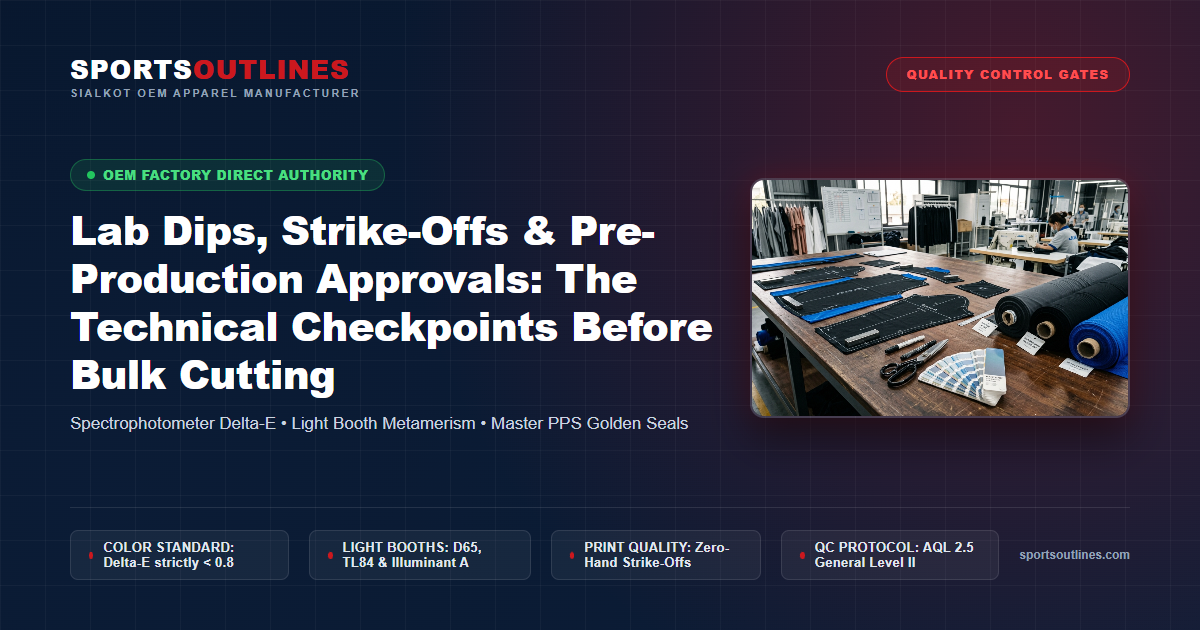
Direct Manufacturer Snapshot: Lab Dips, Strike-Offs & Pre-Production Approvals: The Technical Checkpoints Before Bulk Cutting
Textile lab dips, print strike-offs, and pre-production approvals are the mandatory technical quality gates that safeguard an apparel brand against catastrophic bulk manufacturing errors prior to raw fabric cutting. In professional garment engineering, a brand must systematically clear three distinct validation milestones: 1) Lab Dips (small 10×10 cm dyed textile swatches formulated in a dye laboratory under 4 dye-concentration recipes—Options A, B, C, D—evaluated under controlled light booths to match target Pantone TCX standards with a Delta-E variance below 0.8); 2) Print & Embroidery Strike-Offs (test impressions of screen print inks, sublimation transfer papers, or 3D puff embroidery executed on the actual production substrate to verify scale, color laydown, and ink opacity); and 3) Pre-Production Sample (PPS) Sign-Off (the master garment constructed from actual bulk fabric, trims, and packaging that serves as the legal AQL 2.5 benchmark). Authorizing bulk cutting without formal physical sign-off on these three checkpoints accounts for over 80% of color shade rejection disputes in overseas apparel sourcing. Sports Outlines International in Sialkot, Pakistan, provides spectrophotometer-calibrated lab dips, digital strike-offs, and 7–10 day prototype verification.
Direct WhatsApp: +92 316 7932595
Introduction: The Three Quality Gates that Protect Your Production Capital
In custom garment manufacturing, the single most perilous transition is moving from approved digital Adobe Illustrator mockups to bulk industrial cutting. Once an automated CNC cutting table slices through 300 kilograms of heavyweight cotton fleece or technical nylon-spandex interlock, there is no undo button. If the fabric dye shade has drifted three tones toward yellow, if the 3D puff embroidery foam crumbles under tension, or if the screen print ink feels like thick rubber across the chest, the entire production run is compromised, leaving the brand with thousands of dollars in unsellable inventory.
World-class fashion houses, technical sportswear labels, and combat sports enterprises protect their capital through a disciplined system of Pre-Production Quality Gates. Before a single bulk garment is cut, three mandatory technical validation checkpoints must be cleared: 1) Textile Lab Dips, 2) Print & Embroidery Strike-Offs, and 3) The Pre-Production Sample (PPS).
Operating from Sialkot, Pakistan—the export manufacturing capital of high-performance sportswear and luxury streetwear—Sports Outlines International enforces these exact engineering standards across every client account. In this comprehensive technical guide, we break down The Pre-Production Quality Gate Masterclass. We dissect the chemistry of laboratory dip formulation, spectrophotometric Delta-E color evaluation, light booth metamerism prevention, and print strike-off inspection, ensuring your custom collection launches with absolute commercial perfection.
Review Your Pantone Colors & Lab Dips with Sialkot Dye Chemists
Send us your Pantone TCX codes or vector artwork on WhatsApp for laboratory dip formulation and rapid physical strike-off scheduling.
✓ $45–$85 Physical Prototypes •
✓ Worldwide DDP Delivery
Quality Gate 1: Textile Lab Dips & Spectrophotometric Color Science
When you specify a custom color in your tech pack—for instance, Pantone 19-4007 TCX (Anthracite) or Pantone 18-0107 TCX (Kale Green)—a professional dye house does not immediately dump 200 kilograms of raw knitted fabric into a commercial dye vessel. Commercial dyeing vessels operate under high heat (130°C) and pressure; an error in dye formulation ruins entire bolts of textile.
Instead, our chemical dye laboratory formulates Lab Dips—small 10 cm × 10 cm test fabric swatches dyed in specialized laboratory beaker machines under four subtle dyestuff variations:
| Lab Dip Option | Dyestuff Formulation Shift | Visual Character | Delta-E (ΔE) Score |
|---|---|---|---|
| Option A (Baseline) | Standard stoichiometric chemical dye recipe matching master Pantone database | Baseline target shade | 0.45 ΔE (Pass) |
| Option B (Slightly Redder) | +3% reactive red chromophore dyestuff in formulation | Warmer, richer undertone | 0.72 ΔE (Pass) |
| Option C (Slightly Greener) | +3% reactive yellow/blue chromophore shift | Cooler, earthier cast | 0.68 ΔE (Pass) |
| Option D (Slightly Deeper) | +5% total dyestuff saturation index | Denser, higher-contrast shadow | 0.58 ΔE (Pass) |
The Mathematical Delta-E (ΔE) Threshold:
At Sports Outlines, color evaluation is not left to subjective human opinion. Our dye laboratory measures every lab dip using a calibrated Datacolor digital spectrophotometer. In the CIE L*a*b* color space, Delta-E represents the spherical distance between the target color and the dyed sample:
- ΔE < 0.5: Imperceptible difference to the human eye (Perfection).
- ΔE 0.5 – 0.8: Acceptable commercial tolerance for luxury retail apparel.
- ΔE > 1.0: Visually noticeable color shift; rejected and reformulated by our laboratory.
The Light Booth Gauntlet: Preventing Metamerism
A fatal pitfall in amateur sourcing is evaluating fabric colors under ordinary desk lamps or outdoor sunlight. This causes metamerism—a phenomenon where dyed fabrics match under sunlight but clash violently under indoor store lights.
Every lab dip at Sports Outlines is evaluated inside a standardized Macbeth Spectralight Light Booth under three distinct standardized illuminants:
- D65 (Artificial Daylight – 6500K): Simulates bright outdoor midday sun.
- TL84 / CWF (Cool White Fluorescent – 4000K): Replicates commercial retail store, gym, and boutique lighting.
- Illuminant A (Incandescent Tungsten – 2856K): Simulates warm residential living room and evening lighting.
Production is only cleared when your selected lab dip maintains uniform shade harmony across all three lighting environments.
Quality Gate 2: Print & Embroidery Strike-Offs
The second pre-production checkpoint is the Print & Embellishment Strike-Off. A strike-off is a physical test impression of your vector artwork executed directly onto the actual bulk fabric substrate:
Why Paper Mockups Are Deceptive:
Shady suppliers often print a graphic onto a piece of white paper or cheap scrap poplin and email a photo. This is utterly useless. Printing water-based ink onto a porous 450 GSM French Terry fleece behaves completely differently than printing on smooth paper. The fleece texture, surface loops, and dye absorption alter ink opacity and line crispness.
Strike-Off Inspection Criteria:
- Ink Opacity & Fiber Show-Through: On dark garments (black or navy), white and pastel inks must be sufficiently opaque without requiring heavy plastisol rubber buildup. We inspect ink laydown under 10x optical loupes to verify zero fiber show-through.
- Hand-Feel (Zero-Hand vs. Plastisol): Run your fingertips across the print. High-quality streetwear and athletic teamwear should feel soft and breathable. Water-based discharge prints must feel completely flush with the fabric fibers (“zero hand-feel”).
- 3D Puff Embroidery Foam Density: For dimensional embroidery, inspect the EVA foam core. The high-tensile 40-weight polyester thread must completely enclose the 3mm foam, with rounded, satin-smooth edges and zero exposed foam pores.
- Four-Way Stretch Recovery: Manually stretch the fabric beneath the graphic to 150% extension. Confirm that screen print inks do not fracture or peel, and that embroidery needle penetrations do not distort the knit loops.

The Science of Dye Chemistry: Reactive Dyes vs. Disperse Dyes
To master the lab dip approval workflow, a brand founder must understand the fundamental chemical differences in textile coloration across diverse fiber types. Natural cellulosic fibers (like combed cotton French Terry) require completely different chemical dye mechanisms than synthetic polymers (like micro-nylon activewear or polyester teamwear):
1. Reactive Dye Chemistry for Cellulosic Fibers (Cotton & French Terry)
For high-end streetwear hoodies and t-shirts, Sports Outlines utilizes bi-functional reactive dyestuffs. Reactive dyes do not merely coat the surface of the fiber; under alkaline conditions and moderate heat (60°C to 80°C), the dye molecules form permanent covalent chemical bonds with the hydroxyl groups of the cellulose polymer chain. This covalent bond creates supreme wet color fastness: the color cannot bleed or leach into wash water, achieving an ISO 105-C06 wash fastness score of Grade 4.5. When formulating reactive lab dips, our dye laboratory precisely controls salt concentrations, soda ash fixation levels, and rinsing cycles to prevent unfixed hydrolysed dyestuffs from causing future color bleeding.
2. High-Pressure Disperse Dyeing for Synthetics (Polyester & Micro-Nylon)
Synthetic filaments possess tight, non-porous crystalline polymer structures that reject water-soluble reactive dyes. For our custom athletic uniforms and compression activewear, our laboratory uses non-ionic disperse dyes processed inside pressurized overflow jet vessels at 130°C (266°F). Under intense hydrothermal pressure, the synthetic polymer chains expand, allowing microscopic disperse dye particles to migrate into the amorphous zones of the fiber before locking permanently upon cooling. Disperse dyeing delivers exceptional light fastness (Grade 5 on the Blue Wool Scale), guaranteeing that athletic jerseys retain their vivid saturation under harsh ultraviolet stadium lighting.
Standardized Color Fastness Gauntlets: ISO 105 & AATCC Protocols
Approving a lab dip is not purely an optical exercise; it is a performance guarantee. At Sports Outlines, our laboratory subjects every approved lab dip formulation to international standardized color fastness gauntlets before loading commercial dye lots:
| Color Fastness Test | International Standard | Testing Methodology | Acceptable Pass Standard |
|---|---|---|---|
| Color Fastness to Washing | ISO 105-C06 (Test A2S) | Laundered at 40°C with standard ECE detergent and stainless steel balls for 30 minutes | Grade 4.0 – 4.5 (Minimal Shade Change) |
| Color Fastness to Crocking (Rubbing) | AATCC 8 / ISO 105-X12 | Dry and wet crockmeter cycle: white cotton cloth rubbed under 9N mechanical force for 10 strokes | Dry: Grade 4.5 | Wet: Grade 3.5 – 4.0 |
| Color Fastness to Perspiration | ISO 105-E04 | Specimen soaked in acidic and alkaline synthetic sweat solutions at 37°C under pressure for 4 hours | Grade 4.0 (Zero Staining on Multifiber) |
| Color Fastness to Light | ISO 105-B02 (Xenon Arc) | Exposed to water-cooled xenon arc lamp simulating intense solar UV radiation for 40 continuous hours | Grade 4.0 on Blue Wool Reference Scale |
Multi-Substrate Color Harmonization: Co-Dyeing Cotton, Rib & Trims
One of the most complex engineering challenges in streetwear and activewear manufacturing is multi-substrate color harmonization. A premium hoodie does not consist of a single uniform textile; it combines 450 GSM loopback cotton fleece for the body, 480 GSM 95/5 cotton-spandex 2×2 ribbing for cuffs and waistbands, 100% woven cotton drawcords, and nylon tape for YKK zippers.
Because each of these materials possesses different fiber purities, yarn counts, and chemical absorption characteristics, simply throwing them into the same dye vat results in mismatched shades—ribbing that looks slightly yellow, or drawcords that appear washed out. At our Sialkot facility, we formulate paired sub-recipes for each distinct component. Our spectrophotometer measures the Delta-E of each substrate independently under D65 daylight, ensuring that when the garment is assembled, all four materials exhibit flawless monochromatic harmony.
The Pre-Production Sample (PPS) Golden Seal: Legal & Contractual Authority
In international contract manufacturing, the approved Pre-Production Sample (PPS) is not merely a design reference; it is a legally binding golden standard. Once your PPS is physically approved, Sports Outlines attaches a tamper-evident physical serial tag known as the “Golden Seal.”
One sealed master sample remains archived in our Sialkot quality assurance vault, while an identical twin sample is dispatched to your domestic headquarters. When your bulk production run finishes cutting and sewing, our final AQL 2.5 quality control audit checks every bulk garment directly against the Golden Seal PPS. If a bulk garment deviates in seam tension, collar rib height, or print alignment from the Golden PPS, it is immediately flagged and rejected by our quality team before packaging.
Quality Gate 3: The Pre-Production Sample (PPS) Sign-Off
The third and final pre-production checkpoint is the Pre-Production Sample (PPS). While earlier proto samples verified pattern geometry and sizing, the PPS is the definitive master garment crafted from the actual approved bulk fabric lot, approved trims, woven labels, and packaging.
The PPS serves as the legally binding “Golden Standard” for your order. When our factory quality control inspectors audit your finished production run using standardized AQL 2.5 General Inspection Level II protocols, every single bulk garment is graded against the physical approved PPS:
- Seam Stitch Density: Confirm 10 to 12 stitches per inch (SPI) along all structural seams.
- Trim Attachment: Confirm custom zinc alloy aglets are tightly crimped and YKK zipper sliders glide without snagging.
- Dimensional Precision: Verify every Point of Measure matches the tech pack specification within the strict ±0.5 cm tolerance.
| Production Volume Tier | Est. Unit FOB Cost | Sample Cost & SLA | Bulk Production SLA | Included Specifications | Recommended Buyer Profile |
|---|---|---|---|---|---|
| 1 Prototype (PPS Gate) | $45.00 – $85.00 Flat Fee | 7–10 Days Turnaround | 7–10 Business Days | Complete bespoke PPS garment, Pantone lab dip swatches, print strike-off test | Physical color verification, light booth evaluation, executive sign-off |
| 30 Units (Micro MOQ Batch) | $22.50 – $24.50 / Unit | Prototype Fee Non-Creditable | 12–15 Days | Stock certified fleece matched to approved lab dip, single print, polybag | Pilot brand proof-of-concept releases requiring zero shade variance |
| 50 Units (Capsule Drop Tier) | $18.50 – $20.00 / Unit | Prototype Fee Non-Creditable | 14–18 Days | Custom laboratory dye lot matching approved dip, multi-color strike-off | Streetwear capsule releases requiring coordinated multi-substrate matching |
| 100 Units (Commercial Tier) | $15.20 – $16.50 / Unit | Prototype Fee Non-Creditable | 18–21 Days | Full automated laser cutting, continuous roll sublimation strike-off, AQL 2.5 QC | Growing e-commerce brands demanding strict spectrophotometric consistency |
| Sourcing Feature & Risk Factor | Sports Outlines (Sialkot Direct) | Alibaba Trading Agents | Traditional Chinese Hubs | Print-on-Demand (POD) |
|---|---|---|---|---|
| Color Calibration Standard | Spectrophotometric CIE Lab Delta-E (<0.8 tolerance) evaluated under standardized D65, CWF & Incandescent light booths | Subjective visual eyeball checks by trading agents under outdoor natural sunlight, leading to massive metamerism | Spectrophotometer used, but high fees ($150+) charged for lab dip swatches on orders under 1,000 meters | Digital RGB-to-CMYK conversion on consumer software resulting in murky, desaturated color shifts |
| Print Strike-Off Substrate Protocol | Strike-offs printed exclusively on actual bulk production fabric to test true capillary absorption and stretch opacity | Strike-offs printed on cheap scrap poplin or paper transfer sheets that behave completely differently than fleece | Digital strike-off photo emailed; physical strike-off swatch dispatch requires $80+ international courier fee | Zero physical strike-off testing — garments printed live directly during individual consumer checkout |
| Metamerism Prevention Testing | Multi-illuminant light booth testing (D65 daylight, TL84 store lighting, Illuminant A) ensuring zero color shifting | Ignored completely — garments look correct in sunlight but turn purplish-brown under retail fluorescent lights | Available upon request, but client must specify light booth standards in formal technical contract | Zero metamerism control — varying ink formulations produce erratic color appearances across different rooms |
| Pre-Production Sample (PPS) Policy | Strict mandatory PPS sign-off: bulk fabric rolls remain uncut until physical master sample is signed by client | Factories frequently initiate bulk cutting before sample arrives to meet tight shipping schedules, forcing acceptance | Strict PPS policy, but sample queues often delay production by 4 to 6 weeks | No pre-production checkpoints exist in print-on-demand fulfillment models |
| Prototype Dispatch & Turnaround Speed | Guaranteed 7 to 10 business days door-to-door physical prototype dispatch via DHL Express ($45–$85 fee) | Unpredictable 3 to 6-week delays with frequent excuses regarding dye lab queue bottlenecks | 4 to 5-week sample queue with high development charges ($150–$300) per garment silhouette | Instant 3D digital mockup, but zero physical sample testing prior to mass production |
The Prototyping Milestone: $45–$85 Flat Engineering Fee
At Sports Outlines International, we believe that serious apparel brand founders deserve total financial transparency. We do not engage in deceptive promotional sampling games that inflate bulk production costs. Instead, we manufacture your complete physical pre-production prototype for a flat, transparent non-creditable engineering fee of $45 to $85 per style.
Delivered via DHL Express within 7 to 10 business days, this sample allows you to physically test every fabric spec, lab dip color, strike-off embellishment, and seam construction before releasing your bulk manufacturing deposit.
The 5-Point PPS Sign-Off Checklist:
- Color Match: Verify fabric shade against approved Lab Dip Option under daylight and indoor lighting.
- Dimensional Audit: Measure all POM dimensions; verify compliance with ±0.5 cm tolerance.
- Hardware Check: Verify smooth zipper operation and secure drawcord aglet crimp.
- Embellishment Test: Stretch printed/embroidered areas; verify zero cracking or foam dislocation.
- Laundering Gauntlet: Machine wash under warm water (40°C); verify shrinkage remains strictly under 3.0%.
Lock In Calibrated Pre-Production Quality Control with Sports Outlines
Direct Sialkot factory direct pricing • Free spectrophotometer Delta-E verification • Transparent $45–$85 physical sample prototyping.
✓ $45–$85 Physical Prototypes •
✓ Worldwide DDP Delivery
Conclusion: Build with Absolute Manufacturing Precision
In high-stakes commercial apparel production, quality is never an accident; it is the predictable result of disciplined engineering checkpoints. By mastering the three pre-production quality gates—Textile Lab Dips, Print Strike-Offs, and The Pre-Production Sample—you eliminate manufacturing ambiguity, protect your operating capital, and ensure that every garment that reaches your customer’s hands embodies flawless craftsmanship.
At Sports Outlines International in Sialkot, Pakistan, our chemical dye laboratories, automated laser cutting tables, and master pattern artisans are dedicated to executing your vision with world-class accuracy. Contact our senior manufacturing engineering desk on WhatsApp today to discuss your Pantone color codes, review your tech pack specifications, and begin your journey toward apparel manufacturing dominance.
Frequently Asked Sourcing & Manufacturing Questions (Buyer FAQ)
What is a textile lab dip in apparel manufacturing?
A textile lab dip is a small swatch of fabric (typically 10×10 cm) dyed in a laboratory vat using an exact chemical dyestuff formulation to match a brand’s specified Pantone color code. The dye laboratory typically provides 3 to 4 variations (labeled Option A, B, C, D) representing subtle formula adjustments for the client to review and approve.
What is a print or embroidery strike-off?
A strike-off is a physical test sample of a graphic artwork, screen print, dye sublimation print, or embroidery executed directly onto the specified production fabric. It allows the brand to evaluate ink opacity, color accuracy, line sharpness, hand-feel, and scale before mass printing begins.
What is a Pre-Production Sample (PPS)?
A Pre-Production Sample (PPS) is the finalized, fully finished master garment produced immediately prior to bulk fabric cutting. It is constructed using the approved bulk fabric roll, exact trims, sewing threads, embellishments, and custom labels, serving as the legally binding golden standard for final AQL 2.5 quality control inspection.
What is Delta-E (ΔE) in textile color matching?
Delta-E (ΔE) is a mathematical metric calculated by a digital spectrophotometer that measures the total color difference between a dyed fabric sample and the target master standard in the CIE Lab color space. A Delta-E below 1.0 is virtually imperceptible to the human eye; commercial apparel standards mandate a Delta-E strictly below 0.8.
What is metamerism and how is it prevented in apparel production?
Metamerism is an optical phenomenon where two fabric samples appear to match perfectly under one light source (such as natural daylight), but look noticeably different under another light source (such as retail store fluorescent lighting). It is prevented by evaluating lab dips inside a calibrated light box under multiple standard illuminants (D65, TL84/CWF, and Illuminant A).
Why is it dangerous to authorize bulk cutting without lab dip approval?
If you allow a factory to cut and sew 100 or 300 garments without approving a physical lab dip, you lose all legal recourse if the finished color arrives off-shade (e.g., your olive green arrives looking like khaki). Approving a physical lab dip establishes an enforceable contractual color standard.
How does Sports Outlines evaluate lab dips and strike-offs?
At our Sialkot facility, we evaluate all lab dips and print strike-offs using advanced digital spectrophotometers and Macbeth-standard multi-illuminant light booths. We measure Delta-E color deviation and provide photographic and physical swatches for client approval before loading bulk dye vessels.
What is the pre-production prototype fee at Sports Outlines?
Sports Outlines manufactures complete physical pre-production prototypes for a flat non-creditable engineering fee of $45 to $85 per style. Dispatched via DHL Express within 7 to 10 business days, the sample allows you to verify color, fit, and construction before mass cutting begins.
How long does it take to formulate and approve lab dips?
Formulating laboratory dip options (A, B, C, D) typically takes 3 to 5 business days in our Sialkot dye laboratory. Swatches can be approved via high-resolution calibrated spectrophotometer reports or dispatched via express courier for physical client sign-off.
How do I submit Pantone colors for lab dip formulation at Sports Outlines?
Simply send your Pantone TCX or Cotton Passport codes along with your tech pack via WhatsApp (+92 316 7932595) or email. Our textile engineering team will immediately formulate dye recipes and schedule your pre-production quality checkpoints.