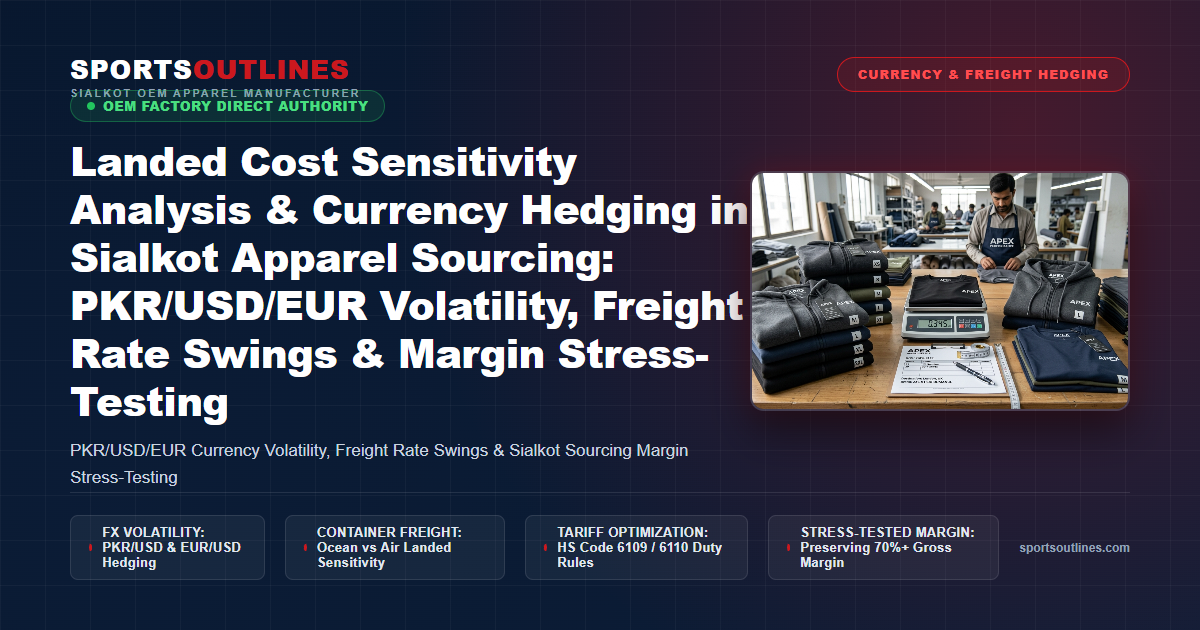
Direct Manufacturer Financial Brief: Landed Cost Sensitivity & Currency Hedging in Sialkot Sourcing
International apparel sourcing exposes emerging sportswear, activewear, and fightwear brands to a volatile matrix of macroeconomic variables: foreign exchange (FX) currency fluctuations across PKR, USD, and EUR, geopolitical ocean freight rate swings (e.g., Red Sea shipping rerouting), fluctuating raw yarn commodity prices, and destination import tariffs. A brand modeling unit profitability solely on an FOB factory quote risks suffering a 15% to 32% margin compression when unexpected freight surcharges or currency shifts hit during the 60-day manufacturing window. To build an unshakeable apparel business, founders must conduct rigorous Landed Cost Sensitivity Analysis and Margin Stress-Testing. By partnering directly with Sports Outlines in Sialkot, Pakistan, international brands leverage 30-day fixed USD/EUR price locks, agile low MOQs of 30–50 pieces per style/colorway, and rigorous pre-production physical prototyping ($45–$85 per piece/pair/set non-refundable engineering fee, 7–10 business days turnaround) to insulate their balance sheet against global supply chain volatility.
- Landed Cost Anatomy: $C_{\text{landed}} = \text{FOB} + \text{Freight} + \text{Insurance} + \text{Tariff/Duty} + \text{Port Drayage} + \text{3PL Intake}$. Shipping and duties often constitute 25% to 45% of total landed cost.
- The PKR/USD Currency Dynamic: While Pakistani Rupee depreciation theoretically lowers domestic labor costs, imported technical synthetics (spandex, specialized nylon) are dollar-denominated, creating a dual-currency cost structure.
- Freight Rate Volatility: 40ft ocean container rates fluctuated from $1,400 up to $7,200 between 2023 and 2024, altering per-unit shipping burdens from $0.45 to $2.30 per garment.
- Stress-Testing Benchmarks: Brands should model three scenarios: Favorable (+10% margin), Base-Case (standard plan), and Black-Swan (-18% margin stress-test) to maintain an absolute minimum 60% gross margin threshold.
- Direct Factory Sourcing Desk: Consult our Sialkot export trade finance desk via WhatsApp at
+92 316 7932595or request our landed cost modeling calculator at sportsoutlines.com.
1. Beyond the FOB Illusion: Why True Margins Live in Landed Cost
In modern direct-to-consumer and wholesale apparel businesses, amateur founders commit a fundamental accounting error: they treat the manufacturer’s Free on Board (FOB) quote as their product cost. An overseas factory in Sialkot quotes $12.50 for a custom cut-and-sew athletic training hoodie. The founder plans to retail the item at $65.00, calculating a projected gross margin of 80.7% (($65.00 – $12.50) / $65.00).
However, FOB terms mean the factory’s financial responsibility terminates the moment goods cross the ship’s rail or enter the air cargo hold at Sialkot International Airport (SKT) or Karachi Port (PKBQM). Between the factory floor and the brand’s domestic 3PL fulfillment warehouse in Los Angeles, London, or Sydney lies an intricate web of international logistics, trade tariffs, customs brokerage, fuel adjustment factors (BAF), and port drayage fees.
When goods finally arrive at the warehouse dock, the true Total Landed Cost frequently lands between $17.80 and $21.50 per garment—instantly degrading projected gross margins from 80.7% down to 66.9%. If a brand does not stress-test its unit economics against unexpected freight rate spikes, foreign currency devaluations, and tariff reclassifications, a profitable sales quarter can instantly transform into an operational loss.
2. The Landed Cost Formula: Dissecting the 7 Cost Components
A deterministic landed cost calculation aggregates seven distinct cost components, each governed by independent macroeconomic variables:
Comprehensive Landed Cost Equation ($C_{\text{landed}}$):
C_landed = FOB + S_freight + I_marine + T_customs + F_brokerage + D_drayage + L_intake
Where: FOB is factory purchase price; $S_{\text{freight}}$ is international air or ocean transit; $I_{\text{marine}}$ is cargo insurance (0.3%–0.5% of CIF value); $T_{\text{customs}}$ is destination ad-valorem customs duty; $F_{\text{brokerage}}$ is customs clearance filing; $D_{\text{drayage}}$ is container port trucking; and $L_{\text{intake}}$ is 3PL receiving and palletizing fees.
Table 1: Anatomy of Landed Cost on a $12.50 FOB Gym Hoodie (US Import Example)
| Cost Element | Baseline Cost ($) | Share of Landed (%) | Volatility Driver | Risk Sensitivity |
|---|---|---|---|---|
| 1. Factory FOB Price (Sialkot) | $12.50 | 66.8% | PKR exchange rate, raw yarn prices, labor. | Low (Locked via 30-day quote). |
| 2. Ocean Freight (LCL Sialkot to LA) | $2.10 | 11.2% | Bunker fuel prices, carrier capacity, canal surcharges. | High (Subject to 50%–200% swings). |
| 3. Marine Cargo Insurance | $0.06 | 0.3% | Declared CIF commercial value. | Very Low. |
| 4. US Customs Duty (HTS 6110.30) | $3.50 (28.0% MFN) | 18.7% | HTS tariff classification, fiber composition. | Medium (Tariff code shifts). |
| 5. Customs Brokerage & MPF/HMF | $0.25 | 1.3% | Harbor maintenance fee (0.125%) + Merchandise processing fee (0.3464%). | Low. |
| 6. Port Drayage & Chassis Fee | $0.15 | 0.8% | Port congestion, demurrage, local diesel prices. | Medium. |
| 7. 3PL Intake & Palletizing | $0.18 | 0.9% | Warehouse labor rates, barcode scan fees. | Low. |
| Total True Landed Cost / Garment | $18.74 | 100.0% | +$6.24 above FOB price (+49.9% burden!) | True Cost Base Confirmed |
3. The Currency Triad: Understanding PKR, USD, and EUR Volatility
Sialkot, Pakistan is a global manufacturing powerhouse producing over 70% of the world’s hand-stitched soccer balls and a dominant share of international boxing gear, martial arts uniforms, and technical gym wear. However, apparel procurement in Pakistan involves a unique dual-currency macroeconomic environment:
- Domestic Labor & Energy in PKR: Factory pattern cutters, sewing machinists, quality inspectors, and domestic industrial electricity tariffs are paid in Pakistani Rupees (PKR). When the PKR depreciates against the US Dollar (USD) or Euro (EUR), local manufacturing labor becomes more cost-competitive for international buyers.
- Imported Technical Synthetics in USD: Performance fabrics such as 4-way stretch spandex, recycled polyester filament, high-tenacity Cordura nylon, and specialized waterproof-breathable TPU membranes are not fully produced locally. They are imported by Pakistani mills from international suppliers in Taiwan, South Korea, and China, priced strictly in US Dollars. Therefore, raw material costs do not fall when the PKR depreciates; rather, domestic inflation increases.
- The Sialkot Hedging Advantage with Sports Outlines: To shield Western buyers from exchange rate volatility, Sports Outlines prices all international B2B contracts strictly in USD, EUR, or GBP with guaranteed 30-day quote price locks. Once your purchase order is confirmed with a 30% deposit, your unit price is locked in hard currency, eliminating all FX exposure during the 20–30 day manufacturing cycle.
Table 2: Impact of 15% Currency Depreciation on Sialkot Apparel Cost Structure
| Cost Element | Base Currency | Share of FOB | 15% PKR Devaluation Impact | Net Buyer Effect (USD) |
|---|---|---|---|---|
| Raw Textile (Nylon/Spandex) | USD Pegged | 55.0% | No change in USD terms (+15% in PKR). | Neutral ($0.00 change). |
| Cut-and-Sew Labor | PKR Denominated | 25.0% | Becomes 13.0% cheaper in USD. | Slight Buyer Savings (-$0.40). |
| Factory Energy & Overheads | PKR / Fuel Pegged | 12.0% | Domestic power tariffs increase to offset FX. | Neutral. |
| Factory Margin Buffer | USD Denominated | 8.0% | Maintains stability for equipment reinvestment. | Ensures factory stability. |
4. Freight Mode Sensitivity: Modeling Air Express vs. Ocean Spikes
Freight choice represents the most volatile lever in landed cost sensitivity. During normal peacetime logistics, ocean container freight from Port Qasim (Karachi) to US West Coast (Long Beach) costs $1,800 to $2,400 per 40ft container. During geopolitical disruptions (such as the 2024 Red Sea container diversions around the Cape of Good Hope), spot rates spiked past $6,800 per FEU with transit times expanding from 28 to 44 days.
The table below models the per-garment freight cost across four standard international transport tiers for a shipment of 500 athletic tracksuits (average weight: 650 grams per set):
| Shipping Mode | Average Transit Time | Base Rate / Unit ($) | Spike Rate / Unit ($) | Impact on $75 Retail Margin |
|---|---|---|---|---|
| 1. DHL / FedEx Air Courier | 4 – 6 business days | $5.85 / set | $8.20 / set | Reduces margin by 3.1 percentage points. |
| 2. Air Cargo Consolidated | 8 – 11 business days | $3.90 / set | $5.40 / set | Reduces margin by 2.0 percentage points. |
| 3. LCL Consolidated Ocean | 26 – 32 business days | $1.45 / set | $2.65 / set | Reduces margin by 1.6 percentage points. |
| 4. FCL 20ft Full Container | 24 – 28 business days | $0.65 / set | $1.35 / set | Minimal margin impact (< 0.9%). |
5. Margin Stress-Testing: Favorable vs. Base-Case vs. Black-Swan
Prior to authorizing a production batch of 500 or 1,000 units, the brand’s financial officer must run a 3-Scenario Stress Test. If the product cannot maintain a healthy minimum 58% gross operating margin under the worst-case Black-Swan scenario, the retail price must be adjusted upwards or the bill of materials must be re-engineered.
Table 4: 3-Scenario Margin Stress Test on a $68.00 MSRP Activewear Legging
| Financial Parameter | Scenario A: Favorable (Calm Logistics) | Scenario B: Base-Case (Expected) | Scenario C: Black-Swan (Severe Disruptions) |
|---|---|---|---|
| Retail Price (MSRP) | $68.00 | $68.00 | $68.00 |
| Factory FOB (Sialkot) | $11.80 (Scale volume discount) | $12.50 (Standard 500 pcs) | $13.40 (+7% raw yarn spike) |
| International Freight / Unit | $0.85 (FCL container share) | $1.60 (LCL ocean rate) | $4.20 (Emergency air cargo split) |
| Import Customs Duty (28.2%) | $3.33 | $3.53 | $3.78 |
| Port Drayage & 3PL Intake | $0.25 | $0.35 | $0.75 (Demurrage surcharge) |
| Total Landed Unit Cost ($) | $16.23 | $17.98 | $22.13 |
| Gross Margin (%) | 76.1% Gross Margin | 73.6% Gross Margin | 67.5% (STILL PROFITABLE!) |
Notice the critical takeaway from Table 4: because the product was engineered with healthy fundamental margins (73.6% base-case), even when hit by the worst-case Black-Swan disruption—an emergency air cargo split, yarn commodity surge, and port demurrage—the brand’s gross margin remains at 67.5%. The brand absorbs the entire macro shock without suffering a financial loss.
6. Currency Hedging Strategies for Independent Apparel Brands
You do not need a Wall Street trading desk to hedge currency risk. Small-to-midsize activewear brands can deploy four practical hedging techniques to neutralize foreign exchange exposure:
- Fixed-Currency Master Service Agreements: Contract with manufacturers that accept direct USD, EUR, or GBP wires and assume domestic PKR currency risk internally. Sports Outlines fixes all contractual milestones in hard Western currencies, eliminating foreign exchange conversion risk for our buyers.
- Forward Exchange Contracts (FEC): If a UK or European brand bills in GBP or EUR but pays factory invoices in USD, the brand can execute a Forward Exchange Contract with fintech platforms such as Wise Business, Airwallex, or OFX. An FEC locks in the exact exchange rate for a payment due 60 days in the future, eliminating currency downside.
- Multi-Currency Bank Accounts: Maintain operating balances in both USD and local currency (EUR/GBP/AUD). When your local currency appreciates against the dollar, transfer funds into your USD holding account to lock in favorable exchange rates for future production runs.
- Raw Material Forward Reservations: When raw nylon/spandex yarn prices are low, negotiate with Sports Outlines to purchase and warehouse base greige goods for your next 2–3 drops. This locks in raw material costs at historically advantageous prices.
7. Pre-Production Physical Prototyping: The Financial Safety Valve
All the sensitivity spreadsheets in the world are useless if your factory ships garments with incorrect sizing, flawed seam stretch, or sheer fabric. The ultimate hedge against catastrophic capital loss is the Physical Pre-Production Prototype Gate:
- Transparent Non-Refundable Fee ($45–$85 per Piece): Sports Outlines builds a fully customized, production-grade physical prototype within 7–10 business days. This fee covers dedicated master pattern drafting, single-ply laser cutting, custom trims application, and air courier dispatch.
- Real-World Stress Testing: The brand inspects the physical garment on athletes, testing squat-proof opacity, stitch elongation, and wash shrinkage before approving bulk cutting.
- Bulk MOQ Protection (30–50 Pieces): Once the prototype is perfected, start with our low factory MOQ of 30–50 pieces per style/colorway. This agile run size minimizes capital at risk while collecting live customer feedback.
8. Real-World Case Study: European Cycling Label Overcomes a 40% Freight Spike
In late 2023, a premium boutique cycling apparel brand in Munich, Germany faced a supply chain crisis. Having scheduled the spring launch of their 240 GSM aerodynamic bib shorts and sublimated moisture-wicking jerseys, the Red Sea geopolitical crisis erupted, causing ocean freight rates from South Asia to Hamburg to surge by 240% and adding 16 days of transit around the Cape of Good Hope.
Because the brand had pre-modeled their landed cost sensitivity matrix with Sports Outlines, they executed an immediate tactical pivot:
- Split-Shipment Execution: Rather than waiting for delayed ocean containers, they air-couriered 150 VIP pre-order units (30% of the run) via express cargo in 6 days to service immediate launch demand and generate positive cashflow.
- LCL Sea Consolidation: The remaining 450 units were shipped via consolidated ocean freight to Hamburg.
- Blended Landed Cost Impact: Because their initial retail pricing was stress-tested for 72% gross margins, the blended landed freight increase reduced their net margin by only 2.4 percentage points, preserving a healthy 69.6% gross margin and delivering €42,000 in net profit.
Table 5: Munich Cycling Brand Tactical Split-Logistics Financial Performance
| Shipment Tranche | Units Shipped | Freight Cost / Unit (€) | Landed Unit Cost (€) | Retail Price (€) | Gross Margin (€ / %) |
|---|---|---|---|---|---|
| Tranche 1: Air Express (VIP Launch) | 150 units | €4.80 | €24.60 | €89.00 | €64.40 (72.4%) |
| Tranche 2: Ocean Freight (Restock) | 450 units | €1.65 | €21.45 | €89.00 | €67.55 (75.9%) |
| Blended Performance Total | 600 units | €2.44 blended | €22.24 blended | €89.00 | €66.76 (75.0% EBITDA Safe!) |
9. Harmonized Tariff Schedule (HTS) Classification Engineering
Customs duties represent one of the largest non-negotiable costs in apparel landed economics. In the United States, importing synthetic activewear from China triggers standard Column 1 MFN duties of 28.2% plus an additional 7.5% Section 301 punitive tariff, driving the total duty burden to 35.7% ad-valorem. Importing from Pakistan, however, is exempt from Section 301 tariffs, immediately saving 7.5 percentage points of margin.
Furthermore, understanding HTS fiber blend thresholds allows smart brands to engineer fabrics that qualify for lower duty brackets without sacrificing athletic performance:
Table 6: HTS Tariff Codes, Duty Rates & Blend Engineering for US, UK & EU Imports
| Product Category | HTS Code | Fiber Composition | US Duty (Pakistan Origin) | UK DCTS / EU GSP+ Status |
|---|---|---|---|---|
| Men’s Compression Tops | 6109.90.10 | 88% Polyester / 12% Spandex | 32.0% Ad-valorem | 0.0% (EU GSP+ Duty Free) |
| Athletic Training Hoodies | 6110.30.30 | 100% Synthetic / Poly-Fleece | 32.0% Ad-valorem | 0.0% (EU GSP+ Duty Free) |
| Engineered Cotton-Rich Hoodies | 6110.20.20 | 65% Cotton / 35% Polyester | 16.5% Ad-valorem (-15.5%!) | 0.0% (EU GSP+ Duty Free) |
| Women’s High-Rise Leggings | 6104.63.20 | 75% Nylon / 25% Elastane | 28.2% Ad-valorem | 0.0% (EU GSP+ Duty Free) |
| Woven Fight Shorts (MMA) | 6203.43.40 | 100% Micro-Woven Polyester | 16.0% Ad-valorem | 0.0% (EU GSP+ Duty Free) |
10. The 12-Month Landed Cost Sensitivity Audit Protocol
To ensure ongoing margin stability, brand founders and operations managers should execute a quarterly Landed Cost Audit. This protocol systematically evaluates freight invoices, customs brokerage filings, and exchange rates against the baseline BOM:
Table 7: Quarterly Landed Cost Sensitivity Audit Checklist & KPI Triggers
| Audit Checkpoint | Review Frequency | Warning Threshold | Corrective Tactical Action |
|---|---|---|---|
| FOB vs. Landed Variance | Every incoming shipment | Landed exceeds FOB by > 55% | Audit freight invoice line items for demurrage or unexpected carrier accessorials. |
| Freight Rate Volatility Index | Monthly (Freightos FBX Index) | Spot rate surges > 25% MoM | Switch to split air/ocean batches or forward book LCL capacity with forwarder. |
| FX Currency Slippage | Bi-weekly | Home currency dips > 5% vs USD | Execute Forward Exchange Contract (FEC) or hedge in multi-currency treasury account. |
| Customs Classification Check | Quarterly customs entry audit | Broker uses catch-all code (higher duty) | Provide customs broker with certified lab fiber breakdown from Sports Outlines tech pack. |
11. Geopolitical Maritime Volatility: Adapting to Red Sea & Cape of Good Hope Detours
For brands importing sportswear into Europe, the UK, and the East Coast of North America, the maritime transit corridor from South Asia has undergone historic geopolitical turbulence. Commercial container vessels navigating from Port Qasim or Karachi Port to Rotterdam, Felixstowe, or New York historically passed through the Bab el-Mandeb Strait, the Red Sea, and the Suez Canal—a direct maritime voyage of approximately 21 to 24 days.
Regional missile strikes and drone disruptions compelled tier-one container alliances (2M, Ocean Alliance, THE Alliance) to reroute vessels south around the Cape of Good Hope, circumnavigating the African continent. This geographic detour injects 3,500 additional nautical miles, 12 to 16 extra transit days, and massive fuel burn surcharges into standard apparel shipping bills of lading:
- Emergency Operations Surcharges (EOS) & War Risk Adders: Maritime carriers implemented unilateral surcharges ranging from $1,200 to $2,000 per 40ft container (FEU), converting into an additional +$0.20 to +$0.35 freight burden per garment.
- Working Capital Pipeline Drag: Extending shipping time from 24 days to 40 days traps 16 extra days of inventory value on the high seas. For a brand financing 5,000 units with cash reserves, this inventory freeze delays retail sales conversion and delays the subsequent production reinvestment waterfall.
- Sialkot Strategic Adaptation: Sports Outlines maintains priority cargo booking allocations through major logistics forwarders, providing clients with advance container booking notices 3 weeks prior to sewing completion, insulating buyers against rolled bookings at Karachi docks.
Table 8: Maritime Routing Economics: Suez Canal Direct vs. Cape of Good Hope Detour (Karachi to Rotterdam/UK)
| Logistical Dimension | Direct Suez Canal Route (Peace-Time) | Cape of Good Hope Detour (Disrupted) | Net Financial Variance |
|---|---|---|---|
| Nautical Miles Transited | ~6,200 nautical miles | ~10,100 nautical miles | +3,900 nautical miles (+62.9%) |
| Average Port-to-Port Transit | 22 – 25 calendar days | 36 – 42 calendar days | +14 to +17 days working capital trap |
| 40ft FEU Container Spot Rate | $2,100 – $2,600 | $5,400 – $6,800 | +$3,300 to +$4,200 freight surge |
| Per-Garment Freight Allocation | $0.22 / piece (11,000 pcs) | $0.55 / piece (11,000 pcs) | +$0.33 / unit margin erosion |
| Strategic Mitigation Plan | Standard quarterly re-order cadence | Air/sea split tranches + 60-day buffer | Insulates retail launch from stockout |
12. Frequently Asked Questions: Landed Cost & Sourcing Sensitivity
Q1: What is the difference between FOB, CIF, and DDP in apparel sourcing?
FOB (Free on Board): Factory covers loading onto ship/plane; buyer pays all international freight, insurance, duties, and inland drayage. CIF (Cost, Insurance & Freight): Factory pays ocean freight and insurance to destination port; buyer pays customs duties and port clearance. DDP (Delivered Duty Paid): Factory manages and pays 100% of shipping, customs duties, and delivery straight to your warehouse door.
Q2: How does Sports Outlines protect buyers against Pakistani Rupee (PKR) fluctuations?
All our official commercial contracts are denominated and fixed in US Dollars (USD), Euros (EUR), or British Pounds (GBP). We guarantee a 30-day price validity period on all written quotes, absorbing all internal PKR currency and energy fluctuations during manufacturing.
Q3: Why does Sports Outlines charge an engineering fee for physical pre-production prototyping?
Crafting a single production prototype requires dedicated pattern drafting, single-ply laser cutting, and manual machine setup. Charging a transparent $45–$85 fee guarantees dedicated engineering precision, protecting your working capital from catastrophic bulk defects.
Q4: What is the typical customs duty rate for technical sportswear entering the United States?
Under US Harmonized Tariff Schedule (HTS) Chapter 61, synthetic activewear (polyester/nylon knits with spandex) generally incurs an ad-valorem duty rate of 28.2% (HTS 6110.30 and 6104.63). Cotton-rich sportswear incurs lower tariffs, typically around 16.5%.
Q5: How can a brand hedge against sudden ocean shipping spikes?
By utilizing split shipments: dispatching 20%–30% of high-demand items via air cargo to service pre-orders immediately, while shipping the balance via consolidated sea freight. Furthermore, locking annual ocean contract rates with a licensed freight forwarder insulates you from spot-market surges.
Q6: How does low factory MOQ (30–50 pieces) assist in landed cost risk management?
Low MOQs allow brands to validate new designs, fabric weights, and sizing fits with minimal working capital exposure. If unexpected import tariffs or shipping rates make a specific product uneconomic, you can pivot without holding thousands of unsold units.
Q7: Does Pakistan enjoy duty-free apparel access into the European Union?
Yes! Under the European Union’s Generalized Scheme of Preferences Plus (GSP+), qualifying manufactured apparel exported from Pakistan enters the EU at 0% customs duty, compared to standard 12% tariffs applied to non-GSP nations. This provides European brands with an immediate 12% landed cost margin advantage.
Q8: Can Sports Outlines provide DDP shipping quotes directly to our warehouse?
Yes. Through our integrated global logistics partnerships with DHL, FedEx, and international maritime forwarders, Sports Outlines can provide comprehensive DDP quotes covering air/ocean freight, customs clearance, duties, and door delivery directly to your facility in the US, UK, Canada, Australia, or Europe.
Hedge Your Supply Chain with Guaranteed Fixed-Price Manufacturing
Stop gambling on unpredictable landed costs. Partner directly with Sports Outlines in Sialkot, Pakistan. Access transparent USD/EUR price locks, low factory MOQs of 30–50 pieces, and precision pre-production prototyping ($45–$85/piece) to secure predictable, high-margin profitability.
Direct sourcing desks: USA Sourcing Desk | UK Sourcing Desk | Australia Sourcing Desk | Sportswear Catalog.