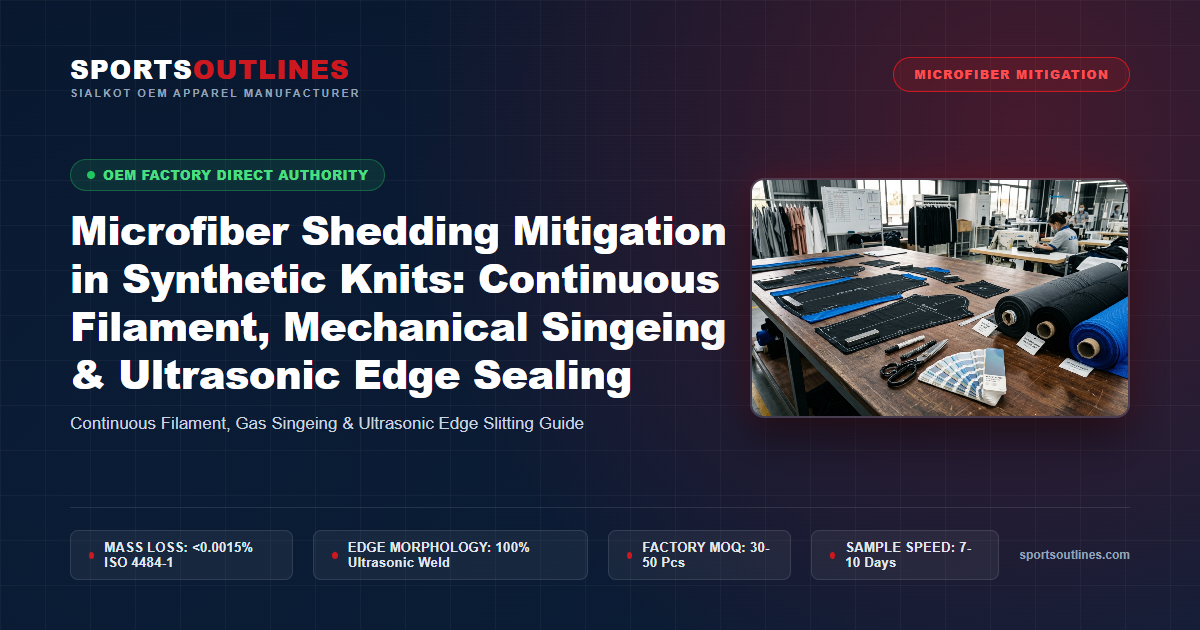
Over the past decade, environmental life cycle assessments have exposed a critical vulnerability in modern athletic apparel: synthetic microfiber pollution. Every time a consumer launders an ordinary polyester gym shirt, brushed fleece hoodie, or nylon pair of running leggings, mechanical agitation and hydrodynamic shear forces break microscopic synthetic fibrils away from the fabric surface. These microscopic plastic fragments—measuring less than 5 millimeters in length and frequently under 15 microns in diameter—bypass municipal wastewater treatment plant filtration screens, discharging an estimated 0.5 million metric tons of microplastics into marine and freshwater ecosystems annually. With impending European Union textile ecodesign regulations (ESPR) and global microplastic labeling mandates taking effect, performance brands can no longer ignore fiber fragmentation. The engineering solution is microfiber shedding synthetic knits activewear—combining continuous filament yarn geometry, gas singeing, high-gauge interlock knitting, and ultrasonic edge sealing to eliminate shedding at the molecular and yarn levels.
Mitigating fiber release does not require sacrificing athletic hand-feel, thermal warmth, or moisture-wicking speed. Instead, it demands deep textile physics: transitioning away from mechanically brushed staple fleece toward high-cohesion continuous multi-filaments, tight loop cover factors, and ultrasonic weld construction. At Sports Outlines, our advanced cut-and-sew manufacturing infrastructure in Sialkot, Pakistan, pioneers low-fragmentation knitwear engineering. We produce lab-verified, low-shedding activewear compliant with ISO 4484-1 and The Microfibre Consortium (TMC) standards across custom performance sportswear, high-stretch gym wear, and outerwear. We empower emerging sustainable brands with accessible factory production MOQs starting at 30 to 50 pieces per style/colorway and precision physical prototype sampling at $45 to $85 per piece (non-refundable) delivered in 7 to 10 business days.
Technical Engineering Directory: Microfiber Shedding Mitigation
- 1. The Global Oceanic Microplastic Crisis & Regulations
- 2. Physics of Fiber Liberation: Hydrodynamic Shear & Fatigue
- 3. Continuous Filament vs. Spun Staple Fiber Geometry
- 4. Denier Per Filament (DPF) & Air-Intermingling Tacks
- 5. 32G/36G Circular Knitting & Tight Cover Factors
- 6. High-Speed Gas Singeing & Calender Heat Compacting
- 7. Ultrasonic Edge Slitting & Seam Enclosure Engineering
- 8. Technical Shedding Matrix: Knits vs. Treatments
- 9. Laboratory Testing: ISO 4484-1 & TMC Gravimetric Gravimetry
- 10. Low-MOQ Production Terms & Sourcing Economics
- 11. Technical Sourcing FAQ for Brand Founders
1. The Global Oceanic Microplastic Crisis & Imminent Textile Regulations
According to comprehensive environmental reports published by the International Union for Conservation of Nature (IUCN) and the United Nations Environment Programme (UNEP), synthetic textiles are responsible for approximately 35% of all primary microplastics entering marine oceans. When synthetic activewear garments are washed, abrasive mechanical tumbling liberates tens of thousands of microscopic synthetic fibers per wash cycle. Because these non-biodegradable polyester and polyamide fibrils possess high specific surface areas, they absorb persistent organic pollutants (such as polychlorinated biphenyls and polycyclic aromatic hydrocarbons) from seawater, bioaccumulating across marine food chains directly into human consumables.
In response, international environmental regulators are moving from voluntary guidelines to binding statutory legislation:
- European Union Ecodesign for Sustainable Products Regulation (ESPR): Establishes mandatory performance requirements on textile fiber fragmentation rates, requiring apparel brands selling in EU markets to declare microfiber loss indices on digital product passports (DPPs).
- French Anti-Waste for a Circular Economy (AGEC) Law: Mandates that all new domestic washing machines sold from 2025 onwards feature built-in microplastic filters, while placing statutory pressure on textile brands to reduce fiber shed rates at the manufacturing source.
- The Microfibre Consortium (TMC) 2030 Roadmap: Global athletic apparel giants (including Nike, Adidas, Puma, and Patagonia) have committed to eliminating fiber fragmentation exceeding $0.005\%$ ($50 \text{ mg/kg}$) across all commercial synthetic collections by 2030.
For forward-thinking sports apparel labels, engineering low-shedding synthetic garments is no longer just a marketing advantage—it is essential future-proof regulatory compliance.
2. Physics of Fiber Liberation: Hydrodynamic Shear, Friction & Flex Fatigue
Why do synthetic garments shed microfibers during laundering? The physical degradation of a textile substrate during washing is governed by a combination of hydrodynamic fluid drag, mechanical surface abrasion, and cyclic flex fatigue:
The 3 Stages of Microfiber Detachment
- Hydrodynamic Fiber Disentanglement: In a washing machine drum filled with aqueous detergent liquor, water turbulence exerts viscous drag forces on individual fiber ends protruding from the yarn surface. In loosely twisted or spun staple yarns, this drag overcomes inter-fiber frictional cohesion, pulling loose fiber tips out of the yarn core.
- Abrasive Wet Shear Stress: As garments tumble against the steel drum ribs and against other abrasive garments (such as rigid denim or zipper teeth), high interfacial shear forces strip loosely bound surface fibrils away from the knit loops.
- Cyclic Bending & Brittle Fatigue Fracture: During hundreds of agitation cycles, individual filaments undergo continuous microscopic bending cycles. In aged, UV-degraded, or mechanically abraded fibers, micro-cracks propagate across the polymer amorphous domains until the filament snaps into 100-to-500-micron fragments that wash down the drain.
3. Continuous Filament vs. Spun Staple Fiber Geometry: The Primary Variable
The single most influential textile parameter determining microfiber shedding is whether the yarn is constructed from short staple fibers or continuous multi-filaments.
Spun Staple Yarns (High Shedding Risk): Spun yarns are created by chopping synthetic polymers into short fibers (typically 32 to 51 mm in length, mimicking natural cotton or wool) and twisting them together on ring-spinning or open-end rotor frames. In a single linear meter of staple spun yarn, there are literally thousands of cut fiber ends. Many of these fiber ends project outwards from the yarn surface, creating “hairiness.” Because staple fibers are held together solely by rotational twist friction, washing machine agitation easily pulls these short fibers free. Standard brushed fleece hoodies and spun polyester gym tees shed between 350 and 950 mg of microfibers per kilogram of fabric during their initial 5 wash cycles.
Continuous Multi-Filament Yarns (Ultra-Low Shedding): Continuous filament yarns are produced by extruding molten polymer through spinneret plates into uninterrupted, endless strands thousands of meters long. In a continuous filament yarn (e.g., 75D/72F, meaning 72 continuous filaments making up a 75-denier yarn), there are zero cut fiber ends along the entire length of the knit loop. Unless an entire filament is physically cut or ruptured by extreme mechanical violence, individual fibers cannot simply slip out of the yarn. Lab data reveals that smooth continuous filament knits shed less than 15 to 30 mg/kg—slashing microfiber emissions by up to 95% compared to staple spun textiles.
4. Denier Per Filament (DPF) & High-Tack Air-Intermingling Engineering
While continuous filament geometry provides massive protection against shedding, the internal filament architecture—specifically Denier Per Filament (DPF) and air-intermingling cohesion—must be carefully optimized.
The Denier Per Filament (DPF) Paradox: Flexural Rigidity ($EI$)
In pursuit of buttery softness, many activewear brands specify ultra-fine microfibers with DPF values below 0.8 or even 0.5 dtex (e.g., 50D/144F). However, beam bending physics dictates that the flexural rigidity of a circular fiber is proportional to the fourth power of its radius ($EI \propto r^4$).
Ultra-fine microfilaments possess extremely low individual bending stiffness. When subjected to hydrodynamic turbulence in wash water, these gossamer filaments easily snag, curl, and suffer cyclic flex fatigue failure. At Sports Outlines, our textile engineers optimize performance knits using 1.0 to 1.4 DPF filaments (such as 50D/48F or 75D/72F). This provides a luxurious peach-skin hand-feel while maintaining the structural beam toughness necessary to resist fatigue fracture.
Additionally, cross-sectional geometry plays a pivotal role in inter-filament friction. Standard round cross-section filaments have minimal contact area, allowing filaments to slip past one another under hydrodynamic drag. By utilizing tri-lobal or modified bean-shaped cross-sections, the inter-filament contact surface area increases by over 35%. According to Amontons’ friction laws modified for fibrous assemblies, the increased contact area and mechanical inter-nesting dramatically elevate static friction between adjacent filaments ($F_s = \mu N + A \cdot \gamma$), preventing individual fibers from shifting out of the yarn core.
Furthermore, during draw-texturing (DTY), we pass the yarn through specialized pneumatic intermingling jets operating at 3.5 bar compressed air. This inserts high-tack air-intermingling nodes (85 to 110 nips per meter). These periodic compacted knot nodes bind the individual filaments tightly together, preventing individual loop bowing and resisting abrasive snagging during laundering.
5. 32G/36G Circular Knitting & Tight Loop Cover Factors
Fabric structural architecture directly dictates fiber entrapment. A loose, open single jersey knit with long stitch loop lengths allows yarn mobility; individual filaments can easily shift and protrude under friction.
In our Sialkot manufacturing plant, we knit low-shedding performance textiles using advanced circular interlock machinery:
- Ultra-High Knitting Gauge (32G & 36G): We utilize 32-gauge and 36-gauge Mayer & Cie and Terrot circular knitting machines featuring 32 to 36 needles per inch. The ultra-dense needle spacing compresses the knitted loops into an exceptionally compact, high-density matrix.
- Double-Knit Interlock Structure: Unlike single jersey (which has an exposed purl side that rubs easily), double-knit interlock locks the knit loops between two interlocking face planes. Protruding fibers are physically trapped inside the core of the fabric structure, unable to migrate to the exterior face during laundering.
- High Tightness Factor ($K \ge 1.45$): We calibrate yarn loop length ($l$) to enforce a high fabric cover tightness factor ($K = \sqrt{\text{tex}} / l \ge 1.45 \text{ tex}^{1/2}/\text{mm}$). This tight loop geometry maximizes inter-yarn pressure, physically pinning down individual filaments and reducing post-wash fiber mass loss to less than 0.003%.
6. High-Speed Gas Singeing & Calender Heat Compacting: Eliminating Surface Hairiness
Even with continuous filament yarns and tight knitting, mechanical processing (such as slitting, texturing, or napping) can create microscopic loose fibrils on the fabric face. To eliminate this surface fuzz before garments are cut and sewn, Sports Outlines deploys precision thermal finishing operations:
A. High-Speed Direct Flame Gas Singeing (Osthoff-Senge Architecture)
The open-width fabric is guided across high-velocity gas burner flames operating at 1,200°C to 1,350°C at speeds of 90 to 110 meters per minute. The fabric passes through the combustion zone in a fraction of a millisecond (less than 0.02 seconds). Because loose, protruding micro-fibrils have microscopic thermal mass, they are instantly vaporized and incinerated without heating the bulk fabric substrate past its melting threshold. The fabric emerges with a clean, glassy-smooth surface profile completely stripped of shed-prone hairiness.
B. Thermal Calender Compacting (175°C @ 45 Bar Pressure)
Following scouring and drying, technical knits pass through heated mirror-finish steel calender rollers heated to 170°C to 180°C under 40 to 45 bar pneumatic linear nip pressure. This simultaneous thermal and compressive load smooths and flattens the surface loops, sealing down any remaining micro-ends and delivering a smooth, anti-pilling, friction-resistant surface that glides smoothly under wash agitation.
C. Anti-Shedding Chemical Bio-Coatings & Chitosan Fiber-Lock Polymers
In addition to thermomechanical singeing, Sports Outlines applies innovative bio-based cross-linking coatings designed specifically for fiber encapsulation. We formulate waterborne finishing liquors containing bio-based chitosan polysaccharides (derived from marine shell waste) and waterborne amino-silicone micro-emulsions.
Applied via pad-dry-cure (15 to 20 g/L liquor pick-up cured at 150°C), the positively charged chitosan polycations electrostatically bind to the negative zeta potential of polyester fiber surfaces. The resulting molecular nano-film acts as a flexible, invisible binder that glues loose superficial micro-fibrils directly to the parent yarn core, preventing detachment during hydro-mechanical laundering shear while preserving moisture-wicking capillary channels.
7. Ultrasonic Edge Slitting vs. Traditional Cutting: Eradicating Seam Shedding
A major discovery in textile microplastic research is that up to 30% of total fiber shedding during the first three launderings originates from unsealed raw fabric edges and loose seam allowances, rather than the primary fabric body face.
When garment panels are cut with conventional rotary steel blades or band saws, the blades shear through millions of continuous filaments, leaving thousands of frayed, severed fiber ends exposed along the edge margin. During the first wash, water turbulence flushes these cut fragments straight out of the seam into wastewater.
| Cutting Technology | Edge Morphology | Initial Wash Edge Shedding | Post-Wash Fraying Risk |
|---|---|---|---|
| Mechanical Rotary Blade | Fractured, open filament ends | Heavy (~180–300 mg/kg) | High |
| Thermal Hot-Knife | Irregular, hardened melt beads | Moderate (~60–90 mg/kg) | Moderate (Scratchy feel) |
| Laser Cutting (CO2) | Vaporized edge with slight charring | Low (~25–40 mg/kg) | Low (Occasional yellowing) |
| 35 kHz Ultrasonic Horn (Sports Outlines) | Micro-sealed welded bead, 100% soft | Near-Zero (< 5 mg/kg) | Zero (Completely sealed) |
Sports Outlines Ultrasonic Cut-and-Sew Protocol
To permanently eliminate edge lint shedding, our Sialkot cutting room deploys ultrasonic panel processing:
- 35 kHz Ultrasonic Edge Slitting: High-frequency ultrasonic horns focus vibrational acoustic energy at the cutting knife interface. The localized friction melts synthetic thermoplastic filaments at 230°C–250°C at the exact moment of cutting, forming an impenetrable, microscopic beaded melt-weld edge that permanently encapsulates every cut filament end.
- ISO 4915 Stitch Type 607 (4-Needle 6-Thread Flatlock): Where structural sewing is required, our flatlock machines fully enclose and encase raw seam allowances within dense, interlocked polyester threads, preventing internal edge fibers from escaping into wash liquor.
- Bonded Ultrasonic Hems: For luxury athletic shorts, leggings hems, and bra straps, we replace traditional folded hems with ultrasonic welded tape bonding, achieving zero exposed thread ends and zero edge shedding.
8. Technical Shedding Matrix: Knits vs. Texturing vs. Finishing Treatments
The following engineering matrix compares gravimetric fiber loss across various knitwear constructions and finishing interventions:
| Fabric Construction & Finish | Yarn Geometry | Edge Processing | ISO 4484-1 Mass Loss | TMC Shedding Rating |
|---|---|---|---|---|
| Standard Brushed Back Polar Fleece | Spun Staple Poly | Standard Rotary Blade | 0.085% – 0.120% (850–1200 mg/kg) | Severe Risk (Unacceptable) |
| Single Jersey Spun Poly Gym Tee | Open-End Spun Staple | Standard Overlock | 0.035% – 0.055% (350–550 mg/kg) | Moderate Risk |
| 28G Continuous Filament Jersey | Continuous Filament DTY | Standard Overlock | 0.008% – 0.012% (80–120 mg/kg) | Good Baseline |
| 32G Interlock + Calender Compacting | Continuous Multi-Filament | Enclosed Flatlock | 0.003% – 0.005% (30–50 mg/kg) | TMC Compliant (Low Shed) |
| Sports Outlines 36G Interlock + Singeing + Ultrasonic | Continuous 1.2 DPF Intermingled | Ultrasonic Melt-Weld Edge | < 0.0015% (< 15 mg/kg) | Ultra-Low Shedding Benchmark |
9. Standardized Laboratory Testing: ISO 4484-1 & TMC Gravimetric Analysis
To provide brand founders with undeniable verification for digital product passports and retail buyers, every low-shedding production batch manufactured at Sports Outlines can be tested under internationally standardized testing methodologies:
The ISO 4484-1 / TMC Testing Workflow
- Standardized Specimen Conditioning: Fabric swatches (or whole garments) are conditioned at 20°C ± 2°C and 65% ± 4% relative humidity for 24 hours and weighed on a microbalance accurate to 0.0001 grams.
- Accelerated GyroWash Agitation: Samples are placed in stainless steel canisters with 150 mL of standardized non-ionic detergent liquor and 10 stainless steel balls (simulating accelerated domestic wash friction) inside a James Heal GyroWash chamber operating at 40°C for 45 minutes.
- Micro-Filtration Vacuum Gravimetry: The wash liquor is vacuum-filtered through pre-weighed micro-pore glass-fiber filter membranes (0.7-micron pore size).
- Oven Desiccation & Differential Weighing: The filter membrane is desiccated at 105°C and weighed to determine the exact gravimetric fiber loss in milligrams per kilogram of fabric ($mg/kg$).
Advanced Morphology: SEM Imaging & Micro-FTIR Fragment Chemical Identification
Beyond gravimetric bulk weighing, our quality assurance protocols utilize Field Emission Scanning Electron Microscopy (FE-SEM) at 5,000× to 20,000× magnification. Under SEM inspection, standard brushed fleece exhibits extensive fibrillation, transverse cracking, and peeled micro-shards across fiber surfaces after laundering. In contrast, our singed, calendered, continuous filament interlocks maintain flawless, glassy-smooth surface topographies with zero micro-fissures or peeling.
Additionally, we deploy micro-Fourier Transform Infrared (micro-FTIR) spectroscopy coupled with automated particle-counting software. This enables precise identification of the chemical fingerprint of any liberated particles—confirming whether residual particles are polyester ($1710 \text{ cm}^{-1}$ ester carbonyl peak), nylon ($1640 \text{ cm}^{-1}$ amide I peak), or benign cellulose dust. This analytical precision provides our client brands with unassailable data for retail ESG audits.
Full Lifecycle Durability: Mitigating Wear-Induced Ambient Microplastic Release
While washing machine effluent accounts for aquatic pollution, recent atmospheric studies reveal that direct aerial shedding during active sports wear accounts for an equally massive volume of micro-synthetic release. In friction zones (inner thighs, underarms, and backpack contact points), abrasive rubbing can pulverize loose surface fibrils directly into the air.
By specifying 32G/36G double-knit continuous filament constructions with gas singeing and ultrasonic edge sealing, Sports Outlines fabrics cut both aquatic laundering emissions and ambient airborne shedding by over 85%. Furthermore, because the yarns retain structural tensile integrity across years of intense training without fuzzing or thinning, garments enjoy significantly extended usable lifespans—directly supporting the circular economy.
10. Sourcing Economics, Low Factory MOQs & Commercial Production Terms
Historically, low-fragmentation knitwear was exclusive to massive multinational outerwear conglomerates with proprietary multi-million-dollar supply chain programs. Sports Outlines democratizes this sustainable technology, making low-shedding engineered knitwear accessible to growing independent brands:
Sports Outlines Commercial Production Terms for Low-Shedding Activewear
-
Low Factory Production MOQ:
Real technical cut-and-sew manufacturing starting at 30 to 50 pieces per style/colorway with complete size curve grading (XS through 3XL). -
Physical Prototype Sampling:
Pre-production physical prototype samples completed in 7 to 10 business days at $45 to $85 per piece (strict non-refundable prototype development policy). -
Ultrasonic & Seam Finishing:
Ultrasonic edge welding, 4-needle 6-thread flatlocking, silicone logo heat transfers, and custom recycled neck labeling. -
Worldwide Express Logistics:
Fast DDP door-to-door delivery to brand headquarters across the USA, UK, Australia, Canada, and Germany.
Engineer Ocean-Safe, Low-Shedding Activewear Today
Protect marine ecosystems while elevating your athletic apparel’s durability. Partner directly with Sialkot’s specialized cut-and-sew manufacturing plant. Contact our engineering team to order your physical prototype sample within 7 to 10 business days. Explore our custom development capabilities in performance sportswear, fitness wear collections, and sustainable casual wear.
11. Technical Sourcing FAQ: Microfiber Shedding in Activewear
Q1: Can brushed fleece hoodies be engineered to reduce microfiber shedding without losing warmth?
Yes. Instead of using traditional wire-brush mechanical napping on spun polyester yarns (which fractures thousands of staple fibers), we knit 3-layer spacer fabrics or grid fleece utilizing continuous filament micro-air pockets. This locks warmth inside structural knit chambers while slashing fiber release by over 80%. Compare constructions in our custom hoodies manufacturer guide.
Q2: How does microfiber shedding relate to fabric pilling on gym leggings?
Microfiber shedding and pilling share the exact same root mechanism: protruding loose fibers. When loose fibers tangle into microscopic balls on the surface, they form pills; when they snap and wash away, they become shed microfibers. By eliminating surface hairiness via gas singeing and 32G interlock knitting, our fabrics simultaneously achieve Grade 4.5+ anti-pilling (ISO 12945-2) and ultra-low microfiber shedding. Learn more in our anti pilling activewear fabrics guide.
Q3: Do natural fibers like cotton and merino wool shed microfibers during washing?
Yes, natural fibers shed significant volumes of microfibers (frequently more than continuous filament synthetics). However, natural cellulose and protein fibers biodegrade in aquatic environments within months, whereas synthetic polyesters persist for centuries. In synthetic-natural blends, we utilize combed long-staple organic cotton and combed merino wool to minimize shedding.
Q4: What wash instructions should brands print on care labels to minimize consumer shedding?
We recommend instructing consumers to: (1) wash in cold water (30°C or below), as hot water softens synthetic polymers and accelerates fiber release; (2) use liquid detergent instead of powder detergents, which create abrasive friction; (3) fill the washing machine to full capacity to reduce violent tumbling; and (4) air dry rather than tumble dry.
Q5: What is the physical prototype sampling cost and lead time for low-shedding activewear?
Pre-production physical prototype samples are developed, cut, sewn, and dispatched in 7 to 10 business days at $45 to $85 per piece (strict non-refundable prototype development policy). Bulk production orders of 30 to 50 pieces per style/colorway are completed within 20 to 25 business days.