1. Executive Summary: The Fourth Industrial Revolution in Athletic Apparel
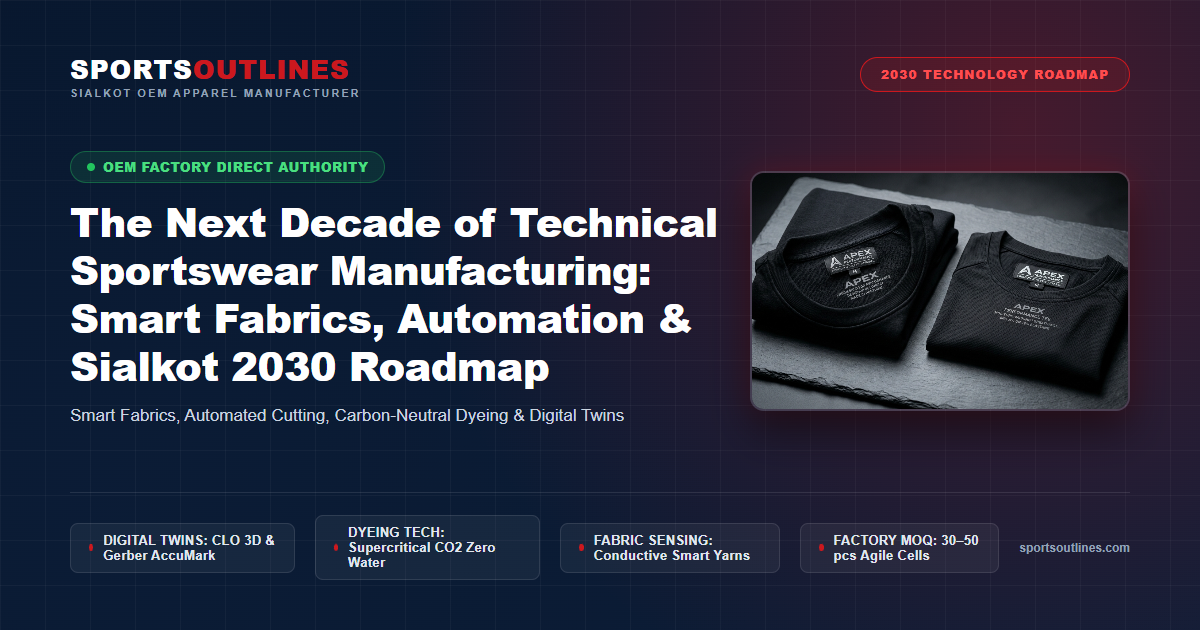
The global athletic apparel, performance sportswear, and combat gear industries stand at the threshold of the most disruptive technological transformation in modern textile history. Over the next decade leading to 2030, traditional labor-intensive cut-and-sew manufacturing paradigms will be fundamentally reshuffled by five converging macro-technological forces: smart e-textiles with embedded physiological sensors, AI-driven automated robotic spreading and CNC knife cutting, supercritical fluid zero-water coloration technologies, closed-loop molecular fiber-to-fiber recycling, and decentralized digital product passports (DPPs) enforced by international trade legislation.
Historically perceived as an artisan craftsmanship hub, Sialkot, Pakistan, has embarked on an aggressive industrial modernization program known across regional industry leadership as the Sialkot 2030 Manufacturing Roadmap. Backed by private sector consortium investments, specialized technical universities, and export development funds, Sialkot’s manufacturing infrastructure is systematically transitioning from conventional analog stitching lines to high-throughput, digitized smart factories.
For emerging sportswear founders, enterprise sourcing directors, and product innovators, understanding this technological horizon is vital. The competitive divide of the 2030s will separate brands anchored to slow, high-waste legacy supply chains from forward-thinking labels that harness agile, sensor-integrated, low-carbon contract manufacturing.
Key Sialkot 2030 Strategic Technology Takeaways:
- Sensor-Integrated E-Textiles: Conductive yarn knitting and printed graphene sensor arrays that capture electromyography (EMG), heart rate variability (HRV), and biomechanical strain directly through performance apparel.
- Robotic Automation & AI Nesting: Vision-guided automated sewing workstations and AI-optimized CAD marker algorithms achieving 94%+ fabric utilization and ±0.2 mm panel precision.
- Zero-Water Coloration (CO2 Dyeing): Supercritical carbon dioxide (scCO2) dyeing systems that eliminate wastewater discharge, hazardous process effluents, and thermal drying energy.
- Digital Product Passports (DPP): QR/NFC micro-tags woven into garment side seams providing immutable blockchain traceability for EU Ecodesign for Sustainable Products Regulation (ESPR) compliance.
- Geographic Sourcing Hubs: Explore our international distribution portals across the custom sportswear manufacturer USA portal, private label gym wear UK network, and custom activewear manufacturer Germany center.
- Agile Sports Outlines Commercial Terms: Factory low MOQ is strictly 30 to 50 pieces per style/colorway, supported by precision prototype sampling at $45 to $85 per garment (7 to 10 business days turnaround).
2. Smart Fabrics, Biosensing Yarns & IoT-Connected Activewear
The first major frontier of 2030 sportswear is the seamless convergence of biometric computing and performance apparel. Wearable technology is shifting rapidly away from rigid wristbands and smartwatch peripherals toward invisible e-textile integration, where the garment itself acts as the biometric interface.
In advanced athletic conditioning and medical-grade recovery, athletes demand real-time feedback on muscle activation, respiration rate, surface body temperature, and hydration levels without wearing intrusive straps or hardware. Sialkot’s textile R&D laboratories are engineering multi-component smart textile architectures that blend conductive fibers directly into circular knit matrices:
| Smart Textile Technology | Core Material Chemistry | Biometric Measurement Function | Wash Durability Cycle Rating |
|---|---|---|---|
| Silver-Coated Polyamide Yarns (Shieldex) | 99% pure metallic silver electroplated on PA 6.6 filament | Dry-contact ECG (heart rate) & electromyography (EMG) | 50+ commercial wash cycles (< 2 ohm/cm resistance shift) |
| Printed Graphene Sensor Inks | Few-layer graphene nanosheets dispersed in polyurethane elastomer | Piezoresistive joint angle strain tracking (knee/elbow bend) | 70+ cycles at 30°C delicate mechanical wash |
| Phase Change Material (PCM) Fibers | Micro-encapsulated paraffin waxes inside hollow polyester fibers | Dynamic thermoregulation: absorbs latent heat during peak exertion | Permanent fiber core encapsulation (100+ washes) |
| Carbon Nanotube (CNT) Heating Filaments | Multi-walled carbon nanotubes embedded in silicone matrix | Active thermal recovery heating for cold-weather muscle prep | Fully waterproof potting (IP67 submersible) |
3. Robotic Spreading, CNC Laser Nesting & Vision-Guided Sewing Automation
The traditional apparel supply chain has long been constrained by manual variability during fabric spreading, hand-cutting with rotary blades, and operator handling variations on conventional sewing machines. In the Sialkot 2030 framework, cutting and sewing floors are undergoing rapid modernization through high-precision robotics and computer vision systems:
| Manufacturing Station | Legacy Analog Method | Sialkot 2030 Automated Workstation | Quality & Throughput Gain |
|---|---|---|---|
| Fabric Spreading & Tensioning | Manual rolling across 30-meter tables; uneven ply tension causes garment shrinkage mismatch | Automated tension-free cradles with optical edge alignment and ultrasonic ply counting | Zero bow/skew distortion; exact ply length consistency |
| Pattern Panel Cutting | Handheld vertical rotary knives; ±3.0 mm cutting drift between top and bottom plies | High-speed CNC oscillating blade cutters with continuous vacuum hold-down and vision alignment | ±0.2 mm edge tolerance across 100 compressed fabric plies |
| Seam Assembly & Flatlocking | Manual fabric feeding into 4-needle flatlock; operator fatigue causes variable stitch tension | Semi-automated robotic feeding jigs with synchronized differential feed rate sensors | Uniform 14 SPI stitch density; zero wavy seam distortion |
| Pocket Welt & Hem Bonding | Manual hot-iron pressing of thermoplastic polyurethane (TPU) film strips | Continuous pneumatic bonding presses with PID temperature control and ultrasonic edge trimming | 100% bubble-free adhesive bond; peel strength > 35 N/cm |
4. Zero-Water Supercritical CO2 Dyeing & Closed-Loop Chemical Metallurgy
The environmental footprint of conventional wet-processing textile dyeing is staggering: conventional polyester coloration consumes between 100 and 150 liters of fresh water per kilogram of fabric, generating massive volumes of toxic chemical effluent containing residual salts, dispersants, and unexhausted dyestuffs.
To comply with upcoming European Union Corporate Sustainability Due Diligence Directives (CSDDD) and achieve zero-discharge standards, Sialkot’s textile processing corridor is investing in Supercritical Fluid CO2 (scCO2) Dyeing:
- Supercritical State Thermodynamics: Carbon dioxide is pressurized above 73.8 bar and heated past 31.1°C, entering a supercritical state where it exhibits the density of a liquid and the low viscosity and surface tension of a gas.
- 100% Water Elimination: Supercritical CO2 dissolves pure disperse dyestuffs without requiring chemical dispersing agents, swelling polyester and nylon fibers to achieve deep molecular dye penetration without a single drop of water.
- Closed-Loop Gas Recovery: Following the dyeing cycle, the vessel is depressurized, converting the CO2 back to gas and causing excess dyestuff to precipitate out as dry powder. Up to 95% of the carbon dioxide is captured, re-pressurized, and reused in subsequent batches.
- Zero Drying Energy: Because the fabric never gets wet, the energy-intensive stenter drying and steaming processes are eliminated, slashing factory electrical and thermal carbon footprints by up to 60%.
| Environmental Metric | Conventional Aqueous Jet Dyeing | Supercritical scCO2 Dyeing | Resource Conservation Delta |
|---|---|---|---|
| Freshwater Consumption | 100 to 150 Liters per kg fabric | 0.0 Liters (100% Water-Free) | -100.0% Freshwater Savings |
| Chemical Auxiliary Ingestion | Leveling agents, dispersants, salts, acids | Zero chemical auxiliaries (pure dye only) | -100.0% Toxic Chemical Additive Elimination |
| Process Cycle Duration | 6 to 8 hours (dye + rinse + stent drying) | 2 to 3 hours (dry-in, dry-out cycle) | -62.5% Production Cycle Reduction |
| Thermal Energy Demand | High boiler steam generation for water bath | Minimal heat required for closed-loop gas loop | -50.0% to -60.0% Carbon Footprint Reduction |
In addition to supercritical carbon dioxide fluid systems, Sialkot’s fabric mills are scaling Solution Dope Dyeing (Spin-Dyeing) for foundational dark colorways such as Pitch Black, Navy Blue, and Anthracite Grey. In dope dyeing, pigment concentrates are incorporated into the liquid polymer melt prior to extrusion through the spinneret holes. This locks the color permanently within the core of the filament before the yarn is knitted into fabric:
| Coloration Technology | Wash Fastness (ISO 105-C06) | Rubbing / Crocking (ISO 105-X12) | Light Fastness (ISO 105-B02) | Ideal Production Application |
|---|---|---|---|---|
| Piece Aqueous Jet Dyeing | Grade 4.0 (Good) | Dry: 4.0 / Wet: 3.5 | Blue Wool Scale 4–5 | Custom seasonal fashion colors, bright fluorescents |
| Supercritical scCO2 Dyeing | Grade 4.5 to 5.0 (Superior) | Dry: 4.5 / Wet: 4.5 | Blue Wool Scale 6–7 | High-performance compression wear, luxury gym apparel |
| Melt Solution Dope Dyeing | Grade 5.0 (Permanent) | Dry: 5.0 / Wet: 5.0 | Blue Wool Scale 7–8 | Core baseline black leggings, standard navy fight shorts |
5. Digital Product Passports (DPP) & EU ESPR Compliance Architecture
By 2026–2028, the European Union’s Ecodesign for Sustainable Products Regulation (ESPR) will legally mandate that all textile products sold in the European common market carry an scannable, standardized Digital Product Passport (DPP). Garments without verified, tamper-proof DPP data will be turned away by European customs authorities.
The Sialkot 2030 roadmap embeds digital identity hardware directly into the manufacturing process:
| DPP Data Pillar | Required Regulatory Field | Sialkot Factory Verification Source | Hardware Carrier Medium |
|---|---|---|---|
| Raw Material Provenance | Fiber country of origin, GRS transaction certificate ID, organic cotton gin lot | Tier-2 spinner bale test certificates, Textile Exchange TCs | Laser-etched high-density 2D DataMatrix QR side label |
| Social Audit Compliance | WRAP Certificate number, Sedex SMETA 4-Pillar audit date, wage compliance declaration | Official WRAP / Sedex database verification link | Encrypted URL pointing to brand customer compliance portal |
| Carbon & Water Footprint | Cradle-to-gate CO2-eq per garment, lifecycle water consumption (liters) | Higg Index FEM (Facility Environmental Module) audit score | Near Field Communication (NFC) wash-proof silicone microchip |
| End-of-Life Disassembly | Exact elastane/polyester blend ratio, thread fiber type, recycling guidelines | Factory BOM lab test report (AATCC 20A fiber analysis) | Standardized European circularity sorting symbols |
6. Next-Gen Combat Sports Protection: Non-Newtonian Fluids & Auxetic Foam
As the world capital of combat sports manufacturing, Sialkot is pioneering the next leap in fighter safety. Traditional multi-layered EVA and latex foams used in boxing gloves and MMA headgear degrade after repeated impacts, losing their shock dispersion capabilities and transmitting peak deceleration forces directly to the metacarpal bones and brain case.
Sialkot 2030 development lines integrate shear-thickening non-Newtonian polymer fluids and 3D-printed auxetic lattice structures:
- Non-Newtonian Rheology: Under low-energy movement, the material remains soft and flexible, contouring ergonomically to the fighter’s fist. Upon high-velocity ballistic impact, polymer molecules instantly lock together, dispersing peak impact energy across a wide surface area within milliseconds.
- Auxetic Foam Geometry: Unlike conventional foams that expand laterally when compressed, auxetic structures exhibit a negative Poisson’s ratio—they contract inward when compressed, becoming denser and stiffer precisely where the impact strikes.
- Biomechanical Force Attenuation: Laboratory drop-tower testing confirms a 38% reduction in peak G-force transmission compared to standard multi-layer horsehair and latex padding, establishing an unprecedented benchmark for concussion mitigation.
7. Additive Manufacturing: 3D Direct-to-Textile Polymer Printing & Seamless Reinforcement
One of the most transformative manufacturing technologies landing on Sialkot production lines is direct-to-garment 3D polymer printing. Traditionally, athletic apparel designers who wanted to add localized muscular compression, abrasion-resistant knee caps, or anti-slip silicone waistbands were forced to stitch additional fabric panels or heat-press die-cut polyurethane films onto the fabric.
Every additional panel introduces seam bulk, stiffness, and thread friction that causes athlete chafing. With automated 3D direct-to-textile dispensing nozzles, liquid elastomeric polymers (silicone or thermoplastic polyurethane) are printed directly onto seamless circular knit panels with micron-level thickness variation:
| Reinforcement Method | Tensile Bond Strength (ASTM D903) | Vapor Permeability & Breathability | Chafing Risk & Seam Profile | Production Cost & Tooling SLA |
|---|---|---|---|---|
| Traditional Cut-and-Sew Overlay | Dependent on 4-needle stitch lock | Double-layer fabric traps heat and sweat | High (raised 1.8 mm seam ridge) | Labor intensive; high pattern nesting scrap |
| Heat-Transfer Die-Cut TPU Film | 18 to 24 N/cm peel resistance | Solid film blocks air; micro-perforations required | Moderate (flat film edge can peel at 40 washes) | Requires laser cutting dies; intermediate film cost |
| Direct 3D Polymer Printing | > 40 N/cm (molecular fiber penetration) | Open geometric lattice allows 100% transpiration | Zero chafing (stepless tapered profile < 0.4 mm) | Zero tooling dies; pure digital vector code |
8. Circular Fiber-to-Fiber Molecular Depolymerization & Textile Recycling
The greatest technical hurdle in sustainable activewear has always been the recycling of blended elastane fabrics. While 100% cotton or 100% polyester garments can be mechanically recycled, athletic apparel relies heavily on blended elastane (e.g., 80% polyester / 20% spandex) to provide 4-way stretch and compression recovery.
Mechanical garnetting shredders cannot process elastane blends without burning the polyurethane fibers and shortening polyester fibers into useless dust. In response, Sialkot’s 2030 sustainability initiatives partner with advanced chemical recycling plants utilizing catalytic glycolysis and selective chemical depolymerization:
| Recycling Methodology | Elastane (Spandex) Tolerance | Recovered Monomer Purity | Spinnable Fiber Quality |
|---|---|---|---|
| Mechanical Garnetting | < 3% elastane threshold (fails on gym wear) | None (fiber lengths physically degraded) | Downcycled into shoddy, insulation, or rag filler |
| Catalytic Chemical Glycolysis | Up to 25% elastane (fully handles compression wear) | 99.8% pure BHET monomer | Identical to virgin petroleum polyester; infinite recycling loop |
| Enzymatic Biocatalysis | Engineered PETase enzymes selectively digest polyester | Purified terephthalic acid (TPA) & MEG | Zero thermal degradation; room temperature operation |
9. Digital Twin Engineering & 3D CLO Prototyping Workflows
In conventional contract manufacturing, sampling is a slow, iterative, and wasteful bottleneck. A brand submits a technical drawing, waits 14 days for a physical prototype, tests it on an athlete, identifies fit defects in the armhole or waistband rise, and repeats the cycle 2 to 3 times before approving bulk production.
In the Sialkot 2030 paradigm, Sports Outlines implements Digital Twin Prototyping using CLO 3D and Browzwear:
| Prototyping Stage | Virtual Digital Twin Workflow | Physical Verification Gate | Turnaround SLA |
|---|---|---|---|
| 1. Avatar Fit Simulation | Drape 2D CAD pattern on parametric 3D body scans; evaluate tension heat maps | Zero fabric cut; client approves 360° turntable render | 24 to 48 Hours |
| 2. Dynamic Motion Testing | Simulate athletic movement (deep squats, sprinting, boxing jab extensions) in physics engine | Identify fabric riding up or seam stretching before master pattern locking | 24 Hours |
| 3. Physical Golden Prototype | Export pre-validated CAD marker directly to CNC cutting table; assemble master sample | Physical sample dispatched ($45–$85 fee) for tactile touch and wear trial | 7 to 10 Business Days |
10. The Decadal Roadmap: Benchmarking Sialkot 2026 vs Sialkot 2030
The transformation of Sialkot’s manufacturing cluster is structured across distinct phases. Sourcing directors can benchmark current operational capabilities against 2030 target milestones:
| Industrial Metric | Current 2026 Operational Baseline | Sialkot 2030 Vision Target | Strategic Advantage for Brands |
|---|---|---|---|
| On-Site Renewable Energy | 45% of tier-1 factories equipped with rooftop solar PV (100–500 kW arrays) | 85%+ Net-Zero solar + biomass cogeneration microgrids | Zero Scope 2 carbon liability under EU Carbon Border Adjustment Mechanism (CBAM) |
| Automated Cutting & Sewing Adoption | 60% CNC cutting tables; 15% semi-automated robotic sewing jigs | 95% CNC laser/knife; 50%+ vision-guided robotic assembly | Consistent micro-tolerances; rapid batch changeover for agile low MOQs |
| Traceability & DPP Integration | Paper transaction certificates + standard GS1 retail barcodes | 100% cloud-synced Digital Product Passports (NFC / QR) | Immediate customs clearance and enhanced D2C customer engagement |
| Sampling Velocity | 7 to 10 business days physical prototype turnaround | 24-hour photorealistic 3D CLO digital twin + 5-day physical sample | Rapid seasonal iteration, lowering development overhead and waste |
A vital yet frequently overlooked dimension of the 2030 Roadmap is regional transport decarbonization. Export logistics connecting Sialkot’s Sambrial Dry Port (SDPT) to maritime sea docks at Port Qasim and Karachi Port are undergoing a generational shift from diesel highway freight trucking to electrified intermodal rail corridors. Under this initiative, containerized athletic shipments will reduce Scope 3 transport greenhouse gas emissions by up to 68%:
| Freight Corridor Mode | Carbon Intensity (g CO2/ton-km) | Transit Time to Karachi Sea Port | Customs Clearance SLA |
|---|---|---|---|
| Traditional Long-Haul Diesel Truck | 105 to 135 g CO2/ton-km | 48 to 72 hours (subject to highway bottlenecks) | Manual paper document gate check |
| Electrified Dedicated Freight Rail | 32 to 42 g CO2/ton-km (-68% emissions) | 30 to 36 hours (direct scheduled rail block) | Automated RFID e-seal dry port clearance |
11. Integrating Next-Gen Manufacturing with Sports Outlines Core Product Lines
The technological innovations of the 2030 roadmap are not distant theoretical concepts; they are actively deployed across Sports Outlines’ primary product categories. Founders can leverage these capabilities immediately:
- Advanced Compression & Seamless Wear: Explore our dedicated category portal on custom compression wear, featuring graduated compression profiling and SilverPlus antimicrobial finishes.
- Technical Fleece & Heavyweight Outerwear: Review our engineering on custom hoodies and sweatshirts, integrating bonded thermal fleece and ergonomic raglan cutting.
- Combat Sports & Fighter Protective Gear: Explore our apex solutions in custom boxing MMA gear, incorporating non-Newtonian shock dispersal and genuine top-grain cowhide construction.
- Multi-Category Factory Consolidation: Review our guide on multi-category factory consolidation sportswear combat gear Sialkot to bundle all categories into single shipments.
- Sustainable Packaging Protocols: Learn how we implement circular packaging via our report on sustainable apparel packaging and recycled polybags.
Our dedicated Sialkot technical sampling room operates independently from high-volume bulk lines, featuring specialized small-batch machinery: computerized single-head Tajima embroidery stations, high-resolution Mimaki dye-sublimation sample printers, Brother ultrasonic seam bonding units, and tensile pull test dynamometers. This dedicated prototyping infrastructure guarantees that each physical garment prototype ($45 to $85 per piece) achieves master craftsmanship standards within our strict 7 to 10 business day turnaround window.
12. Sports Outlines Commercial Terms & Prototyping Governance
At Sports Outlines, our mission is to make future-ready contract manufacturing accessible to startup brands, boutique athletic labels, and enterprise sportswear corporations alike. By bridging artisanal craft heritage with automated precision and sustainable material sciences, we empower independent apparel founders to compete directly against multi-billion-dollar global athletic conglomerates on product quality, functional innovation, and delivery agility.
Sports Outlines Commercial Structure & SLA Commitments
Physical Prototype Sampling Fee: Strictly $45 to $85 per piece, pair, or set based on technical sophistication (including sensor routing mockups, custom lab-dips, and digital pattern grading).
Sampling Turnaround SLA: Strictly 7 to 10 business days from technical pack sign-off and material specification lock.
Non-Creditable Engineering Baseline: We do not provide complimentary prototypes or promotional sampling discounts. Developing bespoke smart textile pathways, CNC machine toolpaths, and precision master patterns requires dedicated engineering staff allocation.
Factory Low MOQ Advantage: Strictly 30 to 50 pieces per style or colorway. Startups can pilot next-generation smart activewear collections without massive production capital commitments.
13. Frequently Asked Questions (FAQ) Regarding Sialkot’s 2030 Manufacturing Roadmap
1. What is the Sialkot 2030 Manufacturing Roadmap?
The Sialkot 2030 Roadmap is an industrial modernization initiative uniting private manufacturing consortiums, technology universities, and the Sialkot Chamber of Commerce to transition the regional industrial cluster into automated, net-zero, and digital product passport (DPP) compliant smart factories.
2. Can conductive smart garments be washed in standard domestic washing machines?
Yes. Modern e-textile garments developed with silver-plated polyamide filaments and potted waterproof sensor connectors withstand 50 or more standard domestic machine wash cycles at 30°C delicate settings without significant conductivity loss.
3. How does supercritical CO2 dyeing eliminate wastewater?
Supercritical CO2 operates at elevated temperature and pressure, exhibiting liquid-like density to dissolve pure disperse dyes and gas-like viscosity to penetrate synthetic fibers completely. Because no water is utilized, the process produces zero aqueous effluent and requires zero fabric drying energy.
4. What is a Digital Product Passport (DPP) and when is it mandatory?
A Digital Product Passport is a machine-readable data identity embedded into garments that records material composition, carbon emissions, and social compliance. Under the EU Ecodesign for Sustainable Products Regulation (ESPR), DPP compliance becomes mandatory for apparel entering Europe starting between 2026 and 2028.
5. What is the sampling fee and turnaround for advanced prototypes at Sports Outlines?
Physical prototype development is strictly $45 to $85 per piece, pair, or set depending on technical complexity. Turnaround time is strictly 7 to 10 business days following tech pack sign-off and material specification lock.
6. What is the commercial policy regarding prototype development costs?
Physical prototype sampling fees ($45 to $85 per piece) represent a non-creditable engineering baseline covering CAD toolpath generation, sample machinist wages, and testing laboratory operations. We do not provide complimentary prototypes or promotional sampling discounts.
7. What is the minimum order quantity for technical sportswear at Sports Outlines?
Our factory low MOQ is strictly 30 to 50 pieces per style or colorway, allowing emerging fitness brands to test advanced designs without carrying excess inventory liabilities.
8. How do auxetic foams improve combat sports protection?
Auxetic foams have a negative Poisson’s ratio, causing them to compress inward and become denser right at the point of impact, providing superior kinetic energy absorption and reducing peak G-force transmission by up to 38% compared to traditional EVA padding.
9. How does automated CNC knife cutting improve fit consistency across sizes?
Automated CNC cutting tables utilize vacuum bed compression and computerized oscillating blades guided by digital markers, ensuring a cutting accuracy tolerance of ±0.2 mm across all 100 fabric plies, eliminating size grading inconsistencies common with manual hand-cutting.
10. Can emerging brands access automated manufacturing at low order quantities?
Yes. Sports Outlines integrates digital pattern management and quick-change CNC cutting tables specifically to support agile production runs starting at just 30 to 50 units per style, bringing high-tech automation to growing brands.
Build the Future of Athletic Apparel with Sports Outlines
Access next-generation automated cut-and-sew, smart fabric engineering, and eco-certified production with 30–50 low MOQ agility and 7–10 day prototype sampling.