Textile Finishing & Dimensional Stability Directive: Eliminating Post-Purchase BJJ Gi Shrinkage Failures
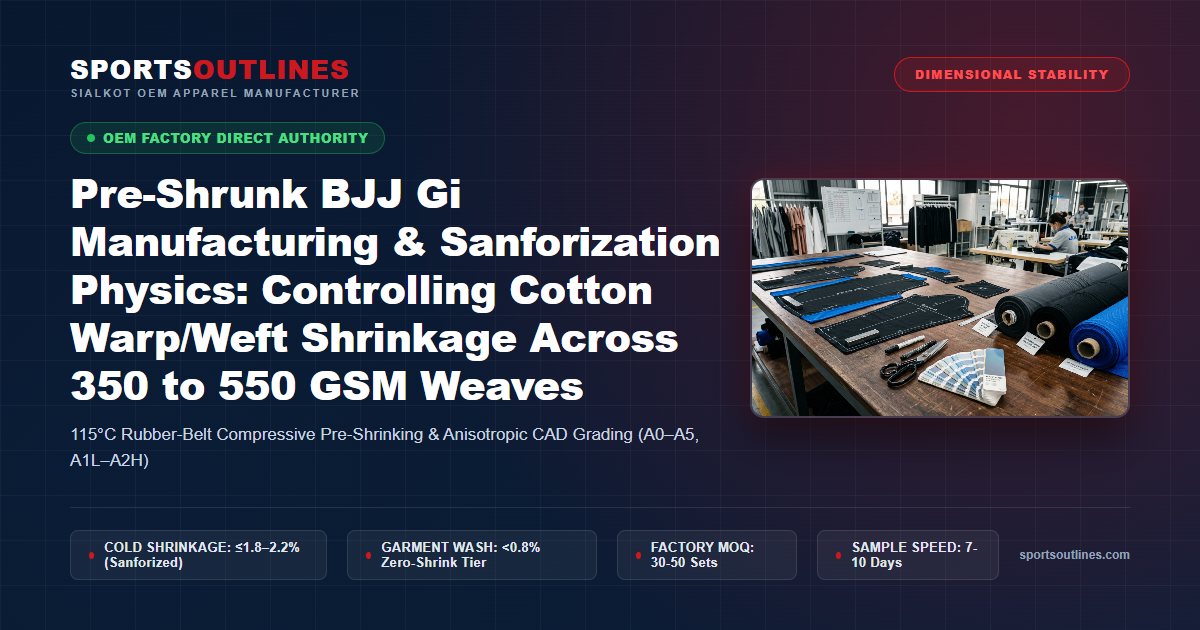
The single largest driver of customer return rates, negative e-commerce reviews, and tournament bullpen disqualifications in the Brazilian Jiu-Jitsu apparel industry is uncontrolled post-purchase kimono shrinkage. An athlete purchases an A2 BJJ Gi that fits perfectly out of the polybag; after two domestic cold washes, the sleeves contract by $6.5\text{ cm}$ ($2.5\text{ inches}$) and ride halfway up the forearm—rendering the uniform 100% illegal under IBJJF wrist-reach inspection rules. Conversely, if a factory blindly adds $+8\%$ oversize pattern grading without pre-shrinking the fabric roll, the Gi fits like a baggy tent on Day 1 and shrinks unpredictably depending on the customer’s water temperature. Continuing Sub-Cluster 5.3 (BJJ Gi Weave Engineering, GSM Shrinkage Control & IBJJF Lapel Construction), this textile engineering blueprint deconstructs the molecular physics of cotton cellulose crimp interchange, the 3-Stage Sialkot Industrial Pre-Shrinking Protocol (Enzymatic Desizing, Compressive Rubber-Belt Sanforization, and Garment Rotary Conditioning), and anisotropic CAD pattern grading across 350 GSM to 550 GSM Pearl, Gold, and Single weaves.
1. The Molecular Physics of Cotton Shrinkage: Why Raw 3D BJJ Weaves Contract by 8% to 14%
Why does a 100% cotton 450 GSM Pearl Weave or 500 GSM Gold Weave BJJ Gi jacket shrink nearly three times more than a standard 180 GSM cotton T-shirt or a 240 GSM bedsheet if left un-sanforized? The answer lies in the interaction between Hydrophilic Cellulose Polymer Swelling, Loom Warp Beam Tension, and Three-Dimensional Weave Crimp Geometry.
Cotton fiber is composed of $94\%$ pure $\beta\text{-1,4-D-glucopyranose}$ cellulose chains arranged in crystalline and amorphous microfibrils held together by hydrogen bonds. When raw (“greige”) Pearl or Gold weave is woven on an industrial Dobby rapier loom, two massive mechanical stresses are locked into the fabric structure:
- High Axial Warp Beam Tension ($T_{\text{warp}} = 180\text{ to }240\text{ cN/end}$): To hold thousands of heavy $10/2\text{ Ne}$ or $12/2\text{ Ne}$ warp yarns taut while the loom reed beats thick $6/1\text{ Ne}$ weft picks into raised “pearl” floats, the warp beam applies extreme longitudinal tension. Furthermore, warp yarns are coated in a hot starch/PVA sizing bath prior to weaving, which dries under tension and “freezes” the elongated warp yarns in an artificially stretched state.
- Radial Fiber Swelling & Sinusoidal Crimp Interchange Upon Wetting: When the finished Gi is submerged in water during its first wash, water molecules penetrate the amorphous regions of the cotton cellulose, breaking internal hydrogen bonds and causing each yarn to swell radially in diameter by $+24\%$ to $+28\%$ while increasing lengthwise by less than $1\%$. Because the horizontal weft picks have suddenly expanded in diameter by $+28\%$, the vertical warp yarns that weave over and under them are forced to travel around a much larger geometric arc!
- Open-Pocket Crimp Collapse in 3D Dobby Weaves: Unlike a tight plain weave where yarns are already jammed shoulder-to-shoulder, Pearl Weave, Gold Weave, and Single Weave feature elevated warp floats and recessed honeycomb pockets. When agitated in a washing machine drum, the swollen warp loops pull the adjacent weft picks together like an accordion—shortening the overall length of the sleeve and skirt by $8.5\%$ to $14.2\%$ in the warp direction and $4.5\%$ to $7.8\%$ in the weft direction!
Peirce’s Geometric Crimp-Interchange Shrinkage Equation ($\Delta S_{\text{warp}}$)
According to F.T. Peirce’s textile geometry model adapted for 3D Dobby weaves, the fractional longitudinal warp shrinkage ($\Delta S_{\text{warp}}$) triggered when dry weft yarn diameter ($d_{\text{weft,0}}$) swells to wet diameter ($d_{\text{weft,wet}} = 1.28 \cdot d_{\text{weft,0}}$) across pick spacing $p_{\text{weft}}$ is governed by:
\[ \Delta S_{\text{warp}} = \varepsilon_{\text{loom}} + \left[ 1 – \frac{\sqrt{L_{\text{float}}^2 – \left( k_{\text{float}} (d_{\text{warp,wet}} + d_{\text{weft,wet}}) \right)^2}}{\sqrt{L_{\text{float}}^2 – \left( k_{\text{float}} (d_{\text{warp,0}} + d_{\text{weft,0}}) \right)^2}} \right] \]
Where $\varepsilon_{\text{loom}}$ is the elastic strain locked in during warp sizing and weaving ($3.5\%\text{ to }5.0\%$), $L_{\text{float}}$ is the arc length of the warp pearl float, and $k_{\text{float}}$ is the Dobby interlacing factor ($1.0$ for Single Weave, $1.35$ for Pearl Weave, and $1.65$ for Gold Weave honeycomb cells). This equation proves mathematically why Gold Weave has the highest raw shrinkage ($11\%\text{–}14\%$), followed by Single Weave ($9\%\text{–}11\%$) and Pearl Weave ($7.5\%\text{–}9.5\%$).
Crucially, because a BJJ Gi jacket is cut with the sleeve wingspan aligned parallel to the weft (or warp, depending on marker layout) and the jacket torso length aligned to the warp, an un-sanforized A2 Gi with a $166\text{ cm}$ sleeve wingspan can lose up to $14\text{ to }18\text{ cm}$ ($5.5\text{ to }7.0\text{ inches}$) of total wrist-to-wrist reach after three washes if the factory skips mechanical pre-shrinking!
2. Inside the Finishing Mill: Our 3-Stage Industrial Pre-Shrinking & Sanforization Protocol
Many budget factories claim their BJJ Gis are “100% Pre-Shrunk” when all they actually did was dip the fabric roll in a cold water trough and hang-dry it on lines—a crude process that leaves $5.5\%\text{ to }7.5\%$ latent shrinkage waiting to ambush the end consumer. At Sports Outlines, every roll of Pearl, Gold, Single, and Double weave fabric undergoes a deterministic, three-stage continuous wet-finishing and mechanical Sanforization line prior to CAD cutting:
Stage 1: Continuous Open-Width Bio-Enzymatic Desizing & Relaxed Scouring ($85^\circ\text{C}$)
Before cotton yarns can relax to their natural equilibrium crimp, the rigid starch sizing applied to the warp beam before weaving must be completely dissolved. We feed the greige fabric roll in open width through an $85^\circ\text{C}$ bath containing $\alpha$-Amylase Bio-Enzymes and Pectinase, followed by counter-current tensionless washing compartments:
- Zero-Tension Overfeed Conveyors: Unlike conventional textile washers that pull fabric from roller to roller under high tension (stretching the wet fabric longer while washing it!), our relax-scouring compartments utilize $+12\%$ positive roller overfeed on submerged stainless steel mesh conveyors. Freed from starch glue and longitudinal pull, the cotton warp yarns immediately release their primary $4.0\%\text{ to }5.2\%$ loom-sizing tension.
Stage 2: Compressive Rubber-Belt Sanforization ($115^\circ\text{C}$ Palmer Cylinder)
Relaxed washing alone cannot force thick $10/2\text{ Ne}$ Pearl Weave yarns past their inter-yarn frictional threshold. That requires true Compressive Sanforization (invented by Sanford Cluett and adapted specifically for heavy 350–650 GSM martial arts weaves):
- How the Sanforizer Mechanically Compresses Warp Crimp: The damp, steam-plasticized Pearl Weave is fed into the nip between a massive steam-heated mirror-polished steel Palmer Cylinder ($115^\circ\text{C}$) and a $68\text{ mm}$ thick endless elastomeric Natural Rubber Blanket. Where the rubber blanket wraps around the small entry feed roller, its outer surface stretches lengthwise; as the rubber blanket immediately reverses curvature against the large heated Palmer drum, its surface recoils and contracts violently by $8\%$ to $12\%$.
- Locking Pick Density permanently: Clamped tightly against the contracting rubber blanket under $4.5\text{ Bar}$ pneumatic pressure and superheated steam, the cotton warp floats are mechanically pushed backward and compacted together—increasing weft picks per inch (PPI) from $28\text{ PPI}$ to $31\text{ PPI}$ and locking the new, pre-compacted crimp geometry via instant Palmer drum drying!
- Stenter Frame Pin-Overfeed for Weft Control: Immediately prior to the Sanforizer cylinder, a computerized pin-stenter frame controls the horizontal width ($158\text{ cm}$ finished usable width from $168\text{ cm}$ greige loom width), eliminating latent horizontal weft shrinkage.
Stage 3: Post-Sewing Garment-Level Enzyme Conditioning (Optional “Zero-Shrink Ready-to-Compete” Tier)
Why can a Gi made from Sanforized fabric roll still exhibit $1.8\%\text{ to }2.5\%$ residual shrinkage during the athlete’s first wash? Because during industrial sewing, operators feed the sleeves, skirt hem, and 6-row EVA lapel collar under high-speed sewing presser feet with Tex 80 thread tension, introducing minor localized seam tension. For premium B2B brands marketing “True Zero-Shrink Out-of-the-Bag Competition Gis,” we offer an optional Stage 3 post-sewing Garment-Level Rotary Silicone-Enzyme Wash & Relaxed Tumble Dry before final polybagging—bringing consumer post-purchase shrinkage down to a near-imperceptible $0.5\%$ to $1.0\%$ while giving the Pearl Weave an ultra-soft, broken-in handfeel!
| BJJ Gi Fabric / Weave Type | Raw Un-Finished Shrinkage (Warp / Weft) | Basic Dip-Wash Only (Budget Factories) | Sports Outlines Stage 1+2 Sanforized Roll ($30^\circ\text{C}$ Wash) | Stage 1+2+3 Garment Pre-Washed (“Zero-Shrink”) | Max Hot Tumble Abuse ($60^\circ\text{C}$ Intentional Shrink) |
|---|---|---|---|---|---|
| 350–380 GSM Light Pearl Weave | $8.2\% \;/\; 5.0\%$ | $5.2\% \;/\; 3.4\%$ | $1.8\% \;/\; 1.2\%$ | $0.6\% \;/\; 0.5\%$ | $3.4\% \;/\; 2.2\%$ |
| 450 GSM Pro Pearl Weave | $9.1\% \;/\; 5.6\%$ | $5.8\% \;/\; 3.8\%$ | $2.0\% \;/\; 1.4\%$ | $0.8\% \;/\; 0.6\%$ | $3.8\% \;/\; 2.5\%$ |
| 550 GSM Heavy Pearl Weave | $9.8\% \;/\; 6.1\%$ | $6.4\% \;/\; 4.1\%$ | $2.2\% \;/\; 1.5\%$ | $0.9\% \;/\; 0.7\%$ | $4.1\% \;/\; 2.8\%$ |
| 500 GSM Gold Weave (Honeycomb) | $12.8\% \;/\; 7.4\%$ | $7.9\% \;/\; 5.0\%$ | $2.5\% \;/\; 1.8\%$ (Dual-Pass) | $1.0\% \;/\; 0.8\%$ | $4.9\% \;/\; 3.4\%$ |
| 10 oz Combed Cotton Twill Pants | $6.8\% \;/\; 3.5\%$ | $4.2\% \;/\; 2.2\%$ | $1.6\% \;/\; 1.0\%$ | $0.5\% \;/\; 0.4\%$ | $2.9\% \;/\; 1.8\%$ |
| 10 oz Military Cotton Ripstop Pants | $4.2\% \;/\; 2.4\%$ | $2.8\% \;/\; 1.6\%$ | $1.1\% \;/\; 0.7\%$ | $0.4\% \;/\; 0.3\%$ | $1.9\% \;/\; 1.2\%$ |
3. Anisotropic CAD Pattern Grading: Compensating for Warp vs. Weft Vectors Across A0–A5 & Fitted Cuts
Even with our Stage 1+2 Compressive Sanforization locking residual cold-wash shrinkage to $\le 2.0\%$, a $2.0\%$ contraction across a $170\text{ cm}$ A2 sleeve wingspan still equals $3.4\text{ cm}$ ($1.34\text{ inches}$) of total reach reduction ($1.7\text{ cm}$ per wrist)! In an IBJJF tournament where the referee fails any jacket whose sleeve cuff falls more than $5.0\text{ cm}$ proximal to the wrist crease, a $1.7\text{ cm}$ unexpected loss per arm is the difference between stepping onto the mat and immediate disqualification.
Therefore, our CAD pattern engineers never use a single “universal” grading block across different weaves. Instead, we run an AATCC 135 / ISO 6330 3-Cycle Wash-and-Dry Lab Test on a $50 \times 50\text{ cm}$ swatch cut from every incoming dye lot of Pearl or Gold weave, and apply Anisotropic Grain-Vector Compensation Multipliers ($K_{\text{warp}}, K_{\text{weft}}$) directly to the digital Gerber/Lectra cutting markers:
- Grain Alignment on Single-Piece Kimono Markers: On a wide-width $158\text{ cm}$ finished Sanforized roll, the continuous wrist-to-wrist sleeve wingspan is laid across the Weft (Cross-Grain) or Warp (Lengthwise Grain) depending on size tier. For standard A0 to A3 cuts where the $155\text{ to }178\text{ cm}$ wingspan runs along the lengthwise warp grain, we build a deterministic $+2.2\%$ to $+2.5\%$ Pre-Wash Allowance ($+1.8\text{ cm}$ per sleeve cuff) into the raw pattern so that after 3 washes at $30^\circ\text{C}$, the sleeve settles onto the exact target IBJJF wrist line!
- Differential Component Shrinkage Preventing “Puckered Lapel & Rippled Tape Syndrome”: A BJJ Gi jacket is a composite assembly of four different textiles sewn together: a 450 GSM Pearl Weave body, a 12 oz Cotton Twill or Ripstop EVA lapel sheath, a $35\text{ mm}$ Jacquard woven inner cuff tape, and a 100% polyester sublimated inner shoulder yoke mesh.
- The Failure Mode: If the Pearl Weave body shrinks by $2.2\%$ after washing, while the synthetic polyester inner cuff tape or un-sanforized lapel twill shrinks by $0.0\%$ (or $6.0\%$), the sleeve cuffs and front lapels twist into hideous, wavy corkscrews (“bacon lapels”)!
- Our Engineering Fix: We pre-shrink all 100% cotton lapel twill and herringbone reinforcement bindings in an autoclave steam chamber to match the exact $2.0\%$ residual shrinkage curve of the Sanforized Pearl Weave body, and apply a calibrated $0.98:1$ differential feed ratio on our Kansai multi-needle machines when attaching non-shrinking polyester seam tapes.
4. Master BJJ Gi Size Grading & Post-Wash Equilibrium Spec Sheet (A0 to A4 + Fitted A1L / A2L / A2H)
Modern B2B BJJ brands win customer loyalty by offering Long/Fitted (“L” — Lanky) and Husky/Heavy (“H” — Stocky) interim sizes alongside standard A0–A5 grades. Below is our production-calibrated dimensional matrix for a 450 GSM Sanforized Pearl Weave Jacket + 10 oz Sanforized Ripstop Pant showing both Out-of-Bag (Pre-Wash) and Equilibrium (Post-3-Cold-Wash) measurements:
| Size Code | Athlete Height & Weight Range | Wingspan Cuff-to-Cuff (Pre-Wash $\rightarrow$ Post-Wash) | Jacket Length HPS to Hem (Pre $\rightarrow$ Post) | Chest Width Pit-to-Pit (Post-Wash) | Pant Outseam Length (Pre $\rightarrow$ Post) |
|---|---|---|---|---|---|
| A0 | $152\text{–}163\text{ cm} \;/\; 50\text{–}62\text{ kg}$ | $153.0\text{ cm} \rightarrow \mathbf{149.8\text{ cm}}$ | $71.5\text{ cm} \rightarrow \mathbf{70.0\text{ cm}}$ | $54.0\text{ cm}$ | $90.5\text{ cm} \rightarrow \mathbf{89.2\text{ cm}}$ |
| A1 | $163\text{–}173\text{ cm} \;/\; 62\text{–}74\text{ kg}$ | $162.5\text{ cm} \rightarrow \mathbf{159.0\text{ cm}}$ | $74.5\text{ cm} \rightarrow \mathbf{73.0\text{ cm}}$ | $57.0\text{ cm}$ | $94.5\text{ cm} \rightarrow \mathbf{93.2\text{ cm}}$ |
| A1L (Fitted Long) | $173\text{–}181\text{ cm} \;/\; 64\text{–}76\text{ kg}$ | $168.0\text{ cm} \rightarrow \mathbf{164.5\text{ cm}}$ | $76.5\text{ cm} \rightarrow \mathbf{75.0\text{ cm}}$ | $57.5\text{ cm}$ (Slim) | $98.5\text{ cm} \rightarrow \mathbf{97.0\text{ cm}}$ |
| A2 (Core Volume) | $173\text{–}181\text{ cm} \;/\; 75\text{–}86\text{ kg}$ | $170.5\text{ cm} \rightarrow \mathbf{167.0\text{ cm}}$ | $77.5\text{ cm} \rightarrow \mathbf{76.0\text{ cm}}$ | $60.5\text{ cm}$ | $98.5\text{ cm} \rightarrow \mathbf{97.0\text{ cm}}$ |
| A2L (Tall Guard) | $181\text{–}189\text{ cm} \;/\; 76\text{–}88\text{ kg}$ | $176.0\text{ cm} \rightarrow \mathbf{172.5\text{ cm}}$ | $79.5\text{ cm} \rightarrow \mathbf{78.0\text{ cm}}$ | $61.0\text{ cm}$ (Slim) | $102.5\text{ cm} \rightarrow \mathbf{101.0\text{ cm}}$ |
| A2H (Stocky / Broad) | $170\text{–}179\text{ cm} \;/\; 88\text{–}102\text{ kg}$ | $171.5\text{ cm} \rightarrow \mathbf{168.0\text{ cm}}$ | $78.5\text{ cm} \rightarrow \mathbf{77.0\text{ cm}}$ | $65.5\text{ cm}$ (Broad) | $98.5\text{ cm} \rightarrow \mathbf{97.0\text{ cm}}$ (Wide Hip) |
| A3 | $181\text{–}191\text{ cm} \;/\; 87\text{–}102\text{ kg}$ | $179.5\text{ cm} \rightarrow \mathbf{176.0\text{ cm}}$ | $81.5\text{ cm} \rightarrow \mathbf{80.0\text{ cm}}$ | $64.5\text{ cm}$ | $103.5\text{ cm} \rightarrow \mathbf{102.0\text{ cm}}$ |
| A4 | $188\text{–}198\text{ cm} \;/\; 102\text{–}122\text{ kg}$ | $187.5\text{ cm} \rightarrow \mathbf{184.0\text{ cm}}$ | $84.5\text{ cm} \rightarrow \mathbf{83.0\text{ cm}}$ | $68.5\text{ cm}$ | $107.5\text{ cm} \rightarrow \mathbf{106.0\text{ cm}}$ |
5. Thermal Abuse Physics: Why $65^\circ\text{C}$ Tumble Dryers Override Sanforization & Warp EVA Collars
Grapplers often ask: “If a BJJ Gi is mechanically Sanforized at the mill, why can I still shrink it an extra $2\%$ to $3\%$ if I throw it in a commercial dryer on High Heat?” Understanding the thermodynamic boundary of Sanforization is essential for designing accurate woven care labels and educating retail customers:
- Wet-State Relaxation vs. Dry-Tumble Mechanical Impact: Compressive Sanforization eliminates the longitudinal elastic strain ($\varepsilon_{\text{loom}}$) and primary wet-swelling crimp interchange up to a $30^\circ\text{C}\text{–}40^\circ\text{C}$ wash followed by hang drying. However, when a wet 450 GSM Pearl Weave jacket is tumbled inside a rotating drum at $65^\circ\text{C}\text{ to }75^\circ\text{C}$ for 60 minutes, thousands of mechanical drop impacts physically hammer the raised warp pearls into an over-compacted state (“felting/tumbling consolidation”), forcing an additional $1.8\%\text{ to }2.2\%$ contraction.
- Thermal Viscoelastic Creep in Vulcanized EVA Lapel Collars: Modern BJJ Gis replace traditional cotton-canvas lapel stuffing with a lightweight, antibacterial Vulcanized Closed-Cell Ethylene-Vinyl Acetate (EVA) Rubber Foam Core (which we examine in depth in Blog #381 and our upcoming Blog #383). While cross-linked EVA is waterproof, its polymer glass-transition/softening onset occurs around $68^\circ\text{C}\text{ to }75^\circ\text{C}$. Repeated high-heat commercial drying softens the EVA foam core while the outer cotton lapel sheath contracts around it—causing permanent lapel curling and premature brittle cracking of the rubber core.
- Mandatory Woven Care Label Engineering (ISO 3758 Pictograms): Every custom BJJ Gi produced at Sports Outlines includes a high-definition damask woven inner care/size label specifying: Wash Cold ($30^\circ\text{C}$ Max) • Do Not Bleach (Chlorine degrades cotton cellulose DP by $40\%$) • Hang Dry in Shade • Never Tumble Dry Hot.
5B. Factory Quality Control Metrology: AATCC 135 Wash-Testing & Spirality/Skewness Elimination (AATCC 179)
How do we guarantee that Lot #14 of a Royal Blue 450 GSM Pearl Weave shrinks by the exact same $2.0\%$ warp / $1.4\%$ weft percentage as Lot #01 ordered six months earlier? In textile dyeing and wet finishing, ambient humidity, reactive dye bath pH, and cotton harvest Micronaire variations can shift residual fabric shrinkage by $\pm 1.2\%$ from roll to roll if left unmonitored. To eliminate lot-to-lot dimensional drift, Sports Outlines enforces a mandatory 4-Step Dye-Lot Shrinkage Quarantine & Lab Verification Protocol before any fabric roll is released to the CAD cutting tables:
- 24-Hour Post-Sanforization Relaxation Conditioning: When a 450 GSM Pearl Weave roll exits the $115^\circ\text{C}$ Palmer cylinder and tight roll-winding beam, the outer layers of the roll carry residual winding tension. If a factory unrolls the fabric and immediately cuts kimono panels within 30 minutes of unrolling, the cut panels contract by $0.8\%$ right on the cutting table (“cutting table creep”)! We unroll and lay all Sanforized kimono yardage in flat, tensionless accordion folds on conditioning racks for a minimum of 24 hours at $21^\circ\text{C}$ and $65\%$ relative humidity prior to spreading.
- AATCC Test Method 135 / ISO 6330 3-Cycle Automated Wash Audit: From the head, middle, and tail of every 500-meter Sanforized production batch, our QC technicians die-cut three $500\text{ mm} \times 500\text{ mm}$ benchmark specimens marked with indelible $350\text{ mm} \times 350\text{ mm}$ warp and weft reference benchmarks. The specimens undergo three consecutive ballast-loaded wash and flat-air-dry cycles in a calibrated Electrolux Wascator reference machine using AATCC 1993 Standard Reference Detergent. Digital vernier calipers record exact warp and weft contraction to $0.1\text{ mm}$ resolution, and the lot-specific shrinkage vector ($\Delta S_{\text{warp}}, \Delta S_{\text{weft}}$) is fed directly into the Gerber CAD marker generator.
- Eliminating Diagonal Garment Torque & Leg Twist (AATCC 179 Spirality $\le 1.5\%$): In 3/1 Combed Cotton Drill Twill pants and asymmetrical Dobby weaves, the $63^\circ$ diagonal twill line creates a rotational torque vector when wet—often causing the outseam of poorly finished Gi pants to twist around toward the front of the shin after washing (just like cheap denim jeans). During Stage 2 Stenter & Sanforizer processing, we utilize an Optical Weft-Straightener (Mahlo Orthopac) that detects weft bow and skew via electro-optical laser sensors and applies counter-skewing roller differentials, holding post-wash garment spirality strictly to $\le 1.5\%$ under AATCC Test Method 179!
- Post-Embroidery Stabilizer Shrinkage Compatibility: When large 40,000-stitch direct tatami embroideries are stitched across the back or shoulders of a Pearl Weave jacket, using a non-shrinking heavy synthetic backing stabilizer causes the cotton weave around the embroidery to pucker like a topographical map after the first wash. We pair pre-shrunk cotton/PVA tear-away and wash-away stabilizers with calibrated bobbin tension so embroidered panels lie 100% flat after repeated laundering.
6. Partnering with Sports Outlines for Pre-Shrunk Sanforized BJJ Gi Production
Eliminating sizing returns and IBJJF bullpen disqualifications starts at the textile finishing mill. At Sports Outlines, we provide AATCC 135 dimensional stability test reports for every custom BJJ Gi production batch:
- Low Factory MOQ (30 to 50 Sets per Style/Colorway): Order custom Stage 1+2 Sanforized or Stage 1+2+3 Garment Pre-Washed BJJ Gis starting at just 30 to 50 sets per design/colorway across full standard, fitted Long (A1L–A3L), Husky (A2H), Female (F1–F4), and Kids (M00–M4) size matrices.
- 7–10 Day Physical Prototype Sampling ($45 to $85 Non-Refundable Fee): Validate our post-wash dimensional accuracy firsthand by ordering a custom prototype sample ($45–$85 per set non-refundable development fee, delivered globally in 7–10 business days) and running your own 3-cycle wash test before approving bulk production.
- Global Export Logistics & Country Silos:
- USA Sportswear & BJJ Kimono Manufacturing Silo: Precision-graded A0–A5, A1L, A2L, and A2H IBJJF-compliant Gis delivered via air and sea DDP to US academies and fightwear brands.
- UK Custom Martial Arts & Gi Production Hub: Duty-free DCTS export fulfillment to UK BJJ open tournaments and gym franchises.
- Germany & EU GSP+ 0% Tariff Kimono Export: Zero-duty REX-certified imports across European Union grappling distributors.
- Canada Custom BJJ & Combat Gear Supplier: Sanforized 450–550 GSM Pearl and Gold Weave kimonos engineered for Canadian academies.
- Australia & New Zealand Fightwear Export Hub: Pre-shrunk lightweight 380–420 GSM competition Gis for Australasian grapplers.
- Complete Product Catalog Integration: Explore our Custom Sportswear & No-Gi Apparel, Team Warmup & Fashion Jackets, and Private Label Streetwear & Gym Hoodies.
7. Frequently Asked Questions (FAQ): Pre-Shrunk BJJ Gi Manufacturing & Sanforization
Q1: What is the difference between a genuinely Sanforized BJJ Gi and a “dip-washed” pre-shrunk Gi?
Budget factories often dip greige Pearl Weave rolls into cold water and line-dry them, which only releases 3% to 4% of surface tension—leaving 5.5% to 7.5% residual shrinkage that ruins the athlete’s sleeve length after two washes. True Compressive Sanforization feeds steam-plasticized fabric between a 115°C heated Palmer cylinder and a recoiling 68 mm rubber blanket that mechanically compacts warp crimp, reducing residual 30°C cold-wash shrinkage to just 1.8%–2.2%.
Q2: Why does Gold Weave naturally shrink more than Pearl Weave if not dual-pass Sanforized?
Gold Weave combines raised Sashiko warp floats with recessed honeycomb basket-weave cells that have higher inter-yarn void spacing (crimp factor k = 1.65 vs 1.35 for Pearl Weave). When cotton fibers swell radially by +28% in water, the open honeycomb pockets collapse inward by 11% to 14% unless mechanically compacted via dual-pass rubber-belt Sanforization.
Q3: How does Sports Outlines prevent BJJ Gi lapels and sleeve cuffs from twisting or puckering after washing?
Lapel and cuff puckering (“bacon lapels”) occurs when the 450 GSM Pearl Weave jacket body shrinks at a different rate than the outer cotton twill lapel sheath or internal polyester seam tape. We autoclave-preshrink all 12 oz lapel twill and cotton trims to match the exact 2.0% shrinkage curve of the Pearl Weave body, and calibrate our multi-needle puller feed ratios.
Q4: What is the prototype sampling fee and lead time for testing a pre-shrunk custom BJJ Gi?
Custom physical BJJ Gi prototypes are produced for a flat, non-refundable engineering fee of $45 to $85 per set and delivered worldwide within 7 to 10 business days so brands can perform multi-cycle wash and fit verification prior to bulk manufacturing.
Q5: Can we include fitted interim sizes like A1L, A2L, and A2H within your 30 to 50 piece MOQ?
Yes! Our 30 to 50 sets per style/colorway factory MOQ allows full size breakdowns across standard adult sizes (A0–A5), fitted Long/Husky sizes (A1L, A2L, A2H, A3L), female cuts (F1–F4), and youth grades (M00–M4).
Eliminate Sizing Returns with True Sanforized Pre-Shrunk BJJ Gis
Build your fightwear brand on deterministic AATCC 135 dimensional stability. Order custom Stage 1+2 Sanforized or Stage 3 Zero-Shrink Garment-Washed BJJ Gis with 30–50 set low MOQs and 7–10 day physical prototyping ($45–$85/set).