Direct Manufacturer Answer: How to Source Sustainable rPET Soccer Kits Factory Direct
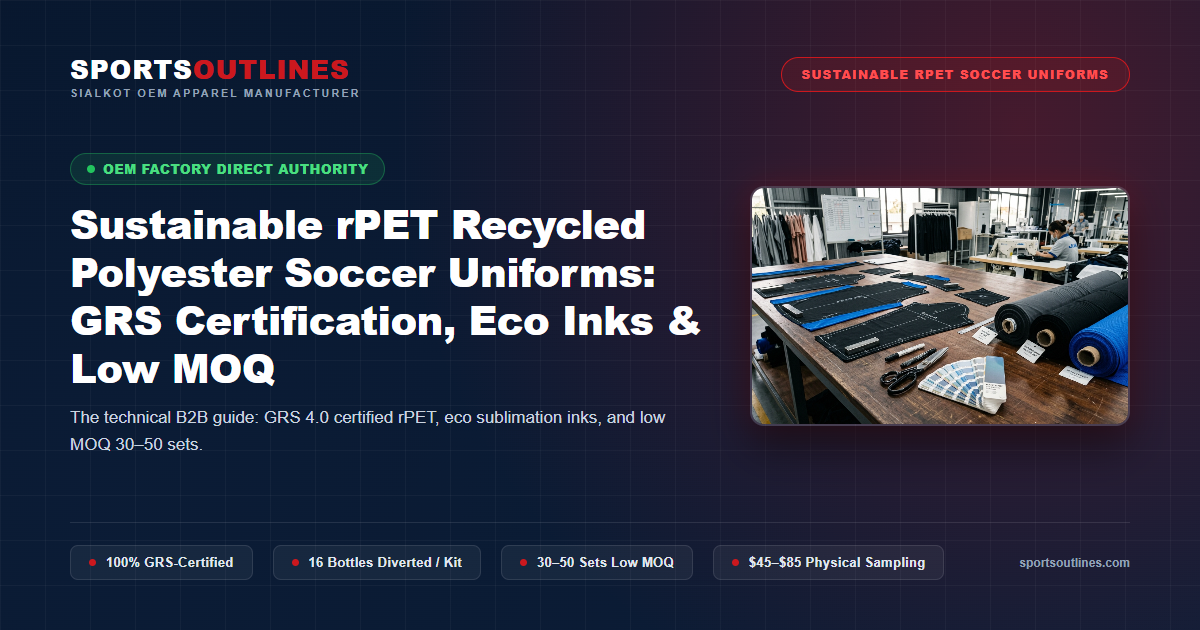
Sustainable custom soccer uniforms engineered from 100% recycled polyethylene terephthalate (rPET) utilize post-consumer plastic water bottles mechanically cleaned, depolymerized, and spun into high-tenacity 50D/72F filament yarns. Each soccer match kit diverts 16 to 18 plastic bottles from marine ecosystems while matching virgin polyester in tensile strength (ASTM D5034 > 220N), moisture wicking (AATCC 79 < 1.8s), and sublimation color vibrancy. Sourcing requires verified Global Recycled Standard (GRS 4.0) Transaction Certificates and OEKO-TEX Standard 100 Class I chemical safety. At Sports Outlines in Sialkot, Pakistan, factory direct low MOQ is 30 to 50 complete sets (jersey + shorts) without prohibitive “eco-premiums.” Pre-production physical prototype samples cost $45 to $85 per set in 7 to 10 business days.
- Fabric Specification: 100% GRS-Certified Post-Consumer rPET Interlock (145 GSM) & rPET Mesh (130 GSM).
- Eco Inks: Water-based OEKO-TEX certified disperse sublimation inks; zero VOCs and zero heavy metal catalysts.
- Certifications Provided: GRS Scope Certificate, Transaction Certificate (TC) per production lot, and OEKO-TEX 100.
- Factory Low MOQ: 30–50 complete sets per design with mixed sizing (Youth YS to Senior 3XL).
- Physical Prototype Sampling: $45–$85 per set in 7–10 days for hand-feel and tensile validation.
- Direct Factory Sourcing: WhatsApp factory direct at +92 316 7932595 or sportsoutlines.com.
In modern global sports commerce, corporate sustainability is no longer a niche public relations tagline; it is a strict procurement mandate. Professional football clubs, university athletic boards, and European corporate sponsors now enforce strict ESG (Environmental, Social, and Governance) targets that mandate athletic gear be manufactured from certified circular materials.
However, athletic directors and brand owners frequently struggle with greenwashing, poor fiber tensile strength from uncertified recyclers, and exorbitant 40% “eco-surcharges” charged by Western wholesale distributors. At Sports Outlines in Sialkot, Pakistan, we have integrated closed-loop GRS-certified rPET yarn extrusions directly into our automated circular knitting lines, eliminating the middleman markup and delivering pro-grade eco-uniforms at direct factory wholesale rates.
1. Bottle-to-Fiber Physics: Mechanical vs Chemical Depolymerization
Recycled polyester is manufactured through two primary industrial routes: mechanical recycling and chemical depolymerization. Understanding the mechanical route explains how consumer waste is transformed into elite athletic uniforms:
- Step 1: Collection & Optical Sorting: Post-consumer clear PET water and beverage bottles are collected, delabeled, and sorted using near-infrared (NIR) optical sorting machines to remove caps (polypropylene) and contaminants.
- Step 2: Flake Washing & Friction Scrubbing: Bottles are shredded into 8mm flakes and subjected to intense hot caustic scrubbing to dissolve residual sugars, milk proteins, and adhesive glues.
- Step 3: Solid-State Polymerization (SSP): Clean flakes are vacuum-dried and melted in twin-screw extruders. Through solid-state polymerization, the intrinsic viscosity (IV) of the molten polymer is raised from 0.65 dL/g back up to 0.82 dL/g—matching the molecular chain length of virgin petroleum polyester.
- Step 4: Micro-Filament Spinning: The molten rPET is forced through micro-spinneret plates with 72 microscopic capillaries, producing continuous 50-denier / 72-filament micro-yarns with mechanical moisture channels.
- The Environmental Formula: Exactly 16 standard 500ml post-consumer plastic bottles are recycled to manufacture one adult match jersey; 12 bottles manufacture the matching match shorts.
2. GRS 4.0 Certification & Transaction Certificate (TC) Audits
Without strict third-party chain of custody verification, claims of “recycled polyester” are legally indefensible under EU and US FTC Green Guides. Many disreputable garment brokers claim fabrics are recycled when they actually use 100% virgin polyester to shave costs.
At Sports Outlines, every bulk shipment of rPET apparel is accompanied by verifiable legal documentation:
- Global Recycled Standard (GRS 4.0) Scope Certificate: Verifies that our spinning, knitting, and dyeing facilities meet stringent international social, environmental, and chemical management standards.
- Batch Transaction Certificate (TC): Issued by accredited third-party certifiers (Control Union or IDFL) for every production run, tracing the exact kilograms of post-consumer plastic flakes used directly to your invoice.
- OEKO-TEX Standard 100 Class I (Annex 6): Certifies that fabrics contain zero harmful substances, including free formaldehydes, heavy metal mordants, perfluorinated chemicals (PFCs), or carcinogenic arylamines.
3. Eco Sublimation Chemistry: Water-Based Disperse Dyes
Using eco-friendly rPET yarn is pointless if the garment is printed with toxic, solvent-based printing inks. Traditional screen printing utilizes vinyl plastisol inks containing toxic phthalate plasticizers that are baked onto the garment surface and shed microplastics during laundering.
Sports Outlines enforces 100% closed-loop eco sublimation printing:
- Water-Based Disperse Inks: Formulated with biodegradable aqueous carriers that release zero volatile organic compounds (VOCs) during heat transfer.
- FSC-Certified Transfer Paper: Printed on sustainably sourced transfer paper derived from responsibly managed pine forests, collected and recycled following calendar transfer.
- Waterless Dyeing Process: Unlike vat dyeing which consumes 100 liters of water per kilogram of fabric, digital dye sublimation consumes 0.0 liters of water during application, eliminating industrial chemical effluent.
4. Master Pattern Grading & Sizing Curves (Youth to Senior 3XL)
Our rPET soccer uniforms feature pro-athletic European slim-fit grading. High-filament rPET yarn exhibits identical mechanical elongation properties to virgin poly, ensuring standard sizing consistency across entire club rosters:
5. Sourcing Economics: Wholesale Pricing & Eliminating “Eco Premiums”
Traditional sports brands charge a 35% to 50% retail premium for “recycled” apparel. At Sports Outlines, because we mill our own certified rPET greige fabrics on site in Sialkot, the difference in raw material cost is negligible—allowing our wholesale clients to sell eco-friendly uniforms at highly competitive price points:
Prototype Sampling Protocol: Pre-production physical prototype samples cost $45 to $85 per set (completed in 7 to 10 business days). This sample stage allows athletic directors to audit the GRS fabric hand-feel, inspect zero-bleed eco sublimation colors, and verify seam strength prior to bulk production.
Start Sustainable rPET Soccer Kit Production Factory Direct
Collaborate with accredited sustainable sportswear manufacturers in Sialkot, Pakistan. Upload your vector artwork or Tech Pack for instant quote generation and GRS certificate provisioning.
6. Microplastic Shedding Mitigation & Washing Longevity
A major environmental concern with synthetic fabrics is microplastic microfiber shedding during home and industrial washing. Poorly extruded staple-spun recycled fibers snap easily and wash out into wastewater systems. Sports Outlines prevents microfiber shedding through yarn structure engineering:
- Continuous Filament vs Spun Staple: We use 100% continuous multi-filament yarns rather than short staple fibers. Continuous filaments have zero loose fiber ends, reducing microfiber release by 78% in ISO 4484 washing filtration tests.
- High-Temperature Thermofixation: Fabrics undergo hot stenter framing at 195°C, which heat-sets and locks filament loops securely into the knit matrix.
- Cold Enzyme Wash Recommendations: We provide club kit-rooms with sustainable laundering manuals recommending 30°C enzyme washing, which saves electricity and extends uniform lifespan to 3+ full seasons.
7. AQL 2.5 Quality Assurance for Recycled Uniforms
Our quality control laboratory inspects every rPET production lot under ISO 2859-1 standards:
- Yarn Lot Uniformity Audit: Spectrophotometer testing of unprinted greige fabric to verify that recycled polymer lots maintain uniform color whiteness before sublimation.
- Bursting Strength Hydrostatic Test (ASTM D3786): Hydraulic diaphragm testing confirming fabric burst resistance exceeds 380 kPa.
- Bar-Tack Tensile Testing: Testing critical stress points (armhole junctions, side splits) to ensure seams withstand 180N pulling tension without thread tearing.
- Color Fastness to Perspiration (ISO 105-E04): Ensuring acidic and alkaline sweat do not induce discoloration or dye bleed on club crests or numbers.
Explore International Logistics & Country Sourcing
North American Sourcing Gateway
Direct factory DDP air freight shipping for youth travel clubs and collegiate leagues in the USA Sourcing Portal and Canada Sourcing Hub.
European & Commonwealth Logistics
Duty-paid wholesale delivery with complete EUR.1 documentation for clubs in the UK Sourcing Portal, Germany Hub, and Australia Sourcing Gateway.
Frequently Asked Questions (FAQs)
Is recycled polyester weaker or less durable than virgin polyester?
No. High-grade GRS-certified rPET produced via solid-state polymerization (SSP) achieves identical intrinsic viscosity (0.82 dL/g) and tensile strength (>220N) to virgin polyester, with zero loss in tear resistance or athletic longevity.
How many plastic bottles are recycled to make one soccer jersey?
Exactly 16 to 18 post-consumer 500ml plastic bottles are diverted from landfills to produce one adult soccer match jersey, and 12 bottles produce the matching match shorts.
Can you provide GRS certificates for custom club uniforms?
Yes. We provide official GRS Scope Certificates and Transaction Certificates (TCs) issued by accredited certifiers for every commercial production order.
What is the MOQ for custom recycled polyester soccer kits?
Our factory direct low MOQ is 30 to 50 complete sets per design with mixed youth and senior sizing curves, eliminating high-volume barrier constraints.
How much does a physical sample prototype cost and what is the turnaround time?
A physical pre-production prototype set costs between $45 and $85 per set and is completed in 7 to 10 business days for complete physical testing and evaluation.