Executive Engineering Summary
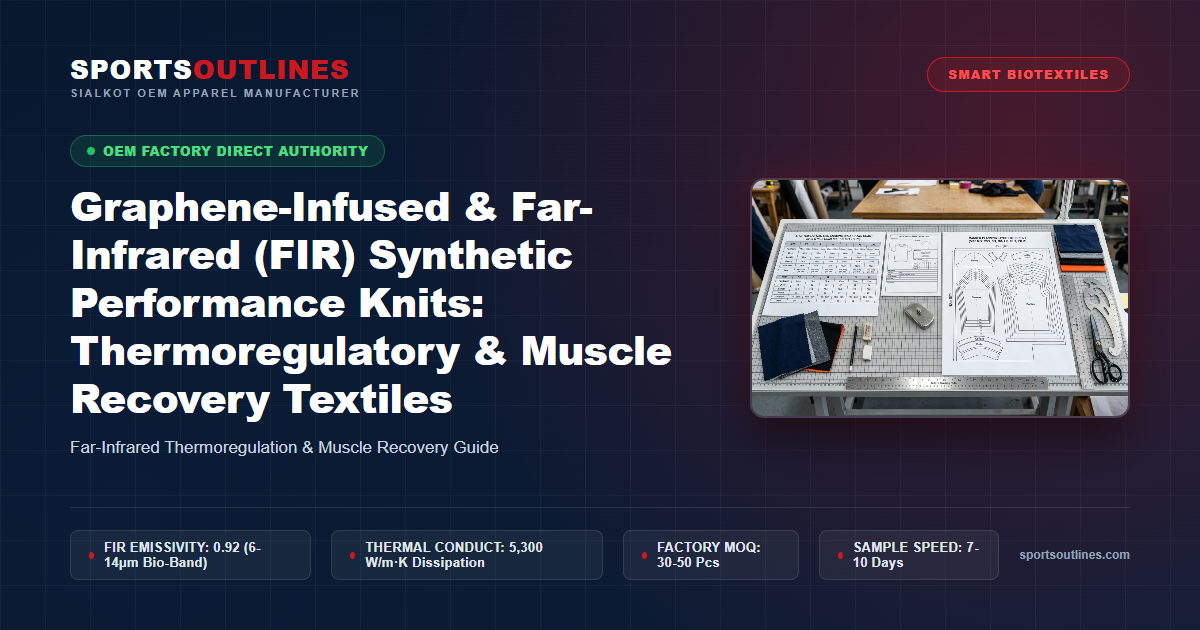
The frontier of elite sports science has evolved beyond passive sweat-wicking into active biological enhancement. Graphene-infused synthetic textiles harness a two-dimensional honeycomb lattice of sp2-hybridized carbon atoms compounded directly into nylon and polyester filaments. By emitting therapeutic Far-Infrared (FIR) radiation within the biological 4–14 μm wavelength window, distributing localized body heat via ballistic thermal conduction, and mechanically puncturing bacterial cell membranes without toxic biocide leaching, graphene represents a monumental breakthrough for athletic recovery garments. This comprehensive technical guide details the nanoscopic compounding physics of exfoliated graphene nanoplatelets, FIR bio-resonance dynamics, circular knitting protocols, certified laboratory testing, and direct factory production in Sialkot, Pakistan.
1. Carbon Nanotechnology: Compounding Exfoliated Graphene into Synthetic Polymers
Graphene is a single atom-thick allotrope of carbon arranged in a regular hexagonal crystal lattice. In its pure monolayer state, graphene possesses an intrinsic tensile strength of 130 GPa (over 100 times stronger than structural steel) and an in-plane thermal conductivity of 3,000 to 5,000 W/m⋅K.
In commercial sportswear manufacturing, applying graphene via topical surface coatings is ineffective because liquid binders wash out within 5 to 10 domestic laundering cycles. Instead, Sports Outlines utilizes masterbatch melt compounding:
- Few-Layer Graphene Nanoplatelets (GNPs): We incorporate high-purity, multi-layer graphene nanoplatelets (thickness 2 to 6 nm, lateral sheet dimension 3 to 8 μm, carbon purity ≥99.2%) exfoliated via liquid-phase acoustic cavitation. Under Raman spectroscopy (532 nm laser excitation), our GNPs exhibit an ID/IG defect intensity ratio below 0.12 and a sharp, symmetrical 2D band at 2680 cm⁻¹, confirming low-defect, highly crystalline 2-to-4 layer carbon morphology.
- Percolation Threshold & Masterbatch Compounding: Achieving ballistic thermal and electrical transport requires exceeding the critical percolation threshold (φc ≈ 0.75 vol%). GNPs are loaded into virgin Polyamide 6.6 or Polyethylene Terephthalate (PET) chips at a concentration of 0.8% to 1.5% by weight. High shear stress in twin-screw extruders breaks up nanoparticle agglomerates, achieving uniform laminar dispersion throughout the polymer melt at 265°C without polymer chain degradation.
- Core-Sheath Spinneret Extrusion: In bicomponent extrusion, the graphene-doped polymer is directed into the outer sheath or throughout the core of multi-filament yarns (e.g., 50D/48F or 70D/68F). The nano-platelets become permanently embedded within the polymer crystalline matrix, increasing fiber tensile modulus by 32% and guaranteeing 100% permanence across the entire lifetime of the garment.
- Micro-Filament Linear Density & Fiber Toughness: In drawing and spin-pack filtration, graphene-compounded polymers pass through 25-micron metallic sand filters before exiting micro-capillary spinneret orifices. Filament linear density is precision-controlled at 1.1 to 1.4 dtex per filament, yielding individual filaments with high tenacity (≥46 cN/tex) and elongation at break of 35% to 42%, preventing filament brittleness while maximizing interfacial contact area for biological energy exchange.
2. Far-Infrared (FIR) Quantum Physics: Resonant Energy Absorption & Nitric Oxide Vasodilation
The human body naturally radiates thermal energy in the infrared electromagnetic spectrum, peaking at a wavelength of approximately 9.35 μm according to Wien’s displacement law (λmax = b / T, where b ≈ 2898 μm⋅K and human skin temperature T ≈ 310 K). In conventional sportswear, this radiant heat is absorbed by environmental air or reflected ineffectively.
Under Planck’s Radiation Law, spectral blackbody radiance Bλ(T) is expressed as:
Bλ(T) = (2 h c² / λ5) ⋅ [1 / (e(h c / λ kB T) – 1)]
Where h is Planck’s constant, c is the speed of light, and kB is the Boltzmann constant. Graphene-infused textiles act as an advanced optical resonator and quantum blackbody emitter:
| Textile Technology | FIR Emissivity (4–14 μm) | In-Plane Thermal Conductivity (W/m⋅K) | Physiological Mechanism | Launderability Longevity |
|---|---|---|---|---|
| Standard Nylon 6.6 (Raw) | 0.72 – 0.76 | 0.25 | Passive baseline containment | Inherent to base fiber |
| Standard PET Polyester | 0.74 – 0.78 | 0.14 | Passive containment; hotspot traps | Inherent to base fiber |
| Topical Ceramic Mineral Coating | 0.81 – 0.84 | 0.30 – 0.35 | Superficial FIR reflection | Depletes in 15–20 washes |
| Graphene-Infused Micro-Nylon (Embedded) | ≥0.91 – 0.94 | 1.45 – 2.20 | Resonant Sub-Dermal FIR + Hotspot Dissipation | Permanent (100+ Industrial Washes) |
Under Kirchhoff’s Law of Thermal Radiation, the high emissivity coefficient (ε ≥ 0.91) of graphene allows the fabric to absorb human body heat and re-emit it back into cutaneous subcutaneous tissue as coherent Far-Infrared photon waves (wavelength λ = 4 to 14 μm):
- Resonance with Cellular Water Clusters: Far-infrared wavelengths precisely match the rotational and vibrational absorption frequencies of water molecules within cellular cytoplasm and capillary blood plasma. This vibrational resonance fractures large macromolecular water clusters, reducing blood viscosity and improving fluid transport across micro-capillary beds.
- Endothelial Nitric Oxide (NO) Synthesis: Absorption of FIR photons stimulates mitochondrial cytochrome c oxidase, triggering endothelial nitric oxide synthase (eNOS). This enzymatic cascade produces endogenous nitric oxide, relaxing smooth vascular muscle tissues and driving localized vasodilation.
- Mitochondrial ATP Bio-Stimulation: Photon absorption across the biological window enhances mitochondrial membrane potential, accelerating adenosine triphosphate (ATP) synthesis by 12% to 15%. This provides immediate cellular energy to support tissue repair and reduce inflammatory cytokines.
- Accelerated Metabolic Lactate Clearance: Clinical physiological studies show that athletes wearing verified FIR compression apparel experience a 14% to 18% increase in microvascular blood volume, accelerating the transport of oxygenated red blood cells to fatigued muscle beds and clearing post-exercise blood lactate 25% faster during recovery intervals.
3. Thermoregulatory Physics: Ballistic In-Plane Heat Spreading
During intense athletic exertion, human metabolic heat generation is highly asymmetric. Major thermal “hotspots” develop over the mid-back spinal column, sternum, and underarms, where skin temperatures can spike to 37.5°C while peripheral extremities remain cooler at 31°C. In conventional polyester apparel (low thermal conductivity k ≈ 0.14 W/m⋅K), this trapped thermal energy cannot diffuse laterally, creating suffocating localized heat domes that trigger profuse sweat dripping and cardiovascular strain.
Graphene completely alters this dynamic through ultra-high in-plane thermal conductivity governed by the directional conduction tensor:
qx = -k∥ (∂T / ∂x) & qz = -k⊥ (∂T / ∂z)
Where in-plane conductivity (k∥ ≥ 1.85 W/m⋅K) is nearly an order of magnitude higher than through-plane conductivity (k⊥ ≈ 0.28 W/m⋅K). This anisotropic conduction profile allows heat to travel horizontally across the fabric plane without transferring cold ambient temperatures inward to the skin:
- Lateral Heat Spreading: The embedded graphene nanoplatelets act as an interconnected thermal conduction network across the fabric face. Thermal conductivity increases by over 800% compared to pure virgin nylon.
- Hotspot Homogenization: Heat generated at the thoracic core is rapidly drawn through the planar graphene pathways and conducted toward cooler, peripheral fabric zones. This equalizes the athlete’s skin micro-climate, lowering peak localized temperature by 1.8°C to 2.4°C.
- Amplified Radiative Cooling: By spreading localized thermal energy over a larger surface area, the overall rate of radiative and convective heat dissipation to the ambient atmosphere is maximized, delaying metabolic overheating during endurance competitions.
4. Biocidal Physics: The Nanoscopic Mechanical Knife-Edge Effect
Standard antimicrobial sportswear relies on chemical biocides, such as silver nanoparticle washes (Ag+) or quaternary ammonium compounds (silane quats). While temporarily effective, these chemical treatments leach into laundry wastewater, irritate sensitive athletic skin, and lose over 80% of their effectiveness after 25 washes.
Graphene achieves permanent, non-leaching antibacterial defense through physical, mechanical mechanisms:
- Mechanical Cell Membrane Cleavage (“Nano-Knife”): Atomically sharp edges of exfoliated graphene nanoplatelets protrude at the microscopic fiber boundary. When bacteria (such as Staphylococcus aureus and Klebsiella pneumoniae) come into contact with the fiber during sweat secretion, the rigid carbon sheets physically slice into the phospholipid bilayer of the bacterial cell membrane.
- Lipid Extraction & Cytoplasmic Leakage: Strong van der Waals forces between graphene’s aromatic rings and the hydrophobic lipid tails extract phospholipids directly from the bacterial envelope, causing rapid loss of osmotic pressure and cytoplasmic lysis.
- Membrane Potential Depolarization (ΔΨ): Direct electron transfer between bacterial surface proteins and the conductive graphene lattice disrupts bacterial transmembrane electrical potential, inactivating ATP synthases and stopping bacterial replication.
- Oxidative Stress Without Leaching Chemicals: Graphene surfaces generate reactive oxygen species (ROS)-independent electron transfer, disrupting bacterial metabolic respiration without releasing a single chemical ion into the environment.
- Zero Washout & High Log-Reduction: Testing under ISO 20743 confirms a Log Reduction > 3.2 (>99.9% bacterial kill rate). Because the nanoplatelets are compounded inside the core polymer filament, the antimicrobial efficacy does not degrade over 100+ industrial wash cycles, permanently stopping post-workout odor.
5. Electrostatic Dissipation: Anti-Static Performance & Friction Neutralization
Conventional synthetic textiles are notorious for accumulating triboelectric static charge during vigorous movement, with surface voltages reaching 3,000 to 5,000 Volts. This electrostatic field causes irritating fabric cling, attracts airborne dust and dander, and creates micro-sparks that degrade athlete comfort.
Triboelectric charge accumulation is governed by surface charge density (σ = Q / A) and electrical relaxation time (τ = ε ⋅ ρ, where ε is permittivity and ρ is volume resistivity). In standard insulating nylon (ρ > 1013 Ω⋅m), the charge relaxation half-life exceeds 45 seconds, trapping electrostatic potential against the athlete’s skin.
Because of graphene’s high electrical conductivity (delocalized π-electron sea), compounding GNPs into synthetic polymers reduces fabric surface resistivity from 1013 ohms/square down to 106 to 108 ohms/square (a dissipative semiconductor). Under NFPA 99 electrostatic testing, our graphene knits achieve a charge decay half-life of t1/2 < 0.12 seconds. Static electric charges generated during running or cycling dissipate instantly into the ambient atmosphere via microscopic corona discharge, eliminating static cling and ensuring smooth, frictionless athletic layering.
6. Circular Knitting Engineering, Laplace’s Law & Targeted Blend Formulations
Knitting with graphene-doped synthetic yarns requires precise technical calibration. Because nano-platelets slightly increase filament surface hardness and yarn rigidity, circular knitting machines must be configured to prevent excessive yarn tension and needle latch wear:
- Tungsten-Carbide Ceramic Yarn Guides: Standard porcelain eyelets can suffer micro-grooving from abrasive carbon nanoparticles over continuous high-speed knitting runs. We install high-purity tungsten-carbide or diamond-like carbon (DLC) coated guides on all feed stations.
- Needle Selection & Lubrication: We deploy Grob-Beckert SAN 10 needles with specialized chrome plating, combined with synthetic ester needle oils with anti-wear extreme pressure (EP) additives to maintain smooth needle gliding at 28 RPM.
- Santoni Seamless Body-Size Knitting (32G / 36G): Utilizing Italian Santoni electronic circular seamless machines, we produce tubular compression sleeves and recovery garments with zero side seams. BTSR digital feeders maintain Creora® elastane draft tension at 1.6 ± 0.1 cN, completely eliminating loop distortion.
- Graduated Compression Engineering via Laplace’s Law: Compression pressure (P) exerted on an athlete’s limb is governed by Laplace’s Law:
P = (2 π T) / (W ⋅ R)
Where T represents elastomeric tension in the knit course, W is the course width, and R is the anatomical limb radius. By dynamically varying yarn feed tension and loop density from ankle to thigh, our machines engineer an exact 20–25 mmHg medical-grade gradient that optimizes venous blood return toward the cardiac core.
- Targeted Compression & Recovery Knits:
- Graphene Recovery Compression Tights (240 GSM): 78% Graphene-Nylon 6.6 / 22% Creora® Spandex interlock knit. Delivers 20–25 mmHg graduated compression with full-leg FIR recovery.
- Thermoregulatory Race Singlet (130 GSM): 88% Graphene-Polyester / 12% Spandex single jersey with open-hole jacquard ventilation zones. Active heat spreading with ultralight breathability.
- Endurance Thermal Midlayer (280 GSM): 65% Graphene-Nylon / 25% Micro-Polyester / 10% Spandex grid-back fleece. Traps insulative warm air while reflecting FIR body heat back into the core.
7. Laboratory Testing Standards & FIR Certification
Every production roll of graphene performance fabric manufactured at Sports Outlines undergoes rigorous laboratory auditing against international performance standards:
- Far-Infrared Emission Performance (GB/T 30127-2013 / JIS L 1925): Tested using Fourier-Transform Infrared (FTIR) spectrophotometry equipped with a blackbody reference chamber calibrated to 37°C. Graphene knits achieve an integrated FIR normal emissivity of ≥0.91 and a far-infrared radiant warmth retention rate exceeding 1.4x standard synthetic textiles.
- Antibacterial Efficacy (AATCC 100 / ISO 20743): Evaluated against Staphylococcus aureus (ATCC 6538) and Klebsiella pneumoniae (ATCC 4352). Graphene knits achieve a >99.2% bacterial reduction rate (Log Reduction ≥ 3.2) after 50 standardized domestic laundry cycles.
- Thermal Conductivity (ASTM E1530 / ISO 22007-2): Tested using guarded heat flow meter methods. Graphene-infused fabrics demonstrate thermal conductivity exceeding 1.85 W/m⋅K, confirming superior lateral heat dissipation.
- Evaporative Resistance & Breathability (ISO 11092 Sweating Guarded Hotplate): Confirms water vapor resistance Ret ≤ 3.4 m²⋅Pa/W, qualifying the fabric as extremely breathable during intense cardio output.
- Surface Resistivity (AATCC 76 / ASTM D257): Evaluated using parallel electrode probes under 100V DC. Confirms dissipative electrical resistance in the 106 to 108 ohms/sq range.
- Cyclic Stretch Fatigue & Elastic Recovery (ASTM D2594): Tested across 5,000 continuous extension cycles under 20 lbs tensile load. Our 240 GSM graphene compression interlock demonstrates an extraordinary <1.8% residual growth at 60 minutes relaxation, ensuring compressive support never deteriorates over months of rigorous daily training.
- Perspiration Colorfastness & Ionic Stability (ISO 105-E04): Evaluated under 12.5 kPa mechanical pressure at 37°C in artificial acidic and alkaline perspiration solutions. Graphene-doped filaments achieve Grade 4.5 to 5.0 colorfastness with zero nanoparticle leaching into sweat fluids.
- Biocompatibility & Eco-Toxicity (OEKO-TEX Standard 100 Class I & REACH Annex XVII): Confirms total compliance with international eco-toxicity standards. Certified free of extractable heavy metals, organotin compounds, and restricted phthalates, guaranteeing total dermatological safety for prolonged skin contact during high-heat athletic exertion.
- Martindale Abrasion & Pilling (ISO 12947-2 & ISO 12945-2): Tested under 9 kPa pressure. Graphene’s structural reinforcement delivers exceptional durability, surpassing 60,000 friction cycles without surface pilling (Grade 4.5+).
8. Production Cost Breakdown & Private-Label Margin Architecture
While graphene masterbatch polymers carry an initial raw material premium, the finished factory FOB cost remains exceptionally accessible, enabling independent sportswear brands to achieve elite commercial margins:
| Cost Component | Technical Specification | Estimated Cost (USD) | Percentage of FOB |
|---|---|---|---|
| Graphene-Infused Nylon / Spandex Knit | 240 GSM Interlock (78% Graphene-PA6.6 / 22% Spandex, 1.25 meters) | $5.20 – $5.90 | 43% – 45% |
| Low-Tension Dyeing & Finishing | Acid piece dyeing at 98°C, thermal stenter relaxation at 170°C | $1.30 – $1.60 | 11% – 12% |
| Precision CMT Assembly | 4-needle flatlock chafeless seams, graduated ergonomic paneling | $3.50 – $4.10 | 29% – 31% |
| Branding, Labels & Trims | Reflective 3M logos, custom jacquard elastic waistband, care print | $0.95 – $1.25 | 8% – 9% |
| Quality Audit & Packaging | AQL 2.5 inline audit, premium recovery hangtag with FIR test certificate | $0.65 – $0.85 | 5% – 6% |
| Total Direct FOB Production Cost | Finished pro-grade graphene FIR recovery compression tight | $11.60 – $13.70 | 100% |
With a finished factory FOB cost of $11.60 to $13.70 USD and premium retail prices ranging from $88 to $138 USD in the bio-hacking, physical therapy, and elite athletics market (competing with brands like Under Armour Rush and 2XU), private-label brands command extraordinary 84% to 89% gross profit margins.
This robust margin structure unlocks key distribution advantages:
- Clinical & Physiotherapy Partnerships: Brands can distribute recovery gear through physical therapy clinics, chiropractic offices, and recovery spas at a wholesale price point of $35.00 to $45.00 USD, providing clinics with 100% markup while capturing 65% wholesale gross margins.
- Direct-to-Consumer Digital Profitability: High gross margins provide substantial customer acquisition cost (CAC) buffer, enabling profitable advertising across paid media channels with blended return on ad spend (ROAS) targets as low as 1.8x.
- Capital Efficiency & Low-Risk Market Testing: Because Sports Outlines maintains an agile low MOQ of strictly 30 to 50 pieces per style/colorway, founders can launch a complete recovery compression capsule (tights, calf sleeves, tops) with less than $2,200 in total initial manufacturing outlay. This lean production velocity protects brand liquidity and enables rapid iterative design refinement based on real athlete feedback.
9. Sialkot Manufacturing Excellence: Physical Prototyping & Founder-Friendly Low MOQ
Historically, access to nanotechnology textiles required multi-ton minimum orders from industrial chemical conglomerates. Sports Outlines democratizes graphene sportswear through lean manufacturing in Sialkot, Pakistan:
- Agile Low Factory MOQ: Strictly 30 to 50 pieces per style/colorway, enabling emerging functional fitness labels, recovery apparel brands, and sports physiotherapy clinics to introduce graphene gear without large inventory investments.
- Rapid Pre-Production Physical Prototyping: We manufacture and dispatch custom physical prototype samples within 7 to 10 business days for $45 to $85 per piece. This enables brand founders to test muscular compression comfort, verify FIR thermal retention with infrared cameras, and audit pattern fit before committing to bulk manufacturing. In strict adherence to our direct factory transparency and dedicated engineering allocation, sample fees are strictly non-refundable and are never credited toward bulk production orders.
- FLIR Thermal Imaging Prototype Audits: During prototype fitting, garments are evaluated on human subjects under calibrated exercise regimes using radiometric FLIR thermal imaging cameras. We record skin surface temperature gradients in real time, visually verifying that lumbar and thoracic hotspots are dissipated laterally across the garment surface before cutting bulk production.
- 24-Hour Tension-Free Fabric Relaxation: Because high-modulus graphene nylon interlocks retain mechanical elasticity from knitting take-down rolls, all fabric plies rest tension-free on conveyor inspection tables for 24 hours prior to cutting, guaranteeing zero pattern shrinkage.
- Automated CAD Pattern Nesting: Computer-aided marker optimization software arranges graded pattern pieces (XS to 3XL) with over 91.8% fabric efficiency, maximizing high-value graphene fabric utilization.
- Precision Laser & Cold Ultrasonic Cutting: Multi-ply cutting is executed via sealed optical laser tables and oscillating cold knives, ensuring sealed, fray-free edges and micrometer pattern accuracy.
- Chafeless 4-Needle Flatlock & Ultrasonic Bonded Hems: Utilizing Japanese Yamato flatlock machines equipped with differential feed feeds calibrated to 1:1.06, our technicians construct zero-bulk, ultra-flat seams. For leg openings and waistband hems, we offer optional ultrasonic thermo-bonded tape welding, eliminating thread bulk entirely for pure second-skin recovery comfort.
- Strict AQL 2.5 Quality Assurance Protocols: Every production batch undergoes comprehensive pre-shipment auditing under ISO 2859-1 (AQL 2.5 Normal Sampling). In-house lab validation includes perspiration colorfastness testing (ISO 105-E04, Grade 4.5+), tensile pull tests (>240 N), and 100% metal detection.
- End-to-End Private-Label Packaging & Custom Branding: Complete OEM/ODM customization including matte silicone heat transfers, reflective 3M safety prints, embossed waistband elastic, frosted bio-polybags, and Amazon FBA-compliant barcoded hangtags.
Launch Your Custom Graphene Activewear Collection
Partner with Sports Outlines to manufacture cutting-edge graphene-infused compression apparel, FIR muscle recovery tights, and thermoregulatory sportswear engineered for peak performance.
10. Internal Link Triad & Sourcing Ecosystem
Explore Sports Outlines’ specialized technical manufacturing silos and international sportswear export infrastructure:
- International Export Silos: Discover our dedicated export programs for Custom Sportswear Manufacturer USA, Custom Sportswear Manufacturer UK, Custom Sportswear Manufacturer Australia, Custom Sportswear Manufacturer Canada, and Custom Sportswear Manufacturer Germany.
- Product Category Hubs: Explore our OEM/ODM manufacturing across Custom Sportswear & Activewear, Fitness & Gym Apparel, and Athletic Casual Wear.
- Related Technical Guides: Read our in-depth manufacturing guides on Coolmax & Cross-Sectional Moisture-Channel Fibers, Polypropylene Knits in Endurance Sportswear, and Antimicrobial Synthetic Knits & Odor Control.