In athletic apparel and performance swimwear manufacturing, elastane—universally known as Spandex or Lycra®—is the invisible powerhouse that enables modern sportswear to exist. Whether it constitutes 15% of a moisture-wicking running singlet, 25% of a squat-proof compression tight, or 20% of an elite racing swimsuit, elastane provides the elastomeric stretch and restorative power that holds garments securely against the human body. However, elastane is simultaneously the most chemically vulnerable and thermally fragile component in the entire textile assembly. When exposed to chlorinated swimming pools, body sweat lipids, sunscreen oils, atmospheric ozone, or high-heat commercial dryers, unshielded generic spandex suffers rapid molecular degradation: the garment loses its holding power, exhibits unsightly fiber breakage (“elastane snap-back” or white hairing on seams), and sags permanently into bagging, unwearable fabric.
For sportswear brand founders, technical product managers, and private label sourcing heads, choosing the right elastane technology is the difference between a high-retention athletic line and catastrophic warranty returns. In the global B2B supply chain, this industrial evaluation centers on the two dominant chemical innovators: Hyosung Creora® (specifically Creora® HighClo™) versus The LYCRA Company (specifically LYCRA® XTRA LIFE™).
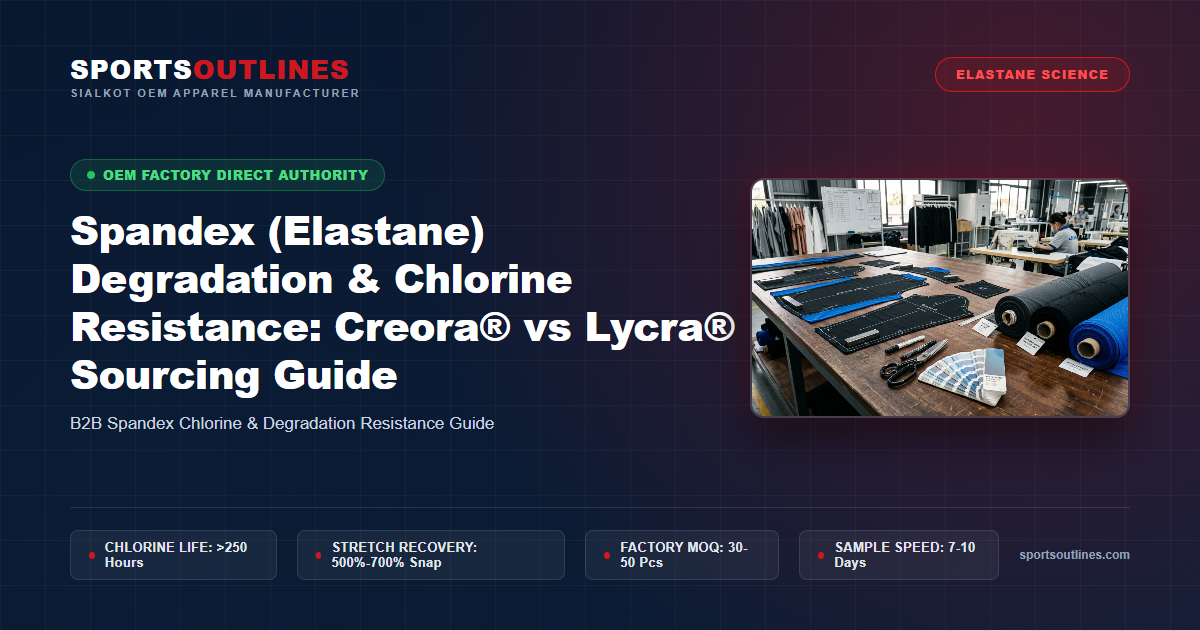
Operating from our vertical textile milling and cut-and-sew manufacturing hub at Sports Outlines in Sialkot, Pakistan, we produce high-performance compression knits, activewear leggings, triathlon skinsuits, and competitive swimwear for elite international athletic labels. We engineer 190 to 320 GSM warp-knit tricot and circular interlock textiles incorporating authentic, lot-certified Creora® HighClo™ and LYCRA® XTRA LIFE™ elastanes in 20D to 70D filament deniers. Backed by our accessible factory minimum order quantity (MOQ) of strictly 30 to 50 pieces per style/colorway and rapid physical prototyping turnaround (7 to 10 days, $45 to $85 per piece, non-refundable), Sports Outlines provides the polymer chemistry, testing rigor, and direct factory transparency required to build indestructible high-stretch athletic apparel.
Executive Engineering Summary: Elastane Degradation & Sourcing
- Segmented Polyurethane Macromolecular Architecture: Elastane is a block copolymer consisting of alternating “hard segments” (rigid polyurethane blocks providing physical crosslinks and elastic recovery) and “soft segments” (flexible polyether or polyester chains providing up to 500%–700% elongation).
- Chlorine Degradation Mechanism: Active hypochlorous acid (HOCl) and hypochlorite ions in chlorinated pool water attack the urethane nitrogen atoms in the hard segments, breaking the polymer chain and destroying the fiber’s elastic snap. Generic spandex degrades within 30 to 50 pool hours; modified elastanes withstand over 250 hours.
- Creora® HighClo™ vs. LYCRA® XTRA LIFE™: Both technologies integrate proprietary zinc-based or phenolic chemical inhibitors into the polyurethane polymer dope that neutralize active chlorine radicals before they attack urethane linkages. Both deliver over 10x the chlorine lifespan of generic elastane, with Creora offering superior price-to-performance efficiency for scaling brands and Lycra providing elite global consumer brand recognition.
- Sweat, Sebum & Heat Vulnerability: Human body lipids (oleic acid, squalene) swell and soften polyether soft segments, while domestic dryer heat (>80°C) causes thermal creep. Protective yarn wrapping (Air-Covered Yarn – ACY or Double-Covered Yarn – DCY) shields elastane cores from friction and chemical exposure.
- Direct Factory Access: Low production MOQ of strictly 30–50 pieces per style/colorway; pre-production physical prototypes delivered in 7–10 business days ($45–$85 per piece, non-refundable).
1. Macromolecular Polymer Science of Segmented Polyurethanes
Unlike true synthetic polymers with uniform recurring units (like polyester or nylon), elastane is a segmented block copolymer. Synthesized via dry spinning or wet spinning, elastane filaments consist of two chemically distinct phases operating in thermodynamic microphase separation:
1. The Soft Segments (Amorphous Elastic Reservoir): Comprising 80% to 85% of the total polymer mass, soft segments consist of long, coiled aliphatic polyether diols (such as polytetramethylene ether glycol – PTMEG) or polyester diols. Under ambient conditions, these chains exist in a high-entropy, randomly coiled state. When the fabric is stretched, these coiled chains uncoil and extend parallel to the tensile axis, allowing the fiber to elongate up to 500% to 700% of its relaxed length without breaking.
2. The Hard Segments (Crystalline Anchor Domains): Comprising 15% to 20% of the polymer mass, hard segments are formed by reacting aromatic diisocyanates (principally 4,4′-diphenylmethane diisocyanate – MDI) with low-molecular-weight diamine or diol chain extenders. These rigid urethane/urea blocks associate into crystalline nanodomains via dense intermolecular hydrogen bonding. These hard domains act as physical crosslinks (anchors). When tensile load is released, the hard domains snap the extended soft segments back into their randomized, high-entropy coiled state, providing elastomeric recovery.
| Polymer Phase | Chemical Precursor | Biophysical Function | Degradation Vulnerability |
|---|---|---|---|
| Soft Segments (80–85%) | Polyether (PTMEG) or Polyester Glycol | Provides 500%–700% elastic elongation and high flexibility | Swollen by body oils, squalene, and sebum; oxidized by UV radiation |
| Hard Segments (15–20%) | MDI Diisocyanate + Diamine Chain Extenders | Forms hydrogen-bonded crystalline crosslinks for instant snap-back | Attacked by chlorine radicals, thermal heat >180°C, and alkaline detergents |
| Chemical Crosslinks | Allophanate and Biuret linkages | Prevents permanent creep under prolonged cyclic strain | Hydrolyzed under prolonged acidic/basic damp environments |
| Microphase Morphology | Phase-separated domain matrix | Maintains high modulus and recovery kinetics | Phase mixing occurs if heat-set above 195°C, killing elastomeric snap |
2. The Four Pathways of Elastane Degradation
When an activewear legging, cycling bib, or swimsuit fails in consumer hands, the root cause is almost always degradation of the elastane component. Understanding the precise biochemical mechanisms of breakdown allows technical apparel designers to engineer preventive defenses.
Pathway 1: Active Chlorine Attack (The Pool Water Crisis)
Municipal swimming pools maintain free available chlorine (FAC) concentrations between 1.0 and 3.0 ppm (mg/L) at pH 7.2–7.8 to disinfect against pathogens. At this pH, chlorine exists primarily as hypochlorous acid (HOCl) and hypochlorite ions (OCl−). The unshared electron pairs on the nitrogen atoms within elastane’s urethane (-NH-COO-) and urea (-NH-CO-NH-) hard segments react violently with HOCl, undergoing chlorination to form chloramides (-NCl-CO-). These chlorinated bonds are chemically unstable and undergo spontaneous chain scission. As the hard domains sever, the physical crosslinks collapse: the fiber elongates permanently, loses all snap-back tension, and fragments into powder inside the fabric knit.
Pathway 2: Unsaturated Sweat Lipids and Sebum Swelling
During heavy athletic perspiration, human sebaceous glands release sebum composed of triglycerides, squalene, free fatty acids (oleic, palmitic, linoleic acids), and cholesterol. Because polyether soft segments are non-polar, these lipid molecules dissolve directly into the amorphous rubbery phase of the elastane filament. This induces plasticization and swelling: the soft segments become spaced too far apart to recoil efficiently, causing fabric slackness and severe knee/elbow bagging. Furthermore, when exposed to body warmth, unsaturated fatty acids auto-oxidize into organic hydroperoxides, accelerating chemical breakdown.
Pathway 3: Thermal Dissociation & Tumble Dryer Creep
The hydrogen bonds holding elastane hard segments together have a thermal dissociation threshold around 150°C to 180°C. While this enables controlled heat-setting during fabric milling, exposing garments to high-heat domestic tumble dryers (>75°C) or hot-water laundry (>60°C) causes the hard domains to slowly unravel. Over repeated wash cycles, this thermal agitation induces permanent creep: the garment permanently stretches out, losing its original compressive silhouette.
Pathway 4: Ultraviolet Photo-Oxidation & Atmospheric Ozone
Outdoor athletes training under direct sunlight expose their apparel to UV-A and UV-B radiation (290–400 nm). The aromatic rings present in MDI diisocyanate hard segments absorb ultraviolet photons, triggering photo-Fries rearrangements that generate quinoid chromophores. This causes two visible failures: yellowing of white or light-colored garments, and radical-induced cleavage of ether bonds in the soft segments, causing the elastane to become brittle and snap under stretch.
3. Industrial Showdown: Creora® HighClo™ vs. LYCRA® XTRA LIFE™
To counteract chlorine and chemical degradation, world-class elastane chemical manufacturers developed specialized chlorine-resistant polymers. The two global leaders are Creora® HighClo™ (developed by South Korean textile giant Hyosung) and LYCRA® XTRA LIFE™ (developed by The LYCRA Company, formerly Invista/DuPont).
The Chemistry of Protection: Both manufacturers solve chlorine attack by compounding proprietary stabilizing additives directly into the polyurethane spinning dope:
- Inorganic Mineral Scavengers: Specialized hydrotalcite-like compounds and zinc oxide nanoparticles dispersed within the polymer matrix actively intercept and neutralize hypochlorite radicals before they can attack urethane nitrogen sites.
- Modified Hard Segment Chemistry: Both innovators utilize steric hindrance—bulky aliphatic or cycloaliphatic molecular side-groups that physically shield urethane bonds from incoming chlorine molecules.
- Anti-Yellowing Stabilizers: Hindered amine light stabilizers (HALS) and phenolic antioxidants prevent UV discoloration and ozone cracking.
| Performance Metric | Creora® HighClo™ (Hyosung) | LYCRA® XTRA LIFE™ (The LYCRA Co) | Generic Bare Spandex |
|---|---|---|---|
| Chlorine Lifespan (5 ppm pool water) | > 250 hours (10x vs generic) | > 260 hours (10x vs generic) | 25 – 35 hours (Rapid failure) |
| Retained Power After Chlorine Exposure | 85% – 90% tension retention | 88% – 92% tension retention | < 20% (Total bag-out) |
| Resistance to Sunscreen & Sebum | Superior (Specialized soft segments) | Superior (Specialized soft segments) | Poor (Heavy fiber swelling) |
| Thermal Heat-Setting Window | 185°C – 192°C (Excellent stability) | 188°C – 195°C (Broadest window) | 175°C – 180°C (Easily damaged) |
| Raw Material Price Premium | Moderate (+15% to +22% vs generic) | High (+35% to +50% vs generic) | Baseline (Lowest initial cost) |
| Sourcing Recommendation | Optimal for scaling performance brands | Optimal for luxury brands leveraging Lycra® hangtags | Strictly avoid for athletic & swim lines |
4. Bare Spandex vs. Covered Yarn Knitting Configurations
In addition to selecting protected elastane chemistry, how the elastane filament is fed into the knitting machine fundamentally dictates fabric hand-feel, durability, and resistance to environmental degradation.
Sports Outlines deploys three primary yarn integration methodologies:
- 1. Bare Elastane Plating: The naked elastane filament is fed directly into the knitting needle hook alongside a synthetic yarn (such as 75D polyester or nylon). While this is the lowest-cost knitting method and delivers high elasticity, the bare elastane core is directly exposed to surface friction, sweat oils, and sunlight. Suitable only for moderate-performance everyday activewear.
- 2. Air-Covered Yarn (ACY): Elastane is drawn through an air-interlacing jet simultaneously with textured filament nylon or polyester. The turbulent air vortex intermingles the outer synthetic filaments around the central elastane core at regular intervals (approx. 100–120 tack points per meter). The outer sheath physically shields the elastane core from chemical contact, enhancing chlorine and sweat resistance by 40% while preserving fluid stretch. This is our default standard for premium leggings and athletic jerseys.
- 3. Double-Covered Yarn (DCY): The elastane core filament is placed under precise draft tension while two continuous layers of multifilament nylon or polyester are wrapped around it in opposing helical directions (S-twist and Z-twist). The elastane is completely entombed within an impenetrable synthetic armor. DCY delivers extraordinary dimensional stability, zero grin-through, and supreme resistance to chlorine and friction, making it the non-negotiable benchmark for Olympic swimwear, competitive cycling bibs, and medical-grade graduated compression gear.
5. Laboratory Testing: Retained Power & Accelerated Aging Standards
To certify fabric performance prior to mass production cutting, Sports Outlines executes standardized accelerated degradation testing in our Sialkot quality control laboratory:
| Test Standard | Degradation Challenge | Test Protocol | Sports Outlines Benchmark |
|---|---|---|---|
| AATCC 162 | Color Fastness to Chlorinated Pool Water | 5 ppm available chlorine, pH 7.0, 21°C | Grade 4.5 – 5.0 (Zero color loss or fiber bleed) |
| ASTM D2594 | Stretch & Recovery of Knitted Fabrics | Post-240-hour chlorinated soak, 60% stretch | > 88% Elastic recovery within 60 seconds |
| AATCC 15 | Color Fastness to Perspiration | Acid & alkaline synthetic sweat at 38°C | Grade 4.5 (No staining on multi-fiber strip) |
| ISO 105-B02 | Color Fastness to Artificial Light (Xenon Arc) | UV-A/UV-B irradiation, blue wool scale | Grade 5 – 6 (Superior lightfastness) |
| AATCC 135 | Dimensional Stability in Domestic Laundering | 5 domestic wash/dry cycles at 40°C | < 2.0% Residual shrinkage warp & weft |
6. Sourcing Strategy: Choosing the Optimal Elastane for Your Collection
How should brand directors allocate their BOM budget between Creora® HighClo™, LYCRA® XTRA LIFE™, and standard elastane blends?
- For Competitive Swimwear & Water Sports: Specify strictly Creora® HighClo™ or LYCRA® XTRA LIFE™ in 20% to 28% content with 100% double-covered yarn (DCY) construction. This prevents garment sag, ensures 100% opacity when wet, and protects your brand from negative customer reviews regarding chlorine damage.
- For High-Compression Running Tights & Triathlon Suits: Deploy Creora® HighClo™ in 24% to 26% content paired with high-gauge warp-knit tricot. This delivers firm graduated muscular compression that withstands endurance sweat acid and frequent machine washes without losing compressive modulus.
- For Boutique Athleisure & Studio Yoga: Choose Air-Covered Yarn (ACY) combining micro-denier Nylon 6.6 with Creora® Black elastane. The dope-dyed black elastane eliminates white shimmer grin-through during deep stretches, while the air-covered sheath delivers buttery softness and durable elasticity.
7. Dope-Dyed Black Spandex: Eliminating Optical Grin-Through Under Strain
One of the most persistent aesthetic failures in black or dark-toned gym leggings is “elastane grin-through” (also called the “shimmer effect” or “silver haze”). Traditional elastane is produced as a translucent white or clear filament. When a black legging is knitted, the face yarns (polyester or nylon) are dyed jet black, but the interior elastane filaments remain white because elastane does not accept standard disperse or acid dyes readily.
During a deep squat, lunge, or bend, the fabric stretches biaxially by 60% to 100%. As the stitches widen, the white elastane core filaments slide forward to the fabric surface, reflecting ambient gym spotlights. The consumer perceives this as a grayish, cheap, or semi-translucent appearance, often triggering immediate product returns under the assumption that the garment is sheer or poorly dyed.
The Solution: Creora® Black & LYCRA® Black Technology: Sports Outlines eliminates grin-through by mandating dope-dyed black elastane in all dark-colored activewear. Micro-milled carbon black pigments are injected directly into the polyurethane polymer dope prior to filament extrusion. Because the black pigment is chemically trapped inside the polymer matrix, the elastane filament is pitch black throughout its entire cross-section. Even under 120% extreme stretch, our leggings maintain 100% deep black color saturation with zero surface reflection or silver shimmer.
8. Sustainable Bio-Based & Recycled Elastane Innovations
As sustainability shifts from a marketing buzzword to a mandatory compliance requirement in Europe and North America, technical apparel brands face increasing pressure to eliminate petroleum-derived virgin polymers. While recycled polyester (rPET) and recycled nylon (rPA) are established, elastane has historically represented the “unsustainable blind spot” of the activewear industry.
Sports Outlines leads the transition by offering next-generation sustainable elastanes:
- Creora® Bio-Based Spandex: Derived partially from renewable industrial field corn rather than fossil petroleum. The polyether glycol (PTMEG) soft segment is synthesized from corn-derived 1,4-butanediol (BDO), reducing the carbon footprint of the elastane by up to 28% without altering its stretch, recovery, or thermal behavior. Certified by the USDA BioPreferred® program.
- LYCRA® EcoMade Recycled Elastane: Manufactured with 20% to 30% pre-consumer industrial waste elastane collected directly from manufacturing facilities. The waste fibers are dissolved and repolymerized, conserving virgin petroleum while delivering the identical mechanical performance and heat tolerance of virgin Lycra.
- OEKO-TEX® Standard 100 Class I Certification: All sustainable elastane variants utilized in our Sialkot facility are certified free of toxic heavy metals, organotin compounds, and restricted phthalates, meeting stringent safety requirements for direct skin contact.
9. Garment Care Labeling: Preserving Elastane Longevity
Even the most technologically advanced elastane will fail prematurely if subjected to improper domestic care. When manufacturing private label activewear, providing clear, scientifically grounded care instructions on heat-transfer interior labels protects your brand’s reputation and extends garment lifespan.
Sports Outlines recommends the following mandatory consumer care protocols:
- Cold Water Washing (≤ 30°C / 85°F): Prevents thermal dissociation of hydrogen-bonded hard domains and avoids thermal creep.
- Zero Fabric Softeners: Chemical cationic softeners leave an oily film that coats elastane filaments, accelerating lipid swelling and preventing moisture wicking.
- Immediate Post-Swim Rinsing: Swimmers must rinse garments in cool fresh tap water immediately after leaving chlorinated pools to dilute active hypochlorous acid before it dries into concentrated salts.
- Air-Drying / Line Drying: Tumble dryers operate at 65°C to 85°C, which causes irreversible elastane fatigue over time. Line drying in shaded areas preserves 95%+ of original stretch power through 100+ wear cycles.
10. Precision Manufacturing Protocols at Sports Outlines
Processing high-elastane textiles requires specialized manufacturing infrastructure to prevent mechanical distortion:
- 24-Hour Stress Relaxation: High-elastane knitted rolls are unrolled and conditioned on tensionless conveyor relaxation tables for 24 hours prior to cutting. This allows residual knitting and winding tensions to dissipate completely, guaranteeing that cut pattern pieces retain their exact engineering geometry.
- Computerized Vacuum Cutting: Multi-ply cutting tables utilize continuous vacuum compression to hold slippery elastane layers firmly in place, while computer-guided oscillating knives cut panels with ±0.5 mm tolerance.
- Yamato 4-Needle 6-Thread Flatseam Assembly: Seams are assembled using specialized high-stretch flatlock stitchers equipped with differential feed mechanisms to eliminate seam rippling, tensioned with texturized micro-threads capable of 130% elastic extension.
11. Sports Outlines Prototyping & Factory Minimums Protocol
Sports Outlines eliminates traditional industry barriers by offering direct factory access for boutique brands and scaling technical apparel companies:
- Low Factory Production MOQ (30–50 Pieces): Order custom cut-and-sew collections starting at strictly 30 to 50 pieces per style/colorway across flexible size curves (XS to 3XL).
- Pre-Production Physical Prototyping: We manufacture fully finished physical prototype samples in 7 to 10 business days for $45 to $85 per piece (non-refundable). Each prototype is delivered with exact fabric hand-feel swatches, custom silicone logos, and lab-certified test documentation.
- Strict Zero-Refund Policy: Sample fees are strictly non-refundable and cannot be credited toward bulk purchase orders. This policy protects our dedicated master patternmakers while guaranteeing the lowest direct factory production pricing on bulk runs.
Technical Elastane Cross-Reference Triad
Connect your brand’s textile engineering across our global production framework: Review our North American export standards in the sportswear manufacturer USA portal, examine complete compression garments in our gym fitness activewear collection, and cross-reference luxury polyamides in our nylon 6.6 supplex tactel activewear fabric guide.
Engineer Indestructible Stretch Performance Apparel
From chlorine-immune Creora® HighClo™ swimwear to high-tenacity LYCRA® XTRA LIFE™ compression gear, Sports Outlines delivers genuine certified elastanes, precision cut-and-sew, and direct factory low MOQs.
Frequently Asked Questions (Spandex & Elastane Science)
Q1: Why does generic spandex break down so quickly in chlorinated pools?
Generic spandex consists of unprotected segmented polyurethanes. Hypochlorous acid (HOCl) in pool water attacks the nitrogen atoms in the urethane and urea hard segments, forming unstable chloramides that spontaneously cleave the polymer chain. Once these hard-segment crosslinks sever, the fiber loses all elastic snap and permanently bags out, typically within 25 to 35 hours of pool exposure.
Q2: How do Creora® HighClo™ and LYCRA® XTRA LIFE™ resist chlorine degradation?
Both technologies incorporate proprietary inorganic radical scavengers (such as modified hydrotalcites and zinc oxide complexes) alongside sterically hindered hard segment chemistry directly into the spinning dope. These additives actively neutralize hypochlorite radicals before they can attack urethane bonds, extending garment lifespan to over 250 hours in chlorinated water (over 10 times longer than generic spandex).
Q3: What is the difference between Air-Covered Yarn (ACY) and Double-Covered Yarn (DCY)?
In Air-Covered Yarn (ACY), an elastane core is intermingled with textured synthetic filament via a turbulent air jet, creating a soft, fluid stretch fabric with good protection. In Double-Covered Yarn (DCY), two opposing helical wraps of filament yarn physically entomb the elastane core, completely shielding it from surface friction, sweat oils, and chlorine. DCY provides maximum durability and holding power for Olympic swimsuits and medical compression gear.
Q4: What causes white ‘elastane grin-through’ in stretched dark leggings?
Elastane grin-through occurs when standard white bare elastane cores stretch, reflecting light through the dyed face yarns and creating an unwelcome shiny, translucent appearance. Sports Outlines prevents this by utilizing dope-dyed black elastane (such as Creora® Black) in all dark-colored fabrics, ensuring 100% color depth and opacity under deep stretch.
Q5: What are your minimum order quantities and sample development policies?
Sports Outlines operates with a founder-friendly low MOQ of strictly 30 to 50 pieces per style/colorway across standard size ranges. Physical pre-production prototypes are developed and dispatched in 7 to 10 business days for $45 to $85 per piece (non-refundable). We maintain zero-refund and zero-sample-credit policies to protect dedicated engineering labor while maintaining direct factory manufacturing margins for our client brands.