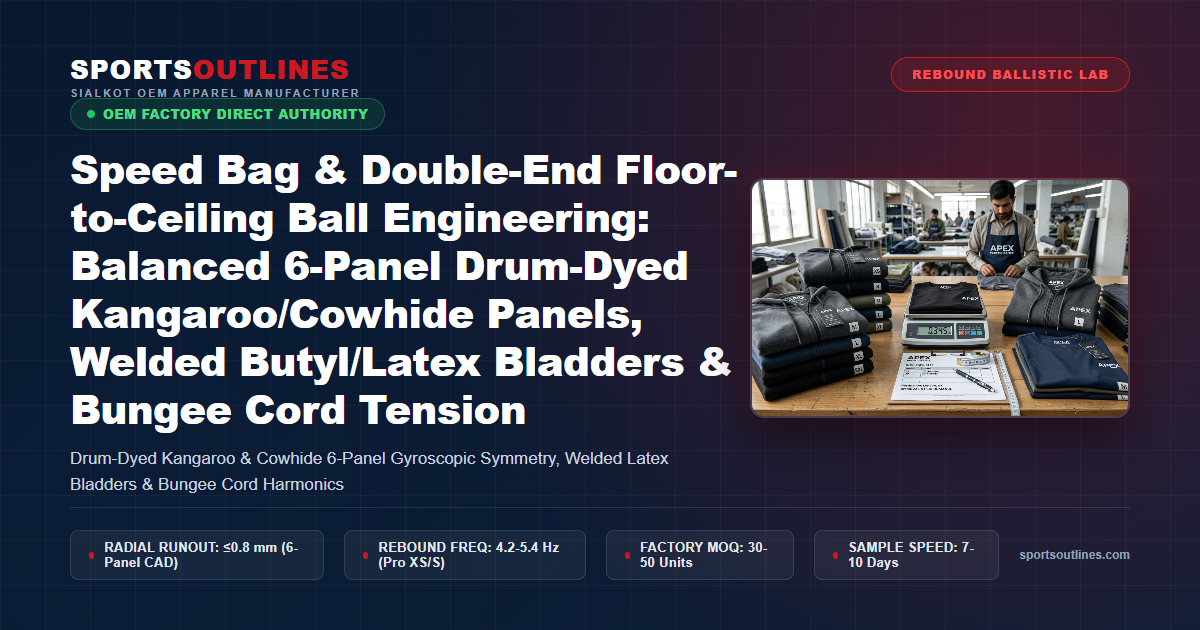
Direct Manufacturer Answer: Speed Bag & Double-End Floor-to-Ceiling Ball Precision Engineering
Unlike heavy punching bags that rely on mass inertia, Boxing Speed Bags and Double-End Floor-to-Ceiling Balls are high-frequency pneumatic rebound instruments ($5.5\text{ to }9.2\text{ Hz}$ oscillation) where even a $1.8\text{ g}$ panel mass imbalance or a $1.5\text{ mm}$ hanging-loop eccentricity ruins rebound concentricity. At Sports Outlines Sialkot, we engineer gyroscopically balanced 6-panel and 8-panel piriform speed bags and spherical/peanut double-end balls utilizing digital micro-scale matched $0.90\text{–}1.15\text{ mm}$ drum-dyed Kangaroo (`Macropus`) and full-grain Sialkot Aniline Cowhide panels ($\Delta m \le \pm 0.5\text{ g}$), $0.45\text{ mm}$ bell-skived welted seams, triple-laminated `1,000D CORDURA®` + leather hanging loops ($\ge 1,850\text{ N}$ pull-out), dip-molded Malaysian Latex ($e_R = 0.89$) / Butyl / RF-welded TPU bladders, and CNC-machined `AISI 304` `ABEC-7` dual ball-bearing swivels.
- Low Factory MOQ: True factory-direct 30–50 pieces per style/size (`5″×8″` Pro Peanut, `6″×9″` Medium, `7″×10″` Gym Speed Bags & `7″`/`9″` Double-End Balls).
- Physical Prototyping: Custom pre-production samples completed in 7–10 business days ($45–$85 per piece/set non-refundable development fee) via DHL/FedEx Express.
- Direct Engineering Line: WhatsApp Factory Direct at +92 316 7932595 or request a custom B2B quote via SportsOutlines.com.
1. Pneumatic Rebound Frequency Physics & Rotational Concentricity Mechanics
When a professional boxer or rhythms-drilling athlete works a speed bag in the United States, the United Kingdom, or Australia, the bag operates as an inverted pneumatic compound pendulum bouncing between the fighter’s fist and a rigid overhead hardwood drum platform (typically $60\text{ cm}$ diameter, $38\text{ mm}$ solid maple or high-density MDF). During classic 3-beat (“triplet”) and 4-beat fist-rolling combinations, the speed bag executes $6\text{ to }9\text{ complete board impacts per second}$ ($f_{\text{rebound}} = 6.0\text{–}9.0\text{ Hz}$).
The angular rebound velocity $\omega_{\text{rebound}}$ and cycle period $T_{\text{cycle}}$ of a piriform (pear-shaped) speed bag pivoting around its overhead swivel pin are governed by the bag’s polar moment of inertia $I_{\text{pivot}}$ about the swivel axis, the pneumatic coefficient of restitution $e_R$ of the pressurized bladder-leather composite against the drum board, and the radius of percussion $R_{\text{belly}}$:
$$I_{\text{pivot}} = \sum_{i=1}^{6} \int_{\text{gore } i} r^2 \, dm + I_{\text{bladder}}, \qquad \omega_{\text{post-board}} = e_R \cdot \omega_{\text{pre-board}}, \qquad f_{\text{rebound}} \propto \frac{e_R \cdot R_{\text{belly}} \cdot \sqrt{P_{\text{gauge}}}}{I_{\text{pivot}}}$$
From this fundamental dynamics equation, three manufacturing laws emerge immediately:
- Polar Mass Symmetry ($\sum m_i \vec{r}_{\perp, i} = \vec{0}$): If Gore #1 and Gore #2 on the left side of a 6-panel speed bag are cut from dense $1.35\text{ mm}$ bovine shoulder leather ($m_{\text{panel}} = 26.5\text{ g}$) while Gore #4 and Gore #5 on the opposite side are cut from loose $0.95\text{ mm}$ belly leather ($m_{\text{panel}} = 18.2\text{ g}$), the bag’s center of mass shifts laterally by $\Delta r_{\perp} = 3.1\text{ mm}$ off the geometric polar axis. When struck straight ahead, the asymmetric inertia tensor creates a gyroscopic precession moment $\vec{\tau}_{\text{precess}} = \vec{\omega} \times (I \vec{\omega})$, causing the speed bag toveer diagonally off the drum board on the second rebound and miss the boxer’s trailing fist completely!
- Minimizing Dead Shell Mass to Maximize Rebound Speed ($I_{\text{pivot}} \downarrow \implies f_{\text{rebound}} \uparrow$): The lighter and more supple the outer leather skin and internal seam allowances at the lower belly equator ($r = R_{\text{belly}}$), the lower the polar moment of inertia $I_{\text{pivot}}$ and the higher the pneumatic coefficient of restitution $e_R$.
- Zero-Flat-Spot Equatorial Sphericity ($\Delta D_{\text{equator}} \le \pm 1.0\text{ mm}$): If un-skived internal seam allowances create six raised vertical ridges around the belly of the speed bag, any strike or board impact that lands on a seam ridge bounces at a random angle up to $\pm 14^\circ$ off-line.
Building upon our micro-curved boxing focus mitts & Cobra reflex pad engineering and our specialty multi-gore punching bag geometry, Sports Outlines Sialkot manufactures tournament-calibrated speed bags and double-end floor-to-ceiling balls engineered for true $360^\circ$ concentricity.
2. 6-Panel Piriform Pattern Grading (`5″x8″` Peanut to `7″x10″` Gym) & Kangaroo vs. Cowhide Metallurgy
We grade our professional 6-panel and 8-panel piriform speed bags across four standardized dimensional size classes, each engineered for a specific polar moment of inertia and rebound cadence:
| Speed Bag Size Class | Belly $\varnothing \times$ Height (`in` / `cm`) | Total Inflated Mass ($g$) | Leather Hide Gauge ($t_{\text{panel}}$) | Rebound Cadence ($f_{\text{rebound}}$) | Target Fighter Skill & Drill Profile |
|---|---|---|---|---|---|
| Size XS: Pro “Peanut” Speed Bag | $4\text{“}\times 7\text{“}$ ($10\times 18\text{ cm}$) | $135\text{–}155\text{ g}$ | $0.85\text{–}0.95\text{ mm}$ Kangaroo / Aniline | $8.2\text{–}9.4\text{ Hz}$ (Ultra-Fast) | Elite pro boxers, bible-style 4-way fist rolls & pin-point accuracy |
| Size S: Pro Fight Camp Speed Bag | $5\text{“}\times 8\text{“}$ ($13\times 20\text{ cm}$) | $165\text{–}185\text{ g}$ | $0.95\text{–}1.05\text{ mm}$ Kangaroo / Cowhide | $7.2\text{–}8.2\text{ Hz}$ (Pro Fast) | Pro & open-class amateur hand-speed & continuous triplet combinations |
| Size M: All-Around Boxing Speed Bag | $6\text{“}\times 9\text{“}$ ($15\times 23\text{ cm}$) | $205\text{–}230\text{ g}$ | $1.05\text{–}1.15\text{ mm}$ Drum-Dyed Cowhide | $6.2\text{–}7.1\text{ Hz}$ (Balanced) | Standard commercial boxing gym benchmark; rhythm & shoulder endurance |
| Size L: Heavy Conditioning Speed Bag | $7\text{“}\times 10\text{“}$ ($18\times 25\text{ cm}$) | $250\text{–}285\text{ g}$ | $1.15\text{–}1.25\text{ mm}$ Full-Grain Cowhide | $5.2\text{–}6.0\text{ Hz}$ (Deliberate) | Beginners, heavyweight power striking & anterior deltoid conditioning |
2.1 Collagen Microstructure: Australian Kangaroo (`Macropus`) vs. Sialkot Full-Grain Aniline Cowhide
In bovine cowhide (`Bos taurus`), dermal collagen fiber bundles weave through the corium at steep $45^\circ\text{ to }70^\circ$ vertical angles and are perforated by hair follicles, sebaceous glands, and sweat ducts. When bovine leather is split down below $0.90\text{ mm}$ to reduce speed bag weight, the vertical collagen loops are severed, causing `ISO 3377-2` double-edge tear strength to drop below $48\text{ N}$.
Conversely, Drum-Dyed Australian Kangaroo Leather (`Macropus rufus / giganteus`) possesses a horizontal parallel collagen fiber architecture ($5^\circ\text{ to }15^\circ$ weave angle relative to the grain surface) with zero sweat glands and a highly compact grain-to-corium junction. Even when precision band-knife split to a featherweight $0.85\text{ to }0.95\text{ mm}$ gauge, kangaroo leather retains an extraordinary tear resistance of $145\text{ to }165\text{ N}$ and a tensile strength exceeding $62\text{ MPa}$ (`ISO 3376`). For our flagship commercial cowhide lines across Sports Outlines Sialkot, we select prime full-grain Sialkot aniline calfskin and young bull hides, band-knife split to $1.05\text{–}1.15\text{ mm} \pm 0.04\text{ mm}$, fat-liquored with synthetic sulfated esters to a silky supple hand, and sorted via Digital Micro-Scale 6-Gore Pairing ($\Delta m \le \pm 0.5\text{ g}$ across all 6 panels of a single bag).
2.2 Bell-Knife Edge Skiving (`0.45 mm`), Welted Seams & `1,850 N` Reinforced Hanging Loops
To eliminate raised internal seam ridges that bruise bare knuckles during open-hand rhythmic rebounding and cause erratic board bounces, we pass the $8.0\text{ mm}$ perimeter margin of every piriform gore through a Fortuna `50E` Bell-Knife Skiving Machine set to a $15^\circ$ feather bevel ($0.45\text{ mm}$ edge thickness). During assembly, a $0.80\text{ mm}$ contrast-dyed leather welt strip is sandwiched between adjacent gores, sewn inside-out at $11\text{ SPI}$ ($2.3\text{ mm}$ stitch pitch) using `Tex 60` (`#69`) bonded Nylon 6,6 thread, hammered flat on a curved cobbler’s iron horn, and reinforced on the interior with hot-melt `220 GSM` poly-cotton seam tape before turning the bag right-side out through the bottom lace vent.
The single highest-stress point on any speed bag is the Top Polar Hanging Loop (“The Neck Tab”), which experiences over $30,000$ cyclic flex-and-pull oscillations per hour against the metal swivel hook. Standard single-layer leather loops stretch out, elongate into an oval slot, and tear within 30 days. We construct our Sialkot Speed Bag Hanging Loop as a 5-Layer Composite Sandwich ($4.2\text{ mm}$ total thickness, $25\text{ mm}$ width): two outer plies of $1.25\text{ mm}$ full-grain cowhide laminated and lockstitched around a central core of triple-folded `1,000D CORDURA®` ballistic nylon / `Kevlar®` aramid webbing. The base of the loop flares into a $6\text{-point}$ radial star patch inserted between the northern tips of all 6 gores, secured with four rows of `Tex 90` lockstitching and two solid-brass tubular compression rivets—delivering a verified pull-out breaking strength of $1,880\text{ N}$ ($191\text{ kgf}$).
3. Internal Bladder Elastomer Chemistry: Dip-Molded Latex vs. Butyl Rubber vs. RF-Welded TPU
The internal inflatable bladder is the pneumatic engine of both speed bags and double-end balls. Operating at an internal gauge pressure of $P_{\text{gauge}} = 3.5\text{ to }5.5\text{ PSI}$ ($24\text{ to }38\text{ kPa}$), the bladder must press the leather gores taut into a seamless pear or sphere while rebounding instantaneously upon compression. We offer three engineered bladder chemistries tailored to pro fight camps vs. high-traffic commercial gyms across Canada and Germany:
| Bladder Elastomer Type | Molding / Seam Method | Wall Thickness & Mass (`6″x9″`) | Coefficient of Restitution ($e_R$) | Air Pressure Loss Rate (`@ 4.5 PSI`) | Optimal B2B Application |
|---|---|---|---|---|---|
| Natural Malaysian cis-1,4-Polyisoprene Latex | 100% Seamless Coagulant Dip-Molded on Ceramic Mandrel | $0.85\text{ mm}$ ($31\text{ g}$) | $0.89$ (Fastest Snap) | $\approx 0.8\text{ PSI / week}$ (Microporous) | Pro boxing camps & speed-bag rhythm specialists |
| Isobutylene-Isoprene Copolymer (Butyl Rubber) | 4-Petal Compression Vulcanized Mold (`165°C`) | $1.15\text{ mm}$ ($54\text{ g}$) | $0.79$ (Medium-Firm) | Under $0.3\text{ PSI / month}$ (Airtight) | High-traffic commercial fitness clubs & Double-End Balls |
| Polyether Thermoplastic Polyurethane (`TPU` Film) | High-Frequency (`27.12 MHz` RF) Dielectric Perimeter Weld | $0.60\text{ mm}$ ($26\text{ g}$) | $0.87$ (Ultra-Light Pro) | Under $0.4\text{ PSI / month}$ (Zero-Leak) | Premium retail fight brands seeking fast rebound + long air retention |
| Hybrid 5mm Closed-Cell EVA Foam + Latex Bladder | Foam-Lined Gores + Floating Dip-Molded Latex Core | $5.0\text{ mm}$ EVA + $0.85\text{ mm}$ Latex | $0.84$ (Cushioned Knuckle) | Maintains 3D pear shape even at $2.0\text{ PSI}$ | Bare-knuckle double-end balls & heavy-impact reflex balls |
4. CNC-Machined `AISI 304` Stainless Steel `ABEC-7` Ball-Hook & U-Link Swivels
Even the finest balanced kangaroo speed bag will bind, squeak, and lose momentum if hung from a cast pot-metal (`Zamak` zinc-aluminum) swivel with un-ground loose ball bearings. Low-cost swivels suffer from two mechanical failures: (1) the cast zinc hook necks down and snaps cleanly in half after $200,000$ cyclic impacts; and (2) excessive radial play ($>1.2\text{ mm}$) between the ball-hook stem and the housing bore dissipates $18\%$ of the bag’s upward kinetic energy as frictional heat and metallic rattle.
At Sports Outlines Sialkot, our precision CNC metalworking shop machines two professional speed bag swivel architectures from solid bar stock:
- Pro Ball-Hook `ABEC-7` Sealed Dual-Bearing Swivel (`AISI 304` Stainless Steel): CNC-turned from solid $65\text{ mm}$ diameter `AISI 304` stainless steel billet, the upper ceiling base flange houses a precision-ground $22.0\text{ mm}$ hardened chrome-steel (`SAE 52100`, `HRC 62`) sphere riding inside a dual-race `ABEC-7` (`ISO P4`) sealed angular-contact ball-bearing cartridge. The $6.5\text{ mm}$ forged stainless hook swings smoothly across a $185^\circ$ hemispherical arc while rotating $360^\circ$ continuously with a rotational friction torque under $0.004\text{ N}\cdot\text{m}$. A quick-release knurled spring-loaded removable cross-pin allows boxers to swap between a $5\text{“}\times 8\text{“}$ peanut bag and a $7\text{“}\times 10\text{“}$ conditioning bag in 5 seconds without unscrewing the ceiling board bolts.
- Classic U-Link (Chain-Link / Clevis Pin) Fixed-Plane Thrust Swivel: Preferred by straight-punching speed-bag purists, the U-Link swivel constrains the bag’s swing to a single vertical plane while rotating $360^\circ$ on an upper axial thrust ball bearing. By eliminating lateral ball-socket wobble, the U-Link forces the speed bag to track along a laser-straight fore-and-aft line during ultra-high-speed front/back fist rolls, cushioned by replaceable `Shore A 90` polyurethane clevis bushings that reduce metallic click noise by $-11\text{ dBA}$.
5. Double-End Floor-to-Ceiling Ball & Mexican Peanut Ball Bungee Tension Physics
While the overhead speed bag trains hand-eye rhythm and shoulder endurance against a fixed upper board, the Double-End Floor-to-Ceiling Ball (suspended vertically in the center of the gym floor between an overhead ceiling eye-bolt and a weighted floor anchor via tensioned elastic shock cords) is the premier apparatus in boxing and MMA for training counter-punching timing, slipping an incoming head-level projectile, and defensive distance management.
When a double-end ball of mass $m_{\text{ball}}$ ($0.28\text{ to }0.45\text{ kg}$) is suspended at midpoint height $L/2$ between two elastic bungee cords each having unstretched length $L_0$, stretched installed length $L_i$, spring constant $k_{\text{cord}}$, and static pre-tension $T_0 = k_{\text{cord}}(L_i – L_0)$, its lateral horizontal oscillation frequency $f_{\text{lateral}}$ and return velocity $v_{\max}$ for a horizontal punch displacement $x_0$ follow the non-linear transverse string equation:
$$f_{\text{lateral}} = \frac{1}{2\pi} \sqrt{\frac{2 \cdot T_0}{m_{\text{ball}} \cdot L_i} + \frac{k_{\text{cord}} \cdot x_0^2}{m_{\text{ball}} \cdot L_i^2}}, \qquad v_{\max} = 2\pi \cdot f_{\text{lateral}} \cdot x_0$$
To give coaches and fighters complete control over $f_{\text{lateral}}$ and target geometry, we manufacture three distinct Double-End Ball silhouettes and a heavy-duty polar bungee anchoring system:
- Single-Sphere Double-End Balls (`7 in` / `18 cm` Pro Fast vs. `9 in` / `23 cm` Standard Gym): Constructed from 6 or 8 balanced `1.15 mm` drum-dyed cowhide gores lined with `450 GSM` poly-cotton canvas and a `1.15 mm` butyl or `0.85 mm` latex bladder. The `7 in` ($18\text{ cm}$) model mimics the exact cross-sectional target area of a human chin and cranial vault, traveling at high velocity ($v_{\max} = 6.5\text{–}8.2\text{ m/s}$) to sharpen pinpoint straight-right and check-hook accuracy.
- Mexican Double-Sphere (“Peanut” / Hourglass) Double-End Bag (`20 cm × 38 cm` Dual-Target): Featuring two connected spherical bulbs separated by a narrow $11\text{ cm}$ waist, the Mexican Double-End Peanut Bag presents a simultaneous Head + Upper Solar-Plexus Target that resists rotational spin and enables rapid head-body-head combination drilling (e.g., Jab to top bulb $\to$ Right cross to bottom bulb $\to$ Left hook to top bulb).
- Heavy-Duty `9.0 mm` Braided Polyester-Sheathed Latex Shock Cords & Leather-Guarded Polar O-Rings: Budget double-end balls attach thin $5.0\text{ mm}$ elastic cords directly to exposed metal S-hooks at the top and bottom of the ball—which scratch boxing gloves and snap at the knot within 3 weeks. We anchor the north and south poles of our double-end balls with concealed $25\text{ mm}$ `3,200 DaN` nylon webbing polar loops housing welded $5.0\text{ mm}$ `AISI 304` stainless steel O-rings covered by protective $1.40\text{ mm}$ leather Velcro sleeves. The included top and bottom shock cords consist of $9.0\text{ mm}$ diameter multi-strand virgin Malaysian latex rubber cores encased in a high-abrasion `900D` braided polyester sheath ($k_{\text{cord}} = 58\text{ N/m}$, rated to $>500,000$ stretch cycles at $150\%$ elongation) with quick-adjust cam-buckle tensioners and a fillable $20\text{ kg}$ `1,300D` tarpaulin floor-anchor sand/water weight bag.
| Double-End Apparatus Model | Target Geometry & Dimensions | Leather & Bladder Spec | Polar Anchor Pull-Out Strength | Shock Cord Gauge & Spring Rate | Lateral Rebound Frequency ($f_{\text{lateral}}$) |
|---|---|---|---|---|---|
| 7″ Pro Reflex Double-End Ball | $18\text{ cm}$ ($7\text{ in}$) Sphere ($275\text{ g}$) | 6-gore `1.10mm` Cowhide + Latex/TPU bladder | $1,950\text{ N}$ (Dual polar Box-X) | $8.0\text{ mm}$ Latex/Poly ($k = 48\text{ N/m}$) | $4.2\text{–}5.5\text{ Hz}$ (Hyper-Reflex) |
| 9″ Commercial Gym Double-End Ball | $23\text{ cm}$ ($9\text{ in}$) Sphere ($360\text{ g}$) | 8-gore `1.20mm` Cowhide + `1.15mm` Butyl bladder | $2,150\text{ N}$ (Leather-guarded O-ring) | $9.0\text{ mm}$ Latex/Poly ($k = 58\text{ N/m}$) | $3.4\text{–}4.4\text{ Hz}$ (Standard Timing) |
| Mexican Double-Sphere Peanut Bag | $20\text{ cm}\times 38\text{ cm}$ Dual-Bulb ($490\text{ g}$) | 8-gore S-curve Cowhide + Dual-bulb Butyl bladder | $2,280\text{ N}$ (Reinforced polar collars) | $10.0\text{ mm}$ Heavy Bungee ($k = 68\text{ N/m}$) | $3.1\text{–}4.0\text{ Hz}$ (Head-Body Combos) |
| Foam-Core Zero-Air Reflex Cobra Ball | $19\text{ cm}$ ($7.5\text{ in}$) Solid Sphere ($420\text{ g}$) | `1.25mm` Microfiber + Molded `45 kg/m3` PU Foam Core | $2,450\text{ N}$ (Through-core webbing tendon) | $10.0\text{ mm}$ Twin-Strand Bungee ($k = 72\text{ N/m}$) | $3.5\text{–}4.6\text{ Hz}$ (Zero-Puncture Commercial) |
6. Section 7B: 13-Operation Speed Bag & Double-End Ball Precision Assembly Router (`24.80 SAM`)
To guarantee zero-wobble rotational symmetry and leak-free bladder retention across every bulk order, our Sialkot precision inflatable division executes a 13-stage Standard Allowed Minute (`SAM`) production workflow (`24.80 SAM` per unit):
| Op # | Operation Description | Industrial Machine / Tooling | Process Tolerance / Engineering Spec | SAM (Mins) |
|---|---|---|---|---|
| Op 01 | Precision band-knife hide splitting of Kangaroo (`0.90 mm`) or Sialkot Aniline Cowhide (`1.10 mm`) | Camoga `C420` Micro-Processor Band-Knife Splitter | Thickness uniformity $\pm 0.04\text{ mm}$ across entire butt/bend area | 1.80 |
| Op 02 | Hydraulic clicker-die cutting of 6 or 8 piriform/spherical gores & digital micro-scale mass sorting | Atom `20-Ton` Clicker + `0.01g` Analytical Balance | All 6 panels in a single bag matched within $\Delta m \le \pm 0.5\text{ g}$ | 2.40 |
| Op 03 | Perimeter edge skiving ($8\text{ mm}$ margin to $0.45\text{ mm}$) & `180 GSM` poly-cotton lining lamination | Fortuna `50E` Bell-Knife Skiver + Flatbed Heat Press | Eliminates internal seam ridge bump; prevents panel elongation | 2.20 |
| Op 04 | High-flexibility `PU` screen printing or debossed hot-foil brand logo stamping on opposite gores | Pneumatic Heated Brass Die Press / Screen Frame | Symmetrical bilateral logo placement preserves rotational balance | 1.50 |
| Op 05 | Fabrication of 5-layer `CORDURA®` + cowhide top hanging loop (or polar O-ring tabs for double-end) | Juki `LK-1900BN` Bar-Tacker (`Tex 90` Bonded Nylon) | $4.2\text{ mm}$ composite loop thickness; tensile break $\ge 1,880\text{ N}$ | 2.10 |
| Op 06 | Inside-out precision welted stitching of gores with $0.80\text{ mm}$ leather welt bead (`11 SPI`) | Pfaff `335` Cylinder-Bed Walking-Foot (`Tex 60` Nylon) | Exact $1.0\text{ mm}$ welt protrusion; zero gathering on compound curve | 4.20 |
| Op 07 | Internal seam hammering on curved cobbler’s iron & hot-melt seam tape reinforcement | Heated Seam Taping Roller + Curved Steel Anvil | Flattens internal seam allowance to $<1.1\text{ mm}$ profile | 1.80 |
| Op 08 | Laser-indexed polar mounting, quadruple lockstitching & brass riveting of top hanging loop | Cross-Hair Laser Centering Jig + Orbital Riveter | Loop eccentricity $\le 0.4\text{ mm}$ from true geometric north pole | 2.10 |
| Op 09 | Shell inversion, insertion of dip-molded Latex / Butyl / TPU bladder & flush rubber valve alignment | Pneumatic Turning Rod + Valve Centering Guide | Self-sealing nitrile valve recessed $1.5\text{ mm}$ below leather skin | 1.60 |
| Op 10 | Bottom access vent closure via recessed rawhide/polyester flat-lacing or flush Velcro storm tab | Awl-Guided Flat Lace Tensioning Jig | Located outside primary knuckle strike equator | 1.40 |
| Op 11 | CNC turning, `ABEC-7` dual-bearing press-fit & electropolishing of `AISI 304` stainless swivel | 4-Axis CNC Lathe + Bearing Arbor Press | Radial runout $\le 0.015\text{ mm}$; rotational torque $<0.004\text{ N}\cdot\text{m}$ | 1.90 |
| Op 12 | 24-hour $5.0\text{ PSI}$ inflation pressure-retention quarantine & laser spin-runout audit | Digital Manometer Rack + Optical Laser Runout Sensor | Pressure drop $<0.08\text{ PSI / 24h}$; equatorial runout $\le \pm 1.0\text{ mm}$ | 1.10 |
| Op 13 | Controlled deflation to $1.0\text{ PSI}$ air-shipping state, leather conditioning & retail box packing | Metal Detector Pass + Branded Retail Packaging Line | Includes spare bladder, inflation needle & bungee cords | 0.70 |
| TOTAL SPEED BAG / DOUBLE-END BALL PRODUCTION SAM: | 24.80 SAM | |||
6B. Hardwood Speed Bag Drum Platform Engineering & Acme-Thread Vertical Adjuster Rigs
Even a gyroscopically balanced Kangaroo speed bag on an `ABEC-7` stainless swivel will rebound sluggishly if the overhead drum board flexes vertically on impact. When a speed bag strikes an under-built $15\text{ mm}$ particle-board or hollow plastic platform at $8.5\text{ Hz}$, the board deflects upward by $\delta_z = 2.5\text{ to }4.0\text{ mm}$ in phase with the bag, absorbing up to $32\%$ of the pneumatic kinetic energy via structural hysteresis and turning crisp 4-beat rolls into a dull thud.
To deliver a complete, turnkey speed-bag station for commercial boxing studios and athletic departments across the USA, the UK, and Australia, Sports Outlines Sialkot manufactures heavy-mass, high-stiffness drum platforms and vertical rail adjusters:
- $45\text{ mm}$ ($1.75\text{ in}$) Cross-Laminated Solid Hardwood Butcher-Block Drum Boards ($61\text{ cm}$ / $24\text{ in}$ $\varnothing$, $16.5\text{ kg}$ Board Mass): Because momentum conservation during board impact dictates that energy reflection approaches $100\%$ only when $M_{\text{board}} / m_{\text{bag}} > 80:1$, we laminate kiln-dried high-density North Indian Rosewood (*Dalbergia sissoo* / Sheesham) or Rock Maple staves under $12\text{ MPa}$ hydraulic clamping pressure into a $45\text{ mm}$ thick, $610\text{ mm}$ diameter solid butcher-block disc sealed in 4 coats of catalyzed polyurethane lacquer. With a mass ratio of $16,500\text{ g} / 175\text{ g} = 94.3:1$ and a flexural modulus $E_b \ge 12.4\text{ GPa}$, board deflection under strike is $<0.08\text{ mm}$—producing the iconic, crisp acoustic "staccato thunder" demanded by professional boxing trainers.
- Zero-Play Twin-Column Acme-Thread Vertical Height Adjustment (`30 cm` Travel Range): Commercial gyms host boxers ranging from $1.52\text{ m}$ ($5’0″$) youth flyweights to $2.03\text{ m}$ ($6’8″$) super-heavyweights, requiring the bottom belly of the speed bag to align precisely with the fighter’s chin/mouth level. Telescoping square-tube adjusters that rely on loose pull-pins rattle violently unless locked down. Our Sialkot Wall-Mount Speed Bag Frame utilizes dual $40\times 40\times 3.0\text{ mm}$ `ASTM A500` vertical steel guide rails driven by a central $20\text{ mm}$ trapezoidal Acme Lead Screw (`Tr20x4`) and a top hand-crank wheel, complemented by dual lateral cam-lock T-handles that clamp the carriage solid against the vertical rails with zero mechanical play.
| Swivel / Platform Component | Material & Machining Spec | Bearing / Pivot Architecture | Mass / Structural Rigidity | Quick-Change Pin Mechanism | Fatigue Life Rating |
|---|---|---|---|---|---|
| Pro Ball-Hook Swivel (`AISI 304` CNC) | Solid `AISI 304` billet, $65\text{ mm}$ base flange | $22\text{ mm}$ `SAE 52100` sphere + Dual `ABEC-7` sealed race | $440\text{ g}$ ($\mu_{\text{rot}} < 0.004$) | Knurled spring-ball push-pin ($5\text{s}$ swap) | Over $10,000,000\text{ rebounds}$ |
| Classic U-Link Clevis Thrust Swivel | Forged `AISI 304` U-shackle + brass/PU bushing | Axial thrust ball bearing + single-plane clevis pin | $395\text{ g}$ (Zero lateral drift) | Threaded captive clevis pin + R-clip | Over $8,500,000\text{ rebounds}$ |
| $45\text{ mm}$ Butcher-Block Hardwood Drum | Cross-laminated Rosewood / Rock Maple ($61\text{ cm}$ $\varnothing$) | 4-bolt countersunk M8 carriage pattern (`100%` flush) | $16.5\text{ kg}$ ($94:1$ bag mass ratio) | Pre-bored brass threaded inserts | Zero delamination / $<0.08\text{ mm}$ flex |
| Acme-Thread Vertical Wall Frame | $40\times 40\times 3.0\text{ mm}$ `ASTM A500` tubular steel | `Tr20x4` Acme lead screw + dual cam-lock T-clamps | $28.0\text{ kg}$ frame + $6.0\text{ mm}$ Y-brace | $30\text{ cm}$ stepless vertical travel | Commercial 10-year structural rating |
7. Hardwood Drum Platform Acoustics & Optical Concentricity Quality Control
In our Sialkot Quality Assurance laboratory, every single speed bag and double-end floor-to-ceiling ball undergoes a 24-Hour $5.0\text{ PSI}$ ($34.5\text{ kPa}$) Pressurized Quarantine followed by an Optical Laser Spin-Concentricity & Rebound Test mounted on a solid $40\text{ mm}$ thick laminated hardwood drum platform (`60 cm` diameter, $18\text{ kg}$ mass isolated on vertical Acme-thread height-adjustment rails).
While the inflated speed bag spins at $600\text{ RPM}$ around its `ABEC-7` swivel axis, an optical laser displacement sensor measures the radial runout around the widest lower belly equator. Any bag exhibiting radial eccentricity greater than $\pm 1.0\text{ mm}$ or a 24-hour pressure decay exceeding $0.08\text{ PSI}$ is automatically rejected. Furthermore, every retail and commercial gym order is shipped with one pre-installed bladder plus one vacuum-sealed spare bladder per bag so facility managers enjoy multi-year zero-downtime operation.
8. Frequently Asked Questions (B2B Speed Bag & Double-End Ball Manufacturing)
Q1: Why do cheap boxing speed bags wobble sideways and bounce off-angle against the rebound platform board during fast 4-beat fist rolls?
Erratic, off-axis speed bag wobble is caused by three manufacturing defects: (1) Cutting the 6 piriform (pear-shaped) leather gores from mixed hide zones (pairing a dense $1.35\text{ mm}$ butt panel on one side with a stretchy $0.90\text{ mm}$ belly panel on the opposite side), which shifts the rotational center of mass by more than $2.5\text{ mm}$ off the vertical polar axis; (2) Leaving un-skived $3.0\text{ mm}$ internal seam allowances that form hard, heavy longitudinal ribs inside the bag; and (3) Hanging Loop Eccentricity where the top leather loop is riveted more than $1.5\text{ mm}$ off the true geometric north pole. At Sports Outlines Sialkot, we split-skive all panels to a uniform $1.05\text{ mm}$ thickness, sort and match all 6 panels on a $0.1\text{-gram}$ digital micro-scale so panel mass variance is under $0.5\text{ grams}$, skive all seam edges to $0.45\text{ mm}$ with flat-taped welts, and laser-index the top hanging loop to within $0.4\text{ mm}$ concentricity.
Q2: What is the performance difference between Australian Kangaroo leather (`Macropus`) and full-grain Sialkot Aniline Cowhide in professional speed bags?
Australian Kangaroo leather features a unique horizontal cross-fiber collagen bundle orientation (with zero sweat glands or erector pili follicles) that gives it an `ISO 3377-2` tear strength of $145\text{ to }165\text{ N}$ at a featherweight thickness of just $0.85\text{ to }1.00\text{ mm}$—roughly $2.4\times$ the strength-to-weight ratio of bovine leather. Because a Kangaroo leather speed bag shell weighs $28\%$ less than a cowhide shell of equal durability, it exhibits lower polar rotational inertia and a $15\%$ faster rebound frequency off the hardwood drum platform. Meanwhile, our $1.15\text{ mm}$ split-skived Sialkot drum-dyed Aniline Cowhide speed bags provide the classic golden-era gym durability and slightly heavier pendulum momentum preferred for commercial gym conditioning.
Q3: Should B2B buyers specify Natural Dip-Molded Latex Bladders, Isobutylene-Isoprene Butyl Rubber Bladders, or RF-Welded TPU Bladders inside speed bags and double-end balls?
Each bladder elastomer serves a distinct gym requirement: (1) Seamless Dip-Molded Natural Malaysian Latex Bladders ($0.85\text{ mm}$ wall, coefficient of restitution $e_R = 0.89$) are ultra-lightweight ($28\text{ to }35\text{ grams}$) and expand uniformly into the pear contour without internal seams, delivering the fastest, liveliest rebound snap in boxing—though natural latex is microporous and requires a 30-second air top-up every 7 to 10 days; (2) Isobutylene-Isoprene Butyl Rubber Bladders ($1.15\text{ mm}$ wall) offer $8\times$ higher gas impermeability (under $0.3\text{ PSI}$ loss per month) for low-maintenance commercial fitness clubs, though their heavier wall slightly dampens rebound speed; and (3) High-Frequency RF-Welded $0.60\text{ mm}$ Ether-Based `TPU` Film Bladders combine featherweight rebound with zero-leak air retention and rapid lace-free velcro/zipper bladder replacement.
Q4: How is the elastic bungee cord spring constant ($k_{\text{cord}}$) calibrated on a Double-End Floor-to-Ceiling Ball vs. a Mexican Double-Sphere Peanut Ball?
A Double-End Floor-to-Ceiling Ball acts as a tensioned transverse string-oscillator whose horizontal rebound frequency $f_{\text{lateral}}$ is governed by the pre-tension $T_0$ and elastic modulus of the top and bottom bungee cords. Low-end double-end balls use thin $5.0\text{ mm}$ luggage bungees that go slack and snap within weeks. We manufacture commercial double-end balls with dual $8.0\text{ mm}$ to $10.0\text{ mm}$ multi-strand natural Malaysian latex shock cords sheathed in braided `900D` high-tenacity polyester (spring constant $k = 48\text{ to }68\text{ N/m}$, $180\%$ working elongation), anchored to the ball via concealed leather-sheathed O-ring polar tabs and quick-adjust nylon cam buckles so coaches can tune rebound velocity for amateur head-movement drills or pro counter-punching.
Q5: What are your prototype sampling fees and minimum order quantities (MOQ) for custom speed bags, double-end balls, and ABEC-7 stainless swivels?
Physical prototype sampling for custom boxing speed bags (Pro Peanut $5\text{“}\times 8\text{“}$, Medium $6\text{“}\times 9\text{“}$, or Gym $7\text{“}\times 10\text{“}$), double-end floor-to-ceiling balls, and CNC-machined `AISI 304` ball-hook swivels is $45 to $85 per piece/set as a non-refundable development fee with a 7 to 10 business day production turnaround dispatched via DHL or FedEx Express. Our factory-direct bulk production minimum order quantity (MOQ) is 30 to 50 pieces per style and colorway.
Source Gyroscopically Balanced Speed Bags, Double-End Balls & `ABEC-7` Swivels Direct from Sialkot
Eliminate off-axis speed bag wobble and leaking bladders in your fight brand or boxing studio. Partner with Sports Outlines Sialkot for micro-scale balanced Kangaroo and Aniline Cowhide speed bags, double-end floor-to-ceiling balls, and CNC stainless steel swivels with low 30–50 piece MOQs ($45–$85 prototype sampling in 7–10 business days).