In the technical outerwear industry, the difference between a commercially viable outdoor apparel brand and a failed venture rarely hinges on design aesthetic alone. It is determined by rigorous Production Cost Engineering, Time-Motion Economics, and Industrial Line Balancing. While standard fashion garments (such as cotton t-shirts or basic denim) follow predictable linear sewing assembly workflows, building a 3-layer waterproof mountaineering hardshell or stitchless bonded down parka introduces complex non-linear thermal processes: hot-air seam taping, ultrasonic cutting, pneumatic heated-platen welding, and automated vacuum down filling.
Each of these thermal joining operations introduces unique machine cycle times, operator handling constraints, and cooling pauses that create severe production bottlenecks. If a factory line is improperly balanced, seam sealing operators become choked with hundreds of unsealed garments, or expensive automated welding presses sit idle waiting for sewing sub-assemblies. Furthermore, inaccurate calculation of Standard Allowed Minutes (SAM), consumable tape scrap allowances, and hydrostatic quality control overhead can distort unit cost estimates by 20% to 35%, eroding brand gross margins.
Mastering technical outerwear cost engineering requires quantifying every second of operator motion, mapping the mathematical flow of factory lines, and optimizing material yield. At Sports Outlines in Sialkot, Pakistan, our industrial engineering team combines advanced GSD (General Sewing Data) motion analysis, lean modular line balancing, and automated computerized taping suites. We empower performance brands globally with transparent commercial terms: fully customized physical prototype development at $45 to $85 per piece (non-refundable, 7–10 business days turnaround) and scalable low-MOQ bulk manufacturing starting at strictly 30 to 50 pieces per style/colorway with flexible size grading across XS to 3XL.
Outerwear Production Cost Engineering: Technical Directory
- 1. Industrial Engineering & Standard Allowed Minutes (SAM) Breakdown
- 2. The Seam Sealing Bottleneck & Line Balancing Mathematics
- 3. Machine Cycle Time Modeling: Hot-Air, Ultrasonic & Platen Press
- 4. Consumable Material Costing: Seam Tape, TPU Films & Scrap Yield
- 5. Multi-Stage In-Line Quality Control (AQL 1.0) & Defect Cost Escalation
- 6. Comprehensive Outerwear Cost Engineering Matrix
- 7. Sialkot Manufacturing Ecosystem & Direct Factory Cost Efficiency
- 8. Outerwear Tech Pack Costing Architecture & Open-Book BOMs
- 9. Sialkot Lean Modular Production Cells & Precision Tooling
- 10. Low-MOQ Contract Manufacturing & Prototyping Terms
- 11. Technical Sourcing FAQ
1. Industrial Engineering & Standard Allowed Minutes (SAM) Breakdown
In garment manufacturing economics, Standard Allowed Minutes (SAM)—also referred to as Standard Minute Value (SMV)—is the foundational metric that determines direct labor cost, factory capacity allocation, line throughput, and unit pricing. SAM represents the exact time required by a qualified operator working at standard performance (100% pace rating) to execute a specific operation, incorporating standardized allowances for personal fatigue and minor machine delays (PF&D).
SAM = Basic Observed Time × Rating Factor (e.g., 1.10) × (1 + Allowance Factor)
Where Basic Observed Time is derived via predetermined motion-time systems (PMTS), specifically GSD (General Sewing Data). In technical outerwear, the standard PF&D allowance factor is calibrated between 14% and 18% to account for the handling friction of rigid 3-layer laminates, slippery silicone-coated nylon shells, and precision alignment pauses required during waterproof seam taping.
To achieve scientific precision, our industrial engineers utilize General Sewing Data (GSD) and Maynard Operation Sequence Technique (MOST) motion systems. Motion codes evaluate human biomechanics in Time Measurement Units (TMU, where 1 TMU = 0.0006 minutes or 0.036 seconds). In technical outerwear assembly, handling stiff 3-layer laminates and high-tenacity nylon ripstop fabrics involves higher handling difficulty codes than standard apparel. For example, positioning a curved 3D hood crown beneath a hot-air sealing roller requires an initial ‘Get & Place’ motion sequence indexed at 45 TMU (1.62 seconds), followed by continuous micro-alignment pauses averaging 18 TMU per 15 cm of taped seam.
While a standard cotton hoodie requires approximately 18 to 24 SAM, a 3-layer alpine mountaineering hardshell requires an average of 135 to 165 SAM across six major production phases:
- Automated Laser & CNC Cutting (12–16 SAM): Automated vacuum-bed nesting, pattern slicing, Galvo laser underarm perforation, and edge notch marking.
- Component Sub-Assembly & Bonding (22–28 SAM): Thermal welding of chest pocket reverse-coil zippers, ultrasonic slider garage installation, and bonded cuff tab lamination.
- Structural Sewing Assembly (42–52 SAM): Precision lockstitch and 4-thread overlock assembly of raglan sleeves, 3D articulated hood panels, drop-tail hem, and storm collar.
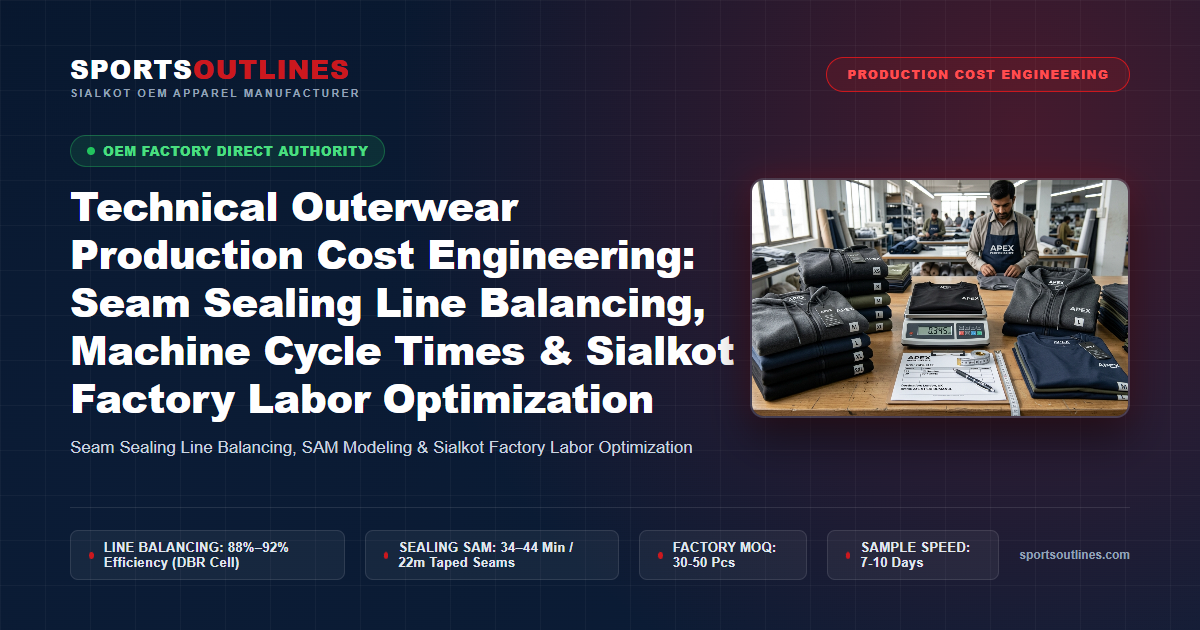
- Hot-Air Seam Sealing & Taping (34–44 SAM): Complete sealing of 18 to 24 linear meters of structural seams, including compound 3D intersections (raglan apex, hood crown, crotch gussets).
- Hardware & Trim Finishing (15–20 SAM): Cohaesive® embedded cord lock installation, elastic shock-cord routing, Velcro hook-and-loop cuff lamination, and center-front zipper insertion.
- In-Line & Final Quality Testing (10–15 SAM): Hydrostatic Suter head spot checking (ISO 811), seam tape peel audits, 100% visual inspection under 1,000 lux illumination, and hangtag packaging.
2. The Seam Sealing Bottleneck & Line Balancing Mathematics
In a technical outerwear production cell, the hot-air seam sealing workstation is the primary bottleneck. Sewing machines operate at high linear speeds (3,500 to 5,000 stitches per minute, translating to 10 to 15 meters of seam sewn per minute). In contrast, a hot-air seam sealing machine operates at a strictly controlled physical speed of 2.5 to 3.8 meters per minute. If feed speed is increased beyond this limit, adhesive dwell time is insufficient, causing catastrophic seam tape delamination under hydrostatic pressure.
Without rigorous line balancing, sewing operators will produce sewn garments four times faster than seam taping operators can seal them, resulting in massive work-in-progress (WIP) accumulation on the factory floor, fabric wrinkling, and extended order lead times. Sports Outlines balances technical lines using lean industrial engineering formulas:
1. Pitch Time (Cycle Time Target): Tpitch = Total Daily Working Time (480 min) / Target Daily Output Units
If the target daily output is 60 jackets per modular cell, the pitch time is: 480 / 60 = 8.0 minutes per jacket.
2. Workstation Quantity Allocation: Nstations = SAMoperation / Tpitch
For a jacket with 40 SAM of seam sealing, the required number of dedicated hot-air taping stations is: 40.0 / 8.0 = 5.0 machines.
For 48 SAM of sewing assembly, the required sewing stations are: 48.0 / 8.0 = 6.0 sewing operators.
3. Balancing Efficiency: Eline = [∑ SAM / (Total Operators × Tpitch)] × 100%
By allocating exactly 5 hot-air taping machines to 6 sewing stations and 3 prep/finishing stations (14 total operators), Sports Outlines maintains line balancing efficiencies exceeding 88% to 92%, eliminating WIP idle time and minimizing direct factory overhead.
4. Theory of Constraints: The Drum-Buffer-Rope (DBR) Mechanism:
Under Goldratt’s Theory of Constraints, the seam sealing machine cluster represents the factory’s “Drum” that beats the production rhythm for the entire facility. Upstream sewing stations are linked via a metaphorical “Rope” that releases precut shell bundles only when the taping buffer has capacity. A calibrated physical “Buffer” of exactly 12 semi-finished jackets is maintained directly before the taping cell. This controlled buffer absorbs micro-delays in sewing without starving the expensive hot-air sealing stations, while strictly preventing uncontrolled inventory build-up. Under Little’s Law (WIP = Throughput × Manufacturing Lead Time), maintaining this lean buffer slashes shop-floor manufacturing lead times from 14 days down to just 3.5 business days.
3. Machine Cycle Time Modeling: Hot-Air, Ultrasonic & Platen Press
Accurate costing requires modeling machine cycle times for each thermal joining process, dividing each operation into handling time, active processing time, and cooling/dwell time:
- Hot-Air Seam Sealing Machine Cycle:
Tcycle = (Lseam / Vfeed) + Talign + Tcut/pause
For a jacket with 20 meters of seam length running at an average feed velocity Vfeed = 3.0 m/min, the pure rolling time is 6.67 minutes. However, positioning complex 3D curved seams beneath the upper pressure roller, threading narrow sleeve cuffs over the free-arm post, and cutting/overlapping tape ends adds an average handling factor of 4.8 seconds per meter, bringing total operator time to 32.5 to 38.0 minutes per jacket. - Pneumatic Heated Platen Press Cycle:
Tpress = Tload + Tdwell + Tunload/cool
For bonded pocket zippers or hem laminations, dwell time under heat (155°C, 0.4 MPa) is strictly 12 to 15 seconds. Loading parts onto silicone alignment jigs requires 18 seconds, while pneumatic pressure ramp-up and unloading requires 8 seconds, yielding a total cycle time of 38 to 41 seconds per bonded pocket. - Ultrasonic Rotary Cut & Weld Cycle:
Operating at ultrasonic frequencies of 35 kHz, rotary cut-and-weld anvils join lightweight stretch-woven panels at linear velocities up to 6.5 to 8.0 m/min. Cycle times are primarily dictated by operator guidance precision around tight curves, yielding an effective SAM of 0.25 minutes per linear meter.
4. Consumable Material Costing: Seam Tape, TPU Films & Scrap Yield
A frequent source of cost underestimation in technical outerwear sourcing is the failure to calculate consumable joining materials accurately. High-performance 3-ply seam sealing tapes and specialty adhesive films are costly engineered materials; accounting only for nominal CAD seam length leads to significant material budget deficits.
1. Seam Sealing Tape Consumption Formula:
Ltape_gross = LCAD_seams × (1 + Woverlap + Wleader + Wscrap)
Where LCAD_seams is nominal seam length (e.g., 20.5 meters). Every seam intersection requires a mandatory 15 to 25 mm tape overlap (Woverlap ≈ 6% to 8%). The automated machine tape cutter requires a leading and trailing scrap margin of 20 mm per continuous seam run (Wleader ≈ 4% to 5%), while roll-end splices and operator test strips account for Wscrap ≈ 3%. Consequently, the true gross tape consumption factor is 1.15 to 1.18 (15% to 18% above CAD length), requiring 23.6 to 24.2 meters of tape per garment.
2. Thermoplastic TPU Adhesive Film Nesting Yield:
For laser-cut pocket flaps, bonded cuffs, and hem reinforcements, adhesive film is purchased in continuous master rolls (typically 1,000 mm or 1,200 mm width). Marker utilization efficiency in CAD vector nesting software (such as Gerber AccuMark or Lectra Modaris) achieves 86% to 91% yield for regular geometric strips, but drops to 72% to 78% yield for complex curvilinear pocket frames. The cost model must incorporate true gross roll consumption rather than net bonded part area.
3. Electrical & Compressed Air Machine Overhead Allocation:
Industrial hot-air tape sealers consume 2.2 kW of electrical power (heating element plus drive motor) and require 120 liters/minute of clean compressed air at 0.6 MPa. At industrial utility tariffs, machine operating utility overhead accounts for $0.28 to $0.45 per hour per workstation, factored directly into factory machine burden rates.
5. Multi-Stage In-Line Quality Control (AQL 1.0) & Defect Cost Escalation
In technical outerwear, quality defects must be intercepted immediately at the workstation. Under the industrial 1-10-100 Cost Escalation Rule:
- A misaligned stitch caught at the sewing station costs $0.50 to unpick and restitch (1x cost).
- A delaminated seam tape or scorched laminate caught after full garment assembly costs $8.00 to $15.00 in labor to strip, patch, and re-tape (10x to 20x cost).
- A leaking seam discovered by a consumer in the field costs over $150.00 in brand warranty replacement, international return shipping, and reputational damage (100x cost).
Sports Outlines enforces an aggressive Acceptable Quality Limit of AQL 1.0 (Special Level S-4) for technical waterproof outerwear. Every hour, QC auditors pull random sealed jackets from each hot-air taping machine and execute destructive hydrostatic Suter head tests (ISO 811) across critical seam intersections. If a test specimen fails to hold 10,000 mm H2O, the entire hour’s production from that specific operator is immediately quarantined, the machine temperature and pressure calibration are re-verified, and corrective repairs are applied before garments proceed to final trim.
6. Comprehensive Outerwear Cost Engineering Matrix
The engineering cost breakdown below illustrates transparent direct-to-factory FOB manufacturing costing across four distinct technical outerwear silhouettes produced at Sports Outlines:
| Garment Style Category | Primary Shell Fabric (BOM) | Total SAM Allocation | Seam Tape / TPU Consumables | Direct Labor Cost | Machine Burden & QC | Estimated Ex-Factory FOB |
|---|---|---|---|---|---|---|
| Ultralight Running Wind Shell | 15D DWR Ripstop ($4.80) | 48 SAM | $0.95 (Galvo Laser Only) | $5.60 | $2.40 | $18.50 – $22.00 |
| 2.5-Layer Packable Rain Shell | 50D 2.5L PU 10K/10K ($7.50) | 95 SAM | $3.80 (18m 2.5L Seam Tape) | $10.80 | $3.90 | $32.00 – $36.50 |
| 3-Layer Alpine Mountaineering Shell | 70D 3L ePTFE/PU 28K/20K ($14.80) | 152 SAM | $7.20 (22m 3-Ply Bemis Tape) | $17.50 | $5.80 | $54.00 – $62.00 |
| Bonded Stitchless Down Parka | 20D 2L + 800 FP Down ($22.50) | 178 SAM | $8.90 (TPU Baffle Film) | $21.20 | $7.40 | $75.00 – $86.00 |
7. Sialkot Manufacturing Ecosystem & Direct Factory Cost Efficiency
Sialkot, Pakistan, occupies a unique global standing in high-precision apparel and sports gear manufacturing. For over a century, the Sialkot cluster has led international production of technical leatherwear, FIFA-certified match balls, and high-tensile protective apparel. This rich heritage provides Sports Outlines with an unmatched foundation of generational craftsmanship:
- Master Artisan Dexterity: Guiding a curved raglan sleeve seam beneath a high-temperature hot-air nozzle at 400°C without puckering or adhesive burn requires exceptional hand-eye coordination. Sialkot’s master technicians possess deep motor-skill proficiency, achieving superior seam smoothness compared to newly established manufacturing hubs.
- Elimination of Middlemen Trading Margins: In traditional sourcing, Western brands work through third-party sourcing agents, trading intermediaries, or regional trading houses that add 25% to 40% hidden markups to ex-factory pricing. Sports Outlines provides direct-to-factory contract manufacturing, passing full cost transparency directly to our brand partners.
- Favorable Labor Economics & Value Arbitrage: Highly skilled technical labor rates in Pakistan provide exceptional cost efficiency compared to East Asia or Eastern Europe, allowing technical brands to achieve 65% to 75% retail gross margins while maintaining enterprise-grade construction quality.
- SIAL International Air Cargo & Dry Port Logistics: Sialkot hosts Pakistan’s premier privately built international airport—Sialkot International Airport (SIAL)—with dedicated daily cargo flights via Emirates SkyCargo, Qatar Airways Cargo, and Turkish Cargo. High-priority prototype samples and urgent seasonal production runs are cleared through on-site customs and delivered to North American and European brand headquarters within 3 to 5 transit days. For ocean freight, the Sialkot Dry Port Trust provides bonded container loading directly to Port Qasim in Karachi, cutting port-handling delays.
- European Union GSP+ Tariff Preferences: Outerwear apparel manufactured in Pakistan enters the European Union (including Germany, France, Italy, and Scandinavia) under the Generalized Scheme of Preferences (GSP+), enjoying 0% import duty tariffs compared to 12% standard tariffs applied to non-GSP nations. This preferential trade access delivers immediate bottom-line savings to European outdoor brands.
8. Outerwear Tech Pack Costing Architecture & Open-Book BOMs
To achieve rapid quotation and precise costing during product development, tech packs must be structured with standardized costing sheets and complete operational breakdowns:
————————————————————-
1. STYLE NAME: Alpine 3L Speed Hardshell (Men’s / Women’s)
2. BILL OF MATERIALS (BOM): Quantified in linear meters and gross consumption
3. SEAM TAPE CALLOUT: 20 mm 3-Ply Nylon Tricot Tape @ 22.5 m Gross per unit
4. BONDING FILM CALLOUT: Bemis 3415 TPU Film @ 0.45 m² Net (0.58 m² Gross)
5. HARDWARE: YKK #5CN AquaGuard Center-Front (78 cm) + 3 × #3CN Pocket Zips
6. SEWING SAM: 48.5 min | TAPING SAM: 36.2 min | ASSEMBLY SAM: 145.0 min
7. SAMPLING TIMELINE: 7 to 10 Business Days @ Strictly $45 to $85 per piece
8. BULK PRODUCTION MOQ: Strictly 30 to 50 pieces per style/colorway (XS–3XL)
9. COMPLIANCE: OEKO-TEX Standard 100, bluesign® certified, Zero-PFAS California AB 1817
Providing a detailed operations breakdown in your tech pack enables our industrial engineering team to calculate accurate machine cycle times within 24 hours, locking in binding ex-factory FOB quotations without guesswork.
9. Sialkot Lean Modular Production Cells & Precision Tooling
To execute high-mix, low-volume technical outerwear manufacturing with maximum efficiency, Sports Outlines structures factory lines into Lean Modular Production Cells:
- U-Shaped Modular Cell Layout: Rather than sprawling, disjointed factory departments, our sewing, ultrasonic cutting, and hot-air taping stations are arranged in compact U-shaped cells. Garments flow sequentially from operator to operator with zero transit time, cutting material handling waste by 40%.
- Cross-Trained Multi-Skilled Operators: Operators are cross-trained across both precision lockstitch sewing and hot-air seam taping. When line balancing fluctuates due to design variations (e.g., a style with fewer seams but more pocket bonding), cross-trained technicians dynamically shift stations, preventing bottlenecks.
- Microprocessor-Controlled European Equipment: Equipped with Ardmel Mk6, Pfaff 8303, and Macpi hot-air seam sealers featuring digital temperature feedback (±1.0°C) and differential upper/lower roller speed controls that eliminate seam puckering on delicate stretch laminates.
- Comprehensive Preventive Maintenance (TPM): Daily nozzle clean-out, roller durometer testing, and thermocouple calibration prevent unexpected machine breakdowns during peak production runs.
10. Low-MOQ Contract Manufacturing & Prototyping Terms
Sports Outlines operates with total commercial transparency, offering emerging performance labels and established outdoor brands direct access to enterprise-grade outerwear production:
Commercial Production Terms & Sourcing Invariants:
- Physical Prototyping Samples: Strictly $45 to $85 per piece (non-refundable). Delivery turnaround is 7 to 10 business days, incorporating full CAD pattern grading, machine calibration, complete seam sealing, and certified ISO 811 hydrostatic testing.
- Low-MOQ Bulk Production: Strictly 30 to 50 pieces per style/colorway with flexible size grading across XS to 3XL.
- Factory Invariant Transparency: We operate with complete commercial integrity: sampling and production are strictly separate engineering phases. Every quote represents true transparent direct-to-factory costing based on dedicated machine calibration hours, master technician labor, and certified raw materials.
- Global Export Infrastructure: Direct air freight shipping via DHL Express, FedEx, and UPS to brands across our major markets, including our USA Sportswear Silo, UK Sportswear Silo, Australia Sportswear Silo, Canada Sportswear Silo, and Germany Sportswear Silo.
Explore our related production portfolios in Custom Performance Sportswear and High-Performance Weatherproof Jackets. Connect directly with our technical shell production engineering team via WhatsApp at +92 316 7932595 or submit your tech pack via our Factory Quote Form.
11. Frequently Asked Questions (FAQ)
1. Why does hot-air seam sealing cost more than standard sewing assembly?
Hot-air seam sealing is a thermal bonding process requiring controlled linear feed speeds (2.5 to 3.8 m/min) to achieve proper adhesive melt dwell times. In contrast, sewing machines run at 10 to 15 m/min. Furthermore, seam sealing requires expensive specialized 3-ply waterproof tapes, continuous compressed air and electrical heating, and skilled operators who can navigate complex 3D curved seams without puckering, making taping SAM significantly more labor- and capital-intensive.
2. How does Sports Outlines balance the line when seam sealing is slower than sewing?
We implement mathematical line balancing using pitch time formulas. For an alpine shell with 40 SAM of seam sealing and 48 SAM of sewing assembly, our modular production cells assign 5 dedicated hot-air seam sealing workstations alongside 6 sewing assembly stations. This exact machine ratio balances takt time perfectly, maintaining line efficiency above 88% and eliminating work-in-progress (WIP) bottlenecks on the factory floor.
3. How much scrap allowance should be budgeted for seam sealing tape in a BOM?
Brands should budget a 15% to 18% scrap allowance above the nominal CAD seam length. This accommodates mandatory 15 to 25 mm tape overlaps at seam intersections (6% to 8%), machine cutter leader/trailer scrap margins (4% to 5%), and roll-end splice test strips (3%). Budgeting only the net seam length results in material shortages during production.
4. What quality standard is enforced for technical outerwear production in Sialkot?
Sports Outlines enforces an Acceptable Quality Limit of AQL 1.0 (Special Inspection Level S-4) for waterproof technical shells. This includes hourly destructive hydrostatic Suter head testing (ISO 811 holding 10,000+ mm H2O) on seam intersections directly from the line, tensile peel strength verification (> 30 N / 25 mm), and 100% visual inspection under 1,000 lux lighting for seam puckering, pinholes, or tape edge lifting.
5. What are Sports Outlines’ sampling costs and factory MOQs for technical outerwear?
We manufacture fully customized physical prototypes—complete with custom CAD pattern grading, full seam sealing line setup, and certified ISO 811 hydrostatic testing—at strictly $45 to $85 per piece under a non-refundable policy with a 7 to 10 business day turnaround. Factory bulk production starts at an accessible low MOQ of strictly 30 to 50 pieces per style/colorway with flexible size grading across XS to 3XL.