
Sub-Cluster 5.5 • Muay Thai Shorts, Kickboxing Shin Guards, Belly Pads & Curved Thai Pads Engineering (Blog #403)
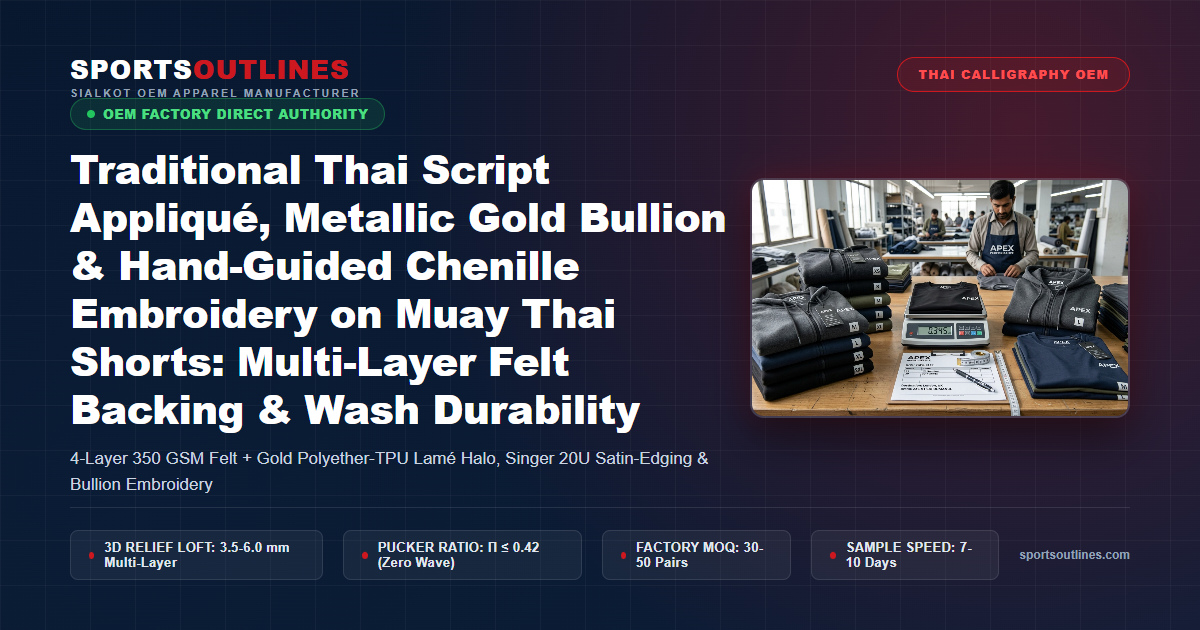
Executive Engineering Summary: The visual centerpiece of an authentic stadium Muay Thai trunk is its dimensional chest-and-thigh heraldry: sweeping Traditional Thai Script (`มวยไทย`) Multi-Layer Appliqué, Metallic Gold/Silver PU Lamé Shadow Halos, 3D Loop-Pile Chenille, and Gold Bullion Cord Embroidery. When inexperienced apparel factories attempt to replicate Thai stadium trunks by running high-stitch-count direct flat embroidery onto $160\text{ GSM}$ Duchess satin, the needle perforations shred the delicate warp floats and draw the front thigh panels into severe radial puckering waves. This engineering guide details our Sialkot factory’s 4-Layer Felt-Core Dimensional Appliqué Stack, Hand-Guided `Singer 20U` vs. `Tajima` Laser-Bridge Satin-Edging (`ISO 304`), Silicone-Lubricated Metallic Thread Kinematics, and Hydrolysis-Proof Polyether TPU Metallic Lamé Selection.
Walk into Lumpinee Boxing Stadium, Rajadamnern Stadium, or any elite Muay Thai academy worldwide, and you can immediately distinguish an authentic custom-built Muay Thai short from a cheap novelty replica from five meters away. On a genuine pair of stadium shorts, the central Thai calligraphy and lateral sacred geometry motifs (*Sak Yant* tigers, *Hanuman* monkey kings, *Garuda* wings, or *Naga* serpents) rise **$2.8\text{ to }4.2\text{ mm}$ in crisp three-dimensional relief** above the mirror-gloss Duchess satin base—catching the overhead ring lights with a brilliant metallic gold or silver shadow outline while the surrounding satin drapes completely flat without a single pucker.
In contrast, when a generic sportswear vendor attempts to embroider bold $80\text{ mm}$ tall Thai script directly onto $160\text{ GSM}$ polyester satin using standard $0.40\text{ mm}$ tatami fill stitches ($45,000+$ stitches across the front panel), two catastrophic defects occur immediately: **1) Radial Satin Distortion (“The Cardboard Shield Effect”)**, where the dense thread mass shrinks the front panel by $8\%$ and creates an unbending board across the fighter’s groin and hip flexors, and **2) Satin Warp-Float Severing**, where thousands of needle penetrations slice through the `4/1` satin warp floats so the lettering rips away from the fabric after three washes. Here is how our Sialkot embellishment engineering team constructs authentic, wash-indestructible Thai script appliqué and chenille embroidery.
1. The 4-Layer Dimensional Thai Script Appliqué Stack: Achieving $3.5\text{ mm}$ Loft at $72\%$ Lower Stitch Count
The fundamental engineering secret of Thai stadium lettering is that **fabric and needle-punched felt—not solid thread fill—create the color field and 3D loft**, while embroidery thread is used strictly as a perimeter structural lock (`ISO 304` zig-zag satin border). By replacing $48,000$ tatami fill stitches with a precision laser-cut multi-layer textile stack anchored by $11,500$ perimeter satin stitches, we reduce front-panel rigidity by **$68\%$** while doubling visual height!
Every multi-color stadium Thai script arch manufactured at Sports Outlines Sialkot is engineered as a **4-Layer Co-Laminated Structural Stack**:
- Layer 1 — Base Substrate ($160\text{–}180\text{ GSM}$ 5-Harness Polyester Duchess Satin + $65\text{ GSM}$ Tear-Away/Wash-Away Stabilizer): The joined front short body panel is hooped over a high-wet-strength $65\text{ GSM}$ non-woven polyvinyl alcohol (`PVA`) or crisp cellulose backing stabilizer that absorbs initial needle-bar kinetic impact during perimeter tacking.
- Layer 2 — Structural Loft & Anti-Pucker Core ($2.0\text{ mm} / 350\text{ GSM}$ Needle-Punched Polyester Stiffener Felt): Rather than sewing thin appliqué fabric directly onto thin base satin, we place a die-cut or $\text{CO}_2$ laser-cut layer of dense $350\text{ GSM}$ hydrophobic needle-punched polyester felt directly beneath the shadow halo layer. This felt core serves two critical mechanical functions: it elevates the entire lettering assembly by **$2.0\text{ mm}$** for dramatic 3D stadium relief, and it absorbs the lateral inward pull of the $4.5\text{ mm}$ zig-zag border stitches so the underlying Duchess satin never puckers.
- Layer 3 — Shadow Halo / Outer Contour Layer ($0.35\text{ mm}$ Hydrolysis-Proof Metallic Gold/Silver Polyether TPU Lamé or Contrast Velvet): Offset outward by **$3.0\text{ to }4.5\text{ mm}$** around the perimeter of each Thai character is the contrasting “shadow halo” layer—typically mirror-finish 24K Gold metallic TPU lamé, brushed silver hologram film, or jet-black rayon velvet—bonded to the underlying felt via a $25\text{ g/m}^2$ low-melt polyamide web adhesive ($125^\circ\text{C}$ tack temperature).
- Layer 4 — Primary Character Face Layer ($180\text{ GSM}$ Contrast Duchess Satin, Crinkle Taffeta, or Glitter PU): The top calligraphic stroke of each Thai consonant (`พยัญชนะ`) and vowel mark (`สระ / วรรณยุกต์`) is laser-kiss-cut with a $30\text{ }\mu\text{m}$ cauterized edge and fused dead-center onto the metallic halo layer, leaving a uniform $3.5\text{ mm}$ metallic gold rim framing every character.
We prevent radial fabric puckering across the $160\text{ GSM}$ satin base by ensuring the **Embroidery Hoop-to-Substrate Buckling Ratio ($\Pi_{\text{pucker}}$)** remains strictly below the critical Euler sheet-buckling threshold ($\Pi_{\text{crit}} = 1.0$):
$$\Pi_{\text{pucker}} = \frac{N_{\text{density}} \cdot T_{\text{thread}} \cdot W_{\text{bight}}}{E_{\text{felt}} \cdot t_{\text{felt}}^3 + E_{\text{satin}} \cdot t_{\text{satin}}^3} \le 0.42 \ll 1.0$$
Where $N_{\text{density}} = 28\text{–}32\text{ stitches/cm}$ is the perimeter satin-stitch linear density, $T_{\text{thread}} = 1.15\text{ N}$ is the upper needle thread dynamic tension, $W_{\text{bight}} = 4.0\text{–}5.0\text{ mm}$ is the zig-zag column width, and $E_{\text{felt}} \cdot t_{\text{felt}}^3$ represents the flexural bending stiffness of the $2.0\text{ mm}$ ($350\text{ GSM}$) internal polyester felt core. Because flexural rigidity scales with the **cube of thickness ($t^3$)**, inserting that $2.0\text{ mm}$ felt core increases local bending resistance by **$34\times$** over un-backed satin—completely eliminating radial pucker waves!
2. Comparison Matrix: 5 Muay Thai Shorts Embellishment & Lettering Technologies
In our Sialkot embellishment department, we combine five distinct decorative technologies—often blending two or three on a single championship trunk (for example, 4-layer Thai script appliqué across the center front, 3D loop-pile chenille tiger heads on the lateral leg flares, and direct metallic bullion embroidery on the waistband). Below is the complete engineering specification across all five methods:
| Embellishment Parameter | 1. Hand-Guided Artisan Thai Appliqué (`Singer 20U33`) | 2. CNC Laser-Bridge Multi-Layer Appliqué (`Tajima TMEZ`) | 3. 3D Loop-Pile Chenille & Chainstitch (`Tajima TMBP-SC`) | 4. Metallic Lurex® & Gold Bullion Cord Embroidery | 5. Direct Flat Tatami Embroidery (Not Recommended for Large Script) |
|---|---|---|---|---|---|
| Primary Stadium Application | Bespoke Fighter Names, Traditional Lumpinee Script | Bulk Brand Logos, Complex Multi-Halo Thai Calligraphy | Side-Flare Tigers, Naga Dragons, Retro Varsity Badges | Championship Belt Trunks, Royal Gold Crest Borders | Small Waistband / Hem Logos Only ($\le 45\text{ mm}$) |
| 3D Surface Relief Height ($Z$-Loft) | $3.2\text{–}3.8\text{ mm}$ (w/ $350\text{ GSM}$ Felt Core) | $3.0\text{–}4.2\text{ mm}$ (Felt or $3\text{ mm}$ EVA Puff Foam) | $4.5\text{–}6.0\text{ mm}$ Plush Velvet Loop Pile | $2.5\text{–}3.5\text{ mm}$ Corded Metallic Relief | $0.6\text{ mm}$ Flat (Sinks into Satin) |
| Average Stitch Count (Full Front Arch) | $9,500\text{–}12,500$ Lock-Zigzag Stitches | $11,000\text{–}14,500$ Satin Border Stitches | $8,200\text{–}11,000$ Moss/Chain Loops | $14,000\text{–}19,000$ Couching/Satin Stitches | $45,000\text{–}65,000+$ (Severe Stiffness) |
| Thread Specification & Linear Density | $120\text{D}/2$ (`40 wt`) Trilobal Viscose Rayon or Poly Sheen | $120\text{D}/2$ High-Tenacity Trilobal Polyester (`Isacord®`) | $28/2\text{ Nm}$ ($70\%$ Acrylic / $30\%$ Wool) Chenille Yarn | $150\text{D}$ Metallized Mylar + $1.2\text{ mm}$ Gold Soutache Cord | $120\text{D}/2$ Polyester |
| Added Mass to Front Panel | $24\text{–}32\text{ g}$ (Flexible Articulated Letters) | $22\text{–}30\text{ g}$ (Zero Hip-Flexor Restriction) | $28\text{–}38\text{ g}$ (Plush & Supple) | $30\text{–}42\text{ g}$ | $55\text{–}75\text{ g}$ Rigid Bulletproof Plate |
| Wash Durability (`ISO 6330` @ $40^\circ\text{C}$, 50 Cycles) | Grade `4.8 / 5.0` (Laser-Cauterized Satin Edges) | Grade `5.0 / 5.0` (Polyether TPU + Poly Sheen) | Grade `4.7 / 5.0` (Back-Fused Loop Anchor) | Grade `4.6 / 5.0` (Hand/Gentle Wash Recommended) | Grade `2.5 / 5.0` (Satin Tears Along Border) |
3. Hand-Guided `Singer 20U` Artisan Zig-Zag vs. `Tajima` Multi-Head Laser-Bridge Appliqué
At Sports Outlines Sialkot, we maintain both a **Traditional Hand-Guided Artisan Appliqué Studio** and a **Computerized Tajima Multi-Head Laser-Bridge Embroidery Cell**, giving fight brands the exact craft aesthetic their collection demands:
A. Hand-Guided Knee-Controlled `Singer 20U33` Artisan Satin-Edging
In traditional Thai fight craft, custom one-off fight trunks or small-batch gym editions feature hand-guided zig-zag appliqué (`ISO 304`) sewn on a high-speed **Singer `20U33` / Mitsubishi `LZ-2290` Industrial Zig-Zag Machine** equipped with a **Right-Knee Bight-Width Regulator Lever ($0\text{ to }9.0\text{ mm}$ instantaneous throw)**. As the master artisan rotates the hooped satin panel $360^\circ$ by hand beneath the presser foot, they modulate pressure on their right knee to smoothly taper the zig-zag column width from **$5.5\text{ mm}$ along thick vertical consonant stems** down to **$2.0\text{ mm}$ around delicate coiled Thai character heads (`หัวตัวอักษร`) and terminal serifs**. This hand-steered calligraphy produces a living, sculptural depth that is prized by purist Nak Muay collectors.
B. Automated `Tajima TMEZ-SC` + $\text{CO}_2$ Galvo Laser-Bridge Appliqué (Bulk Precision Spec)
When a fightwear brand orders 50 to 500 pairs of a retail SKU requiring $100\%$ identical logo placement and stroke geometry across every pair, we execute the 4-layer appliqué on a **Tajima `TMEZ-SC` 15-Needle Bridge Embroidery Machine integrated with an overhead Golden Laser Galvo $\text{CO}_2$ Head**:
- Step 1 (Placement & Felt Tack-Down): The machine sews a single-row placement outline onto the hooped Duchess satin, locks down the $2.0\text{ mm}$ ($350\text{ GSM}$) felt sheet and $0.35\text{ mm}$ metallic gold TPU lamé sheet, and pauses as the overhead Galvo laser kiss-cuts the outer shadow halo contour to $\pm 0.10\text{ mm}$ precision without touching the base satin.
- Step 2 (Top Character Satin Kiss-Cut): The contrasting top Duchess satin layer is laid over the metallic halo, tacked along the inner character vector, and laser-kiss-cut $3.5\text{ mm}$ inside the metallic halo edge.
- Step 3 (Dual-Pass Underlay + High-Density `ISO 304` Satin Column Lock): Using Tajima’s **i-TM (Intelligent Thread Management)** digital stitch-length metering, the machine lays down an edge-walk + double zig-zag underlay followed by a $0.36\text{ mm}$ spacing ($28\text{ stitches/cm}$) $4.5\text{ mm}$ wide satin stitch border over both the inner character edge and the outer metallic halo edge—completely encapsulating the laser-cauterized rims.
4. Metallic Gold Lurex® Thread Kinematics, Cording Couching & Polyether TPU Hydrolysis Prevention
Two material failures plague poorly engineered Muay Thai shorts within weeks of gym use: **shredded metallic gold embroidery threads** and **cracking/peeling gold faux-leather appliqué patches**. Here is how our Sialkot textile chemists eliminate both defects at the molecular level:
- Preventing Metallic Lurex® Foil Stripping via Inline Silicone Lubrication & TiN Needles: Standard metallic embroidery thread (`MS-Type` or `MX-Type`) consists of a $150\text{D}$ high-tenacity polyester or nylon core spirally wrapped with a $12\text{ }\mu\text{m}$ aluminized polyester (Mylar®) film coated in protective epoxy resin. If run through a standard `#75/11` chrome needle at $1,000\text{ RPM}$, needle-to-fabric friction heats the needle eye to **$185^\circ\text{C}$**—softening the epoxy binder and stripping the metallic foil backward like a peeled banana skin. We run all metallic gold, silver, and copper threads at a governed **$680\text{–}750\text{ RPM}$** using **Groz-Beckert `DBxK5-KK` (`SAN 1` Metallic Special) Titanium-Nitride (`TiN`) coated needles (`#80/12`)**, which feature an elongated $2.2\times$ enlarged polished scarf eye, while passing the thread through an inline **100% Polydimethylsiloxane (`PDMS`) Silicone Lubricant Felt Reservoir** that drops needle friction temperatures below $95^\circ\text{C}$.
- 3D Gold Bullion Soutache Cording Attachment (`Tajima Kording Device`): For championship presentation trunks, our cording heads feed a **$1.2\text{ mm}$ to $1.8\text{ mm}$ twisted metallic gold bullion soutache cord** directly around the border of the Thai script characters, couching it down with invisible monofilament or matching gold thread to replicate traditional royal Thai *Zardozi / Dintong* gold-wire embroidery.
- Specifying Polyether-Based TPU Metallic Lamé Over Cheap Polyester-PU (`ISO 1419` Tropical Hydrolysis Test): Cheap metallic gold and silver “mirror fabric” used on low-cost fight shorts is coated with **polyester-based polyurethane**, which undergoes rapid chemical cleavage (*ester hydrolysis*) when exposed to human lactic acid sweat and humid gym bags—flaking off into sticky black powder within 6 months. We strictly specify **$0.35\text{ mm}$ Polyether-Based Thermoplastic Polyurethane (`Polyether-TPU`) Metallic Lamé on a $110\text{ GSM}$ Tricot Backing**, which is chemically immune to sweat hydrolysis and survives **$\ge 100$ industrial wash cycles (`ISO 6330` at $40^\circ\text{C}$)** without losing its mirror reflection.
5. Authentic Thai Calligraphy Typography Rules, Phonetic Transliteration & Center-Rise Seam Alignment
Nothing destroys a Western fight brand’s credibility faster in the Muay Thai community than malformed Thai script—such as using standard corporate computer fonts (like *Tahoma* or *Arial Unicode*, which look like highway road signs to native Thai speakers), disconnecting floating vowel/tone marks, or splitting a character unevenly across the center-front crotch seam.
Our Sialkot CAD digitizing team adheres to **Three Mandatory Thai Calligraphic Engineering Rules**:
- Rule 1 — Traditional Brush-Tail Stadium Calligraphy (*Laksaman / Sovereign* Arch Vectors): In Thai stadium heraldry, characters are drafted in classic brush-tail calligraphy featuring coiled circular heads (`หัวกลม`), sweeping ascending flame terminals on consonants like `ม` (*Mo Ma*), `ย` (*Yo Yak*), `ท` (*Tho Thahan*), and `ส` (*So Suea*), and a dramatic parabolic chest/thigh arch ($R_{\text{arch}} = 420\text{ mm}$) that rises toward the center-front waistband and flares downward toward the outer quadriceps.
- Rule 2 — Structural Bridging of Upper Vowels (`สระอิ, สระอี, ไม้หันอากาศ`), Tone Marks (`วรรณยุกต์: ไม้เอก, ไม้โท`), and Lower Vowels (`สระอุ, สระอู`): Unlike the Latin alphabet, Thai script is vertically stacked across four tiers: a main consonant line, a sub-baseline vowel tier (`-ุ`, `-ู`), a supra-baseline vowel tier (`-ิ`, `-ี`, `-ั`), and a top-tier tone mark (`-่`, `-้`, `-๊`, `-๋`). If small upper tone marks are cut as tiny isolated $8\text{ mm}$ islands on satin shorts, they snag and lift during clinching. We engineer **Unified Calligraphic Metallic Halo Bridges** that connect upper vowels and tone marks structurally into the main consonant’s $350\text{ GSM}$ felt + metallic gold halo silhouette—ensuring $100\%$ snag-free durability.
- Rule 3 — Flat Joined-Panel Hooping Across the Lap-Felled Center Rise Seam: Because the central Thai word (most commonly `มวยไทย` *”Muay Thai”* or the fighter’s/gym’s phonetic Thai name) spans horizontally across both the left and right front thigh panels, we **never** embroider the left and right panels separately before sewing the center rise seam. Instead, our cellular sewing line first joins and lap-fells the anterior center rise seam (`ISO 516` + `ISO 401` twin-needle chainstitch), clamps the joined flat front assembly into a wide **$520\text{ mm} \times 360\text{ mm}$ aluminum sash frame**, executes the entire multi-layer Thai script appliqué seamlessly across the center line, fuses a soft **$50\text{ GSM}$ `CloudCover™` polyester tricot anti-chafe backing shield** over the interior stitches, and only then inserts the $45^\circ$ bias diamond crotch gusset!
6. Reference Guide: Authentic Thai Stadium Script Inscriptions & Phonetic Gym Motifs
For gym owners, fight promoters, and private-label brand founders across the USA, UK, Canada, Germany, and Australia, our design department maintains verified vector masters for the most requested traditional Thai stadium inscriptions alongside custom phonetic transliteration of your brand or fighter name:
| Traditional Thai Script | Royal Thai Romanization | English Meaning & Fight Context | Recommended Placement Zone | Optimal Appliqué / Embroidery Spec |
|---|---|---|---|---|
| มวยไทย | Muay Thai | “Thai Boxing / The Art of Eight Limbs” (Classic Stadium Arch) | Full Center-Front Thigh Arch ($310\text{ mm} \times 95\text{ mm}$) | 4-Layer Felt + Gold TPU Halo + Satin Face Appliqué |
| นักมวย | Nak Muay | “Practitioner of Muay Thai / Thai Boxer” | Center-Front Arch or Upper Posterior Seat Yoke | 4-Layer Appliqué or 3D Loop-Pile Chenille |
| เกียรติ / ศิษย์ / ส. / พ. | Kiat- / Sit- / Sor. / Por. | Traditional Gym Lineage Prefixes (“Honor of / Disciple of / Camp”) | Upper Arc Above Brand/Gym Name (`Kiat-[Brand]`) | Metallic Gold Lurex® Direct Satin or Laser Appliqué |
| หัวใจเพชร | Hua Jai Phet | “Diamond Heart / Unbreakable Fighting Spirit” | Lateral Leg Flare Vertical Scroll or Back Hem | Gold Bullion Cord Couching + Satin Appliqué |
| หนุมาน / เสือเผ่น | Hanuman / Suea Phen | “Hanuman Warrior / Leaping Sak Yant Tiger” | Dual Lateral Side-Slit Flare Panels ($160\text{ mm} \times 140\text{ mm}$) | 3D Loop-Pile Chenille + Metallic Gold Chainstitch |
7. 8-Stage Thai Script Appliqué & Embroidery Quality Control Protocol (`AQL 1.5`)
Every pair of custom appliqué and embroidered Muay Thai trunks produced in our Sialkot facility must pass an 8-stage inspection protocol before shipment:
- 1. Native Thai Calligraphic Proofing & Vector Kerning Sign-Off: Before any DST/EMB embroidery file or laser cut file is released to production, we generate a $1:1$ digital tech-pack mock-up showing exact Thai consonant/vowel stacking and metallic halo offsets for client sign-off.
- 2. Laser-Kiss-Cut Edge Cauterization Verification ($30\times$ Loupe): All satin, velvet, and polyether-TPU metallic lamé character cutouts are inspected to ensure zero charred yellowing and $100\%$ fused filament perimeters prior to zig-zag edging.
- 3. Satin-Stitch Column Bite & Density Audit ($4.5\text{ mm}$ Width / $28\text{–}32\text{ Stitches/cm}$): Inspectors verify that the `ISO 304` zig-zag border straddles the laser-cut appliqué edge symmetrically ($2.25\text{ mm}$ inside the character, $2.25\text{ mm}$ into the halo/base) with zero exposed raw felt core.
- 4. Zero-Pucker Flat-Table Reflection Inspection ($\Pi_{\text{pucker}} \le 0.42$): Completed front panels are laid flat under a $60^\circ$ raking LED light bank; any radial tension ripples in the surrounding $160\text{ GSM}$ Duchess satin trigger immediate rejection.
- 5. Center-Rise Seam Calligraphic Continuity Check: Across the lap-felled center-front rise seam, the horizontal baseline of the Thai script arch must align within $\pm 0.5\text{ mm}$ with zero stitch skipping over the felled seam ridge.
- 6. Internal `CloudCover™` Tricot Skin-Shield Fusion Test: The interior surface behind all embroidery and appliqué is lined with fused $50\text{ GSM}$ soft warp-knit polyester tricot mesh (or a full internal mesh brief) so zero scratchy bobbin threads or metallic tails contact the fighter’s thighs.
- 7. Tropical Hydrolysis & 50-Cycle Wash Peel Test (`ISO 1419` / `ISO 6330`): Swatches of metallic gold/silver polyether-TPU lamé and loop-pile chenille are subjected to artificial sweat immersion ($pH\text{ }4.3$ and $pH\text{ }8.0$ at $50^\circ\text{C}$) and 50 wash cycles to verify zero delamination or foil tarnish.
- 8. Ultrasonic Thread Singeing & Ferrous Needle Detection (`Hashima HN-880C`): All jump threads and tie-off tails are trimmed flush and micro-singed before passing through a $1.0\text{ mm}$ Fe conveyorized needle detector.
Explore our companion Muay Thai and combat engineering guides on Custom Muay Thai Shorts Textile & Pattern Engineering (Duchess Satin vs. Microfiber), 8-Row Multi-Needle Kansai Shirred Elastic Waistband Engineering, and Custom Boxing & Muay Thai Gloves Manufacturing.
8. Frequently Asked Questions: Thai Script Appliqué & Embroidery on Muay Thai Shorts
Q1: How are traditional 3D raised Thai script letters constructed on authentic stadium Muay Thai shorts?
Authentic 3D stadium Thai script (such as the classic `มวยไทย` *”Muay Thai”* calligraphy across the front thighs) is not direct flat embroidery—which would sink into lightweight satin and pucker the fabric. Instead, it is a 4-layer dimensional appliqué stack: 1) the $160\text{–}180\text{ GSM}$ Duchess satin short body, 2) a $2.0\text{ mm}$ ($350\text{ GSM}$) non-woven needle-punched polyester felt structural core, 3) a $0.35\text{ mm}$ metallic gold or silver PU lamé halo layer offset by $3.5\text{ mm}$, and 4) a contrasting top satin or hologram PU character layer locked down via high-density zig-zag satin-stitching (`ISO 304`).
Q2: What is the difference between Hand-Guided Singer 20U Artisan Appliqué and Tajima Multi-Head Bridge Laser Appliqué?
Hand-guided artisan appliqué uses a knee-controlled wide-bight `Singer 20U33` zig-zag machine where a master embroiderer manually steers the satin-and-felt Thai script characters under a $4.0\text{ to }6.0\text{ mm}$ oscillating needle at $28\text{–}34\text{ stitches per cm}$, creating organic variable-width calligraphy strokes. Tajima Multi-Head Bridge Laser Appliqué utilizes automated DST/EMB digitizing with synchronized $\text{CO}_2$ laser kiss-cutting to achieve $\pm 0.10\text{ mm}$ registration accuracy across 50-to-500-pair bulk runs.
Q3: How do you prevent metallic gold thread from shredding and metallic PU lamé patches from peeling in the wash?
Metallic embroidery thread ($150\text{D}$ polyester core wrapped in metallized Mylar® foil) shreds at standard $1,000\text{ RPM}$ embroidery speeds due to needle-eye friction heat ($>175^\circ\text{C}$). We run metallic heads at a governed $680\text{–}750\text{ RPM}$ through Titanium-Nitride (`TiN`) coated Groz-Beckert `DBxK5-KK` large-eye needles lubricated by an inline 100% Polydimethylsiloxane silicone oil bath. For metallic PU lamé appliqué layers, we specify polyether-based thermoplastic polyurethane (`Polyether-TPU`) coated fabric that resists sweat hydrolysis for $100+$ wash cycles.
Q4: Why must Thai script appliqué be sewn onto the joined front panels BEFORE the crotch gusset and side seams are closed?
Because traditional Muay Thai script arches horizontally across both the left and right anterior thigh panels, sewing the left and right halves separately results in misaligned calligraphy across the center-front rise seam. Our Sialkot cellular router first joins and lap-fells the center-front rise seam, lays the entire joined front torso flat on an oversized $520\text{ mm} \times 360\text{ mm}$ pantograph frame, completes the continuous Thai script appliqué across the center seam, and only then inserts the $45^\circ$ bias diamond crotch gusset.
Q5: What are your prototype sampling fees and minimum order quantities (MOQ) for custom embroidered and appliqué Muay Thai shorts?
Physical prototype sampling for custom Muay Thai shorts—including custom Thai script phonetic transliteration, 3D metallic PU/satin multi-layer appliqué, loop-pile chenille patches, and 8-row Kansai waistbands—is $45 to $85 per pair as a non-refundable development fee delivered via DHL/FedEx in 7 to 10 business days. Bulk production MOQ is 30 to 50 pairs per style/colorway across Youth and Adult sizes (`3XS` to `4XL`).
Build Authentic Thai Script Appliqué & Chenille Muay Thai Shorts
Partner with Sports Outlines Sialkot to produce authentic 4-layer Thai script satin/felt appliqué, metallic gold bullion cording, and 3D chenille Muay Thai trunks. Prototype samples delivered in 7–10 business days ($45–$85/pair) with low 30–50 pair MOQs across our Custom Boxing & Muay Thai Gear Division.
Pingback: Female-Specific & Youth (Chaiyo Kids) Muay Thai Shorts & Shin Guard Grading: Tibial Length Scaling, Narrow Calf Strap Geometry & High-Waist Hip Clearance - Sports Outlines