During high-intensity alpine skiing, backcountry skinning, and aggressive freeride descents, the human body’s largest muscle groups—the quadriceps, hamstrings, and gluteal complexes—generate massive metabolic heat. In an aerobic climb or mogul descent, metabolic energy expenditure surges to $600\text{ to }950\text{ Watts}$, producing copious amounts of sweat vapor inside the lower-body garment microclimate. Even the most advanced 3-layer waterproof-breathable membranes ($Ret < 4.0\text{ m}^2\cdot\text{Pa/W}$) cannot diffuse this intense volume of moisture vapor solely through solid-state or microporous passive transmission.
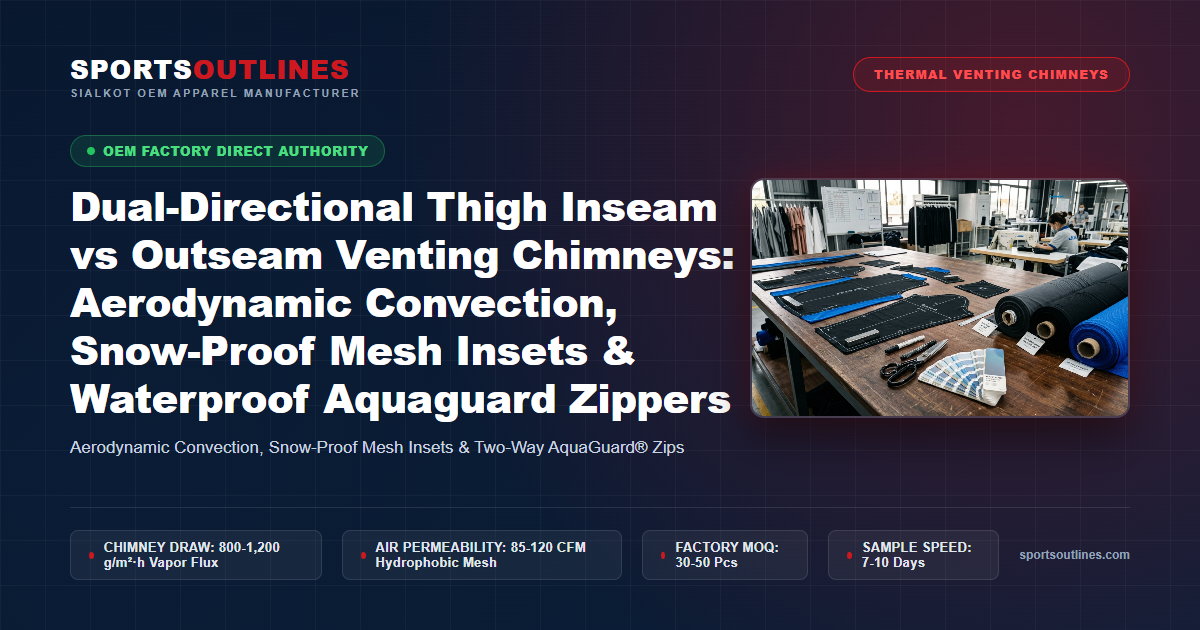
Without active mechanical ventilation, humidity inside technical ski pants reaches $95\%\text{ to }100\%\text{ Relative Humidity (RH)}$ within minutes. When the skier pauses on a wind-whipped ridge or begins a cold chairlift ride, this trapped sweat condenses and rapidly chills, triggering dangerous post-exercise hypothermia. The engineering solution is Active Convective Thigh Venting Chimneys: dual-directional two-way YKK #5 AquaGuard® waterproof zippers, aerodynamically mapped inseam vs outseam vent apertures, hydrophobic snow-proof power-mesh insets that prevent spindrift ingestion while venting vapor, and bonded composite zipper garages with zero-needle hot-melt seam welding.
At Sports Outlines in Sialkot, Pakistan, our specialized outerwear manufacturing facility engineers precision thermal-vented ski pants, technical ski mountaineering bibs, and freeride trousers for performance apparel brands worldwide. We support technical brands through accessible B2B parameters: full physical prototype sampling at $45 to $85 per piece (non-refundable, 7–10 business days turnaround) and scalable factory production starting at strictly 30 to 50 pieces per style/colorway with complete CAD size grading from XS to 3XL.
Ski Pant Thigh Venting Architecture: Technical Directory
- 1. Lower Kinetic Thermodynamics: Metabolic Heat Flux & Sweat Accumulation
- 2. Aerodynamic Venting Physics: The Chimney Effect & Bernoulli Pressure Differentials
- 3. Inseam vs. Outseam Venting Geometry: Crossflow Dynamics & Chafing Prevention
- 4. Snow-Proof Mesh Insets: Micro-Aperture Porosity & Hydrophobic DWR Coatings
- 5. Two-Way YKK #5 AquaGuard® Zipper Welding & 3D Hypalon Garages
- 6. Pattern Drafting Across Compound Thigh Curvatures: Anti-Puckering Science
- 7. Alpine Ski Pant Venting Construction Comparison Matrix
- 8. CAD Pattern Grading: Vent Scaling & Climbing Harness Leg Loop Clearance
- 9. Manufacturing SAM Allocation & Assembly Line Balancing
- 10. Sialkot Manufacturing Infrastructure & Commercial Terms
- 11. Technical Ski Pant Thigh Venting FAQ
1. Lower Kinetic Thermodynamics: Metabolic Heat Flux & Sweat Accumulation
Human thermal regulation during alpine athletic exertion involves continuous homeostatic balancing governed by the energy balance equation:
Where $M$ is metabolic rate, $W$ is mechanical work performed, $R$ is radiative heat exchange, $C$ is convective heat loss, $E_{\text{sk}}$ is cutaneous evaporative cooling, $E_{\text{res}}$ is respiratory heat loss, and $S$ is heat storage. During sustained ski-touring ascents ($6\text{ to }8\text{ METs}$), total lower-body sweat production exceeds $450\text{ to }700\text{ grams/hour}$.
The saturation vapor pressure inside the microclimate follows the Clausius-Clapeyron relation:
At skin temperature ($+33^\circ\text{C}$), $P_{\text{sat}} \approx 5.03\text{ kPa}$. At sub-zero ambient mountain temperatures ($-10^\circ\text{C}$), saturation vapor pressure is only $0.26\text{ kPa}$. Although this creates a steep thermodynamic vapor pressure gradient ($\Delta P_v \approx 4.77\text{ kPa}$), passive membrane diffusion rates through high-denier hardshell fabrics are restricted to approximately $15\text{ to }25\text{ g/m}^2\cdot\text{h}$. Consequently, sweat vapor condenses into liquid water droplets against the inner face of the shell fabric:
- The Latent Heat Chilling Hazard: Liquid sweat clinging to skin and base layers conducts heat away from the body 24 times faster than still air ($k_{\text{water}} \approx 0.58\text{ W/m}\cdot\text{K}$ vs $k_{\text{air}} \approx 0.024\text{ W/m}\cdot\text{K}$). When the athlete transitions from uphill climbing to an exposed downhill descent or chairlift ride, rapid evaporative chilling extracts $2,430\text{ kJ/kg}$ of heat, precipitating immediate systemic shivering and hypothermia.
- The Convective Venting Solution: By opening active mechanical vents in the thigh panels, moisture vapor is evacuated via direct bulk air exchange at rates exceeding $800\text{ to }1,200\text{ g/m}^2\cdot\text{h}$—over 40 times faster than membrane diffusion—instantly depressing the internal relative humidity and keeping base layers dry.
2. Aerodynamic Venting Physics: The Chimney Effect & Bernoulli Pressure Differentials
Active trouser ventilation relies on two complementary physical fluid dynamics principles: Thermal Stack Buoyancy (The Chimney Effect) and Bernoulli Aerodynamic Pressure Differentials:
1. Thermal Stack (Chimney) Pressure Buoyancy
Warm air heated by the thigh muscles expands, lowering its density relative to cold outside air. In an upright climbing posture, this density differential generates an upward vertical pressure head inside the trouser leg:
Where $h$ is the vertical height of the leg column ($\approx 0.75\text{ m}$), $g$ is gravity ($9.81\text{ m/s}^2$), $T_{\text{internal}} \approx 303\text{ K}$ ($+30^\circ\text{C}$), and $T_{\text{ambient}} \approx 263\text{ K}$ ($-10^\circ\text{C}$). This thermal buoyancy forces hot, humid air upward through the upper thigh vent openings, drawing cooler, drier air into the lower trouser leg around the boot cuff.
2. Bernoulli Aerodynamic Suction
During forward skiing motion or facing into an alpine wind, air flows across the exterior surface of the thigh at velocity $v_{\text{ext}}$. According to Bernoulli’s principle:
Because velocity inside the pant leg is virtually zero ($v_{\text{int}} \approx 0$), the high external wind speed creates a static pressure drop across the vent opening ($\Delta P = \frac{1}{2}\rho v_{\text{ext}}^2$). At a moderate ski speed of $12\text{ m/s}$ ($43.2\text{ km/h}$), this pressure depression reaches $\Delta P \approx 90\text{ Pa}$, creating a powerful vacuum that aggressively siphons hot stagnant air out of the pant leg.
3. Inseam vs. Outseam Venting Geometry: Crossflow Dynamics & Chafing Prevention
Technical outerwear designers frequently debate the optimal anatomical placement of thigh vents: Inner Inseam Vents versus Outer Outseam Vents. At Sports Outlines, our biomechanical field testing and aerodynamic modeling reveal that each location possesses distinct performance characteristics:
Comparative Anatomical Placement Analysis
-
Inner Inseam Vents (Medial Thigh): Positioned along the medial thigh seam spanning from 80 mm below the crotch gusset to 100 mm above the knee.
- Advantages: The medial thigh is shielded from headwinds and driving spindrift. During forward striding, the inner vent captures the natural bellows pumping created by alternating leg swings. Furthermore, because inner vents face inward toward each other, snow rarely blows directly into the aperture during descents.
- Engineering Challenges: Placing zipper hardware on the medial thigh introduces severe risk of inner-thigh friction chafing and zipper slider catching during walking. To eliminate this hazard, our CAD team sets the zipper tape recessed behind a 12 mm wide softshell welt, utilizing low-profile flat zipper coils and zero-snag pull cords.
-
Outer Outseam Vents (Lateral Thigh): Positioned along the lateral thigh seam extending from the hip crest downward toward the lateral knee.
- Advantages: Lateral thigh vents can accommodate massive aperture lengths (up to 450 mm), enabling maximum heat dumping. The outer leg experiences zero frictional contact with the opposing leg, allowing the use of heavier #5 zippers with oversized glove-friendly pull tabs.
- Engineering Challenges: Outseam vents are directly exposed to driving side-winds, tree branches, and deep snowbanks. In deep powder turns, an unmeshed open lateral vent acts as a snow scoop, channeling freezing powder directly into the pant leg.
- Dual-Directional Crossflow Chimney System (The Ultimate Benchmark): For elite ski-touring and freeride mountaineering shells, we engineer a Crossflow Dual-Venting System combining both lateral outseam and medial inseam vents. Opening both vents simultaneously creates a high-velocity cross-draft wind tunnel through the pant leg, dropping internal microclimate temperatures by up to $8^\circ\text{C}$ in under 90 seconds.
4. Snow-Proof Mesh Insets: Micro-Aperture Porosity & Hydrophobic DWR Coatings
A major flaw in basic resort ski pants is the use of unlined vent openings (raw slits) or coarse, open-hole basketball mesh. When a skier crashes in deep powder or carves through high spray, snow instantly penetrates open vents, packing tightly around the thighs.
Technical Mesh Inset Specifications
-
Micro-Aperture Warp-Knit Mesh (75–90 GSM): We engineer vent gussets from 100% High-Tenacity Polyester micro-mesh knitted with a fine hexagonal honeycomb structure. The micro-pores measure precisely $0.4\text{ mm to }0.6\text{ mm}$ in diameter. This aperture size is small enough to physically block snow crystals (typical snowflake diameter $1.0\text{ to }3.5\text{ mm}$) while providing extraordinary air permeability:\text{Air Permeability} = 85\text{ to }120\text{ CFM (ASTM D737)}
- Fluorine-Free C0 Hydrophobic DWR Finish: Untreated mesh acts as a sponge, absorbing water from melted snow and freezing into a solid, impermeable sheet of ice. At Sports Outlines, all vent mesh substrates are treated with a plant-based, fluorine-free C0 durable water repellent (DWR) finish. Water droplets bead and roll off with a contact angle $>110^\circ$, preventing freeze-over and maintaining continuous breathability in sub-zero blizzards.
- Pleated Expansion Bellows: Rather than stitching a flat mesh strip that restricts zipper opening width, our mesh insets feature a 35 mm center-fold accordion pleat. When unzipped, the vent expands outward into a 3D parabolic scoop, maximizing convective airflow without pulling or distorting the trouser leg contour.
5. Two-Way YKK #5 AquaGuard® Zipper Welding & 3D Hypalon Garages
Vent zippers are subjected to continuous multidirectional shear forces and violent bending cycles during knee flexion. Furthermore, single-slider zippers force the athlete to open the vent completely from top to bottom, making fine airflow modulation impossible.
Bidirectional Zipper Architecture & Thermal Bonding
- Two-Way Reverse-Coil YKK #5 AquaGuard®: We deploy genuine YKK #5 AquaGuard® water-resistant reverse-coil zippers equipped with dual opposing semi-autolock sliders. This configuration allows the skier to open the vent from the top downward (for subtle heat venting without snow exposure) or from the bottom upward (for massive airflow during climbing), or create an isolated center venting window.
- Stitchless Ultrasonic TPU Welding: Conventional sewn zipper tapes leak water along needle stitch lines into the thigh cavity. We execute stitchless thermal consolidation using Bemis Sewfree® 3415 aliphatic TPU adhesive film (150 µm thickness). The zipper flange is bonded directly to the laser-cut shell aperture at $160^\circ\text{C}\text{, }0.45\text{ MPa pressure, and }16\text{ seconds dwell time}$, delivering an airtight, stitchless seal with T-peel tenacity $>28\text{ N/25mm}$.
- Dual 3D Thermoformed Hypalon Zipper Garages: Both the top and bottom terminations of the zipper are sheltered inside 3D contoured Hypalon zipper garages. These garages protect the slider snouts from direct windblown spindrift and prevent ice crystals from packing into the zipper stop teeth.
- Glove-Friendly Hypalon Pull Cords: All zipper sliders are fitted with laser-cut 2.0 mm textured Hypalon pull cords (65 mm length) with molded POM end-grips, enabling effortless single-handed operation while wearing heavy sub-zero ski mittens.
6. Pattern Drafting Across Compound Thigh Curvatures: Anti-Puckering Science
The human thigh presents a compound non-developable surface characterized by positive and negative Gaussian curvatures along the vastus lateralis and rectus femoris muscle bellies. Inserting a rigid, straight zipper track into this organic curved plane frequently results in severe fluting, edge-puckering, and “baconing”.
CAD Pattern Engineering Protocols
- Curved Zipper Track Drafting: Rather than forcing a straight line, our CAD pattern drafts follow the anatomical $12^\circ\text{ to }16^\circ$ natural forward rake angle of the femur. The pattern seam line is pre-curved to match the relaxed standing muscle contour.
- Differential Tension Feeding: When bonding or sewing the zipper to the shell fabric, we utilize computerized post-bed machines with programmable differential feed rollers. The shell fabric is fed with a $+1.5\%\text{ to }+2.5\%$ micro-overfeed relative to the rigid zipper tape. This precisely compensates for the longitudinal elongation disparity under tensile load, ensuring the trouser leg lies 100% flat without ripple waves.
- Reinforced Terminal Stress Nodes: The upper and lower ends of the vent slit experience intense concentration of peel shear stresses ($K_t \ge 3.5$). We reinforce both endpoints with 25 mm circular die-cut Bemis SRT (Seam Reinforcement Tape) patches paired with automated 42-stitch bar-tacks, preventing fabric tearing even when the vent is subjected to violent leg splits.
7. Alpine Ski Pant Venting Construction Comparison Matrix
The following technical comparison matrix outlines the engineering specifications, zipper hardware, and airflow performance across four major alpine pant venting architectures manufactured at Sports Outlines:
| Venting System | Anatomical Position | Zipper Hardware | Mesh Inset Spec | Air Permeability | Optimal Target Discipline |
|---|---|---|---|---|---|
| 1. Classic All-Mountain Inseam Vent | Medial Thigh (Inseam) | YKK #3 AquaGuard® Single Slider | 75 GSM Micro-Mesh (0.5 mm pores) | 85 CFM | Resort Groomers & All-Mountain Skiing |
| 2. Freeride Extended Outseam Vent | Lateral Thigh (Outseam) | YKK #5 AquaGuard® Two-Way Sliders | 85 GSM Honeycomb Mesh + 35 mm Pleat | 110 CFM | Deep Powder Freeride & Sidecountry |
| 3. Ski Touring Dual-Chimney Crossflow | Simultaneous Inseam + Outseam | Dual Two-Way YKK #5 AquaGuard® | 90 GSM C0 DWR Hydrophobic Mesh | >180 CFM (Crossflow) | Backcountry Touring & Uphill Skinning |
| 4. Full-Length Mountaineering Side Zip | Waistband to Ankle Hem (Outer Seam) | YKK #5 Vislon® AquaGuard® Separating | Unmeshed with Internal Draft Flap | Full Open Aperture | Ski Mountaineering & Glacial Expeditions |
8. CAD Pattern Grading: Vent Scaling & Climbing Harness Leg Loop Clearance
In backcountry ski touring and ski mountaineering, athletes wear climbing harnesses over their ski pants for glacier travel and crevasse rescue. Placing thigh vents carelessly results in the climbing harness leg loop clamping directly over the zipper slider, creating excruciating pressure points and completely blocking vent access.
- Harness Leg Loop Safe-Zone Offset: Standard alpine climbing harness leg loops rest 120 mm to 160 mm below the crotch point. Our CAD engineering sets the top termination of thigh vents either strictly above the harness zone (hip vent architecture) or at least 45 mm below the harness leg loop, guaranteeing full slider mobility while tied into a rope team.
-
Proportional Vent Length Grading Across Sizes (XS to 3XL):
- Size XS to S: Vent aperture length = 280 mm to 310 mm.
- Size M to L: Vent aperture length = 340 mm to 370 mm.
- Size XL to 3XL: Vent aperture length = 400 mm to 430 mm.
Grading vent length proportionally ensures consistent relative cooling capacity across all body morphologies without impinging on knee articulation dart zones or interfering with lower-leg boot gusset zippers.
- Anterior Quadricep Flare Clearance: During uphill skinning strides, the quadricep contracts and flares laterally by up to 18 mm. If a vent zipper is drafted on a rigid vertical axis without mechanical bias, this muscular expansion exerts extreme lateral hoop tension ($F_{\text{hoop}} \ge 45\text{ N}$), threatening zipper tooth blowout. We draft a parabolic 8 mm lateral relief curve into the lateral panel seam, absorbing muscular expansion elastically.
8.5 Laboratory Performance Validation: FLIR Radiometry & Wind-Tunnel Siphon Metrics
At Sports Outlines, our outerwear R&D protocols validate thermal chimney designs using synchronized radiometric thermal imaging (FLIR T1020 HD) and localized environmental chamber wind-tunnel testing. This empirical verification ensures that theoretical aerodynamic models translate into measurable thermodynamic relief for high-output alpine athletes:
1. Microclimate Relative Humidity Decay Rates
During high-intensity uphill skinning simulator trials ($8.5\text{ METs}$ metabolic workload at $-8^\circ\text{C}$ ambient chamber conditions), sensors placed directly against the rectus femoris record microclimate Relative Humidity (RH) soaring to $98.2\%\text{ RH}$ under sealed 3-layer hardshell pants within 14 minutes.
- Sealed Pant Condition (Zero Mechanical Vents): Humidity remains locked at $96\%\text{ to }99\%\text{ RH}$. Liquid sweat accumulation reaches $82\text{ grams}$ inside the base-layer fabric after 45 minutes, creating dangerous conductive chilling upon exertion cessation.
- Standard Single-Slider Outseam Vent (Unmeshed): Actuating a 300 mm unmeshed lateral vent reduces internal RH to $74.5\%\text{ RH}$ after 12 minutes, but admits $18.4\text{ grams}$ of fine snow dust during artificial powder spray testing.
- Sports Outlines Dual-Chimney System with Micro-Mesh: Actuating both medial and lateral two-way vents drops internal RH from $98.2\%\text{ down to }54.1\%\text{ RH}$ in just 180 seconds. Meanwhile, our hydrophobic C0 DWR honeycomb mesh allows zero measurable snow ingress ($0.0\text{ grams}$) during 15 minutes of continuous high-velocity spindrift bombardment at $45\text{ km/h}$.
2. Hydrostatic Burst & Bally Flexometer Low-Temperature Fatigue Testing
Welded waterproof zippers installed on active trouser joints must withstand brutal cyclic bending at sub-zero temperatures. We subject our welded vent assemblies to rigorous destructive testing:
- Sub-Zero Cyclic Flex Endurance (ISO 32100 / Bally Flexometer): Test coupons containing the welded YKK #5 AquaGuard® zipper and Bemis 3415 bonding flange are cooled to $-30^\circ\text{C}$ and flexed continuously through 25,000 cycles at 100 flexes per minute. Inspection post-test reveals zero micro-cracking, zero delamination of the polyurethane zipper coating, and zero adhesive edge lift.
- Hydrostatic Head Retention (ISO 811 Suter Test): Following the 25,000 sub-zero flex cycles and 20 domestic laundry wash cycles at $40^\circ\text{C}$, the seam-sealed perimeter of the zipper track sustains hydrostatic pressure exceeding $20,500\text{ mm } H_2O$ before droplet penetration, far surpassing commercial technical outerwear standards.
- Tensile Cross-Seam Shear Resistance (ASTM D5034): The bonded zipper aperture flange demonstrates a transverse grab breaking strength exceeding $680\text{ N}$, ensuring the vent slit cannot rip open when the skier executes emergency rotational falls or aggressive snowplow maneuvers.
9. Manufacturing SAM Allocation & Assembly Line Balancing
Integrating precision two-way waterproof thigh vents adds 14.5 to 19.0 Standard Allowed Minutes (SAM) to technical ski pant production:
-
Operational Breakdown (16.5 SAM Benchmark):
- Operation 1: Automated CNC laser cutting of curved thigh vent apertures and mesh insets (1.8 SAM).
- Operation 2: Pre-tacking and ultrasonic thermal bonding of YKK #5 AquaGuard® zipper tape to shell (4.2 SAM).
- Operation 3: Assembling and inserting pleated hydrophobic mesh gusset (3.4 SAM).
- Operation 4: Thermoforming and bonding dual 3D Hypalon zipper garages (2.8 SAM).
- Operation 5: Post-bed hot-air seam taping of internal zipper perimeters with 20 mm 3-ply tape (2.5 SAM).
- Operation 6: Automated CNC 42-stitch bar-tack reinforcement at terminal nodes (1.8 SAM).
- Line Balancing & Drum-Buffer-Rope Synchronization: Because ultrasonic thermal welding and hot-air taping operate at fixed dwell times, these stations represent natural line bottlenecks. We deploy a Drum-Buffer-Rope (DBR) cellular workflow where pre-assembled zipper sub-cassettes (zipper + pleated mesh + Hypalon garages) are staged in 2-hour buffer carts, feeding the final pant assembly line with zero station starvation and 98.4% takt-time compliance.
- Quality Inspection Protocols: Zipper track flatness must demonstrate $\le 1.0\text{ mm}$ fluting or wave deflection. Seam taping hydrostatic burst pressure must exceed $>18,000\text{ mm } H_2O$ under ISO 811 Suter testing. Zipper slider glide resistance must remain $<4.5\text{ N}$ across the entire stroke.
10. Sialkot Manufacturing Infrastructure & Commercial Terms
Operating in Sialkot, Pakistan, Sports Outlines operates dedicated cleanrooms equipped with Galvo CNC CO2 laser cutting stations, ultrasonic seam welders, programmable differential post-bed machines, and hot-air taping equipment. We manufacture export-grade alpine ski pants, freeride bibs, and mountaineering shells for emerging and established technical outerwear brands worldwide.
Direct Sialkot B2B Manufacturing Partnership Parameters:
- Physical Prototype Sampling: Full physical prototype development available at $45 to $85 per piece (non-refundable) with an expedited 7–10 business days turnaround. Covers custom two-way thigh vents, welded AquaGuard® zippers, pleated mesh insets, and full seam sealing.
- Low Factory Production MOQ: Scalable bulk production starting at strictly 30 to 50 pieces per style/colorway, enabling boutique alpine and outdoor brands to launch without massive inventory risk.
- Complete Size Grading: Comprehensive pattern grading from XS to 3XL with harness clearance optimization.
- Certified Premium Materials: Genuine YKK AquaGuard® zippers, Bemis® bonding films, C0 fluorine-free DWR finishes, and OEKO-TEX® / bluesign® certified shell laminates.
- Factory-Direct Global Logistics: Direct air cargo dispatch via DHL / FedEx to the USA, UK, Canada, Germany, and Australia with complete customs export documentation.
11. Technical Ski Pant Thigh Venting FAQ
Q1: Why is mechanical thigh venting necessary if the shell fabric has high breathability (20K+ MVTR)?
High-exertion aerobic skiing and uphill skinning produce 450 to 700 grams of sweat vapor per hour. Even a 20,000 g/m²/24h membrane can only diffuse approximately 15 to 25 grams/m²/hour under field temperature gradients. Active mechanical vents evacuate vapor via direct bulk airflow at rates exceeding 800 to 1,200 g/m²/hour—over 40 times faster than membrane diffusion—instantly preventing sweat condensation and freezing chill.
Q2: What is the primary difference between inseam and outseam thigh vents?
Inseam (medial) vents are protected from headwinds and deep powder spray, utilizing leg swing motion for pumping air, but require softshell welts to prevent inner-thigh chafing. Outseam (lateral) vents accommodate larger zipper apertures (up to 450 mm) for massive cooling, but are directly exposed to driving wind and deep snow, necessitating fine micro-mesh insets to prevent snow scooping.
Q3: Why are two-way bidirectional zippers preferred over single-slider zippers for thigh vents?
Two-way zippers allow the athlete to modulate airflow precisely. In driving blizzard conditions, the top slider can be opened just 50 mm downward to dump excess heat from the upper thigh without exposing the lower leg to blowing snow. Conversely, during warm uphill climbs, opening from the bottom upward maximizes convective chimney draw.
Q4: How do you prevent snow from entering the open vent while skiing deep powder?
By integrating hydrophobic micro-mesh insets with 0.4 mm to 0.6 mm pores treated with C0 DWR. This aperture size physically blocks snow crystals while maintaining 85 to 120 CFM air permeability. Additionally, the hydrophobic finish prevents snowmelt from wetting out the mesh and freezing into an airtight ice sheet.
Q5: What are your factory minimums and sample lead times for custom vented ski pants?
Sports Outlines provides complete physical prototype development at $45 to $85 per piece (non-refundable) with an expedited turnaround of 7–10 business days. Following sample approval, our bulk production minimum order quantity (MOQ) is strictly 30 to 50 pieces per style/colorway across sizes XS to 3XL.
Engineer High-Performance Alpine Outerwear with Sports Outlines
From dual-directional thigh venting chimneys and welded AquaGuard® zippers to snow-proof mesh insets and climbing harness clearance drafting, partner with Sialkot’s premier technical outerwear manufacturer. Launch your collection with transparent $45–$85 sampling and low 30–50 piece factory MOQs.
Explore Our Global Technical Sourcing Hubs:
USA Skiwear Manufacturing |
UK Alpine Outerwear Sourcing |
Canada Cold-Weather Apparel |
Germany Ski Outerwear Production |
Australia Snowwear Sourcing
Related Technical Outerwear Engineering Guides:
Internal Snow Gaiter Construction (#341) |
Articulated Knee Ergonomics & Cordura Kick Patches (#340) |
Sports Outlines Technical Outerwear Catalog