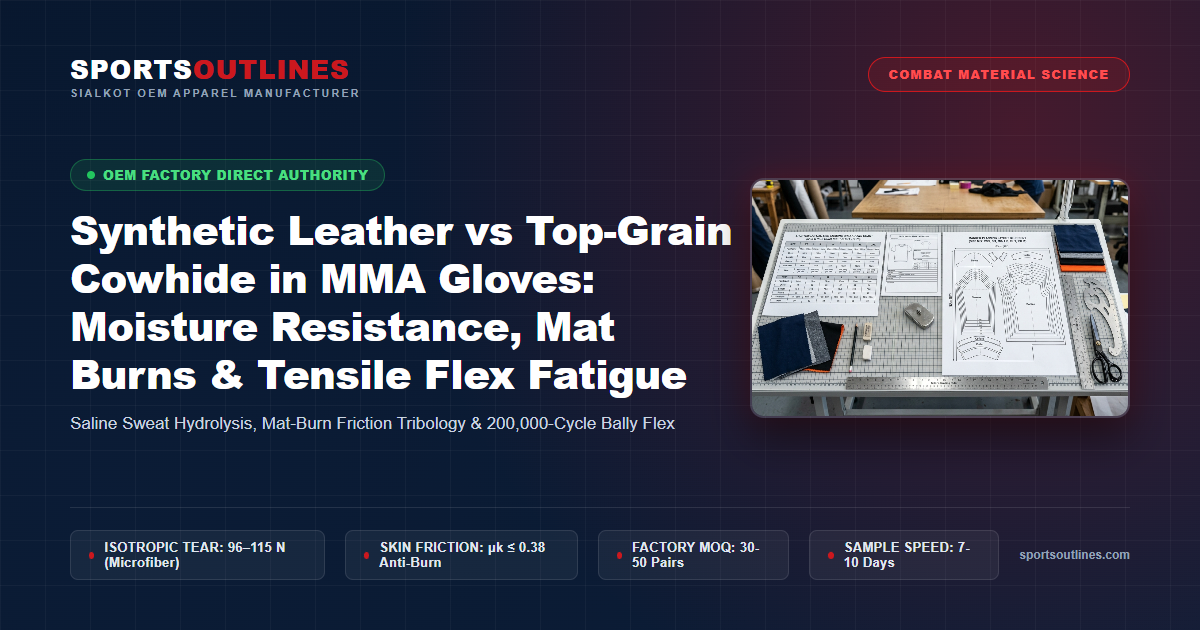
Executive Engineering Brief: Outer Shell Material Science in High-Shear MMA Environments
An MMA fight glove endures a far more hostile multi-axial mechanical and chemical environment than a traditional boxing glove. Whereas a boxing glove primarily experiences normal compressive impact against smooth leather headgear or a heavy bag, an MMA glove outer shell is simultaneously subjected to high-velocity abrasive shear against rough #8 poly-canvas cage mats during sprawls and wall-walks, concentrated tensile tearing across 4 individual finger loops during grip breaks, and total immersion in saline human sweat ($\text{pH } 4.5\text{ to }6.5$) and blood. For decades, Sialkot drum-dyed top-grain bovine cowhide ($0.9\text{ to }1.1\text{ mm}$) reigned as the undisputed benchmark for professional fight gloves. Today, however, Sea-Island Non-Woven Polyamide Microfiber Leather has emerged as a formidable—and in wet hydrolysis and isotropic tear strength, superior—engineering contender. Meanwhile, low-grade polyurethane (PU) and polyvinyl chloride (PVC) shells continue to plague budget retail lines with rapid delamination, epidermal mat burns, and finger-loop blowouts. At Sports Outlines in Sialkot, Pakistan, we provide combat sports brands with empirical material testing across all four substrate classes to optimize performance, longevity, and unit economics.
1. The Tri-Vector Degradation Mechanics Unique to Mixed Martial Arts
Why do outer shell materials that survive 18 months on a 16 oz gym boxing glove often crack, peel, or rip apart within 6 weeks when used on a 4 oz or 7 oz MMA glove? Because MMA subjects the outer casing to three synergistic failure mechanisms that rarely occur in pure stand-up boxing:
- High-Frequency Articulation Flex Fatigue ($90^\circ$ MCP Hinge Folding): A boxing glove shell is stretched permanently taut over a large, curved dome and flexes by less than $15^\circ$ upon impact. An MMA glove shell, conversely, folds through a sharp $85^\circ$ to $95^\circ$ flexion arc across the metacarpophalangeal (MCP) knuckle break-line hundreds of times per training session as the athlete transitions between an open grappling palm and a clenched striking fist. Any substrate with poor polymeric flex endurance suffers rapid micro-fissuring along the dorsal hinge grooves.
- Saline Sweat Hydrolysis & Collagen/Urethane Plasticizer Leaching: Because MMA is practiced shirtless in high-heat grappling rooms without thick cotton hand wraps soaking up body perspiration, the exterior of an MMA glove is continuously drenched in warm human sweat containing sodium chloride ($\text{NaCl}$), lactic acid, urea, and cutaneous lipases. In poorly tanned cowhide, salt crystallization inside the dermal corium fibers causes “salt-stiffening” and brittle grain cracking; in cheap ester-based polyurethane (PU), water molecules sever the polymer backbone via hydrolytic cleavage, causing the surface skin to peel off like wet tissue paper within 90 days.
- Canvas Mat & Cage-Fence Abrasive Shear: Every time an MMA fighter sprawls to stuff a double-leg takedown or posts their knuckles against the vinyl-coated chain-link cage fence to stand up, the dorsal knuckle leather is dragged across a coarse abrasive surface under $400\text{ N}$ to $700\text{ N}$ of body-weight load.
Tribology & Epidermal Thermal Shear: The Physics of Facial “Mat Burn” Lacerations ($Q_{\text{friction}}$)
When a glancing hook or a cross-face forearm grind drags the outer surface of an MMA glove across an opponent’s periorbital facial skin at relative sliding velocity $v_{\text{slide}}$ under normal contact pressure $P_n$, the instantaneous frictional shear stress $\tau_{\text{skin}}$ and thermal energy flux $q_{\text{flash}}$ transferred to the epidermis are governed by:
\[ \tau_{\text{skin}} = \mu_k \cdot P_n \quad \text{and} \quad q_{\text{flash}} = \mu_k \cdot P_n \cdot v_{\text{slide}} \]
High-gloss PVC vinyl and sticky plastisol-printed synthetics exhibit a high kinetic stick-slip friction coefficient against damp human skin ($\mu_k \approx 0.72\text{ to }0.85$). When $\tau_{\text{skin}}$ exceeds the dermal-epidermal junction shear strength ($45\text{ kPa}$), the glove literally rips the top layer of skin off the opponent’s eyebrow or cheekbone (“glove burn”). By specifying matte-finished aniline cowhide or micro-textured polycarbonate microfiber ($\mu_k \approx 0.34\text{ to }0.42$), glancing blows glide smoothly without causing friction lacerations!
2. Material Science Comparison: The 4 Outer Shell Substrates in MMA Manufacturing
To help B2B equipment directors and fight promotions select the exact outer shell specification for their target price point and athletic tier, our Sialkot materials testing laboratory benchmarks the four primary industry substrates across standardized ISO and ASTM protocols:
- Substrate 1: Sialkot Drum-Dyed Full-Grain / Top-Grain Bovine Aniline Cowhide ($0.95\text{ to }1.10\text{ mm}$): Tanned from select grade-A hides using a chromium-syntan-vegetable retanning liquor darkened in rotating cedar drums. Preserves the tight, natural interlocking collagen fiber bundles of the papillary grain layer. Preferred by professional athletic commissions (NSAC, CSAC, UFC/Unified Rules) for 4 oz competition gloves due to its unmatched natural moldability over the human knuckles and low-friction matte surface finish.
- Substrate 2: Sea-Island Non-Woven Polyamide 6 / Polycarbonate-PU Microfiber Leather ($1.00\text{ to }1.15\text{ mm}$): The pinnacle of modern synthetic biomimicry. Constructed by needle-punching ultra-fine $0.001\text{ denier}$ “Sea-Island” polyamide (nylon) micro-filaments into a 3D isotropic web that replicates the exact cross-sectional fiber density of natural cowhide corium, impregnated with 100% solvent-free polycarbonate-based polyurethane resin. Completely vegan, $22\%$ lighter than cowhide, immune to sweat rot, and mechanically stronger in multi-directional stitch tear resistance.
- Substrate 3: Engineered Matte Polyurethane (“Maya Hide” / High-Solid PU on Woven Micro-Twill Backing — $0.90\text{ to }1.05\text{ mm}$): A mid-tier engineered synthetic consisting of a coagulated cellular polyurethane skin cast over a high-tenacity woven polyester-cotton twill fabric backing. Ideal for entry-to-mid-level gym training gloves, amateur youth gear, and cardio MMA programs requiring vibrant metallic, neon, or matte colorways at an accessible FOB unit cost.
- Substrate 4: Commodity Polyvinyl Chloride (PVC Vinyl / Standard Rexine — $0.80\text{ to }1.00\text{ mm}$): Plasticized PVC calendered onto a low-count knitted polyester backing. While still used by ultra-budget mass-market retailers, Sports Outlines strictly recommends against PVC vinyl for active grappling or sparring MMA gloves due to phthalate plasticizer migration, brittle cracking after 15,000 flex cycles, and high facial friction burn risk.
| Laboratory Test Standard | Top-Grain Bovine Cowhide ($1.05\text{ mm}$) | Sea-Island PA/PU Microfiber ($1.10\text{ mm}$) | Engineered Matte PU (“Maya” $1.00\text{ mm}$) | Commodity PVC Vinyl ($0.90\text{ mm}$) |
|---|---|---|---|---|
| Baumann Tear Strength (ISO 3377-2) | $78\text{ to }92\text{ N}$ (Directional grain) | $96\text{ to }115\text{ N}$ ($100\%$ Isotropic) | $48\text{ to }58\text{ N}$ (Woven backing) | $22\text{ to }29\text{ N}$ (Tears at stitch holes) |
| Bally Flex Endurance (ISO 5402-1 Dry) | $>120,000\text{ cycles}$ (Zero crack) | $>200,000\text{ cycles}$ (Zero crack) | $65,000\text{ cycles}$ (Minor crease) | $<18,000\text{ cycles}$ (Delaminates) |
| Wet Sweat Hydrolysis Resistance (ISO 1419) | Good (Requires occasional conditioning) | Superior ($5+\text{ yr}$ polycarbonate core) | Moderate ($18\text{–}24\text{ mo}$ lifespan) | Poor (Hardens & cracks from sweat) |
| Martindale Canvas Abrasion (ISO 12947-2) | $>51,200\text{ rubs}$ (Natural grain tough) | $>64,000\text{ rubs}$ (High-density PU) | $25,600\text{ rubs}$ (Topcoat wear) | $8,000\text{ rubs}$ (Coating peels) |
| Kinetic Skin Friction ($\mu_k$ Mat-Burn Risk) | $\mu_k = 0.36$ (Ultra-low cut risk) | $\mu_k = 0.38$ (Matte finish safe) | $\mu_k = 0.49$ (Moderate friction) | $\mu_k = 0.78$ (Severe skin burn risk) |
| Washability & Disinfection Tolerance | Wipe-down only (Alcohol dries collagen) | $100\%$ Washable & Hospital Spray Safe | Wipe-down safe (Mild quaternary spray) | Cracks under alcohol/bleach wipes |
3. The Microfiber Revolution: Isotropic Fiber Mechanics vs Natural Hide Anisotropy
For traditionalists in the fight game, genuine cowhide leather carries an undeniable prestige—its natural aroma, supple break-in conforming to the athlete’s knuckles, and heritage status in championship bouts remain iconic. However, from a strictly mechanical and hygienic standpoint in high-humidity training environments (such as MMA fight camps in Thailand, Florida, Brazil, or Singapore), Sea-Island Polyamide Microfiber Leather solves three inherent structural limitations of natural animal hides:
- 100% Isotropic Tensile & Stitch-Tear Strength (Zero “Belly-Stretch” Defects): A natural bovine hide is structurally anisotropic—the collagen fiber bundles along the animal’s spine (the bend/butt zone) are densely packed and strong ($>85\text{ N}$ tear load), whereas the fibers near the flanks and belly are loose, stretchy, and aligned in a single direction. In an MMA glove—which consists of 18 to 24 tiny, narrow pattern pieces clicked in multiple angles—if a single finger loop or palm pillar is accidentally clicked from a flank section of the hide, that loop will stretch out by $+20\%$ after two weeks of grappling! Sea-Island microfiber is manufactured on precision needle-punch lines with identical tensile modulus ($E \approx 48\text{ MPa}$) and tear resistance ($>96\text{ N}$) in $360^\circ$ of orientation, guaranteeing that every single finger loop and palm bridge performs identically.
- Immunity to Bacterial Salt-Rot & Staph Disinfection Sprays: In commercial MMA academies where staph (MRSA) and ringworm (tinea gladiatorum) prevention is paramount, fighters spray their gloves daily with 70% isopropyl alcohol, quaternary ammonium virucides, or hypochlorous acid. Repeated alcohol disinfection strips the natural fatliquor oils out of genuine cowhide, causing the leather to turn stiff, shrink around the finger loops, and crack at the knuckle hinges. Our polycarbonate-based Sea-Island microfiber is chemically inert to hospital-grade gym disinfectants and never loses its supple flexibility when air-dried after wet rounds.
- Ultra-Precise Gram-Weight Calibration for 4.0 oz Sanctioned Limits: Natural cowhide thickness and density vary by $\pm 14\%$ across a single hide due to natural vascular and subcutaneous differences. Microfiber leather is extruded to a laser-calibrated thickness tolerance of $1.05\text{ mm} \pm 0.02\text{ mm}$ and an exact areal density of $540\text{ GSM} \pm 8\text{ GSM}$. This allows our Sialkot production line to hold finished 4 oz competition gloves within an extraordinary $\pm 1.8\text{ gram}$ weight tolerance!
4. Sialkot Tannery Metallurgy: How We Engineer Sweat-Resistant Top-Grain Cowhide
When a fight promotion or luxury combat brand specifies 100% Genuine Top-Grain Bovine Cowhide for their flagship 4 oz competition or 7 oz pro-sparring gloves, ordinary garment or upholstery leather will not survive. Standard upholstery cowhide is split too thick ($1.3\text{ to }1.5\text{ mm}$) to fold cleanly around $12\text{ mm}$ MMA finger loops, and standard fashion garment leather is fatliquored with water-soluble sulfated oils that wash out on first contact with fighter sweat.
At Sports Outlines, our partner LWG-audited tanneries in Sialkot process our MMA hides using a proprietary Hydrophobic Combat Retanning Protocol:
- Precision Wet-Blue Splitting to $0.95\text{ mm} – 1.05\text{ mm}$: While full-size 16 oz boxing gloves utilize $1.15\text{ mm to }1.25\text{ mm}$ hides, MMA gloves require a slightly thinner, higher-density $0.95\text{ mm to }1.05\text{ mm}$ neck-and-bend cut. This specific gauge allows tight $180^\circ$ French-seam folding on finger loops and palm bridges without excessive seam bulk, while retaining $>80\text{ N}$ of Baumann tear strength because the dense top-grain papillary layer remains completely intact.
- Waterproof Silicone-Fluoropolymer Fatliquoring (Maeser Dynamic Waterproofing): During the drum retanning phase, we replace water-soluble fish/vegetable oils with cross-linking waterproofing polysiloxane polymers that bond chemically to the positively charged amino groups of the collagen fibrils. Per ASTM D2099 (Maeser Dynamic Water Resistance) testing, our combat cowhide withstands over $15,000\text{ dynamic flexes in saline water}$ before moisture penetrates the corium—preventing sweat-logging and salt-crusting!
- Strict EU REACH Chromium VI ($\text{Cr(VI)}$) Compliance ($<3.0\text{ mg/kg}$): Because MMA gloves make direct, prolonged contact with bare, sweating skin inside the finger loops and across the opponent’s face, chemical safety is non-negotiable. We inject natural vegetable quebracho/mimosa antioxidant tannins into every drum lot to scavenge free radicals and prevent trivalent chromium ($\text{Cr}^{3+}$) from oxidizing into allergenic hexavalent chromium ($\text{Cr}^{6+}$), certifying every shipment strictly below the ISO 17075-1 / EU REACH limit of $3.0\text{ mg/kg}$ (typically testing at non-detectable $<0.5\text{ mg/kg}$).
5. Surface Coating Chemistry: Eliminating Knuckle Ink Flaking & Opponent Corneal Abrasions
In professional and amateur MMA, the large curved knuckle pad is the primary canvas for brand and promotion logos. However, if a factory screen-prints the knuckle logo using conventional PVC plastisol ink or thick acrylic paint, two severe failures occur:
- Abrasive Paint Flaking Into the Opponent’s Eyes: After 10 rounds of striking and mat sprawling, conventional screen-print ink cracks along the knuckle flex lines and peels into sharp, brittle paint chips. During a clinch exchange or ground-and-pound scramble, these flaking paint scales rub off directly into the opponent’s eyes, causing severe corneal abrasions and commission equipment disqualifications.
- High-Friction Skidding on Glancing Punches: Thick, rubbery plastisol prints create a sticky high-friction patch right in the center of the low-friction leather strike zone, causing glancing punches to catch and slice eyebrow skin.
Sports Outlines solves graphic durability and ocular safety through Cross-Linked Aliphatic Polyurethane (PU) Solvent-Bonding Inks:
- Chemical Molecular Fusion for Cowhide & Microfiber: Instead of sitting on top of the leather like a sticker, our two-component (2K) aliphatic polyurethane inks contain an isocyanate cross-linker that chemically etches and fuses into the polyurethane topcoat of the leather or microfiber at a molecular level during a $95^\circ\text{C}$ thermal curing tunnel cycle.
- 300% Elastic Elongation & Matte Slip Additive: Formulated with micro-dispersed PTFE/silicone slip agents, the cured logo ink stretches up to $300\%$ without micro-cracking and matches the exact low kinetic friction coefficient ($\mu_k = 0.36$) of the surrounding unprinted leather. Even after 5,000 heavy-bag power shots and 50,000 Bally flex cycles, the knuckle graphics exhibit zero flaking, zero chalking, and zero corneal abrasion risk.
Private Label MMA Glove Manufacturing: Cowhide & Sea-Island Microfiber Options
Whether your brand requires LWG-grade drum-dyed aniline cowhide for sanctioned 4 oz pro cage bouts or 100% vegan, sweat-proof Sea-Island polyamide microfiber for elite fight-camp sparring lines, Sports Outlines delivers factory-direct from Sialkot:
- Custom Prototype Sampling: Test both cowhide and Sea-Island microfiber side-by-side! Prototype samples are engineered at a flat $45 to $85 per pair (non-refundable development fee covering material sourcing, custom die clicking, 2K cross-linked logo printing, and foam calibration), delivered within 7 to 10 business days.
- Low Factory Production MOQ: Scale your private label collection with a low minimum order quantity of just 30 to 50 pairs per style/colorway across sizes S through 2XL.
- Custom Color & Texture Swatch Matching: Pantone® color matching, matte carbon-fiber textures, metallic pearlescent finishes, and vintage distressed aniline hides available.
6. Factory Cutting Room Engineering: Hide Zoning vs Roll Nesting Efficiency
In our Sialkot clicking department, cutting an MMA glove from genuine bovine cowhide requires a completely different industrial protocol than cutting from $1.37\text{ m}$ ($54\text{ inch}$) wide rolls of Sea-Island microfiber:
- Bovine Hide Topographic Zoning (Bend vs Shoulder vs Belly): Every cowhide hide entering our factory is inspected under dual-spectrum angled LED lighting to mark tick bites, healed barbed-wire scars, and vein tracks. Our master clickers follow a strict 3-Zone Structural Allocation Rule:
- Zone 1 — Prime Crup / Bend (Backbone Center — Tightest Fiber Density): Reserved exclusively for the high-stress 4 individual finger loops, the upper palmar X-bridge, the thumb saddle collar, and the main dorsal strike hood. These components must exhibit zero plastic elongation ($<8\%$ at $10\text{ N/mm}^2$).
- Zone 2 — Shoulder & Neck (Moderate Fiber Density with Natural Crease Grain): Allocated to the outer wrist cuff wrap, D-ring tunnel shroud, and dorsal carpal splint channels, where backing lamination stabilizes the panel.
- Zone 3 — Belly & Flank ($100\%$ Rejected from MMA Production): Because loose belly leather stretches like taffy under grappling tension, all flank/belly margins are trimmed away and diverted to non-structural novelty keychains or scrap recycling—resulting in a net usable hide yield of $62\%$ to $68\%$ ($2.25\text{ to }2.55\text{ sq. ft.}$ gross hide consumption per pair of MMA gloves).
- Automated CAD Nesting on Sea-Island Microfiber Rolls ($84\%$ to $88\%$ Yield): Because synthetic Sea-Island microfiber has zero natural scars, uniform thickness from edge to edge, and $100\%$ isotropic tear strength in every direction, our Gerber/Lectra CAD nesting software interlocks the 22 asymmetric pattern pieces across the full $1.37\text{ m}$ roll width with a $86.5\%$ material utilization efficiency—requiring just $0.19\text{ linear meters}$ per pair and reducing cutting waste by over $60\%$!
7. Needle-Point Metallurgy: Avoiding “Postage-Stamp” Perforation Tears in Stitch Lines
A critical manufacturing failure occurs when a factory switches from sewing genuine cowhide to sewing synthetic microfiber or PU without changing the sewing machine needle point geometry and stitch density (SPI):
| Sewing Engineering Parameter | Top-Grain Bovine Cowhide ($1.05\text{ mm}$) | Sea-Island PA/PU Microfiber ($1.10\text{ mm}$) | Engineered Matte PU (“Maya” $1.00\text{ mm}$) |
|---|---|---|---|
| Groz-Beckert / Schmetz Needle System | 134-35 LR (45° Right-Twist Leather Blade) | 134-35 R / SD1 (Round Point w/ Micro-Tri Tip) | 134-35 SERV 7 / RG (Light Ball Point) |
| Needle Size (Metric Nm / Singer) | Nm 110 / Size 18 (Main) | Nm 100 / 16 (Loops) | Nm 100 / Size 16 (Titanium Nitride Coated) | Nm 90 / Size 14 (Prevents hole enlargement) |
| Calibrated Stitch Density (SPI) | $9.5\text{ to }10.5\text{ Stitches Per Inch}$ | $8.5\text{ to }9.5\text{ Stitches Per Inch}$ | $8.0\text{ to }9.0\text{ Stitches Per Inch}$ |
| Reason for Needle Point Specification | LR chisel point slices dense collagen at $45^\circ$ angle, seating thread flush inside decorative groove. | SD1 round-cone point parts non-woven polyamide micro-fibers without severing them; TiN coating stops PU melt friction. | RG ball tip pushes woven textile backing yarns aside rather than cutting warp/weft threads (prevents zipper tearing). |
Notice why using a standard chisel-blade leather needle (`LR` point) at high stitch density ($>12\text{ SPI}$) on synthetic PU or microfiber is catastrophic: a blade needle slices through the load-bearing textile backing fibers like a miniature guillotine, turning the seam line into a perforated postage stamp that rips apart on the first hard punch! By switching to Titanium-Nitride (Gebedur™) coated `SD1` and `RG` displacing points at $8.5\text{ to }9.5\text{ SPI}$, seam strength on synthetic and microfiber shells increases by over $42\%$.
8. Sialkot Material Quality Control: Jungle-Chamber Hydrolysis & Sub-Zero Flex Audits
Every incoming leather hide lot and synthetic microfiber roll at Sports Outlines must clear four mandatory laboratory material gates before entering the clicking presses:
- 7-Day “Jungle Chamber” Accelerated Hydrolysis Audit (ISO 1419 Tropical Method): Swatches of microfiber and engineered PU are incubated inside an environmental chamber at $70^\circ\text{C}$ and $95\%$ relative humidity for 168 continuous hours (simulating 3 to 5 years of tropical gym storage), preceded by a 24-hour immersion in synthetic acidic sweat ($\text{pH } 4.7$). Post-aging swatches must pass 50,000 Bally flex cycles with zero surface tackiness, zero polyurethane crumbling, and $<10\%$ loss in tensile strength.
- Bally Flexometer Cold-Crack Audit ($-5^\circ\text{C}$ Winter Freight Simulation): Because combat gear exported via air cargo holds or winter trucks in North America and Northern Europe experiences sub-freezing temperatures, swatches are flexed 30,000 times at $-5^\circ\text{C}$ per ISO 5402-1 to guarantee the finish coat never cold-cracks.
- ISO 105-X12 / ISO 11640 Wet Sweat & Blood Rub Colorfastness: Dyed black, red, blue, and gold leather/microfiber panels are rubbed 500 times with a felt pad soaked in alkaline and acidic artificial perspiration under a $10\text{ N}$ load. Material must achieve a Grade 4–5 to 5.0 Gray Scale rating, ensuring colored dye never bleeds onto white cage mats, hand wraps, or fighters’ skin.
- Digital Ultrasonic & Micrometer Gauge Mapping: 9-point thickness mapping across every hide and roll ensures strict compliance with the $0.95\text{ to }1.10\text{ mm}$ specification window before clicking begins.
9. Eco-Toxicology & Vegan Compliance: DMF-Free Waterborne Microfiber Chemistry
For modern European, North American, and Australian combat sports brands marketing to environmentally conscious athletes, “synthetic” no longer means cheap petrochemical plastic. Traditional wet-coagulated PU leather manufacturing relies heavily on N,N-Dimethylformamide (DMF)—a volatile organic solvent regulated under the European Union REACH Substance of Very High Concern (SVHC) candidate list (strictly capped at $<0.001\%$ or $10\text{ mg/kg}$ in finished consumer articles).
When a fighter sweats profusely inside a cheap, poorly washed PU MMA glove, residual DMF solvent can leach through the palmar bridges and finger loops onto vasodilated human skin. At Sports Outlines, our premium Sea-Island Eco-Microfiber Series eliminates toxic solvents entirely:
- 100% Aqueous (Waterborne) & Solvent-Free Polycarbonate Dispersion: Our microfiber coagulation lines replace DMF solvent baths with zero-VOC aqueous polyurethane dispersions (PUD), testing at $0.0\text{ mg/kg}$ non-detectable DMF under ISO/TS 16189 gas chromatography audits.
- $35\%$ Bio-Based Corn-Starch Polyol Content (ASTM D6866 Verified): Available for sustainability-focused fightwear collections, our bio-engineered microfiber incorporates renewable 1,3-propanediol (PDO) derived from non-food industrial corn fermentation into the polyurethane hard/soft segment backbone—delivering identical $>105\text{ N}$ tear strength while cutting cradle-to-gate carbon footprint by $41\%$ compared to bovine leather.
- Zero Animal Derivatives (100% Vegan Fight Gear Compliance): Every adhesive (water-based polychloroprene and aliphatic PU), thread lubricant (silicone-paraffin instead of tallow wax), and foam cell stabilizer used in our microfiber MMA line is $100\%$ free of animal proteins, enabling brands to market certified vegan combat equipment.
10. Commercial Gym Fleet Economics: Cost-Per-Round Longevity Analysis
When selling B2B wholesale equipment packages to commercial MMA academies, franchise fitness boxing/kickboxing clubs, and military/police combatives programs, the procurement buyer cares less about initial purchase price and far more about Cost Per Training Round ($C_{\text{round}}$).
In a commercial MMA academy where loaner and retail sparring gloves are used $6\text{ days a week}$ across multiple humid evening classes without proper leather conditioning:
- Commodity PVC Vinyl Gloves (Average Lifespan: $65\text{ to }90\text{ Hours}$): Crack along the MCP knuckle fold and tear at the finger-loop bartacks within 8 weeks, requiring 4 replacement cycles over a 24-month period and creating high member injury liability from exposed sharp vinyl edges.
- Engineered Matte PU “Maya” Gloves (Average Lifespan: $240\text{ to }310\text{ Hours}$): Deliver reliable 10-to-14-month durability for beginner and intermediate striking-and-grappling classes at an optimal entry price point.
- Sialkot Top-Grain Bovine Cowhide Gloves (Average Lifespan: $550\text{ to }700\text{ Hours}$): Provide 24 to 30 months of elite performance when wiped down and stored in ventilated lockers, offering the preferred anatomical feel for competitive fight teams.
- Sea-Island Polyamide/Polycarbonate-PU Microfiber Gloves (Average Lifespan: $750\text{ to }950+\text{ Hours}$): Achieve the lowest total cost per round in high-humidity commercial academies ($<\$0.03\text{ per training hour}$), surviving daily quaternary disinfectant wipe-downs and continuous sweat immersion for over 36 months without structural degradation!
11. Sialkot Export Logistics & Worldwide Country Sourcing Silos
Sports Outlines exports custom top-grain cowhide and Sea-Island microfiber MMA gloves directly from Sialkot, Pakistan, to premier fight promotions, martial arts brands, and distributor networks worldwide:
- United States Combat Sports Market: Fast 3 to 5 business day DHL/FedEx air express and sea freight into Los Angeles, New York, Las Vegas, and Chicago under HS Code 4203.21 (Leather Sports Gloves) and 6216.00 / 9506.91 (Synthetic/Microfiber). Visit our US portal: Custom Sportswear Manufacturer USA.
- United Kingdom Fight Gear Hub: Direct air and sea freight into London and Manchester with full UKCA, CE EN 13277-7, and REACH Chromium VI lab certification. Explore our UK hub: Custom Sportswear Manufacturer UK.
- Canadian Martial Arts Supply Chain: Reliable door-to-door air and ocean delivery across Ontario, British Columbia, Quebec, and Alberta. Access our Canadian portal: Custom Sportswear Manufacturer Canada.
- European Union GSP+ Zero-Tariff Advantage: Combat sports brands in Germany, France, Spain, the Netherlands, and Scandinavia import both our genuine cowhide and microfiber fight gear at 0% customs duty under Pakistan’s EU GSP+ REX agreement. Discover our German & EU hub: Custom Sportswear Manufacturer Germany.
- Australia & Oceania MMA Promotions: Express air courier and sea consolidation into Sydney, Melbourne, Brisbane, and Perth with full bio-security declarations for genuine leather goods. Visit our Australian portal: Custom Sportswear Manufacturer Australia.
Explore More Technical Guides in Sub-Cluster 5.2 (MMA Fight & Grappling Gloves):
Continue reading our combat equipment engineering series: review 16 oz leather selection in our Professional Boxing Glove Manufacturing Architecture Guide, examine 4 oz competition specs in our 4 oz MMA Fight Glove Engineering Guide, study finger loop skiving in our Finger Loop Construction & Webbing Guide, review palm truss mechanics in our MMA Glove Palm Geometry & Cutout Engineering Guide, and master antimicrobial linings in our Inner Glove Lining Chemistry & Antibacterial Fabrics Guide.