Direct Manufacturer Answer: How to Manufacture Custom Insulated Running Vests & Gilets
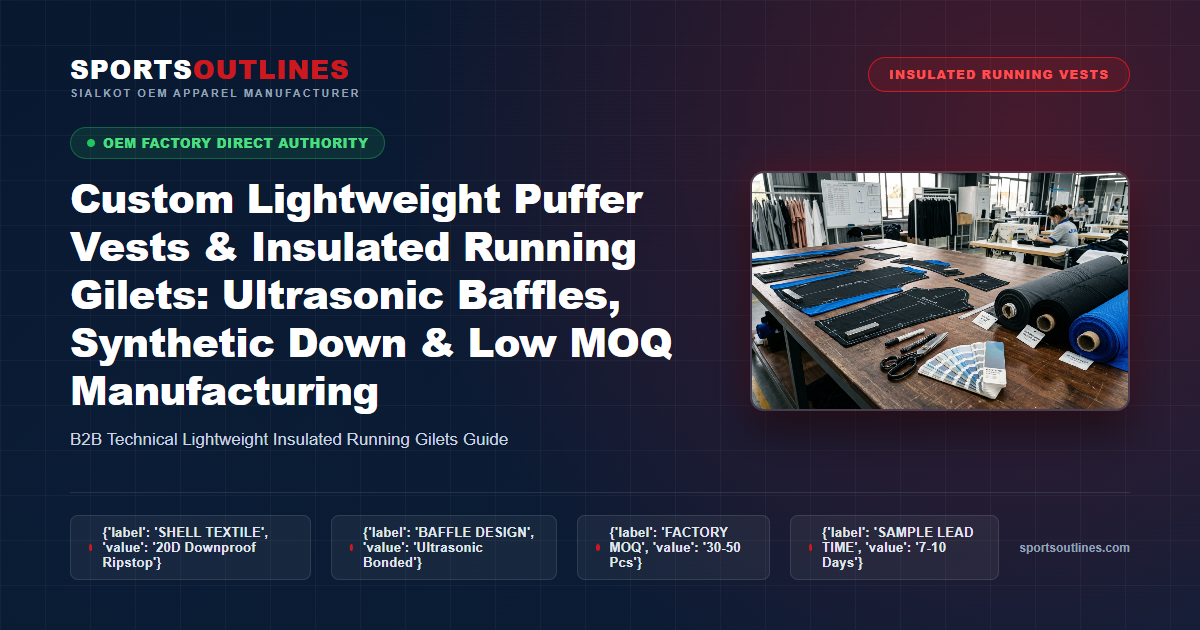
Manufacturing commercial-grade custom lightweight puffer vests and insulated running gilets requires engineering ultralight 20D to 40D downproof micro-ripstop nylon or recycled polyester shell fabrics (38 to 52 GSM), filled with hydrophobic synthetic micro-cluster insulation (80 to 120 GSM), and constructed using ultrasonic stitch-free heat-welded baffles or downproof micro-quilting, hybrid stretch-fleece side ventilation panels, elasticized Lycra-bound armholes, and drop-tail hem geometry. In endurance running, winter track warmups, trail marathons, and high-performance athleisure lines, the running gilet serves as the ultimate core thermo-regulation garment. Unlike bulky street puffers, an athletic running vest must maintain torso core warmth around the heart and lungs while allowing total upper-body heat release and unrestricted arm-swing mobility. Key engineering disciplines include eliminating needle punctures via ultrasonic quilting (preventing down leakage and blocking wind drafts), integrating 280 GSM brushed poly-spandex stretch side panels, installing YKK semi-autolock reverse coil zippers with interior draft tubes, and designing an internal self-stowing packable pocket. At Sports Outlines in Sialkot, Pakistan, we manufacture private label insulated running vests at an accessible low factory MOQ of 30 to 50 pieces per style/colorway with complete size grading from XS to 3XL. Physical pre-production prototypes are developed in 7 to 10 business days for $45 to $85 per piece under a strict zero refund and zero credit policy.
- Shell & Lining Textile: 20D 400T Ciré Downproof Ripstop Nylon (42 GSM) treated with eco-friendly C6 DWR water repellency.
- Thermal Fill Technology: 100 GSM Hydrophobic Micro-Cluster Synthetic Down (0.95 Clo rating, retaining 95% loft when damp).
- Baffle Construction: Ultrasonic seam-free heat-welded chambers eliminating needle hole down migration and wind infiltration.
- Hybrid Stretch Panels: 280 GSM 4-way stretch brushed poly-spandex side panels providing thermal ventilation and lat mobility.
- Packable Utility: Interior zippered chest pocket reversing into a self-stow pouch with elastic carry loop for marathoners.
- Reflective Safety: 360-degree high-candela silver reflective transfers on front zipper tape, chest logo, and rear lumbar stripe.
- Low Production MOQ: 30–50 pieces per style/colorway across flexible size curves from XS to 3XL.
- Physical Sample Terms: $45–$85 per custom prototype in 7–10 days (strict zero credit or refund policy).
- Direct Sourcing Channel: WhatsApp factory direct at +92 316 7932595 or via sportsoutlines.com.
In the demanding world of endurance athletics, cold-weather trail running, and luxury athletic streetwear, the lightweight insulated running vest (gilet) is revered as the single most functional layering piece an athlete can own. When outdoor temperatures plunge between -2°C and 10°C, a full insulated jacket often causes severe overheating after the first two miles, saturating sleeves in sweat and forcing the runner to strip down.
The running vest solves this biological paradox by applying targeted insulation strictly over the body’s critical core organs—the chest, heart, and lungs—while leaving the arms, underarms, and shoulders completely unencumbered. This maintains essential vascular core temperature while maximizing radiant convective cooling from the arms and armpits during intense aerobic expenditure.
However, engineering a technical running gilet requires far greater manufacturing precision than standard lifestyle puffer vests. Cheap promotional vests suffer from major performance defects: feather and fiber leakage through porous needle holes, cold spots where insulation bunches into the bottom of baffles during running cadence, armhole chafing that blisters the runner’s biceps after 5 miles, and ballooning aerodynamic drag that catches head-on crosswinds like a parachute.
At Sports Outlines in Sialkot, Pakistan, we combine advanced downproof weaving, automated ultrasonic baffle bonding, precision synthetic cluster blow filling, and laser pattern cutting. Whether your sportswear brand is building marathon gear for runners in the United States, technical running clubs in the United Kingdom, or outdoor activewear lines in Australia, Canada, or Germany, our flexible low factory MOQ of 30 to 50 pieces per style empowers you to launch custom insulated vests with professional marathon-grade performance.

1. Insulation Science: Hydrophobic Synthetic Micro-Cluster Down vs Natural Down
In static lifestyle outerwear, goose or duck down offers exceptional loft-to-weight ratios. However, in high-intensity cardiovascular athletic gear, natural down is a dangerous liability: the instant natural down encounters heavy athlete sweat or freezing rain, the fragile feather plumes absorb water, collapse into a sodden clump, and lose 100% of their insulating thermal clo value.
For athletic running vests, Sports Outlines engineers Hydrophobic Synthetic Micro-Cluster Fiberfill (100% recycled polyester ultra-fine conjugated filaments):
- Moisture-Resistant Loft Retention: The synthetic filaments are coated in a sub-micron silicone finish that repels liquid water. Even when saturated with runner perspiration or freezing drizzle, the fibers maintain 95% of their three-dimensional air-trapping loft, preserving thermal warmth.
- Ultra-Fast Drying Speed: Unlike natural down that requires 24+ hours in commercial dryers, synthetic micro-clusters dry in less than 45 minutes on a hanger, allowing athletes to train daily without garment mildew.
- Hypoallergenic & Cruelty-Free: 100% vegan construction certified by GRS (Global Recycled Standard) and OEKO-TEX Standard 100, aligning with modern athletic consumer ethics.
2. Baffle Architecture: Ultrasonic Welded vs Stitch-Through Quilting
How the insulation is partitioned into chambers determines both the windproof defense and the long-term durability of the vest:
Ultrasonic Stitch-Free Heat-Welded Baffles (Pro Marathon Grade)
In traditional quilted vests, sewing machines punch thousands of needle holes through the shell to create horizontal baffle lines. Under freezing crosswinds, cold air shoots directly through these micro-punctures, while synthetic fibers slowly leak through the stitch holes.
Sports Outlines utilizes rotary ultrasonic welding calenders. High-frequency ultrasonic vibrations (28 kHz) melt and fuse the thermoplastic shell and lining fabrics together along geometric baffle lines with zero sewing needles:
- 100% Wind & Water Block: Because the fabric is fused continuously, there are zero needle punctures. Freezing air cannot penetrate, and down fibers can never poke through the baffle dividers.
- Bespoke Geometric Chamber Quilting: Ultrasonic technology allows us to create custom baffle shapes—such as chevron arrows, hexagonal honeycombs, or ergonomic body-contoured waves—that follow muscular chest anatomy without needle puckering.
- Reduced Garment Weight: Eliminating hundreds of meters of sewing thread shaves 25 to 35 grams off the total vest weight, creating an ultra-featherweight running feel.
Ciré Heat Calendering & Downproof Air-Permeability Dynamics
To prevent ultra-fine synthetic microfibers (measuring less than 0.8 denier) from migrating between the yarn threads of the 20D ripstop shell, fabric rolls undergo an industrial high-temperature ciré calendering treatment. The fabric is fed between a high-pressure mirror-polished steel cylinder heated to 180°C and a compressed cotton backing roller under 35 kg/cm² pressure.
This thermo-mechanical process flattens the rounded nylon yarn filaments and partially melts the microscopic gaps at yarn intersections. The resulting fabric achieves three critical technical performance thresholds:
- Permanent Fiber Lockout: Pore dimensions are reduced to less than 5 microns, permanently blocking fiber clusters from poking through to the exterior face without requiring heavy, non-breathable polyurethane coatings.
- Controlled Wind Filtration (1.0 to 1.5 CFM): The calendering process leaves an exact microscopic porosity that stops freezing gusts dead while permitting high-pressure internal moisture vapor to escape.
- Low Acoustic Friction (Whisper-Quiet Stride): Standard ripstop shells generate a loud, annoying swishing noise with every arm swing. Ciré-flattened yarn faces glide against each other almost silently, providing a quiet, focused running experience.
Body-Mapped Differential Gram-Weight Injection Matrix
Cheap commercial vests fill all baffle chambers with a uniform quantity of insulation. This creates thermal imbalances: the spine overheats and soaks through with sweat, while the lower kidneys and collarbones freeze. Sports Outlines applies an anatomically graduated gram-weight injection matrix:
- Anterior Thoracic Zone (Chest & Clavicle): Filled to 120 GSM equivalent density to shield the bronchial airways, heart, and lungs against direct headwind convection.
- Posterior Lumbar & Kidney Zone: Filled to 100 GSM density to maintain vital organ temperature and lower-back lumbar muscular warmth during long tempo runs.
- Upper Thoracic Spine & Shoulder Caps: Reduced to 70 GSM density to facilitate evaporative cooling along the central dorsal sweat trough where the human body dumps maximum thermal heat during intense running.
Traditional Micro-Stitched Baffles with Tex-40 Downproof Thread
For brands seeking a classic lifestyle aesthetic, we offer micro-stitched baffle quilting using ultra-fine SPI-12 (12 stitches per inch) precision sewing. We pair this with Tex-40 bonded downproof continuous filament threads and apply internal heat-expanding seam seal coatings that expand after laundering to permanently plug the needle puncture channels.
3. Biomechanical Hybrid Construction: Stretch-Fleece Side Panels
A puffer vest constructed entirely of insulated nylon has zero lateral stretch. When a runner breathes deeply or swings their arms during hill sprints, a rigid vest binds across the chest and forces the bottom hem to ride upward.
Sports Outlines engineers a bi-zonal hybrid construction:
- Front & Back Insulated Cores: 20D ripstop nylon shell with 100 GSM synthetic down, blocking wind across the chest, clavicle, upper back, and kidneys.
- Side Body Flex Panels (8.0 cm Wide): Constructed from 280 GSM 88% polyester / 12% spandex brushed microfleece. These side inserts stretch up to 45% laterally, accommodating full ribcage expansion during maximum oxygen uptake (VO2 max) efforts.
- Active Vapor Evacuation: The uninsulated fleece side panels function as thermal exhaust chimneys, venting excess heat and sweat vapor directly away from the underarms where sweat glands are most concentrated.
- Anti-Chafe Lycra Armhole Binding: Armholes are bound with soft, 15 mm pre-folded four-way stretch Lycra tape sewn with flatlock elasticity. This prevents abrasive edge seams from rubbing against the runner’s inner bicep during a 26.2-mile marathon.
4. Hardware & Functional Utilities: Packable Stowage & Media Pockets
Our technical running gilets incorporate dedicated endurance sports hardware:
- Packable Self-Stowing Pocket: An interior chest pocket fitted with a double-sided reversible YKK zipper slider. The entire vest compresses down and packs inside this pocket into a compact 18 x 12 cm pouch equipped with an elastic hand strap for easy mid-run carrying.
- Semi-Autolock Center Front Zipper: YKK #3 reverse-coil zipper featuring a flip-down locking puller that stays pinned against the chest without bouncing or tapping against the runner’s breastbone during stride cycles.
- Internal Storm Flap & Chin Garage: Full-length draft flap behind the zipper backed with brushed micro-tricot, shielding the neck from icy drafts and zipper bite.
- Silicone Gripper Drop-Tail Hem: The curved back lumbar hem features an interior 2.5 cm elastic band lined with silicone wave beads, locking the vest firmly against running tights and preventing it from riding up.
5. Complete POM Sizing & Pattern Grading Specification (XS to 3XL)
Below is our master factory Point of Measure (POM) grading chart for Custom Insulated Running Vests (20D downproof nylon, 100 GSM synthetic down, stretch side panels, athletic fit):
6. Step-by-Step 11-Stage Factory Manufacturing Workflow
From downproof fabric inspection through ultrasonic welding and fiber injection to finished polybagging, here is Sports Outlines’ rigorous 11-stage factory manufacturing pipeline:
- Downproof Fabric Calendering & Ciré Finishing: 20D nylon rolls pass through 180°C high-pressure steel rollers to melt surface fiber intersections, sealing the weave tight against fiber migration.
- DWR C6 Hydrophobic Pad Curing: The outer shell receives fluorocarbon-free water-repellent polymers, baked at 160°C for high droplet bead-off performance.
- Automated CNC Knife Cutting: Vest shell, lining, and stretch fleece side panels are cut under vacuum hold-down with 0.2 mm precision.
- Ultrasonic Baffle Chamber Welding: Rotary ultrasonic machines weld horizontal and ergonomic chevron baffle lines across front and back panels without needle stitching.
- Calibrated Synthetic Down Injection: Computer-controlled pneumatic blowing machines inject exact gram-weight synthetic micro-clusters into each individual welded chamber.
- Chamber Perimeter Sealing: Perimeter edges are locked using 4-thread overlock safety stitches, trapping all insulation permanently inside the chambers.
- Hybrid Stretch Side Panel Joining: 280 GSM brushed poly-spandex side inserts are joined using 4-needle flatlock seams for flush, chafe-free comfort.
- Center Front Zipper & Storm Flap Insertion: Semi-autolock YKK reverse coil zippers and tricot-lined chin guard draft flaps are topstitched into place.
- Lycra Armhole Binding & Hem Finishing: 15 mm stretch Lycra bindings are folded and topstitched around armholes, and silicone wave elastic is inserted into the hem.
- Reflective Safety Transfers & Packable Pocket: 360-degree reflective silver brand logos and reversible packable zipper pockets are installed and inspected.
- Inline Measurement Audit, Steaming & Packaging: Every vest undergoes complete POM verification, tunnel steaming, and sealing into 65-micron frosted LDPE polybags.
Laboratory Performance Testing & Quality Benchmark Suite
To verify that custom insulated running vests withstand freezing endurance runs, heavy sweat saturation, and repeated commercial laundry without leaking insulation or losing loft, Sports Outlines tests every production run against strict international standards:
Athlete Care Protocols & Retail Packaging Standards
To preserve the 20D micro-ripstop nylon integrity, DWR water repellency, and synthetic micro-cluster loft of custom running vests, activewear brands must communicate explicit care guidelines. We recommend machine washing on gentle cycle in cold water (30°C) with technical liquid detergent. Never use powdered detergents or fabric softeners. Tumble dry on low heat with two clean tennis balls or dryer balls for 30 minutes to re-loft the synthetic clusters evenly throughout all baffle chambers.
For premium retail presentation, Sports Outlines delivers each custom insulated vest individually compressed and packed in heavy-gauge 65-micron frosted LDPE polybags featuring zip-slider closures, punched air vents, silica gel desiccant packets, and scannable GS1-compliant barcode stickers.
7. Factory Low MOQ & Prototype Sampling Policy
In traditional overseas manufacturing, outerwear factories refuse custom insulated puffer vest orders under 500 to 1,000 pieces per style due to the complexity of baffle tooling and synthetic blow filling. Sports Outlines empowers emerging activewear brands through an accessible low-risk manufacturing model:
- Low Factory Production MOQ: 30 to 50 pieces per style/colorway, with flexible size distribution from XS to 3XL.
- Physical Prototype Sampling: Complete pre-production physical prototypes delivered in 7 to 10 business days for $45 to $85 per piece.
- Strict Sample Policy: Prototype sampling fees cover specialized CAD vectoring, digital pattern nesting, ultrasonic tooling calibration, and technician setup. Under our strict zero refund and zero credit policy, all prototype fees are 100% non-refundable and cannot be applied as credits toward bulk orders.
- Bulk Production Turnaround: Full commercial bulk manufacturing completed and shipped in 18 to 24 business days following physical sample sign-off.
- Direct Manufacturer Channel: Communicate directly with our apparel production engineers in Sialkot, Pakistan via WhatsApp at +92 316 7932595 for instant quotes, fabric swatch dispatch, and tech pack reviews.
Manufacture Custom Lightweight Insulated Running Vests
Partner directly with Sialkot’s premier technical athletic outerwear manufacturing factory. Send us your tech packs or design concepts to develop physical prototypes in 7–10 days with production MOQs starting at just 30–50 pieces.
Frequently Asked Questions (FAQ) – Insulated Running Vest Manufacturing
Why is synthetic micro-cluster down superior to natural goose down for running vests?
Natural down collapses and loses all insulation when wet from athlete perspiration or freezing rain. Our hydrophobic synthetic micro-cluster down is siliconized to repel moisture, retaining 95% of its thermal loft and drying in under 45 minutes.
What is the benefit of ultrasonic welded baffles over stitched quilting?
Ultrasonic welding uses high-frequency sound waves to fuse the shell and lining without sewing needles. This eliminates thousands of puncture holes, creating 100% windproof chambers that permanently prevent down fiber leakage.
Why do you include stretch-fleece side panels on running vests?
Our 280 GSM poly-spandex side panels stretch up to 45% to accommodate deep chest breathing during running, while functioning as breathable chimneys that vent excess heat and sweat vapor away from the underarms.
What is your minimum order quantity (MOQ) for custom insulated running vests?
Our low factory production MOQ is 30 to 50 pieces per style/colorway. You can distribute this quantity across sizes XS to 3XL, enabling activewear and running brands to launch technical outerwear without heavy inventory risk.
How much do custom insulated running vest physical samples cost and what is the lead time?
Physical pre-production prototypes are developed in 7 to 10 business days for $45 to $85 per piece. Under our strict zero refund and zero credit policy, prototype development charges are 100% non-refundable and non-creditable toward bulk orders.
Published by the Endurance Outerwear & Technical Running Division at Sports Outlines. For private label manufacturing inquiries and custom tech pack evaluations, contact our Sialkot factory directly via WhatsApp at +92 316 7932595 or explore our related manufacturing guides for weatherproof softshell jackets, running windbreakers, and poly tricot track jackets.