
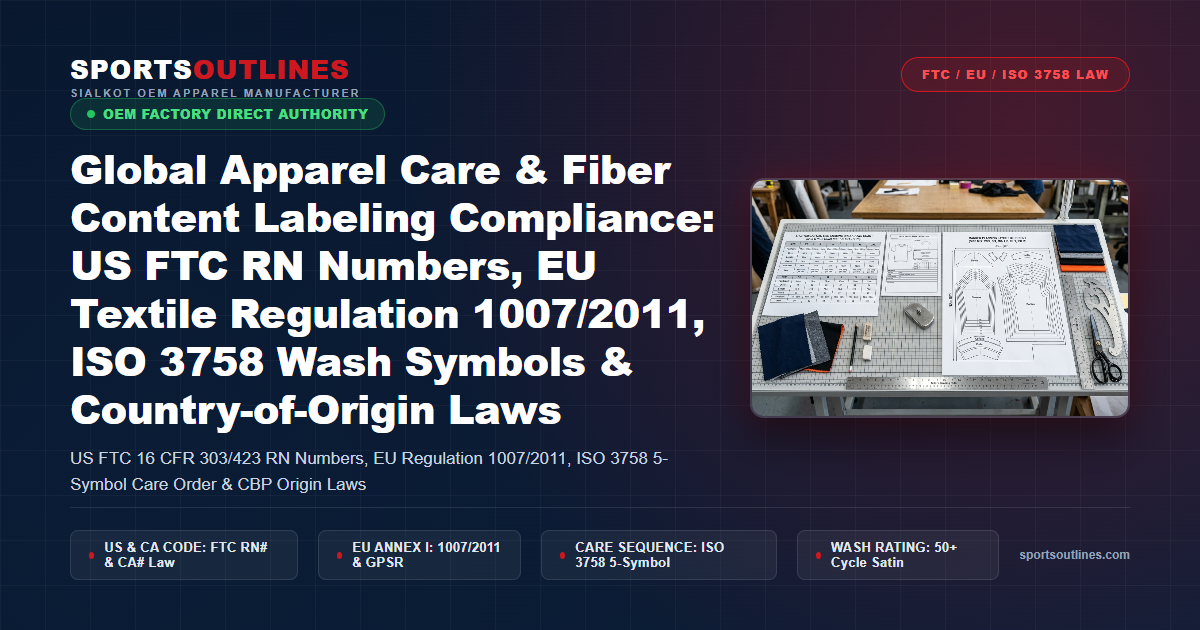
Sub-Cluster 6.2 • Regulatory Customs Compliance & Textile Labeling Law Blueprint (Blog #443)
Why Non-Compliant Care and Fiber Labels Trigger US CBP Customs Holds, EU Market Recall Orders, and Retail Chargebacks
A custom athletic garment can pass every physical seam-tensile test and spectrophotometer Delta E audit on the factory floor in Sialkot, yet still be seized at the Port of Los Angeles, Port of Rotterdam, or Felixstowe if its internal care and fiber composition label violates statutory customs and consumer-protection regulations. Under 19 U.S.C. § 1304 (United States Tariff Act Country of Origin Marking), US FTC 16 CFR Part 303 (Textile Fiber Products Identification Act), 16 CFR Part 423 (Care Labeling of Textile Wearing Apparel), EU Regulation (EU) No 1007/2011, and Canada’s Textile Labelling Act (R.S.C., 1985, c. T-10), missing a single mandatory disclosure—or printing trade names like “Spandex” or “Lycra” where “Elastane” is legally required—subjects an importer of record to immediate U.S. Customs and Border Protection (CBP) Form 4647 Notice to Mark/Redeliver holds, 10% ad valorem marking duties, and civil penalties exceeding $50,120 per violation. This exhaustive legal-engineering guide provides private-label sportswear founders and compliance directors with the complete global statutory blueprint for compliant care and fiber content labeling.
When scaling an omnichannel activewear, combat sports, or technical outerwear brand across North America, the European Union, the United Kingdom, Canada, and Australia, apparel founders quickly discover that textile labeling laws are not harmonized globally. While the physical garment construction remains identical across territories, the legal nomenclature, placement rules, language translations, and care-symbol standards differ sharply by customs jurisdiction.
To eliminate costly re-labeling reworks at third-party logistics (3PL) warehouses—where unbagging, sewing replacement care labels, and re-polybagging garments costs $2.50 to $4.75 per unit—our Sialkot export compliance division engineers Multi-Jurisdictional Harmonized Care & Content Labels directly at the point of origin. By combining compliant neck transfer typography (Blog #441: Custom Apparel Neck Label Engineering) with multi-page ultrasonic satin side-seam care labels and retail barcode swing tickets (Blog #442: Luxury Sportswear Hangtag Engineering), a single SKU can clear customs seamlessly in all five primary Western markets.
1. United States Labeling Statutory Framework: FTC 16 CFR Part 303, 16 CFR Part 423 & CBP 19 CFR Part 134
Apparel imported into the United States is policed concurrently by two federal agencies: U.S. Customs and Border Protection (CBP) at the port of entry, and the Federal Trade Commission (FTC) in domestic retail and e-commerce commerce. Every textile garment entering the United States must satisfy four non-negotiable statutory pillars:
1.1 Generic Fiber Content Disclosure & The 5% Ornamentation / 3% Tolerance Rules (16 CFR Part 303)
Under the Textile Fiber Products Identification Act (16 CFR § 303.16), every garment must disclose its constituent fibers by percentage of total fiber weight in descending order of predominance, using official FTC generic fiber names (16 CFR § 303.7) or ISO 2076 equivalents:
- Descending Weight Hierarchy & Equal Type Typography: A compression legging composed of 78% nylon and 22% spandex must be printed as
78% Nylon / 22% Spandex(or22% Elastane). All fiber names and percentages must be printed in type or lettering of equal size and conspicuousness—you cannot print “100% ORGANIC COTTON” in 14pt bold font while hiding “80% Polyester / 20% Cotton” in 6pt font. - The 5% Minimum Disclosure Threshold (“Other Fiber” Rule): Under 16 CFR § 303.3, any non-functional fiber representing less than 5% of total weight cannot be named specifically unless it serves a definite functional purpose (such as
3% Spandex for elasticityor2% Silver-Coated Polyamide for anti-static control). Non-functional fibers under 5% must be designated collectively asOther FiberorOther Fibers. - Multi-Sectional Garments & Exclusivity Clauses: For multi-panel athletic garments—such as a winter softshell jacket with a woven nylon shell, polyester fleece lining, and rib-knit cuffs—each structural section must be separated clearly:
Shell: 88% Polyamide, 12% Elastane | Lining: 100% Polyester | Rib Trim: 95% Cotton, 5% Spandex. Under 16 CFR § 303.10 and § 303.12, structural trimmings, embroidery threads, elastic waistbands (constituting less than 20% of garment surface area), and decorative appliqués do not need to be weighed into fiber composition provided the label includes the statutory phrase “Exclusive of Decoration” or “Exclusive of Elastic”. - Statutory Manufacturing Tolerance (±3%): Under 16 CFR § 303.43, the FTC allows a ±3% weight tolerance between the stated percentage on the label and destructive chemical fiber-dissolution laboratory verification (AATCC Test Method 20A / ISO 1833) for blended fabrics. However, zero tolerance (0%) is permitted when a garment is labeled
100% CottonorAll Polyester—even 1% spandex in the main body invalidates a “100%” claim.
1.2 Registered Identification Number (RN Number) vs Corporate Legal Name
Under 16 CFR § 303.20, every textile label must identify the company that manufactured, imported, distributed, or retailed the garment. Foreign factories outside the United States cannot obtain an FTC RN number directly unless they maintain a physical U.S. business presence, though their full legal corporate name may appear on the label. For private-label sportswear brands operating in the USA, you have two legal options:
- Print Your Exact Registered Corporate Legal Name: The exact name under which your LLC or Corporation conducts business (e.g.,
Apex Athletics LLC), as shown on commercial invoices and state incorporation filings. Trade marks or brand slogans alone do not satisfy FTC identification rules unless registered as a DBA. - Print Your FTC Registered Identification Number (RN#): Any U.S. business importing, manufacturing, or distributing apparel can apply online via the official FTC RN database for a permanent 5-to-7-digit
RN# XXXXXXidentifier (orWPL#for legacy Wool Products). PrintingRN# 164892satisfies federal traceability requirements while keeping your corporate shell or manufacturing relationships private from competitors who scrape import manifests.
1.3 Mandatory Neck Placement Rule for Country of Origin (19 U.S.C. § 1304 & CBP T.D. 54640(6))
The single most common mistake committed by emerging streetwear and activewear brands is moving the Country of Origin statement (e.g., Made in Pakistan) off the center-back neck label and onto the lower left side-seam care label to keep the neck graphic “minimalist.” Under CBP Treasury Decision T.D. 54640(6) and 16 CFR § 303.15(b), for any garment constructed with a neck (T-shirts, hoodies, polos, sports bras, track jackets, and jerseys):
- Center-Back Neck Mandate: The Country of Origin MUST be permanently affixed on the inside center of the neck—either midway between the shoulder seams or in close proximity to another label affixed to the center of the neck. Placing “Made in Pakistan” exclusively on the lower hip side-seam care label of a hoodie or T-shirt is a per se customs violation in the United States and triggers immediate CBP port detention.
- Trousers, Shorts, Leggings & Skirts: For bottom-weight garments without a neck opening, the Country of Origin label must be permanently affixed in a conspicuous location on the inside waistband or immediately adjacent to the center-back or side waistband seam where it is immediately visible when inspecting the garment at retail.
- Reversible Garments (Mesh Pinnies & Reversible Basketball Jerseys): When a garment is engineered to be worn reversibly, permanent sew-in labels would mar the reverse side. Under 16 CFR § 303.15(c) and § 423.6(c)(2), fiber content, RN#, and Country of Origin may be affixed via a loop label inside a pocket or via a robust hangtag/clamp label securely attached to the garment edge, provided the neck still bears a conspicuous Country of Origin mark removable by the ultimate consumer after purchase.
2. European Union Regulation (EU) No 1007/2011 & General Product Safety Regulation (GPSR 2023/988)
When exporting athletic apparel to our Germany Sportswear Manufacturer hub or fulfilling pan-European orders across France, Spain, Italy, and the Netherlands, compliance shifts from US FTC standards to Regulation (EU) No 1007/2011 on textile fibre names and related labelling and marking of the fibre composition of textile products, alongside the EU General Product Safety Regulation (GPSR – Regulation (EU) 2023/988).
2.1 The “Spandex” Ban & Strict Annex I Fiber Nomenclature
Article 5 of EU Regulation 1007/2011 states unequivocally: “Only the textile fibre names listed in Annex I shall be used for the description of fibre compositions on labels and markings of textile products.”
- Why “Spandex” Fails EU Customs & Market Surveillance: The word
Spandexdoes not appear in Annex I of EU Regulation 1007/2011. The only legally permitted term in English within the EU and UK isElastane(German:Elasthan; French:Élasthanne; Spanish:Elastano; Italian:Elastan). Because the US FTC explicitly permitsElastaneunder 16 CFR § 303.7 (via ISO 2076 incorporation), engineering all global labels to use Elastane (or dual-listingElastane (Spandex)) is the universal best practice for transatlantic compliance. - Prohibition of Descriptive Adjectives Inside Fiber Percentage Lines: Under Article 9 and Article 16 of EU 1007/2011, marketing adjectives such as “Organic”, “Recycled”, “Breathable”, or “Mercerized” cannot be inserted directly inside the statutory fiber composition line if they obscure the Annex I generic name. Instead, the statutory line must read
100% Cotton(or100% Baumwolle / Coton), while sustainability claims likeContains 100% GOTS Certified Organic Cottonare printed on a visually separate line below the statutory fiber declaration. - Article 12 — Non-Textile Parts of Animal Origin: If a technical ski jacket, varsity bomber, or athletic glove incorporates real leather patches, down feather insulation, horn buttons, or mother-of-pearl trims, Article 12 of EU 1007/2011 mandates the exact statutory phrase: “Contains non-textile parts of animal origin” translated into the official language of the destination Member State whenever those components are present.
- EU GPSR (Regulation 2023/988) Traceability Mandate: Under the General Product Safety Regulation, every consumer garment placed on the EU market must bear a permanent batch/lot/serial number (e.g.,
PO# SO-2026-Q4 / Batch 085) and identify the EU Responsible Person (either the EU-domiciled brand or an authorized EU representative/importer) with both a physical EU postal address and an electronic contact address (URL or support email).
2.2 The FTC & EU Crackdown on “Bamboo” Fiber Claims
One of the highest-fine enforcement priorities of the US FTC and EU market surveillance authorities involves activewear brands advertising base layers, yoga tops, and socks as "100% Bamboo". Unless the yarn is mechanically crushed bast linen-style bamboo fiber (which is coarse and almost never used in soft next-to-skin sportswear), bamboo apparel is chemically regenerated cellulose manufactured via the viscose/rayon process. Both the US FTC (which has levied multimillion-dollar civil penalties against major retailers for deceptive bamboo labeling) and EU Regulation 1007/2011 forbid labeling chemically processed bamboo as “Bamboo.” In the United States, it must be labeled Rayon made from Bamboo or Viscose made from Bamboo; in the European Union, the statutory fiber composition line must state solely 100% Viscose (or Modal / Lyocell depending on the solvent process).
3. ISO 3758 / GINETEX & ASTM D5489: The Mandatory 5-Symbol Care Sequence
Whether complying with the US FTC Care Labeling Rule (16 CFR Part 423, which authorizes ASTM D5489 care symbols) or international standards in Europe, the UK, Canada, and Australia (governed by ISO 3758 and GINETEX), care instructions must communicate a “regular care procedure” necessary for the ordinary use and enjoyment of the garment—and warn against any step that would visibly damage the garment or other items washed alongside it.
Crucially, ISO 3758 and GINETEX mandate that the five care symbols appear in a strict, unalterable left-to-right horizontal sequence:
- Symbol 1 — Washing (The Wash Tub): Indicates whether the garment can be washed in water (domestic machine wash or hand wash), the maximum water temperature in degrees Celsius (
30°C,40°C,60°C, or dots in ASTM D5489 where 1 dot = 30°C Cold, 2 dots = 40°C Warm, 3 dots = 50°C Hot), and mechanical agitation bars underneath the tub (no bar = normal cycle; 1 bar = permanent press / synthetic gentle cycle; 2 bars = delicate / wool cycle). - Symbol 2 — Bleaching (The Triangle): Indicates bleaching permissibility. An open empty triangle permits any bleach; a triangle with two diagonal parallel lines inside permits only non-chlorine (oxygen-based) bleach; a solid or open triangle crossed out with an St. Andrew’s cross (
X) means Do Not Bleach. Because chlorine bleach rapidly degrades elastane/spandex polyurethane polymers and strips reactive dyes, 99% of technical sportswear requires the Do Not Bleach symbol. - Symbol 3 — Drying (The Square): A circle inside the square denotes Tumble Drying (1 dot = low heat 60°C max; 2 dots = normal heat 80°C max; crossed out = Do Not Tumble Dry). Line symbols inside the square denote natural air drying: a single vertical line (or curved top arc) = Line Dry / Hang to Dry; a single horizontal line = Dry Flat; diagonal lines in the upper-left corner = Dry in the Shade.
- Symbol 4 — Ironing & Pressing (The Hand Iron): Dots inside the iron specify maximum soleplate temperature: 1 dot =
110°C max(Nylon, Elastane, Polyester, Acetate — without steam); 2 dots =150°C max(Wool, Polyester/Cotton blends); 3 dots =200°C max(100% Cotton, Linen). For sublimated polyester jerseys, DTF/plastisol graphics, or 3D silicone badges, the iron must either be crossed out (Do Not Iron) or accompanied by the written warningDo Not Iron Decoration / Iron Inside Out Only. - Symbol 5 — Professional Textile Care (The Circle): Letters inside the circle instruct commercial dry cleaners and wet cleaners:
P= dry clean with perchloroethylene or hydrocarbon solvents;F= hydrocarbon solvents only;W= professional wet cleaning; Circle crossed out = Do Not Dry Clean (mandatory for garments featuring polyurethane DWR membranes, TPU seam tape, or heat-transfer logos that dissolve in perchloroethylene).
3.1 Why “Do Not Use Fabric Softener” Is Mandatory on Technical Activewear
Under the US FTC Care Labeling Rule’s “Reasonable Basis” requirement (16 CFR § 423.6(c)), an importer must possess reliable evidence (laboratory washing tests or supplier component guarantees) proving that the garment will perform without degradation when laundered according to its care label—and must explicitly warn against any common consumer laundry habit that destroys the garment’s primary function. In moisture-wicking polyester and nylon activewear, cationic liquid fabric softeners and dryer sheets deposit a hydrophobic waxy silicone/quaternary ammonium film over the yarn micro-capillaries. Within 3 wash cycles, this waxy barrier permanently blocks moisture transport and traps bacterial body odor (staph/corynebacteria) inside the hydrophobic coating. Including the explicit multilingual line Do Not Use Fabric Softener / Ne pas utiliser d'assouplissant / Keinen Weichspüler verwenden protects garment performance and shields the brand from consumer warranty claims.
4. Canada Bilingual Requirements (CA Number & Quebec Bill 96) and Australia AS/NZS 1957
Brands fulfilling cross-border orders to our Canada Sportswear Manufacturer and Australia Sportswear Manufacturer distribution lanes must account for two specialized statutory regimes:
4.1 Canada’s Textile Labelling Act, CA Identification Number & Quebec Charter of the French Language (Bill 96)
- Mandatory Bilingual Fiber Disclosure: Under Section 11 of the Canadian Textile Labelling and Advertising Regulations (C.R.C., c. 1551), all generic fiber names must be stated in both English and French with equal prominence—unless the garment is sold solely in an area where only one official language is used by consumers (which never applies to national e-commerce or wholesale brands). Example:
80% Polyester / 20% Elastane (Élasthanne) — Exclusive of Decoration / Décoration non comprise. - CA Identification Number (CA#): Similar to the US FTC RN number, Canadian importers and domestic apparel dealers may register with the Competition Bureau of Canada for a 5-digit CA Identification Number (e.g.,
CA 59821) in lieu of printing their full corporate legal name and Canadian postal address on the sew-in label. If a US or European brand imports directly into Canada without a Canadian-resident dealer holding a CA number, the full legal name and postal address of the dealer must appear on the label. - Quebec Bill 96 (Charter of the French Language): For garments sold in the Province of Quebec (whether in brick-and-mortar retail or via e-commerce checkout), every descriptive word, care warning, size descriptor (e.g.,
Small / Petit (S/P),Medium / Moyen (M/M),Large / Grand (L/G)), and Country of Origin marking (Made in Pakistan / Fabriqué au Pakistan) must appear in French with at least equal visual prominence to English.
4.2 Australia ACCC Consumer Goods (Care Labelling) Information Standard & AS/NZS 1957
In Australia, care labeling is legally mandatory under the Australian Competition and Consumer Commission (ACCC) Consumer Goods (Products Requiring Care Labelling) Information Standard, which enforces AS/NZS 1957:1998 (Textiles—Care labelling). While international ISO 3758 care symbols are widely accepted to assist consumers, Australian law requires legible English written care instructions (or clear standard care instructions adequate to prevent damage during cleaning) alongside a prominent, indelible Country of Origin statement (Made in Pakistan) under the Commerce (Trade Descriptions) Act 1905.
5. Youth Sportswear & Children’s Apparel: CPSIA Tracking Labels & EN 14682 Drawstring Safety
If your sportswear line includes youth team uniforms, kids’ Brazilian Jiu-Jitsu (BJJ) gis, junior gymnastics leotards, or youth tracksuits (defined in the United States as apparel intended primarily for children 12 years of age or younger), two strict product-safety laws govern your labeling and trim engineering:
- US CPSC CPSIA Section 103 Permanent Tracking Label Mandate (15 U.S.C. § 2063(a)(5)): Every children’s garment imported into the United States must bear a permanent, distinguishing tracking mark on the product itself (and its packaging) that remains legible for the useful life of the garment. A hangtag alone is illegal for CPSIA tracking compliance. The permanent sew-in or heat-transfer tracking label must disclose four mandatory data points: (1) Manufacturer or Private Labeler Name, (2) Location of Production (City and Country, e.g.,
Sialkot, Pakistan), (3) Date of Production (Month and Year, e.g.,10/2026), and (4) Cohort/Batch/Run Number (e.g.,Batch #SO-2610-Y04). - Lead, Phthalates & Flammability Testing (16 CFR Part 1610): Youth garments and adult general wearing apparel must comply with 16 CFR Part 1610 (Standard for the Flammability of Clothing Textiles). While plain-surface heavyweight synthetic fabrics (polyester, nylon, acrylic) and fabrics weighing ≥ 2.6 oz/sq yd (88 GSM) are often exempt from laboratory flame testing under 16 CFR § 1610.1(d), raised-fiber fleece hoodies must pass Class 1 normal flammability testing, and youth trims (zippers, snaps, silicone badges, plastisol inks) must meet CPSIA total lead (<100 ppm in substrates, <90 ppm in surface coatings) and phthalate limits.
- US 16 CFR Part 1120 & European EN 14682 Drawstring Strangulation Bans: Never engineer hood or neck drawstrings into youth hoodies or track jackets! Both the US CPSC (16 CFR Part 1120 / ASTM F1816) and the EU/UK (EN 14682: Safety of children’s clothing — Cords and drawstrings) classify upper-outerwear neck/hood drawstrings on children’s clothing as a substantial product hazard subject to immediate port seizure and mandatory recall. Waist drawstrings on youth joggers must also comply with strict protruding-length limits, bar-tacked center-back anchoring so the cord cannot be pulled out, and zero free-swinging toggles on small children’s sizes.
6. Physical Permanence Engineering: AATCC 135 / ISO 6330 Wash Durability & Booklet Construction
Both US 16 CFR § 423.6(a) and EU Regulation 1007/2011 Article 14 mandate that care and fiber composition labels be attached permanently so that they remain legible throughout the useful life of the garment. If a cheap ink-jet printed nylon taffeta label fades to an unreadable white ribbon after 5 home launderings, the garment violates federal law.
7. The Universal Harmonized Label Blueprint (USA + Canada + EU + UK + Australia)
To prevent SKU fragmentation—where a brand has to segregate inventory into “US-only stock” and “EU-only stock”—we engineer a unified Dual-Zone Harmonized Labeling System across our 30–50 piece per style/colorway low-MOQ production runs:
- Zone A — Inside Center-Back Neck Label (Tagless Heat Transfer or Woven Damask): Contains Brand Logo, Size in Dual US/CA Bilingual Notation (e.g.,
M / MorL / G), and Bilingual/Multilingual Country of Origin (Made in Pakistan • Fabriqué au Pakistan • Hecho en Pakistán). This satisfies US CBP T.D. 54640(6) center-neck origin law and Canadian Charter of the French Language sizing law simultaneously. - Zone B — Lower Left Side-Seam Ultrasonic Satin (or Tear-Away Satin) Care Booklet (10 cm above bottom hem):
• Page 1 (Front): Multilingual Fiber Composition using harmonized generic terms:EN: Shell: 80% Polyester, 20% Elastane (Spandex) — Exclusive of Decoration | FR: Extérieur: 80% Polyester, 20% Élasthanne — Décoration non comprise | DE: Oberstoff: 80% Polyester, 20% Elasthan — Ausschließlich Verzierung | ES: Exterior: 80% Poliéster, 20% Elastano — Exclusivo de decoración.
• Page 2 (Inside): The 5-Symbol ISO 3758 / ASTM D5489 Care Row (Wash 30°C Gentle, Do Not Bleach, Do Not Tumble Dry / Line Dry in Shade, Cool Iron 110°C Reverse Only, Do Not Dry Clean) + multilingual text warnings (Wash Inside Out With Like Colors / Do Not Use Fabric Softener / Do Not Iron Print).
• Page 3 (Back): Regulatory Traceability Block:RN# XXXXXX | CA# XXXXX, EU Responsible Person Name & EU Postal/Email Address, UK Importer Address, CPSIA / GPSR Production Batch & Date Code (Sialkot, PK • Batch #SO-2026-10).
During your pre-production prototyping phase (where custom sample development fees are $45–$85 per piece/pair/set as a non-refundable development fee with a rapid 7–10 business days turnaround), our compliance team generates a complete vector proof of both Zone A and Zone B labels inside your tech pack (Blog #439: Pre-Production Samples & Golden Sample Sealing) and verifies fiber composition percentages against mill lab sheets before bulk cutting begins.
8. Frequently Asked Questions (FAQ): Global Apparel Care & Fiber Labeling Laws
Q1: Can I put “Made in Pakistan” only on the side-seam care label of a T-shirt or hoodie to keep the neck area completely blank?
No. Under U.S. Customs and Border Protection (CBP) ruling T.D. 54640(6) and FTC regulation 16 CFR § 303.15(b), all garments designed with a neck opening (T-shirts, hoodies, polos, jerseys, track jackets, and sports bras) imported into the United States MUST have their Country of Origin label permanently affixed on the inside center of the neck (midway between the shoulder seams). Placing the Country of Origin solely on the lower hip side-seam care label of an upper-body garment triggers CBP Form 4647 detention, mandatory port re-labeling at your expense, and potential 10% marking duties.
Q2: Why is printing “80% Nylon / 20% Spandex” non-compliant in the European Union and United Kingdom?
Under EU Regulation (EU) No 1007/2011 (and retained UK Textile Products Regulations 2012), only the official generic fiber names listed in Annex I may be used on textile composition labels. The word “Spandex” is a North American trade term and does not exist in Annex I; the European Union and United Kingdom strictly require the term “Elastane” (German: Elasthan; French: Élasthanne; Spanish: Elastano). Because the US FTC accepts both “Spandex” and “Elastane” under 16 CFR § 303.7, printing “Elastane” (or “Elastane (Spandex)”) satisfies US, Canadian, UK, EU, and Australian laws simultaneously.
Q3: Do I need an FTC RN Number before importing my first 30–50 piece private-label sportswear batch into the USA?
An FTC RN number is optional if you print your exact registered U.S. corporate legal business name (e.g., “Apex Performance Apparel LLC”) on the garment label, matching your commercial import invoice. However, obtaining a free FTC RN number online takes only a few days and allows you to print a compact code (e.g., “RN# 164892”) instead of your corporate legal entity name, which protects supply-chain privacy while meeting 16 CFR § 303.20 traceability standards.
Q4: What is the mandatory left-to-right symbol order for ISO 3758 / GINETEX care labels?
Under ISO 3758 and GINETEX international standards, the five care symbols must always appear in this exact horizontal sequence from left to right: (1) Washing (Wash Tub with max °C temperature and agitation bars), (2) Bleaching (Triangle), (3) Drying (Square for tumble drying or natural line/flat drying), (4) Ironing (Hand Iron with soleplate temperature dots), and (5) Professional Textile Care (Circle for dry cleaning or wet cleaning).
Q5: Are tear-away care labels legal on compression leggings and sports bras in the USA and EU?
Yes, provided the label is permanently sewn into the garment seam so that it endures normal shipping, retail display, and laundering until it is intentionally torn off by the ultimate consumer after purchase. Our perforated tear-away ultrasonic satin labels feature a 10 mm stitch anchor sewn into the overlock seam and a precision micro-perforation line that passes AATCC 135 wash testing while allowing the wearer to remove the care leaflet cleanly without damaging the seam.
Engineer 100% Customs-Compliant Global Care & Neck Labels with Sports Outlines
Whether you are shipping to our USA, UK, Canada, Germany, or Australia export hubs, our Sialkot factory compliance engineers build harmonized FTC, EU 1007/2011, and ISO 3758 labels directly into your custom production run. Prototype sampling is $45–$85 per piece/pair/set (non-refundable development fee, 7–10 business days turnaround) with low bulk MOQs of 30–50 pieces per style/colorway.
Pingback: International Apparel Export Documentation Blueprint: Commercial Invoice, Packing List, Air Waybill (AWB), Ocean Bill of Lading (B/L), REX / Certificate of Origin & Customs Clearance Workflows - Sports Outlines