
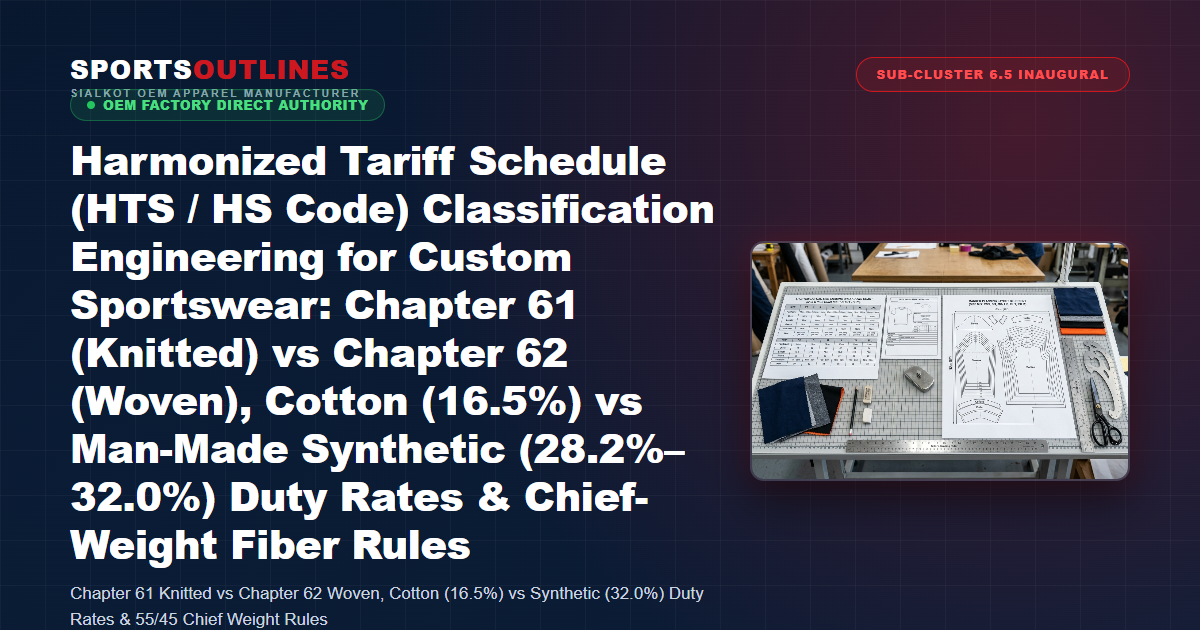
Why a 6% Shift in Yarn Blend (`55% Cotton / 45% Polyester` vs. `48% Cotton / 52% Polyester`) Changes Your US Import Tariff from 16.5% to 32.0% (`+$2.32/Garment`): The Complete Sportswear HTS Classification Blueprint
Welcome to the inaugural engineering guide of Sub-Cluster 6.5 (`Blogs #471` to `#480`): Harmonized Tariff Schedule (`HTS / HS Code`) Classification Engineering, Duty-Free Trade Agreements (`EU GSP+ REX`, `UK DCTS`, `ChAFTA`), Customs Valuation & Landed Duty Optimization! For custom sportswear, gym wear, and streetwear brands importing into the United States, United Kingdom, European Union, Canada, and Australia, customs duties are not arbitrary taxes—they are deterministic mathematical outputs governed by the World Customs Organization (`WCO`) Harmonized System (`HS`). In the United States (`HTSUS`), a knitted pullover hoodie made of `55% Cotton / 45% Polyester` (`Chief Weight Cotton`) is classified under `HTS 6110.20.20` at a `16.5%` MFN duty rate. If your designer unknowingly specifies a `48% Cotton / 52% Polyester` fleece blend (`Chief Weight Man-Made Fiber`), that exact same hoodie jumps into `HTS 6110.30.30` at a staggering `32.0%` MFN duty rate—nearly doubling your tariff bill and destroying `$2.32 per hoodie` (`$2,320 per 1,000 units`) in net profit! This master guide deconstructs the 10-digit anatomy of apparel tariff codes, the boundary between Chapter 61 (`Knitted/Crocheted`) and Chapter 62 (`Woven`), Section XI Chief-Weight Fiber Rules, and legal Tariff Engineering strategies executed at the tech-pack stage in Sialkot.
🧶 Chief-Weight Rule: 55/45 Cotton Fleece Saves 15.5% US Duty!
🇪🇺🇬🇧 Origin Dividend: 0.0% EU GSP+ & UK DCTS across Ch. 61 & 62
⚡ Prototypes: $45–$85/pc (7–10 Days) • Bulk MOQ: 30–50 pcs
1. Dissecting the 10-Digit Apparel Tariff Code: WCO 6-Digit HS Root vs. National Statistical Suffixes
When customs brokers in Los Angeles (`US CBP`), Felixstowe (`UK HMRC`), Hamburg (`German Zoll / EU TARIC`), Toronto (`CBSA`), or Sydney (`ABF`) process your Commercial Invoice (see Blog #464: International Apparel Export Documentation Blueprint), they read a 10-digit numeric string. Understanding how each digit pair is constructed is the foundation of customs compliance:
📐 Anatomical Breakdown of a 10-Digit Apparel HTS Code (Example: `6110.20.2079` — Men’s Cotton Fleece Hoodie)
[ 61 ] • [ 10 ] • [ .20 ] • [ .20 ] • [ 79 ]
Chapter • Heading • Subheading • US Tariff Line • Statistical Suffix
- Digits 1–2 (`Chapter = 61` — WCO Universal): Identifies the primary construction method inside WCO Section XI (`Textiles and Textile Articles`, Chapters `50–63`). `Chapter 61` = Articles of apparel and clothing accessories, knitted or crocheted. `Chapter 62` = Articles of apparel and clothing accessories, not knitted or crocheted (woven).
- Digits 3–4 (`Heading = 6110` — WCO Universal): Identifies the specific garment silhouette/category within that chapter. Heading `6110` covers “Sweaters, pullovers, sweatshirts, waistcoats (vests) and similar articles, knitted or crocheted.”
- Digits 5–6 (`WCO Subheading = 6110.20` — WCO Universal across 200+ Countries): Identifies the predominant textile fiber by weight (`Chief Weight`). `.20` = Of Cotton (`6110.20`); `.30` = Of Man-Made Fibers such as Polyester, Nylon, Acrylic, or Rayon (`6110.30`); `.11/.12` = Of Wool or Fine Animal Hair. Crucial Rule: The first 6 digits (`6110.20`) are 100% identical in the USA, UK, Germany, Canada, Australia, and Pakistan!
- Digits 7–8 (`National Tariff Rate Line = .20` in `6110.20.20`): Determined nationally (`HTSUS` in the US, `CN` Combined Nomenclature in the EU/UK). This 8th digit locks in the actual ad valorem duty percentage (`16.5%` in the US; `12.0%` MFN or `0.0%` GSP+/DCTS in the EU/UK).
- Digits 9–10 (`Statistical Reporting Suffix = 79` in `6110.20.2079`): Used by national census and trade bureaus to track gender (`Men’s vs. Women’s vs. Boys’/Girls’`) and specific sub-type (` hooded sweatshirt vs. crew-neck pullover`).
2. The Golden Boundary: Chapter 61 (`Knitted / Interlooped`) vs. Chapter 62 (`Woven / Interlaced`)
The #1 classification error committed by freight forwarders and generalist customs brokers is confusing Chapter 61 (`Knitted`) and Chapter 62 (`Woven`)—especially on hybrid activewear garments like softshell jackets, stretch-woven MMA fight shorts with knit lycra gussets, or tracksuits.
- What Qualifies for Chapter 61 (`Knitted or Crocheted Apparel`)? Any garment cut and sewn from fabric formed by the interlooping of one or more yarns—either Weft Knits (Single Jersey, Double-Knit Interlock, French Terry, 3-End Brushed Fleece, Piqué, Rib `1×1 / 2×2`) or Warp Knits (Tricot, Raschel Mesh, Power-Net Compression Spandex). Even if a heavy `450 GSM` double-knit interlock or scuba-fleece hoodie feels rigid like a woven fabric, microscopic examination reveals intermeshing needle loops (`wales` and `courses`), placing it strictly in Chapter 61.
- What Qualifies for Chapter 62 (`Not Knitted or Crocheted — Woven & Non-Woven Apparel`)? Any garment constructed from fabric formed by the orthogonal (`90°`) interlacing of warp (`lengthwise`) and weft (`crosswise`) yarns on a loom—including Plain Weave (`Poplin`, `Taffeta`, `Microfiber`), Twill (`3/1 Chino`, `Denim`), Satin (`Duchess Muay Thai Satin`), Ripstop (`MMA Fight Shorts`, `Windbreakers`), and Sashiko/Pearl Weave (`BJJ Gi Tops`, `Judo Gis`).
- How Do Customs Authorities Classify “Hybrid Knit + Woven” Garments (e.g., Woven Fight Shorts with a Knitted Lycra Crotch Gusset, or a Woven Puffer Vest with Knitted Fleece Sleeves)? Under General Rule of Interpretation `GRI 3(b)` (`Essential Character Rule`) and US CBP Informed Compliance Publications on Textile Costumes & Hybrid Garments:
- The `> 60%` Visible Exterior Surface Area Rule: Customs examines which fabric component imparts the “essential character” of the garment, primarily measured by visible exterior surface area (excluding linings, pocket bags, and narrow rib cuffs/collars).
- Case A (MMA Fight Shorts): `82%` of the exterior surface is 4-way stretch woven polyester ripstop (`Chapter 62`), while `18%` is the knitted `260 GSM` Lycra crotch gusset and waistband insert (`Chapter 61`). Because the woven shell exceeds `60%` of the visible surface area, the shorts are classified under Chapter 62 (`HTS 6203.43` — Men’s Woven Synthetic Shorts).
- Case B (Hybrid Alpine Training Jacket): Front chest and back torso panels (`55%` surface area) are woven nylon ripstop baffled down/synthetic insulation, while the sleeves, side panels, and hood (`45%` surface area) are knitted `320 GSM` tech-fleece. If neither component clearly imparts essential character (`e.g., 50% / 50% split`), `GRI 3(c)` (“Last in Numerical Order”) applies—meaning between Heading `6101/6102` (Knit) and Heading `6201/6202` (Woven), the garment defaults to the higher-numbered heading: Chapter 62 (`6201/6202`)!
| Sportswear Garment Category | Chapter 61 (`Knitted`) 6-Digit HS & 10-Digit HTSUS | US CBP MFN Duty Rate (`Ch. 61 Knit`) | Chapter 62 (`Woven`) 6-Digit HS & 10-Digit HTSUS | US CBP MFN Duty Rate (`Ch. 62 Woven`) | EU `GSP+ REX` & UK `DCTS` Duty (Pakistan Origin) |
|---|---|---|---|---|---|
| 1. Hoodies, Sweatshirts & Pullovers (Cotton Chief Weight) | `6110.20.2079` (Men’s) `6110.20.2081` (Women’s) | `16.5%` | `6205.20.20` (Men’s Woven Shirt) `6211.32.90` (Woven Track Top) | `19.7%` (Shirt) `8.1%` (Track Top) | `0.0%` Duty-Free (`12%` MFN Waived) |
| 2. Hoodies, Quarter-Zips & Pullovers (Man-Made / Polyester Chief Weight) | `6110.30.3053` (Men’s) `6110.30.3059` (Women’s) | `32.0%` (Highest Apparel Tier!) | `6211.33.9040` (Men’s Woven Pullover / Anorak Shell) | `16.0%` (`-50%` vs Knit!) | `0.0%` Duty-Free (`12%` MFN Waived) |
| 3. T-Shirts, Singlet Tank Tops & Compression Rashguards (Cotton vs Synthetic) | `6109.10.00` (Cotton Tee) `6109.90.10` (Poly/Nylon Tee & Rashguard) | `16.5%` (Cotton) `32.0%` (Synthetic) | `6205.30.20` (Men’s Woven Poly/Nylon Jersey/Top) | `29.1¢/kg + 25.9%` | `0.0%` Duty-Free (`12%` MFN Waived) |
| 4. Joggers, Sweatpants, Gym Shorts & Squat-Proof Leggings (Cotton vs Synthetic) | `6103.42.10` / `6104.62.20` (Cotton) `6103.43.15` / `6104.63.20` (Poly/Nylon Leggings & Shorts) | `16.6%` / `14.9%` (Cotton) `28.2%` (Synthetic) | `6203.42.40` (Cotton Woven) `6203.43.90` / `6204.63.90` (Woven Fight/Running Shorts) | `16.6%` (Cotton) `27.9%` (Synthetic) / `7.1%` (Water-Resistant) | `0.0%` Duty-Free (`12%` MFN Waived) |
| 5. Windbreakers, Track Jackets, Puffer Parkas & Rain Shells (Synthetic) | `6101.30.20` (Men’s Knit) `6102.30.20` (Women’s Knit) | `28.2%` (`+ 38.6¢/kg` women’s) | `6201.40.70` / `6202.40.70` (Standard) `6201.40.65` / `6202.40.65` (Water-Resistant AATCC 35) | `27.7%` (Standard) `7.1%` (Water-Resistant!) | `0.0%` Duty-Free (`12%` MFN Waived) |
| 6. High-Support Sports Bras & Compression Crop Tops | `6114.30.1020` (Knit Crop Top) | `29.9%` | `6212.10.9020` (Brassieres — Knit or Woven Included!) | `16.9%` (`-13.0%` Duty Saved under 6212.10!) | `0.0%` Duty-Free (`6.5%` MFN Waived) |
3. Section XI Subheading Note 2(A): The “Chief Weight” Fiber Rule & Why 55/45 Cotton-Polyester Beats 50/50
Why does the United States charge `16.5%` duty on Cotton knitted apparel (`6109.10`, `6110.20`), but charges `28.2% to 32.0%` duty on Man-Made Fiber (`Polyester / Nylon / Spandex`) knitted apparel (`6109.90`, `6110.30`, `6104.63`)? Because historic US textile lobby protections placed the highest tariff walls around synthetic filament and staple yarns.
When a garment is knitted from a blend of two or more textile fibers (such as Cotton + Polyester fleece, or Cotton + Polyester + Spandex jersey), how does customs decide whether it is a “Cotton” garment (`16.5%` duty) or a “Man-Made Fiber” garment (`32.0%` duty)? The answer lies in WCO Section XI, Subheading Note 2(A) and Note 2 to Chapter 54/55:
🧬 The 3-Step Customs Fiber Dominance (“Chief Weight”) Algorithm
- Step 1 — Aggregate All Man-Made Fibers Together: Under Section XI Note 2(B)(b), all synthetic and artificial fibers (`Polyester + Nylon + Spandex/Elastane + Rayon/Modal/Lyocell`) are summed together as a single “Man-Made Fibers (`MMF`)” group before comparing against natural fibers (`Cotton` or `Wool`).
Example Warning: Suppose you knit a premium lifestyle T-shirt from `48% Cotton / 47% Modal (Cellulosic MMF) / 5% Spandex (Synthetic MMF)`. An amateur founder thinks, “Cotton is 48%, which is bigger than Modal (47%) and Spandex (5%), so it’s Chief-Weight Cotton!” WRONG! Customs adds `47% Modal + 5% Spandex = 52% Man-Made Fibers` vs. `48% Cotton`—classifying the shirt as Man-Made Fiber (`32.0%` US duty instead of `16.5%`)! - Step 2 — The Equal-Weight (`50% / 50%`) Tie-Breaker Trap: What happens if you order a classic `50% Cotton / 50% Polyester` CVC fleece hoodie? Under Section XI Note 2(A) (`GRI 3(c)` Principle), when no single fiber group predominates by weight (`50.0% Cotton = 50.0% Man-Made Fiber`), the textile is classified under the heading/subheading that occurs LAST in numerical order! Between `6110.20` (Cotton) and `6110.30` (Man-Made Fibers), `.30` comes last—meaning a `50/50` Cotton/Polyester hoodie is legally taxed at the `32.0%` Man-Made Fiber rate! Furthermore, even if you specify `52% Cotton / 48% Polyester`, normal dyeing/finishing tolerance (`±3%` under ASTM D629 / ISO 1833 chemical dissolution testing) could test at `49.5% Cotton / 50.5% Polyester` in a US CBP laboratory audit!
- Step 3 — The Sialkot `55%–60% Cotton / 40%–45% Polyester` Tariff-Engineered Fleece Standard: To guarantee 100% bulletproof classification under `6110.20.20` (`16.5%` US duty) or `6103.42 / 6104.62` (`14.9%–16.6%` US duty) with a wide safety margin above the `±3%` lab tolerance, Sports Outlines engineers our export CVC fleece and French terry with a `100% Ring-Spun Combed Cotton Face + Cotton/Polyester Tie- & Loop-Yarn Back` calibrated to `55%–65% Cotton / 35%–45% Polyester` by bone-dry conditioned weight (`ISO 1833`).
| Fleece / Jersey Yarn Blend Specification (`420 GSM` Hoodie, `$15.00` FOB Sialkot) | Customs Aggregate Fiber Math (`Cotton` vs `Total MMF`) | Assigned 10-Digit US HTS Code | US CBP Ad Valorem Duty Rate | Duty Paid per Hoodie (`on $15.00 FOB`) | Net Duty Saved on a `1,000-Unit` Drop |
|---|---|---|---|---|---|
| 1. Unoptimized Polyester-Heavy Fleece (`35% Cotton / 65% Polyester`) | `35% Cotton` vs `65% MMF` (MMF Predominates) | `6110.30.3053` | `32.0%` | `$4.80 / hoodie` | Baseline (`$4,800` Tariff Bill) |
| 2. The `50% Cotton / 50% Polyester` Equal-Weight Tie-Breaker Trap | `50% Cotton` = `50% MMF` (`Note 2(A)` Defaults to Last Subheading `.30`!) | `6110.30.3053` | `32.0%` (Tie-Breaker Penalty!) | `$4.80 / hoodie` | `$0.00` (`-$2,325` unnecessary tax!) |
| 3. Tri-Blend Trap (`48% Cotton / 47% Modal / 5% Spandex`) | `48% Cotton` vs `52% MMF (47% Modal + 5% Spandex)` | `6110.30.3053` | `32.0%` | `$4.80 / hoodie` | `$0.00` |
| 4. Sports Outlines Tariff-Engineered CVC Fleece (`60% Combed Cotton / 40% Polyester`) | `60% Cotton` vs `40% MMF` (`+10%` Buffer Above Lab Tolerance!) | `6110.20.2079` | `16.5%` (-15.5% Rate Drop!) | `$2.475 / hoodie` | `+$2,325.00 SAVED (+$2.325/unit!)` |
4. The “Sports Bra vs. Crop Top” Classification Engineering Secret (`HTS 6212.10` @ 16.9% vs. `HTS 6114.30` @ 29.9%)
One of the highest-impact tariff engineering breakthroughs for women’s activewear and gym wear brands importing into the United States involves the legal distinction between a “Knitted Synthetic Top / Garment (`HTS 6114.30.1020`)” and a “Brassiere (`HTS 6212.10.9020`)”:
- Notice the Heading Anomaly (`Heading 6212`): Even though Heading `6212` sits inside Chapter 62, the statutory text of Heading `6212` explicitly states: “Brassieres, girdles, corsets, braces, suspenders, garters and similar articles and parts thereof, whether or not knitted or crocheted.”
- The Tariff Spread (`29.9%` vs. `16.9%` — a `13.0%` Duty Saving!): If a women’s nylon-spandex (`78% Polyamide / 22% Elastane`) athletic top is invoiced and constructed as a general “Knitted Crop Top / Tank Top,” US Customs classifies it under `HTS 6114.30.1020` (`Tops, knitted or crocheted: Of man-made fibers`) at a punishing `29.9%` duty rate (or `6109.90.10` at `32.0%`). However, if the garment is engineered and documented as a “Body-Supporting Sports Brassiere” under `HTS 6212.10.9020`, the US duty rate drops to `16.9%`—saving `13.0%` of FOB value (`~$1.45 per piece`)!
- What Structural Features Does US CBP Require for a Garment to Qualify Under `6212.10` (`Sports Brassiere`)? Per binding US Customs rulings (`NY N304812`, `HQ H287540`), our Sialkot pattern engineers build four physical support elements into your tech pack so the garment indisputably qualifies as a `6212.10` Sports Bra:
- Encapsulated or Compression Dual-Ply Bust Support Lining: A dedicated internal power-mesh or high-modulus double-lined bust support shelf (`240–280 GSM`) with removable molded polyurethane foam cup pockets.
- Heavy-Duty Elastic Underbust Chest Band (`≥ 25 mm / 1.0 inch` width): A high-recovery jacquard or encased elastic chest band directly beneath the bust line providing upward anatomical structural support.
- Racerback, Cross-Back, or Stabilized Shoulder Straps: Engineered to limit vertical and lateral breast bounce during high-impact athletics.
- Hem Terminating at or Immediately Below the Infra-Mammary Fold (`Underbust Band`): If a crop top extends all the way down to the natural waist (`like a full cami tank without an internal shelf bra`), CBP classifies it under `6109` or `6114` (`29.9%–32.0%`), unless it is a genuine support garment.
5. Gender & Sizing Classification Rules: When Does “Unisex” Streetwear Default to Women’s Tariff Codes?
Every streetwear founder launching an oversized boxy hoodie (`450–550 GSM`) or relaxed sweatpant drop markets their collection as “Unisex.” However, there is NO “Unisex” subheading in the Harmonized Tariff Schedule! Every adult garment must be classified as either “Men’s or Boys'” OR “Women’s or Girls’.”
- Chapter 61 Note 9 & Chapter 62 Note 8 (The Universal Statutory Default Rule):
- Rule 1 (Front Closure Direction): Garments with a full front opening (`buttoned baseball jerseys, varsity jackets, zip hoodies`) that close left-over-right are classified as Men’s or Boys’; garments closing right-over-left are classified as Women’s or Girls’.
- Rule 2 (Anatomical Cut & Grading): Pullover garments without a directional closure (`pullover hoodies, crewnecks, T-shirts, joggers`) that are clearly cut and graded to Men’s anthropometric chest/shoulder/hip specifications (`S–3XL`) are classified as Men’s or Boys’.
- Rule 3 (The “Unisex” Default to Women’s Rule!): Statutory Note 9 to Chapter 61 states: “Garments which cannot beuringly identified as either men’s or boys’ garments or as women’s or girls’ garments are to be classified in the headings covering women’s or girls’ garments.”
- Why This Matters Financially: On certain tariff lines (such as knitted synthetic windbreakers `6101.30.20` Men’s @ `28.2%` vs. `6102.30.20` Women’s @ `38.6¢/kg + 28.2%`, or woven shirts), defaulting to the Women’s code because your Commercial Invoice lazily says `”Unisex Oversized Hoodie”` instead of `”Men’s Graded Boxy Pullover Hoodie (Men’s S–2XL Block)”` can trigger compound per-kilogram duties or customs queries! On every Sialkot export invoice, we specify the exact gender grading block alongside the 10-digit HTS code.
6. Tracksuits (`6112.11 / 6112.12`) vs. Coordinates: How Ensemble Classification Works
Many teamwear academies and streetwear brands order matching 2-Piece Tracksuits (`Zip/Pullover Track Jacket + Matching Track Pants`) or 2-Piece Sweatsuits (`Hoodie + Joggers`) packed together in a single polybag. Does a matching 2-piece set get classified under a single “Tracksuit” tariff code (`Heading 6112` or `6211.32/33`), or must the top and bottom be declared on two separate invoice lines with two separate HTS codes?
| 2-Piece Garment Set Configuration | WCO / US CBP Classification Rule (`Ch. 61 Note 3(b)`) | Required Commercial Invoice Breakdown | Assigned US HTS Codes & Duty Rates |
|---|---|---|---|
| 1. True Unlined Knitted Athletic Tracksuit (Long-Sleeve Zip Track Jacket + Elastic-Waist Track Pants, Sold Exclusively as a Set) | Qualifies under `Heading 6112.11` (Cotton) or `6112.12` (Synthetic) ONLY if unlined (or brushed inside), without tailored suit features, and imported/sold in matching 1:1 pairs. | Even under `6112.12`, US Statistical Note requires reporting the Top (`6112.12.0030`) and Bottom (`6112.12.0050`) values separately on the entry summary! | `6112.11.00` (Cotton): `14.9%` `6112.12.00` (Synthetic): `28.2%` (Saves `3.8%` on the top vs `32.0%` under `6110.30`!) |
| 2. Streetwear Hoodie + Jogger Coordinate Set (Sold Separately by Size on Shopify or Mixed Top/Bottom Sizes) | Does NOT qualify as an “Ensemble” (`Note 3(b)`) or “Tracksuit” if tops and bottoms are sold à la carte or in unequal quantities. Must be classified separately as individual garments! | Line 1: Pullover Hoodies (`Qty, Unit FOB, HTS`) Line 2: Fleece Jogger Pants (`Qty, Unit FOB, HTS`) | `60/40 Cotton/Poly`: Hoodie `6110.20.20` (`16.5%`) Jogger `6103.42.10` (`16.6%`) |
| 3. Sublimated Soccer / Basketball Uniform Kit (Jersey + Shorts + Socks Packed in 1 Player Bag) | Under US CBP & EU TARIC rules, a team uniform kit (`Shirt + Shorts + Socks`) is NOT a single tariff item—each component must be itemized separately on the Commercial Invoice! | Line 1: Sublimated Jersey (`$9.50` FOB) Line 2: Sublimated Shorts (`$7.00` FOB) Line 3: Jacquard Crew Socks (`$2.50` FOB) | Jersey: `6109.90.10` (`32.0%` US / `0%` EU/UK) Shorts: `6103.43.15` (`28.2%` US / `0%` EU/UK) Socks: `6115.96.90` (`14.6%` US / `0%` EU/UK) |
7. Multi-Country Master HTS / CN / HS Cross-Reference Directory for Custom Sportswear
Bookmark this institutional 5-Region Tariff Comparison Table mapping our most popular Sialkot cut-and-sew sportswear products across the United States (`HTSUS`), European Union (`TARIC / GSP+`), United Kingdom (`UK Global Tariff / DCTS`), Canada (`CBSA Customs Tariff`), and Australia (`ABF Working Tariff`):
| Sportswear Product & Fiber Spec | 6-Digit WCO HS Root | USA (`HTSUS` MFN Duty) | EU (`TARIC` MFN vs `GSP+ REX`) | UK (`UKGT` MFN vs `DCTS`) | Canada (`CBSA` MFN) | Australia (`ABF` Duty) |
|---|---|---|---|---|---|---|
| 1. Heavyweight Cotton/CVC Hoodie (`≥ 55% Cotton`, Knit) | `6110.20` | `16.5%` | `0.0%` (`REX` vs `12%`) | `0.0%` (`DCTS` vs `12%`) | `18.0%` | `5.0%` (`0% ≤ $1k AUD`) |
| 2. Sublimated Polyester Jersey / Rashguard (`100% Poly / Poly-Spandex`, Knit) | `6109.90` | `32.0%` | `0.0%` (`REX` vs `12%`) | `0.0%` (`DCTS` vs `12%`) | `18.0%` | `5.0%` (`0% ≤ $1k AUD`) |
| 3. Women’s Nylon/Spandex Compression Leggings (`78/22 PA/EA`, Knit) | `6104.63` | `28.2%` | `0.0%` (`REX` vs `12%`) | `0.0%` (`DCTS` vs `12%`) | `18.0%` | `5.0%` (`0% ≤ $1k AUD`) |
| 4. High-Support Athletic Sports Bra (`Nylon/Poly-Spandex`) | `6212.10` | `16.9%` | `0.0%` (`REX` vs `6.5%`) | `0.0%` (`DCTS` vs `6.0%`) | `18.0%` | `5.0%` (`0% ≤ $1k AUD`) |
| 5. DWR Water-Resistant Woven Windbreaker / Puffer Jacket (`AATCC 35 Passed`) | `6201.40` / `6202.40` | `7.1%` (vs `27.7%` non-DWR!) | `0.0%` (`REX` vs `12%`) | `0.0%` (`DCTS` vs `12%`) | `18.0%` | `5.0%` (`0% ≤ $1k AUD`) |
Frequently Asked Questions (FAQ): Sportswear HTS & HS Code Classification Engineering
1. Why is it illegal to guess an HS code or use a generic “Sportswear” description on a Commercial Invoice?
Under the US Customs Modernization Act (`19 U.S.C. § 1484` — “Reasonable Care” standard), UK HMRC CDS regulations, and EU Union Customs Code (`UCC`), the Importer of Record is legally responsible for declaring the exact 10-digit tariff classification and exact fiber percentage composition. Writing vague descriptions like `”Gym Clothes”` or `”Activewear Samples”` triggers automatic customs holds, intensive X-ray/physical examinations (`$350–$900` exam fee), and potential `19 U.S.C. § 1592` negligence penalties if synthetic garments (`32%` US duty) are misdeclared under lower-duty headings.
2. How does switching from 50% Cotton / 50% Polyester fleece to 60% Cotton / 40% Polyester fleece save 15.5% in US import duty without changing the garment’s performance?
In a 3-end brushed fleece (`e.g., 400 GSM`), the outer face yarn (`which receives screen printing and DTG`) is already 100% combed ring-spun cotton, while the internal tie yarn and brushed backing loop yarn contain polyester for dimensional stability and tensile strength. Under WCO Section XI Note 2(A), an exact `50% Cotton / 50% Polyester` blend defaults to the higher-numbered subheading (`6110.30` Man-Made Fibers @ `32.0%` US duty). By engineering the knitting feeder ratios in Sialkot to `60% Cotton / 40% Polyester`, the garment remains ultra-stable (`≤ 3%` shrinkage) while legally classifying under `6110.20.20` (`Chief Weight Cotton` @ `16.5%` US duty)—cutting your US tariff rate nearly in half!
3. How are $45–$85 physical pre-production prototype samples classified for customs?
When we ship your physical pre-production prototypes (`$45–$85 per piece`, completed in 7–10 business days), we can either declare them under their commercial 10-digit Chapter 61/62 HTS code (which clears duty-free in the US under the `$800` Section 321 de minimis threshold, or `0%` in the UK/EU under `£135 / €150` low-value relief), OR—for high-value multi-piece sample boxes—declare them as “Commercial Samples of Negligible Value (`HTS 9811.00.60`)” when stamped or marked `”SAMPLE – NOT FOR RESALE”` per customs regulations.
4. Does the 5% to 22% Elastane (Spandex / Lycra) in compression leggings change the 6-digit HS code?
In synthetic compression wear (`e.g., 78% Nylon / 22% Spandex` or `82% Polyester / 18% Spandex`), both Nylon/Polyester AND Spandex are Man-Made Synthetic Fibers (`100% MMF total`), so the 6-digit subheading (`6104.63` or `6109.90`) remains Man-Made Fiber. However, under certain US 10-digit tariff lines (such as `6104.62` cotton trousers or `6112` swimwear/tracksuits), garments containing `5% or more by weight of elastomeric yarn` have dedicated 10-digit statistical suffixes and specific duty treatments—which is why our Commercial Invoices always state the exact `Polyester % + Elastane %` breakdown.
5. Does Sports Outlines pre-assign verified 10-digit HTS / TARIC / UK Commodity codes on every quote and Commercial Invoice?
Yes! Every proforma quotation and export Commercial Invoice issued by Sports Outlines for your 30–50 piece low-MOQ launch or 1,000+ piece bulk order includes pre-verified 10-digit destination tariff codes (`HTSUS` for USA, `TARIC` + `REX Statement` for EU, `UK Commodity Code` + `DCTS Origin Declaration` for UK, `CBSA` for Canada, and `ABF` for Australia) cross-checked against your exact BOM fiber composition.
Want Tariff-Engineered Custom Sportswear Built to Maximize Your Landed Margin?
Partner with Sports Outlines in Sialkot, Pakistan. We develop custom physical prototypes for $45–$85 per piece in 7–10 business days, manufacture bulk orders starting at just 30–50 pieces per style, and engineer your BOM fiber blends and 10-digit HTS documentation for minimum landed duty.
Pingback: EU GSP+ & Registered Exporter (REX) System Blueprint for Sportswear Brands: How European Apparel Importers Claim 0.0% Customs Duty (Saving 12.0% CIF) on Sialkot Cut-and-Sew Production - Sports Outlines
Pingback: US CBP Sportswear Import Tariff & Customs Engineering: Water-Resistant Outerwear (HTS 6201.40 / 6202.40 7.1% vs 27.7% Duty), Compression vs Streetwear Classification & Binding Ruling (eRuling) Strategies - Sports Outlines