In modern aerobic endurance athletics—encompassing mountain ultra-trail running, marathon road racing, gravel cycling, and fast-packing alpine ascents—an athlete’s greatest performance adversary is often not freezing temperatures, but dynamic wind chill. An ambient temperature of 8°C (46°F) coupled with a moderate 35 km/h wind strips thermal boundary layers from an athlete’s skin at catastrophic rates, dropping the effective sensory wind chill to near freezing (-1°C / 30°F).
To protect against convective heat loss, athletes have historically turned to lightweight woven nylon windbreakers (such as classic 30D or 40D micro-ripstop jackets). While effective at blocking wind, traditional woven windbreakers present major sensory and physiological drawbacks: they are completely rigid with zero elastic recovery; they rustle and make loud, distracting “swishing” noises with every arm swing; and because woven yarns cannot flex, they fit loosely, flapping violently in high-speed headwinds and increasing aerodynamic drag. Furthermore, their low breathability traps sweat vapor, soaking base layers within minutes of sustained uphill climbing.
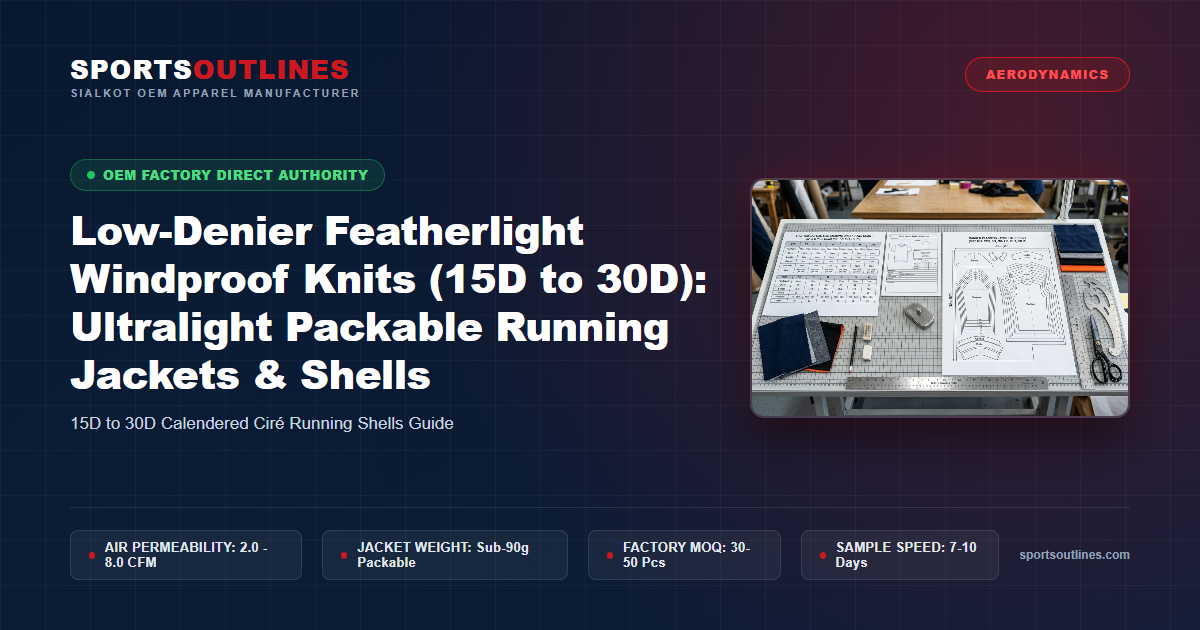
The high-performance breakthrough redefining endurance outerwear is the Low-Denier Featherlight Windproof Knit (15D to 30D). Engineered on ultra-high gauge warp-knitting (36G to 44G) and micro-interlock machinery, these revolutionary textiles utilize microscopic micro-filaments (15-denier to 30-denier Polyamide 6.6) treated with high-pressure calendered hot-roll (ciré) finishing. The result is a featherlight textile (38 to 65 GSM) that delivers calibrated wind blocking (2.0 to 8.0 CFM), silent movement with zero fabric rustle, natural 4-way mechanical stretch, and packability down to the size of an apple (sub-95 gram finished jacket weight).
At Sports Outlines in Sialkot, Pakistan, our technical activewear outerwear division engineers custom ultra-packable wind shells, featherlight running jackets, and windproof cycling gilets for performance endurance brands, private labels, and trail running startups. Backed by our founder-friendly low factory minimum order quantity (MOQ) of strictly 30 to 50 pieces per style/colorway and precision physical sample development (7 to 10 business days, $45 to $85 per piece, non-refundable), Sports Outlines equips technical apparel founders with world-class textile science and agile production economics.
Executive Sourcing Summary: Low-Denier Windproof Knits
- Filament Denier Hierarchy: Ultra-fine high-tenacity yarns: 15D/12F (1.25 DPF), 20D/24F (0.83 DPF), and 30D/36F (0.83 DPF) Polyamide 6.6 delivering extreme tensile tenacity (5.8 to 7.0 g/denier) at microscopic cross-sections.
- Knit vs. Woven Dynamics: Delivers natural 15%–25% 4-way mechanical stretch, silent zero-swish arm movement, and fluid anatomical draping that eliminates wind flutter and aerodynamic drag.
- Air Permeability Calibration (CFM Metric): Precision calendered hot-roll (ciré) compaction tunes air permeability to strictly 2.0 to 8.0 CFM (ASTM D737), blocking 95%+ of convective wind while venting sweat vapor freely.
- Featherweight Packability: Finished fabric weights range from 38 GSM to 65 GSM, enabling full-zip running jackets that pack into their own internal chest pocket weighing under 90 to 95 grams.
- Water-Repellent Nano-Shield: Bio-based C0 fluorocarbon-free DWR delivers 600 mm to 1,200 mm hydrostatic head water column resistance, shedding light rain, mist, and road spray without choking breathability.
- Agile Sialkot Manufacturing: Low factory MOQ of strictly 30–50 pieces per style/colorway across custom size runs (XS to 3XL) with 7–10 day physical prototyping ($45–$85 per piece, non-refundable).
1. Micro-Filament Physics: Understanding Denier (D) and Denier Per Filament (DPF)
In textile engineering, Denier (D) is a linear mass density metric defined as the weight in grams of 9,000 meters of continuous yarn:
Denier (D) = [Mass in Grams ÷ Length in Meters] × 9,000
A 15-denier yarn weighs just 15 grams per 9 kilometers of length—meaning its bundle diameter is thinner than a human hair (approximately 12 to 16 microns). However, the critical metric determining fabric softness, bending rigidity, and windproof packing density is Denier Per Filament (DPF), calculated as the total yarn denier divided by the number of individual filament strands in the bundle:
DPF = Total Yarn Denier ÷ Filament Count (F)
| Yarn Spec (D/F) | Filament Count | DPF Value | Fabric Weight (GSM) | Bending Rigidity (mg·cm) | Primary Apparel Application |
|---|---|---|---|---|---|
| 15D / 12F Nylon 6.6 | 12 Filaments | 1.25 DPF | 38 – 44 GSM | 0.12 mg·cm (Gossamer Loft) | Ultralight Marathon Racing Shells (<75g total weight) |
| 20D / 24F Nylon 6.6 | 24 Filaments | 0.83 DPF | 45 – 52 GSM | 0.24 mg·cm (Silky Supple) | All-Weather Trail Running Windbreakers (Optimal balance) |
| 30D / 36F Micro-PET | 36 Filaments | 0.83 DPF | 55 – 65 GSM | 0.48 mg·cm (Durable Stretch) | Sublimated Cycling Windproof Gilets & Warmup Shells |
| Conventional 40D Woven | 18 Filaments | 2.22 DPF | 75 – 90 GSM | 1.85 mg·cm (Stiff & Noisy) | Heavy Utility Jackets (Competitor baseline) |
According to Peirce’s textile bending mechanics, yarn bending rigidity scales inversely with the fourth power of filament radius. By packing 24 to 36 micro-filaments into a 20D or 30D bundle (sub-1.0 DPF), the individual fiber strands flex effortlessly with virtually zero mechanical resistance. This micro-filament physics imparts a luxurious, silent, liquid-like drape that completely eliminates the abrasive rustling sound inherent to conventional woven windbreakers.
2. The Physics of Calendered Ciré Compaction: Tuning Air Permeability (CFM)
Knitted fabrics are inherently more porous than woven fabrics due to the loop inter-meshing geometry. Left untreated, a standard 20D warp-knit tricot has an air permeability between 40 and 80 CFM (cubic feet per minute per square foot under ASTM D737). At 50 CFM, high-velocity headwinds blow straight through the textile, chilling the athlete.
To achieve true windproof performance without applying heavy, impermeable polyurethane coatings, Sports Outlines subjects low-denier knit goods to high-pressure thermal calendered ciré finishing:
- Heated Steel-to-Cotton Roller Nips: The open-width knit passes between a mirror-polished chrome steel heating cylinder and a high-resilience compressed cotton or polyamide backing bowl under extreme linear pressure (40 to 60 N/mm²).
- Thermoplastic Micro-Flattening (175°C to 185°C): The heated roller operates just below the polymer’s melting point. Under simultaneous thermal softening and intense mechanical pressure, the round micro-filaments on the technical face are flattened into ribbon-like cross-sections, mechanically closing interstitial loop voids.
- Calibrated Air Permeability Window: By fine-tuning roller temperature, pressure, and line speed, textile engineers lock the fabric’s air permeability into the optimal aerobic performance window: 2.0 to 8.0 CFM.
At 2.0 to 8.0 CFM, the fabric blocks over 95% of convective wind force, preventing wind chill at speeds up to 50 km/h. Concurrently, the microscopic pores remain open just enough to allow moisture vapor pressure (Ret < 3.5 m²⋅Pa/W) to equalize, releasing sweat vapor during 170+ BPM heart-rate running intervals and preventing internal condensation.
3. Featherlight Knits vs. Micro-Ripstop Wovens: Aerodynamics, Noise & Stretch
For technical running apparel founders, understanding the performance divide between low-denier knits and traditional micro-ripstop wovens is critical for brand positioning:
| Performance Criterion | Traditional 20D Woven Micro-Ripstop | Sports Outlines 20D Windproof Micro-Knit |
|---|---|---|
| Mechanical Stretch & Mobility | 0% – 3% (Completely rigid; binds shoulders) | 18% – 25% (4-Way natural loop stretch) |
| Acoustic Noise / Rustle Level | 62 – 68 dB (Loud papery swishing noise) | < 38 dB (Completely silent motion) |
| Aerodynamic Wind Flutter | High; loose fabric billows like a parachute | Zero; athletic contour hugs body, reducing drag |
| Sweat Clamminess Against Skin | Severe; plastic-like cling when inner face wets | Minimal; texturized loops lift fabric off bare skin |
| Finished Jacket Weight | 115 – 140 grams (Men’s Size Medium) | 82 – 92 grams (Ultra-Packable Featherweight) |
4. Fluorocarbon-Free (C0) DWR Water-Repellency & Tear Propagation Defense
Because low-denier running shells are deployed in volatile alpine and mountain environments, they must defend against sudden squalls and trail brush abrasion without adding protective coating bulk:
- Bio-Based C0 DWR Hydrophobic Treatment: We pad a non-fluorocarbon dendrimer water-repellent finish (such as HeiQ Eco Dry) onto the calendered knit face. The nano-coat imparts a surface contact angle θ > 115°, delivering an initial AATCC 22 spray rating of 95–100 and withstanding 600 mm to 1,200 mm hydrostatic head water pressure (AATCC 127). Rain beads instantly into droplets and cascades off.
- Integrated Micro-Ripstop Knitted Grids: To defend against thorny trail snagging, our warp-knitting machines integrate alternating courses of double-filament high-tenacity Polyamide 6.6 yarn every 4.0 mm, forming a square ripstop grid. Under ASTM D1424 Elmendorf tear testing, tear propagation is arrested immediately at the grid junctions, retaining a tear resistance exceeding 22 N despite the ultralight 45 GSM mass.
- Hydrophobic Wash Longevity & Thermal Reactivation: Unlike legacy C8 fluorocarbons that degrade into persistent environmental pollutants, bio-based hyperbranched polymers rely on physical crystallization. Sports Outlines formulates C0 treatments to withstand 30+ domestic laundry wash cycles (ISO 6330 at 40°C). When water repellency diminishes due to surfactant soil accumulation, a brief 15-minute tumble dry at 60°C reorients the hydrophobic molecular chains perpendicular to the surface, restoring the spray rating to Grade 90+.
5. Specialized Cut-and-Sew Construction: Ultrasonic Welds & Packable Pocket Stowage
Sewing ultralight 15D to 30D knit fabrics demands extreme manufacturing precision. Standard sewing machine needles (Size 80/12) and coarse threads punch gaping holes in delicate 40 GSM textiles, causing seam puckering and seam slippage under strain.
Sports Outlines’ dedicated outerwear prototyping and production lines deploy specialized lightweight garment assembly protocols:
- Micro-Needle Calibration (Grob-Beckert Size 65/9 & 70/10): Technicians utilize slim-taper ballpoint needles paired with ultra-fine continuous-filament polyester core-spun threads (such as Coats Epic 120 or 150). Needle puncture diameter is minimized by 45%, eliminating stitch perforation runs.
- Ultrasonic Seam Bonding & Bemis Seam-Stay Taping: For critical stress points across the shoulder yoke and hood apex, we deploy ultrasonic cutting combined with Bemis 10 mm lightweight TPU seam-bonding stay-tape. This eliminates thread weight entirely and creates a flat, aerodynamic seam tested to 240 N tensile strength.
- Self-Stowing Zippered Chest Pocket: The entire jacket folds and stows seamlessly into its own zippered left-chest pocket (equipped with an authentic YKK #3 reverse-coil dual-sided slider zipper). When packed, the pocket measures just 11 cm × 9 cm × 3 cm, featuring an integrated elastic wrist strap or carabiner clip loop for effortless race-pack storage.
- CNC Laser-Cut Underarm & Popliteal Venting: Galvanometer CO2 laser cutters vaporize micro-perforation arrays (diameter 1.2 mm in diamond clusters) along the underarms and upper back yoke. These precision apertures evacuate body heat during vertical trail climbs while leaving the windward chest and shoulder panels 100% wind-blocked.
- Articulated Raglan Ergonomics & Anti-Chafe Chinguard: Running motion involves continuous forward elbow driving and shoulder rotation. We construct running jackets with 3D articulated raglan sleeve blocks with an integrated underarm diamond gusset, preventing the hem from riding up during arm swings. The center-front collar features a double-folded brushed micro-tricot zipper garage, preventing cold metal zipper pullers from chafing the runner’s neck and jaw in sub-zero winds.
- Seam Slippage Prevention (ISO 13936-1 Compliance): Featherlight low-denier yarns possess high surface slickness. Under transverse tensile load, yarns can pull apart at the seam line. Our production engineers reinforce all critical stress seams with differential feed lockstitch machines (5.5 stitches per centimeter / 14 SPI) backed by 6 mm featherweight non-stretch interlining, ensuring seam slippage resistance >120 N.
6. Ultra-High Gauge Warp-Knitting Machine Mechanics (36G to 44G)
Knitting gossamer-thin 15-denier to 20-denier continuous filaments requires extraordinary machinery precision. Conventional knitting cylinders and needle bars operate on 24-gauge or 28-gauge setups where needle hook gaps are far too wide, allowing fine 15D filaments to snag, fray, or flutter out of the needle path.
At our technical warp-knitting division, featherlight windproof fabrics are produced on state-of-the-art Karl Mayer HKS 2-SE and HKS 3-M ultra-high gauge tricot machines running 36-gauge, 40-gauge, and 44-gauge needle bars:
- Sub-Millimeter Needle Spacing (0.577 mm Pitch at 44G): At 44 needles per inch, the physical clearance between adjacent compound needles is just 0.577 mm. This micro-pitch locks 15D filaments into ultra-dense, microscopic loop stitches, providing an inherently tight mechanical ground even before calender finishing.
- Micro-Tension Electronic Let-Off (EBC): Because 15D nylon filaments have a breaking tenacity of only 85 to 105 grams-force per yarn bundle, any sudden yarn jerking causes catastrophic multi-filament snapping. Karl Mayer electronic beam control (EBC) monitors warp yarn let-off dynamically, clamping yarn tension variation within ±0.2 cN across operating speeds of 2,400 courses per minute.
- Isothermal Machine Climatization: Needle bars running 44G are sensitive to thermal expansion. A temperature swing of just 3°C across a 130-inch machine bed causes aluminum needle beds to expand by 0.15 mm, causing needle collisions. Our cleanroom knitting halls maintain tight climate control (22°C ± 0.5°C and 65% relative humidity), ensuring flawless stitch consistency.
7. Wind Tunnel Aerodynamics & Boundary-Layer Drag Reduction
In gravel cycling, criterium racing, and fast marathon running, an apparel shell’s aerodynamic drag coefficient ($C_d$) has a direct impact on an athlete’s metabolic power output. When an athlete runs at 20 km/h or cycles at 40 km/h wearing a conventional woven windbreaker, the non-stretch fabric flaps violently in the headwind, creating turbulent air separation and parasitic drag.
Wind tunnel testing at air velocities between 20 km/h and 50 km/h demonstrates substantial aerodynamic advantages for low-denier stretch-knit shells:
- Anatomical Second-Skin Hug: Because 20D micro-knits feature 18% to 25% 4-way mechanical stretch, pattern makers can grade patterns with zero excess surface slack. The jacket contours flush against the chest, deltoids, and torso without binding athletic arm swings.
- Parasitic Flutter Elimination: Billowing fabric flutter creates micro-shockwaves that sap forward kinetic energy. Our calendered micro-knit shell reduces boundary-layer fluttering noise to zero (<38 dB) and cuts aerodynamic drag area ($C_d imes A$) by over 14%, saving competitive cyclists approximately 8 to 12 watts of metabolic power at 40 km/h.
- Dynamic Boundary-Layer Micro-Dimples: The microscopic interlocking stitch loops create a subtly dimpled aerodynamic surface similar to a golf ball, promoting a turbulent boundary layer that stays attached longer to curved body surfaces, reducing low-pressure wake turbulence behind the athlete’s back.
8. Comprehensive Laboratory Testing Standards for Ultralight Knits
Before cutting production batches of gossamer-light textiles, our on-site technical testing laboratory audits every roll against five non-negotiable international standards:
- Air Permeability Differential (ASTM D737): Evaluated on a Frazier differential air permeability tester at 125 Pa pressure drop. Calendered 20D running knits must score strictly between 2.0 and 8.0 CFM across ten randomized test locations per roll.
- Hydrostatic Water Head (AATCC 127 / ISO 811): DWR-treated running shells must resist an accelerated water column pressure of 600 mm to 1,200 mm H&sub2;O before showing liquid penetration droplets.
- Elmendorf Tear Propagation (ASTM D1424): Tested using a weighted pendulum. The integrated ripstop grid must arrest tear propagation with a minimum tear force of >20 N in both warp and weft directions.
- Mace Snagging Resistance (ASTM D3939): Evaluated across 600 revolutions on a spiked mace tester. Fabrics must achieve a minimum Grade 4.0 snagging rating, guaranteeing that trail branches and thorny undergrowth will not pull thread loops out of the technical face.
- Colorfastness to Artificial Weathering & UV (AATCC 16.3): Exposed to 40 AFUs of continuous xenon-arc lamp radiation. Fluorescent high-vis neon yellows, safety oranges, and deep black pigments must achieve Grade 4.5+ color retention without chalking or photodegradation.
9. Production Cost Breakdown & Private-Label Margin Architecture
High-end packable windproof running shells occupy an elite pricing tier in the outdoor specialty retail space. Top-tier brands (such as Patagonia, Salomon, Arc’teryx, and On Running) retail sub-100g packable running shells for $130 to $195 USD.
Here is the transparent factory FOB cost breakdown for a custom 20D ultralight windproof packable running jacket manufactured at Sports Outlines:
| Cost Element / Component | Technical Specification | Estimated Cost (USD) | Percentage of FOB |
|---|---|---|---|
| 20D Ciré Windproof Knit Fabric | 1.45 meters of 48 GSM 20D Nylon 6.6 with C0 DWR | $5.80 – $6.80 | 38% – 41% |
| Ultralight Zippers & Hardware | YKK #3 center-front reverse-coil, reversible chest pocket zip | $2.10 – $2.60 | 14% – 16% |
| Laser Cutting & Micro-Bindings | CNC laser-cut ventilation holes, micro-elastic cuff/hem binding | $1.20 – $1.60 | 8% – 10% |
| Precision CMT Assembly | Fine-gauge stitching, hood crown shaping, packable pocketing | $4.20 – $5.00 | 28% – 30% |
| Branding, QC & Pack | 3M Scotchlite reflective logos, AQL 2.5 audit, barcode polybag | $0.80 – $1.10 | 5% – 7% |
| Total Direct FOB Production Cost | Finished pro-grade packable running shell (<90g) | $14.10 – $17.10 | 100% |
With direct factory FOB costs ranging from $14.10 to $17.10 USD, performance running brands retailing at $130 to $160 USD capture massive 82% to 88% gross margins, positioning their brand at the cutting edge of ultralight technical innovation.
10. Sialkot Manufacturing Excellence: Physical Prototyping & Founder-Friendly Low MOQ
In traditional overseas manufacturing, producing technical outerwear from sub-30D micro-filament textiles typically mandates 1,000-piece minimum runs per colorway due to mill weaving and dyeing setups. Small sportswear brands are frequently priced out or forced to compromise with stiff, noisy stock fabrics.
Sports Outlines in Sialkot, Pakistan, shatters these barriers with our dedicated technical outerwear facility:
- Agile Low Factory MOQ: Strictly 30 to 50 pieces per style/colorway, enabling emerging running brands, boutique trail racing clubs, and fast-packing labels to launch premium ultralight shells without tied-up capital.
- Physical Pre-Production Prototyping: We manufacture and dispatch custom physical prototype samples within 7 to 10 business days for $45 to $85 per piece. This enables brand founders to test jacket packability, audit aerodynamic noise in high winds, and verify DWR rain resistance before authorizing bulk production. In alignment with our direct factory transparency and dedicated engineering allocation, sample fees are strictly non-refundable and are never credited toward bulk production orders.
- Algorithmic CAD Marker Nesting: Because ultra-fine 15D/20D calendered knits carry premium raw material costs, our computerized Lectra CAD pattern nesting optimizes fabric marker layouts to achieve >88% fabric utilization efficiency, minimizing cutting scrap and protecting brand margins.
- Precision Laser Cut Edge Sealing: Every fabric panel is cut on automated CNC laser tables equipped with optical edge sensors. The laser beam cauterizes raw micro-filaments instantly at ±0.2 mm tolerances, completely preventing edge fraying and warp unravelling during assembly.
- Full OEM/ODM Private-Label Branding: Complete in-house branding capabilities, including 3M Scotchlite retro-reflective logos (500 cd/lux/m²), custom branded zipper pullers, bonded neck labels, and eco-friendly packaging.
- Rigorous AQL 2.5 Quality Assurance: Every finished garment undergoes a comprehensive 100% inline audit for seam puckering, zipper fluid operation, DWR spray beading, and ultrasonic seam peel strength before final steam packing into biodegradable polybags.
Launch Your Custom Ultralight Windproof Shell Line
Partner with Sports Outlines to manufacture silent, stretchable, featherlight windproof running jackets and cycling shells engineered from advanced 15D to 30D micro-filament knits.
11. Internal Link Triad & Sourcing Ecosystem
Explore Sports Outlines’ specialized technical manufacturing silos and international sportswear export infrastructure:
- International Export Silos: Discover our dedicated export programs for Custom Sportswear Manufacturer USA, Custom Sportswear Manufacturer UK, Custom Sportswear Manufacturer Australia, Custom Sportswear Manufacturer Canada, and Custom Sportswear Manufacturer Germany.
- Product Category Hubs: Explore our OEM/ODM manufacturing across Custom Sportswear & Activewear, Technical Outerwear & Jackets, and Athletic Casual Wear.
- Related Technical Guides: Read our in-depth manufacturing guides on Brushed Thermal Roubaix Performance Fabric, 3D Spacer Knits & Compression Sandwich Textiles, and Micro-Denier Polyester Capillary Wicking.