Direct Manufacturer Snapshot: Lean Modular Manufacturing Cells vs Traditional Progressive Bundle Systems in Sportswear Production: Agility & Quality Control
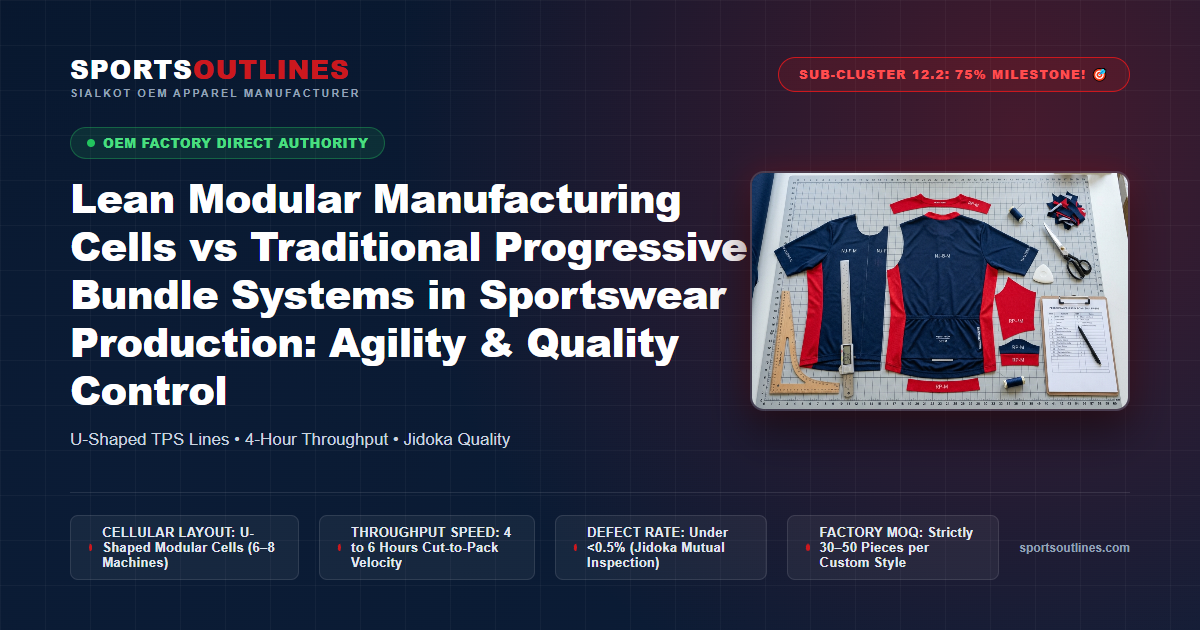
Sports Outlines manufactures high-performance athletic apparel direct from Sialkot, Pakistan, utilizing Lean Modular Manufacturing Cells based on Toyota Production System (TPS) single-piece flow. Arranging 6 to 8 specialized sewing machines in agile U-shaped cells with cross-trained multi-skilled technicians, we reduce cut-to-pack throughput time to 4 to 6 hours and achieve defect rates below 0.5% through in-line Jidoka quality-at-the-source audits. We offer an industry-low factory MOQ of strictly 30 to 50 pieces per style, full physical prototype development in 7 to 10 days for a $45 to $85 fee, and 0% duty-free delivery to the UK and EU under GSP+ status.
Direct WhatsApp: +92 316 7932595
In global sportswear contract manufacturing, factory layout and floor architecture dictate lead time, quality consistency, and minimum order economics. For over half a century, the apparel industry has been shackled to the Progressive Bundle System (PBS): massive linear rows of single-operation sewing machines where cut panels are tied into heavy 100-piece bundles and slowly pushed across cavernous factory floors. In the fast-moving modern landscape of e-commerce athletic apparel, rapid replenishment drops, and private label activewear, the Progressive Bundle System is a dinosaur: it creates weeks of work-in-progress (WIP) stagnation, astronomical defect rates, and rigid 1,000-unit minimum order barriers. The modern manufacturing revolution is defined by Lean Modular Manufacturing Cells operating on Toyota Production System (TPS) single-piece flow. At Sports Outlines in Sialkot, Pakistan, we have re-engineered our production floor into agile, U-shaped modular sewing cells staffed by multi-skilled, cross-trained technicians. We deliver rapid 4-to-6-hour cut-to-pack throughput and zero-defect quality at an industry-low factory minimum order quantity (MOQ) of strictly 30 to 50 pieces per custom style, supported by dedicated $45 to $85 prototype engineering in 7 to 10 days.
Design & Manufacture Custom Lean Modular Manufacturing Cells Direct from Sialkot
Low 30–50 Piece/Set MOQ • Dedicated Sampling in 7–10 Days • 0% Import Tariffs
✓ $45–$85 Physical Prototypes •
✓ Worldwide DDP Delivery
1. Progressive Bundle System (PBS) vs. Lean Modular Cells: The Structural Comparison
Understanding why traditional factories demand massive minimums and suffer from chronic delivery delays requires examining the fundamental physical workflow of the factory floor:
| Operational Attribute | Progressive Bundle System (PBS) | Lean Modular Cellular Manufacturing (Sports Outlines) |
|---|---|---|
| Floor Layout & Configuration | Linear rows of 30 to 50 single-operation machines separated by wide aisles. | Compact ‘U-shaped’ modular cells (6 to 8 machines) arranged for minimal operator travel. |
| Material Movement Unit | Massive tied bundles (50 to 100 cut garment plies per bundle). | Single-Piece Flow (garments move unit-by-unit between adjacent workstations). |
| Work-in-Progress (WIP) Inventory | Massive holding queues; hundreds of bundles stacked between machine rows. | Ultra-lean; maximum of 6 to 10 garments in process inside the entire cell at any moment. |
| Cut-to-Pack Throughput Velocity | 20 to 30 Days (Garments spend 95% of time waiting in idle bundle stacks). | 4 to 6 Hours (Continuous value-added sewing from first panel to finished polybag). |
| Defect Discovery Latency | Catastrophic delay; defects found only at final packing after 500 units are sewn. | Immediate discovery within 1 to 2 minutes by the adjacent downstream operator. |
| Machine Changeover Flexibility | Rigid; takes 2 to 3 days to re-tool a 50-machine linear production line. | Agile; quick-changeover tooling allows switching styles/fabrics in under 30 minutes. |
2. Single-Piece Flow & The Elimination of Manufacturing Stagnation
The core engine of lean activewear manufacturing is Single-Piece Flow. In traditional bundle manufacturing, an operator assigned to sew front pocket welts receives a bundle of 100 cut panels. The operator sits at their machine, unties the bundle ticket, sews 100 pocket welts sequentially, reties the bundle, and stacks it on a cart. The bundle sits on the cart for two days waiting for an available flatlock operator.
In a Sports Outlines U-shaped modular manufacturing cell, garments never wait in bundles:
- Unit-by-Unit Handoff: Operator 1 receives cut panels from the automated laser table, joins the raglan sleeve, and immediately hands the single garment to Operator 2. Operator 2 executes the 4-needle flatlock underarm seam and immediately passes the single garment to Operator 3 for bar-tacking.
- Continuous Value-Added Transformation: At no point does the garment sit on a floor cart or in a storage bin. The garment experiences continuous physical transformation, traveling from raw cut panels to fully assembled, pressed, and polybagged product in just 4 to 6 hours.
- Zero Material Creasing & Soilage: Because garments do not sit in heavy compressed stacks on factory floors, delicate synthetic fabrics (such as high-gloss foils, liquid holographic Lycra®, and ultra-fine meshes) remain pristine, free of dust, oil smudges, and permanent storage creases.
3. Jidoka & Poka-Yoke: Sub-Minute Defect Containment and Zero Rework
In traditional apparel contract manufacturing, quality control occurs at the very end of the factory floor at the ‘Inspection Table.’ If a sewing machine developing uneven tension begins skipping stitches on an inner thigh flatlock seam, the operator in a traditional bundle line—paid on piece-rate speed—continues sewing through 500 garments without stopping. Weeks later, when the final inspector opens the bundles, 500 garments are defective, resulting in delayed shipments, frantic patch repairs, or catastrophic commercial scrap.
Sports Outlines enforces the lean principle of Jidoka (Quality at the Source) combined with Poka-Yoke (Mistake-Proofing):
Consecutive Inspection Protocol: In our U-cells, every operator acts as the quality inspector for the preceding operation. When Operator 3 receives a garment from Operator 2, they perform a rapid 2-second visual and tactile audit of the seam before initiating their stitch. If a stitch irregularity, tension loop, or fabric run is detected, the line halts immediately.
Root-Cause Elimination in Under 60 Seconds: Because the defect is identified within 90 seconds of its occurrence, the technical supervisor immediately inspects the machine needle, looper timing, or thread tension. The mechanical issue is corrected before a single additional garment can be sewn, dropping production defect rates from industry averages of 4%–7% down to under 0.5%.
| Sourcing Feature & Risk Factor | Sports Outlines (Sialkot Direct) | Alibaba Trading Agents | Traditional Chinese Hubs | Print-on-Demand (POD) |
|---|---|---|---|---|
| Manufacturing Architecture | Lean U-shaped modular manufacturing cells (6–8 machines) operating on single-piece flow and cross-trained technicians. | Traditional Progressive Bundle System (PBS); massive bundles stacked between rows, taking weeks to travel the floor. | Linear assembly lines optimized strictly for 10,000+ unit mass production; incapable of small-batch agility. | Fragmented subcontracting network with zero cellular coordination or standardized assembly lines. |
| Minimum Order Quantity (MOQ) | Strictly 30–50 pieces per custom style and colorway — accessible for emerging technical brands. | Quotes 50 units for blank stock, but demands 1,000 to 3,000 units for dedicated custom production lines. | 1,000 to 2,000 units per style to justify setting up linear assembly lines and conveyor tooling. | Single unit available, but lacks any technical athletic construction, flatlock seaming, or bar-tacking. |
| Production Throughput Velocity | Cut-to-pack throughput time is 4 to 6 hours within a single cell; fast order execution in 12–15 business days. | 25 to 45 day throughput delays as bundles sit idle in massive WIP holding queues between sewing operations. | 30 to 60 day production lead times due to rigid scheduling and large factory line allocations. | Print queue delays of 10–14 days for a single t-shirt without real-time tracking. |
| Defect Containment & Quality (Jidoka) | Immediate in-line defect detection within 2 minutes of occurrence; zero defect propagation down the line. | Defects discovered only at final packaging after hundreds of flawed units have already been fully stitched. | Statistical sampling at end-of-line, but minor sewing defects often slip through high-speed lines. | Zero in-line inspection; defective items drop-shipped directly to end consumers without human audits. |
| Prototype Development & Turnaround | $45–$85 non-creditable engineering prototype fee; cellular-built master sample dispatched in 7–10 days. | Promises cheap samples ($35), but samples are hand-cobbled by sample tailors and do not represent line production. | $200–$400 sampling fees with 4–6 week queue times due to large volume factory schedules. | Digital mockups only; physical drop-shipped blanks take 14 days and cannot be adjusted. |
| Customs Duty & Tariffs (US / EU / UK) | 0% import customs duty into EU & UK via Pakistan GSP+ status; low trade tariff access into the US. | Unpredictable customs brokerage fees, freight surcharges, and full import duties payable by buyer. | Subject to Section 301 tariffs (7.5%–25%) in the US and standard MFN customs duties in the EU/UK. | Local domestic sales taxes and fulfillment surcharges added per unit, destroying profitability. |
4. Multi-Skilled Cross-Trained Technicians: The Human Core of Agile Manufacturing
The conventional apparel industry treats sewing workers as mechanical cogs trained on a single repetitive motion: a worker might spend twenty years doing nothing except sewing collar ribbing on t-shirts. If that worker is absent or the factory switches to collarless tank tops, the factory line is paralyzed.
At Sports Outlines, our cellular manufacturing technicians undergo rigorous cross-training under our internal Technical Skills Matrix:
- Multi-Machine Competency: Every cell technician is certified on at least three to four distinct machine types: high-speed 4-needle 6-thread flatlock machines (ISO 607), 3-needle bottom-coverstitch machines (ISO 406), direct-drive differential overlockers (ISO 514), and programmable electronic bar-tackers (Juki LK-1900BN).
- Dynamic Line Balancing: Technicians move fluidly within the U-cell based on workload pacing. If a complex compression waistband temporarily creates a micro-bottleneck at Station 4, the upstream technician automatically shifts to assist with prep operations, maintaining smooth, continuous single-piece flow.
- Ergonomic Stand-and-Walk Operation: Technicians in our lean cells operate on ergonomic standing mats, walking smoothly between adjacent machine heads. This increases operator alertness, eliminates repetitive-strain muscular fatigue, and enhances overall sewing precision.
5. Low MOQ Factory Direct Economics: Solving the 30–50 Piece Lean Challenge
Why do conventional mega-factories in China, Vietnam, and Bangladesh enforce 1,000 to 3,000-piece minimums? It is an architectural limitation of the Progressive Bundle System. Reconfiguring a 50-machine linear conveyor line, rethreading looper paths, and resetting mechanical folders for a 50-piece run causes massive downtime that large factory management refuses to accommodate.
Sports Outlines engineered our Sialkot manufacturing floor specifically around agile U-shaped cells. With quick-disconnect pneumatic air feeds, universal machine head brackets, and computerized digital stitch memory presets, our technicians execute complete cell changeovers in under 30 minutes. We offer genuine lean modular activewear manufacturing at an accessible factory MOQ of strictly 30 to 50 pieces per custom style. Emerging private labels and boutique athletic founders gain access to the exact same high-efficiency, zero-defect production methodology pioneered by Toyota and utilized by premier global brands.
| Production Volume Tier | Est. Unit FOB Cost | Sample Cost & SLA | Bulk Production SLA | Included Specifications | Recommended Buyer Profile |
|---|---|---|---|---|---|
| 30 – 50 Sets/Pieces (Lean Cellular Startup Tier) | $12.40 – $15.80 / cellular-built activewear top | $15.40 – $19.50 / compression bottom | $45 – $85 non-creditable prototype fee | 12 – 15 Business Days | Dedicated U-shaped modular sewing cell allocation, cross-trained multi-machine operator assembly, continuous in-line quality verification, physical master prototype in 7–10 days, 30–50 piece low factory MOQ. | Startup activewear brands, direct-to-consumer fitness labels, quick-turnaround tournament merchandise, and athletic founders requiring rapid delivery and zero-defect consistency. |
| 51 – 150 Sets/Pieces (Agile Line Scaling Tier) | $10.20 – $13.10 / cellular-built activewear top | $13.10 – $16.40 / compression bottom | $45 – $85 non-creditable prototype fee | 14 – 18 Business Days | Kanban pull scheduling, quick-changeover tooling (under 30 minutes), sub-assembly single-piece flow, custom heat-seal branding, full size breakdown across XS to 3XL. | Scaling sportswear brands, crossfit affiliate gym merchandise lines, collegiate athletic teamwear, and e-commerce labels operating on agile just-in-time inventory models. |
| 151 – 500 Sets/Pieces (Commercial Distribution Wholesale Tier) | $8.60 – $10.90 / cellular-built activewear top | $11.10 – $13.80 / compression bottom | $45 – $85 non-creditable prototype fee | 18 – 22 Business Days | Synchronized multi-cell parallel manufacturing, real-time digital Andon board monitoring, full AQL 2.5 quality control audit certification, express DDP door-to-door delivery. | Established international sportswear labels, national gym franchise networks, commercial sportswear distributors, and sports equipment retail chains. |
| 500+ Sets/Pieces (Enterprise Volume Wholesale Tier) | $6.80 – $8.60 / cellular-built activewear top | $8.80 – $11.20 / compression bottom | $45 – $85 non-creditable prototype fee | 22 – 28 Business Days | Dedicated continuous cellular production floor allocation, integrated automated robotic material handling, sea freight or air cargo consolidation, 0% GSP+ duty-free customs clearance. | Multinational sportswear conglomerates, department store private athletic labels, international sports federation uniform contracts, and high-volume commercial garment importers. |
6. Technical Specifications & Export Compliance: The Sialkot Direct Advantage
Sialkot, Pakistan, stands as the premier global engineering center for technical sports equipment and apparel, manufacturing for Olympic federations, international combat sports organizations, and premier athletic brands. Partnering directly with Sports Outlines provides decisive commercial benefits:
- Strictly 30–50 Piece Factory MOQ: Launch custom technical activewear manufactured in agile lean cells with multi-machine precision at accessible startup minimums.
- Full Physical Prototyping in 7–10 Business Days: For a transparent $45 to $85 non-creditable prototype fee, we manufacture and dispatch your cellular-built pre-production master prototype. You verify construction accuracy and seam strength in your hands before bulk production.
- 0% Import Customs Duty via EU & UK GSP+ Status: Custom sportswear manufactured in Pakistan enters the European Union and the United Kingdom at 0% customs import duty under GSP+, delivering a direct 12% to 14% landed margin benefit over China, Vietnam, or Turkey.
- Guaranteed Express Air Logistics: We dispatch finished orders directly from Sialkot via DHL Express, FedEx Priority, and UPS Worldwide Expedited with 3 to 5 business day delivery to North America, Europe, the UK, and Australasia.
Get a Factory Direct Quote for Lean Modular Manufacturing Cells
Chat with our Sialkot Engineering Team via WhatsApp • Instant DDP Air Freight Quotes
✓ $45–$85 Physical Prototypes •
✓ Worldwide DDP Delivery
7. Explore Our Technical Sportswear Manufacturing Ecosystem
Deepen your athletic production knowledge by exploring our related technical manufacturing guides and regional activewear sourcing portals:
- Custom Activewear & Athleisure Manufacturer Italy: Low MOQ Sialkot OEM
- Cut-and-Sew Sportswear Manufacturing: Advanced Technical Pattern Engineering Guide
- Automated Polybag Packaging & Barcode Labeling in Sportswear OEM
- 3D Body Scanning & Digital Anthropometric Custom-Fit Activewear
- 4-Needle 6-Thread Flatlock (ISO 607) Differential Feed in Sportswear
Frequently Asked Sourcing & Manufacturing Questions (Buyer FAQ)
What is the difference between a Lean Modular Manufacturing Cell and a Traditional Progressive Bundle System (PBS)?
The fundamental difference lies in workflow velocity, inventory buffer, and defect containment: 1) Progressive Bundle System (PBS): The traditional apparel manufacturing model where garments are cut in large batches (typically bundles of 50 to 100 plies) and moved sequentially through specialized machine rows. An operator performs only one isolated operation (e.g., sewing collar bands) on all 100 units before tying the bundle and moving it to the next queue. This creates massive Work-in-Progress (WIP) inventories, lengthy throughput times (20 to 30 days for a garment to traverse the factory floor), and catastrophic defect propagation (if an operator sews a seam incorrectly, 500 garments are ruined before the error is discovered). 2) Lean Modular Manufacturing Cells: A modern cellular layout based on Toyota Production System (TPS) principles where 6 to 8 specialized machines (overlock, flatlock, bar-tack, coverstitch, heat press) are arranged in a compact ‘U-shape’ staffed by multi-skilled, cross-trained operators. Garments travel unit-by-unit in a continuous single-piece flow. A cut panel enters the U-cell and emerges as a fully sewn, pressed, and inspected garment in 4 to 6 hours with sub-minute defect detection.
What is ‘single-piece flow’ and why is it superior for activewear manufacturing?
Single-piece flow (also known as continuous flow or one-piece flow) is a lean manufacturing discipline where one individual garment moves through successive assembly operations one at a time, rather than waiting in large batch queues. In sportswear manufacturing, single-piece flow eliminates 90% of non-value-added waiting time, dramatically accelerates production velocity, and reduces fabric handling creases. Furthermore, because only one garment is worked on at a time between stations, sewing tension anomalies, skipped stitches, or needle friction issues are detected instantaneously by the next downstream operator, completely eliminating batch defects.
How does quality at the source (Jidoka / Poka-Yoke) function inside a modular sewing cell?
Inside a lean modular cell, every operator functions as a primary quality inspector. Under the lean principle of Jidoka (autonomation or quality at the source), an operator never passes a defective component to the next workstation. The cell operates under 100% mutual inspection: when Operator B receives a bodice from Operator A, they inspect the previous seam (taking under 2 seconds) before executing their operation. If a skipped stitch or uneven seam margin is identified, the line halts immediately, the root cause is resolved at the sewing head, and the single unit is remediated within minutes. This prevents defective garments from ever accumulating.
What is the factory minimum order quantity (MOQ) for modular cellular manufacturing at Sports Outlines?
Our minimum order quantity for custom activewear produced via lean modular manufacturing cells is strictly 30 to 50 pieces or sets per style and colorway. Traditional mega-factories require 1,000 to 5,000 units because their massive linear assembly lines take days to reconfigure. In contrast, our agile U-shaped cells in Sialkot feature modular quick-changeover tooling and universal quick-disconnect pneumatic air lines, allowing our multi-skilled technicians to switch between sports bras, compression tights, and training hoodies in under 30 minutes.
What is your prototype fee and turnaround time for cellular-built activewear samples?
We charge a transparent, non-creditable engineering prototype fee of $45 to $85 per style. This covers complete CAD digital pattern drafting, computerized nesting, CNC laser cutting, dedicated cellular workstation setup, and full garment assembly. Your physical pre-production master prototype is built directly on our modular production cells (ensuring that bulk production will match your sample with 100% fidelity) and dispatched via express air courier within 7 to 10 business days.
How do cross-trained multi-skilled operators improve garment quality and delivery reliability?
In traditional bundle factories, workers are strictly single-operation operators: a worker who sews side seams cannot operate a flatlock or bar-tack machine. If a key operator is absent, the entire factory line bottlenecks and shuts down. In our Sialkot modular cells, every sewing technician is cross-trained on at least three to four distinct machine types (4-needle flatlock, 3-needle coverstitch, programmable bar-tack, direct-drive overlock). Technicians dynamically rebalance line workloads according to Kanban pull signals, ensuring a smooth, continuous flow without bottlenecks or downtime.
What is an Andon system and how does visual factory management work at Sports Outlines?
An Andon system is a visual lean manufacturing communication tool. In our Sialkot production cells, overhead electronic LED display boards and color-coded signal lights (Green = Normal Flow, Amber = Quality Assistance Needed, Red = Immediate Stop) are positioned directly above each U-cell. If an operator encounters a technical issue—such as needle thread breakage, tension variance, or fabric shading discrepancy—they activate the Andon switch. A senior technical supervisor and maintenance engineer arrive at the workstation in under 60 seconds to resolve the issue, maintaining zero-defect flow.
How does lean manufacturing reduce unit production costs for small sportswear orders?
Lean modular manufacturing reduces costs by systematically eliminating the ‘Eight Wastes’ of traditional manufacturing (Overproduction, Waiting Time, Transportation, Overprocessing, Excess Inventory, Unnecessary Motion, Defects, and Underutilized Talent). By eliminating massive piles of work-in-progress inventory tied up on the factory floor, minimizing material handling damage, reducing factory footprint requirements, and slashing defect scrap rates to under 0.5%, our cellular lines deliver highly competitive unit FOB pricing on 30-to-50-piece orders that traditional factories could never match.
What Point of Measure (POM) dimensional tolerances are guaranteed in modular cellular production?
We enforce strict AQL 2.5 quality control standards with guaranteed dimensional tolerances of ±0.5cm (±0.2 inches) across all critical Point of Measure dimensions (chest circumference, waist width, sleeve length, and total garment length). Finished garments are measured on flat, tension-free calibrated granite inspection tables against approved CAD specifications before final packaging.
What are the export shipping options and customs duty advantages from Sialkot, Pakistan?
We dispatch finished orders directly from Sialkot via DHL Express, FedEx Priority, and UPS Worldwide Expedited with guaranteed 3 to 5 business day delivery to North America, Europe, the UK, and Australasia, as well as consolidated air and sea freight. European Union and United Kingdom apparel brands benefit directly from Pakistan’s GSP+ status, allowing custom technical activewear to enter at 0% import customs duties, delivering an immediate 12% to 14% bottom-line advantage over sourcing from China, Vietnam, or Turkey.