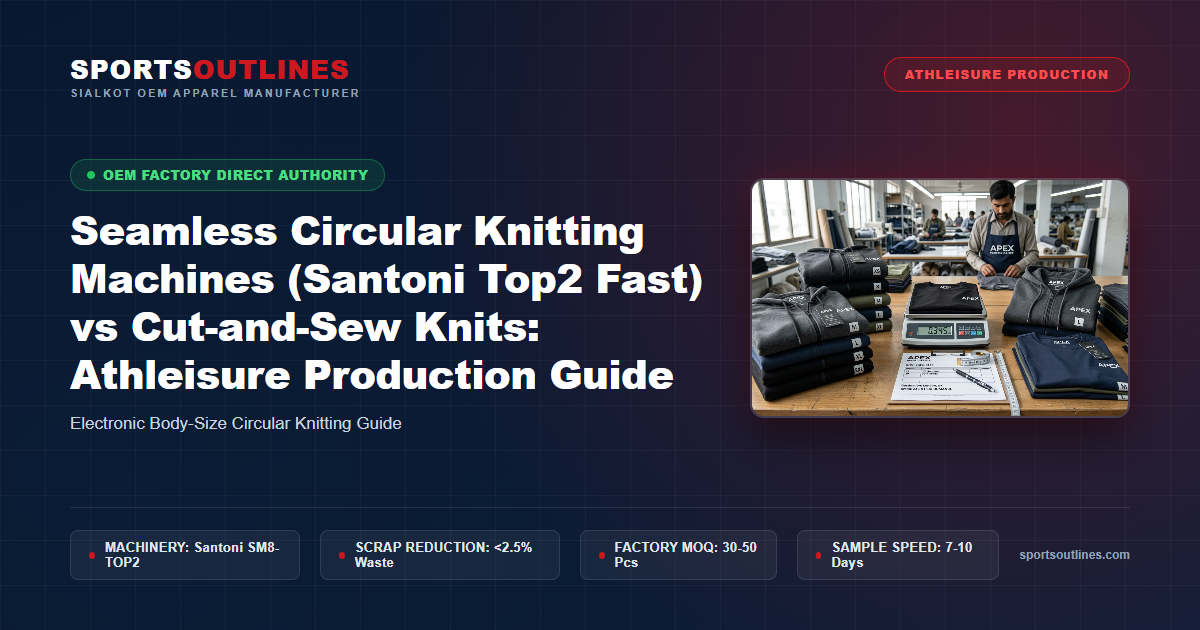
In global athletic apparel manufacturing, the fundamental architecture of an activewear garment is dictated by one foundational manufacturing choice: Seamless Circular Body-Size Knitting versus Traditional Cut-and-Sew Assembly. For decades, performance apparel was built almost exclusively via the cut-and-sew method—knitting large rolls of open-width fabric, spreading and nesting pattern markers on computerized cutting tables, and stitching distinct panels together using high-speed overlock and 4-needle 6-thread flatlock sewing machines.
However, the advent of electronic body-size circular knitting machines—epitomized by the legendary Santoni SM8-TOP2 FAST series from Brescia, Italy—permanently altered the athletic landscape. Instead of cutting flat panels from large fabric rolls, Santoni seamless machines knit fully formed, 3D tubular garments directly from raw yarn bobbins in a continuous, automated cycle. In a single seamless tube, computerized piezo-ceramic actuators can transition seamlessly from an ultra-firm 3×1 ribbed compressive waistband into a micro-perforated ventilation zone behind the knee, into a smooth, squat-proof interlock across the glutes, and finally into a non-slip ribbed ankle cuff—all without a single vertical side seam.
For sportswear brand founders, technical designers, and sourcing directors, evaluating Seamless versus Cut-and-Sew is not merely an aesthetic choice; it is an industrial equation involving raw material utilization, tooling amortizations, compression zone programming, garment hand-feel, and production flexibility. While seamless delivers unparalleled anti-chafing comfort and slashes fabric cutting waste from 20% down to under 3%, cut-and-sew retains decisive advantages in multi-fabric paneling, complex color-blocking, pocket integration, and custom silhouette grading across non-cylindrical human bodies.
Operating from our vertical activewear milling and apparel engineering hub at Sports Outlines in Sialkot, Pakistan, we operate both high-efficiency Santoni seamless circular knitting batteries and advanced cut-and-sew production lines equipped with Gerber automated laser cutting and Yamato flatlock machines. Backed by our accessible factory minimum order quantity (MOQ) of strictly 30 to 50 pieces per style/colorway and rapid physical prototyping turnaround (7 to 10 business days, $45 to $85 per piece, non-refundable), Sports Outlines provides the technical clarity and production agility required to engineer award-winning activewear collections across both manufacturing paradigms.
Executive Engineering Summary: Seamless vs. Cut-and-Sew
- Santoni Seamless Machine Architecture: Electronic body-size circular knitting machines (SM8-TOP2 FAST) featuring 8 yarn feeds, 13-inch to 17-inch cylinder diameters, and 28-gauge to 32-gauge needle spacing. Capable of rotational speeds up to 130–140 RPM.
- Piezo-Ceramic Jacquard Actuation: Electronic actuators control individual needle selection on every feed, enabling instant structural transitions between ribbing, jersey, tuck-stitch mesh, and plush terry cushioning within a single tubular blank.
- Material Waste Disparity: Traditional cut-and-sew generation results in 16% to 22% cutting-room scrap loss from pattern marker nesting. Seamless knitting reduces raw material scrap to under 2%–3% (limited to yarn tails and crotch gusset cutouts).
- Ergonomics & Chafing Eradication: Seamless construction eliminates lateral outer-leg and inner-thigh seams, providing frictionless 3D body contouring. Cut-and-sew excels when garments require bonded zipper pockets, reflective piping, or contrasting multi-textile zoning (e.g. mesh inserts combined with high-modulus power-net).
- Low-Barrier Sialkot Manufacturing: Factory MOQs of strictly 30–50 pieces per style/colorway; physical wear-test prototypes delivered in 7–10 business days ($45–$85 per piece, non-refundable).
1. The Machine Mechanics of Santoni Electronic Seamless Circular Knitting
To understand seamless activewear, one must examine the electromechanical architecture of the Santoni SM8-TOP2 FAST machine, the undisputed global benchmark for seamless sportswear manufacturing:
Unlike open-width circular knitting machines with large 30-inch to 34-inch cylinders that produce flat fabric rolls, a Santoni machine is a single-cylinder, body-size circular machine. The cylinder diameter is precisely matched to human anatomical circumference:
- 11″ to 12″ Cylinders: Engineered for youth apparel, compression calf sleeves, and sports bra underbust bands.
- 13″ to 14″ Cylinders: Engineered for Women’s Size XS and S sports bras, crop tops, and petite leggings.
- 15″ to 16″ Cylinders: The industry workhorse for Women’s Size M/L leggings, Men’s compression base layers, and fitted long-sleeve performance tops.
- 17″ to 18″ Cylinders: Engineered for Men’s athletic wear (L/XL/XXL) and plus-size activewear lines.
| Machine Component | Santoni SM8-TOP2 FAST Spec | Functional Role in Activewear | Engineering Impact |
|---|---|---|---|
| Yarn Feeds | 8 Feeds with Motorized Stripers | Allows simultaneous feeding of face yarns, elastane & plating colors | High knitting output; 1 tube completed every 2.5–4.5 minutes |
| Needle Selection Actuators | Piezo-Ceramic Electronic Actuators | Individual needle-by-needle control on all 8 feeds | Enables complex jacquard patterns, mesh perforations & rib zoning |
| Gauge Range | 24G, 28G, 32G (Needles Per Inch) | Dictates stitch density and fabric fineness | 28G/32G provides squat-proof opacity with micro-denier yarns |
| Rotational Speed | Up to 130 – 140 RPM | Dynamic speed regulation during patterning transitions | Reduces cycle time while protecting delicate elastane filaments |
| Stitch Cam Control | Step-Motor Electronic Cam Adjustment | Alters loop length dynamically during knitting | Knits graduated compression (tighter ankle, looser thigh) in real-time |
The CAD Programming Layer: Santoni Nautilus Software
In seamless production, the garment’s entire physical pattern, structural gradient, and compression profile are encoded via computerized textile programming (using software suites such as Santoni Nautilus or Lonati PhotoGraph). A textile CAD programmer assigns pixel values to specific knitting actions:
- Knit (Miss): Needle catches yarn and forms a standard jersey loop.
- Tuck: Needle retains previous loop while catching a new yarn strand, creating open mesh eyelets for localized breathability behind knees or along the lower back.
- Float: Needle bypasses yarn, allowing elastane to float on the reverse side to create ultra-high compression holding zones across abdominal tummy panels.
- Mock Rib / True Rib: Alternating needle selections produce 1×1, 2×2, or 3×1 compression ribs that eliminate the need for elastic waistband insertions.
2. Traditional Cut-and-Sew Mechanics: The Flat-Fabric Assembly Model
Traditional cut-and-sew activewear remains the backbone of the global apparel industry, representing over 70% of all sportswear volume. The process operates on a subtractive, multi-step workflow:
- Open-Width Fabric Milling: Knitted or woven fabric is produced on large circular or warp knitting frames, dyed, heat-set on stenters, and rolled into bolts (typically 58 to 60 inches wide).
- Pattern Nesting & Spreading: Fabric bolts are unrolled in multi-layer plies (up to 50–100 layers) on long vacuum spreading tables. Computerized nesting software (such as Gerber AccuMark or Lectra Modaris) arranges garment pattern pieces (front leg, back leg, waistband, crotch gusset, pocket panels) to optimize fabric utilization.
- Computerized Cutting: High-speed CNC oscillating knife cutters or automated laser cutting tables slice through the stacked fabric plies with millimeter precision.
- Sewing Line Assembly: Cut panels are bundled by size and distributed across an assembly line of skilled sewing operators. Panels are assembled using specialized industrial machines:
- 4-Needle 6-Thread Flatlock (ISO 607): Creates flat, zero-bulk, high-stretch seams along the inseam, outseam, and crotch rise.
- Overlock / Serger (ISO 504 / 514): Joins internal waistband elastics and liners.
- Coverstitch (ISO 406): Finishes leg hem cuffs and sports bra underbands.
3. Head-to-Head Architectural Comparison: Seamless vs. Cut-and-Sew
To make an informed sourcing decision, brands must evaluate how these two manufacturing methodologies compare across performance, material efficiency, cost, and design freedom:
| Evaluation Parameter | Santoni Seamless Knitting | Traditional Cut-and-Sew Knits |
|---|---|---|
| Raw Material Waste | <2% to 3% Waste (Yarn-efficient) | 16% to 22% Waste (Pattern marker scrap) |
| Seam Construction & Chafing | Zero side seams; only crotch/inseam join | Multiple seams (inseam, outseam, waistband, yoke) |
| Compression Zoning Ability | Engineered directly into knit tube via CAD | Requires sewing separate high-modulus fabric panels |
| Multi-Fabric & Pocket Integration | Extremely difficult (Requires post-sewing) | Unlimited (Zipper pockets, cargo mesh, trims) |
| Sizing & Grading Flexibility | Cylinder-constrained (1 machine diameter per size) | Infinite CAD grading across all body shapes (XS–4XL) |
| Initial Tooling / Programming Cost | High ($300–$600 per size CAD programming) | Low ($50–$100 digital pattern grading) |
| Unit Production Labor Cost | Low (Knitted automatically in 3–4 minutes) | Moderate (Requires multi-station manual sewing) |
| Ideal Sourcing Volume (MOQ) | Best for ≥100–300 pcs (Sports Outlines MOQ: 30–50) | Highly flexible for 30–50 pcs quick launches |
4. Material Waste & Sustainable Manufacturing Dynamics
In an era where global apparel brands are scrutinized under stringent environmental, social, and governance (ESG) metrics, the raw material efficiency gap between seamless and cut-and-sew is profound:
The Cut-and-Sew Scrap Problem
Because human limbs and torsos have curved, non-rectangular contours, even the most sophisticated algorithmic marker nesting software cannot pack legging and sports bra pattern pieces with 100% geometric density. On standard cutting tables, marker efficiency typically peaks at 78% to 84%. This means that 16% to 22% of expensive, virgin technical fabric is cut away as scrap trimmings and discarded. In a 10,000-piece legging production run, this scrap waste translates to thousands of pounds of elastane-blended synthetic textiles that cannot be easily recycled.
The Seamless Additive Model
Seamless circular knitting operates on an additive manufacturing principle akin to 3D printing. Needles draw only the exact grams of yarn required to build the tubular garment blank. When the tube drops from the Santoni cylinder, the only material removal required is cutting a small triangular slot for the crotch gusset and slitting the lower tube into two separate leg cylinders (for one-piece legging blanks). Total manufacturing scrap loss is consistently below 2.5%. For brands emphasizing sustainable activewear positioning, seamless provides an indisputable carbon and waste reduction story.
5. Post-Knitting Assembly: Boarding, Dyeing and Gusset Sewing
A common misconception among emerging apparel founders is that seamless garments exit the knitting machine completely finished and ready to wear. In reality, a Santoni machine produces an unfinished tubular blank. The garment must undergo crucial downstream assembly steps:
- Tube Splitting and Gusset Insertion: For leggings, the lower portion of the tubular body is slit open along the centerline. A diamond or teardrop-shaped breathable crotch gusset (often lined with antibacterial cotton or silver-infused polyamide) is sewn using a 4-needle flatlock or 3-needle overlock machine to join the legs together.
- Garment Dyeing & Scouring: Seamless blanks are frequently knitted in raw greige yarn and dyed at the garment stage in rotary drum dyeing machines (such as Flainox or Tonello). This allows brands to knit thousands of neutral blanks in advance and dye them into trending seasonal colorways on rapid demand.
- Steam Boarding / Autoclave Thermo-Fixation: Once dyed, damp seamless garments are pulled onto metallic leg or torso forms (boarding forms) and loaded into industrial steam autoclaves (such as Heliot or Cortese machines). Subjected to pressurized steam at 115°C to 120°C for 20 to 30 seconds, the synthetic yarns and elastane cores undergo thermal relaxation. This locks the garment into its permanent 3D anatomical shape, guarantees dimensional stability across wash cycles, and activates the elastic memory of the compressive zones.
Sialkot Dual-Line Capability at Sports Outlines
Unlike specialized niche factories that only offer one technology and push clients into ill-fitting solutions, Sports Outlines maintains fully equipped facilities for both Santoni seamless knitting and precision cut-and-sew manufacturing in Sialkot, Pakistan. Our technical directors provide unbiased engineering consultations to help you assign each garment in your seasonal collection to its optimal manufacturing method.
Gerber CNC Laser Cutting
Low Factory MOQ: 30–50 Pieces
Rapid Prototyping: 7–10 Days ($45–$85/pc)
6. Sensor Kinetics & BTSR Ultrafeeder Yarn Tension Management
In high-speed seamless circular knitting, the single greatest source of visual and structural defects is uneven yarn tension fluctuations across the 8 knitting feeds. Because a Santoni machine operates at up to 140 RPM, a minor 1-gram spike in yarn drag through a ceramic guide creates visible horizontal shadow lines (“barre”) or differential loop tightness around the garment circumference.
To ensure absolute stitch consistency, Sports Outlines equips its Santoni SM8-TOP2 machines with BTSR Ultrafeeder 2 digital constant-tension yarn feeders:
- Closed-Loop Microsecond Tension Adjustment: The BTSR system continuously monitors yarn feeding tension via non-contact optical sensors. If tension deviates by as little as ±0.1 cN from the programmed setpoint, an ultra-fast stepper motor accelerates or decelerates the feed wheel within 2 milliseconds, maintaining mathematically constant yarn input.
- Elastane Graduated Feeding: When transitioning from a loose single-jersey knee panel to a high-modulus compression waistband, the BTSR controller dynamically increases elastane tension from 2.5 cN to 7.0 cN in synchronization with needle cylinder position. This builds firm anatomical compression directly into the tube without sewing in secondary elastic webbing.
- Real-Time Broken Filament Detection: If an individual filament snaps or snags, the BTSR optical sensor triggers an emergency electromagnetic brake within 5 milliseconds, stopping the cylinder before a dropped stitch or vertical ladder ruin can occur.
7. Industrial Defect Troubleshooting Guide in Seamless vs. Cut-and-Sew
Quality control in activewear manufacturing requires rapid root-cause diagnosis. The following engineering matrix illustrates how factory technicians at Sports Outlines isolate and rectify common defects across both production systems:
| Production System | Observed Failure Mode | Underlying Root Cause | Factory Remediation Protocol |
|---|---|---|---|
| Santoni Seamless | Vertical needle streak / line | Damaged needle hook or burred latch trick | Immediate needle replacement; polish cylinder slot with diamond stone |
| Santoni Seamless | Waistband rolls down during squat | Insufficient elastane tension on rib feeds; wrong rib knit ratio | Recalibrate BTSR feed tension to 6.5 cN; reprogram from 1×1 to 3×1 structured rib |
| Santoni Seamless | Leg length discrepancy between pairs | Inconsistent steam autoclave boarding time/temp | Standardize autoclave boarding at 118°C for exactly 25 seconds on calibrated metal forms |
| Traditional Cut-and-Sew | Flatlock seam cracking / popping | Inadequate stitch density (SPI < 12) or rigid thread | Increase flatlock density to 14–16 SPI; switch to bulked textured Nylon 6.6 looper thread |
| Traditional Cut-and-Sew | Leg seam spirality / twisting | Fabric cut off-grain; fabric tension not relaxed prior to cutting | Enforce 24-hour tension-free fabric relaxation on air tables; laser cut strictly parallel to wales |
| Traditional Cut-and-Sew | Crotch gusset blow-out under strain | Single 3-thread overlock seam without reinforcement | Replace with double-layered diamond gusset joined via ISO 607 4-needle flatlock + bartack reinforcement |
8. Economic Break-Even Analysis Across Production Volumes
For sportswear startup founders and private label directors, selecting between Seamless and Cut-and-Sew often hinges on unit economic thresholds. The total cost of producing an athletic garment consists of fixed pre-production costs (pattern making, CAD programming, grading, sample making) and variable unit costs (yarn/fabric cost, cutting, knitting/sewing labor, dyeing, finishing, packaging):
- At 30 to 100 Pieces: Cut-and-sew is frequently more economical on a total project cash outlay basis because digital 2D CAD patterns are inexpensive to grade and modify ($50 to $100 total tooling). Seamless requires upfront Santoni CAD machine programming ($300 to $500 per size) which amortizes heavily over small batches unless working with Sports Outlines’ pre-programmed modular templates.
- At 300 to 1,000 Pieces: The economic break-even point is reached. The zero-waste yarn efficiency of seamless (saving 18% in raw nylon/elastane material costs) and automated high-speed knitting cycle (3.5 minutes per blank vs. 18 minutes of manual flatlock sewing) offset the CAD programming costs. Unit costs become nearly identical.
- Above 3,000 Pieces: Seamless circular knitting becomes 15% to 25% cheaper per finished unit than cut-and-sew. Labor savings are massive, fabric scrap waste is nearly eliminated, and garment-dyeing allows flexible inventory management across seasonal color drops.
9. Sourcing Decision Framework: When to Choose Seamless vs. Cut-and-Sew
To maximize return on capital and deliver optimal athlete satisfaction, sportswear brands should apply the following product-level decision framework:
Choose Santoni Seamless When Your Garment Prioritizes:
- Skin-Contact Comfort & Chafing Elimination: Second-skin yoga tights, seamless rib sports bras, high-waisted lounge shorts, and thermal ski base layers where side seam friction causes skin irritation.
- Engineered Compression Contouring: Garments requiring anatomical body mapping (e.g. scrunch bum glute contouring, ribbed underbust support, vented spine panels) created through jacquard stitch variation rather than bulky sewn seams.
- Minimalist Visual Aesthetics: Clean, monolithic silhouettes with unbroken visual texture and integrated waistbands.
Choose Traditional Cut-and-Sew When Your Garment Prioritizes:
- Utility, Pockets & Hardware: Running tights with zippered phone pockets, waterproof key compartments, drawcord channels, or bonded reflective tape.
- Complex Multi-Textile Paneling: Garments that fuse distinct materials—such as high-abrasion Cordura knee panels, perforated mesh side vents, and high-modulus power-net waistliners.
- Extreme Size Inclusivity (XS to 4XL+): Cut-and-sew digital grading allows pattern adjustments for varying hip-to-waist ratios, muscular calves, or tall inseams without requiring dedicated machine cylinder changes.
- Bold Color-Blocking & Sublimation: Garments featuring sharp geometric panel breaks, all-over custom sublimated graphics, or contrasting panels.
10. Commercial Execution: Prototyping, Low MOQ & Scale with Sports Outlines
For scaling apparel brands, the biggest obstacle to developing seamless activewear has traditionally been massive factory MOQs (often 500 to 1,000 pieces per size/color from large East Asian mills) and expensive CAD programming fees. Cut-and-sew lines, conversely, often suffer from poor craftsmanship when outsourced to low-tier cut-and-stitch subcontractors.
At Sports Outlines, we disrupt these barriers with our agile, founder-first manufacturing policies:
- Low Factory Minimums: Our production MOQ is strictly 30 to 50 pieces per style/colorway for both cut-and-sew and seamless activewear lines. This allows your brand to launch refined collections without excessive inventory capital lockup.
- Rapid Physical Prototyping: We develop and dispatch physical, wear-testable prototypes within strictly 7 to 10 business days for $45 to $85 per piece. Our prototyping covers digital 2D CAD pattern grading, computerized cutting, dedicated artisan sewing or Santoni CAD program setup, steam boarding, and comprehensive QA inspection. To protect dedicated engineering labor while maintaining direct factory margins, sample fees are strictly non-refundable and are never credited toward bulk production orders.
- Comprehensive Branding & Packaging: Custom heat-transfer care labels, embossed silicone branding, woven waistbands, custom hangtags, and biodegradable frosted zip polybags are all produced in-house.
Discover our dedicated export capabilities at our USA sportswear manufacturing portal or browse our comprehensive activewear wholesale collections. For technical guidance on yarn covering options, explore our in-depth companion analysis on Air-Covered Yarn (ACY) vs Conventional Covered Spandex (SCY/DCY).
Frequently Asked Questions (FAQ)
Q1: What is a Santoni seamless knitting machine?
A Santoni machine (such as the SM8-TOP2 FAST) is an electronic single-cylinder circular knitting machine engineered to knit tubular garment blanks directly from yarn. Using individual piezo-ceramic needle actuators across 8 yarn feeds, it knits complete 3D garment tubes with integrated rib waistbands, compression zones, and mesh ventilation with zero vertical side seams.
Q2: Why does seamless activewear produce significantly less fabric waste than cut-and-sew?
Traditional cut-and-sew requires cutting curved pattern pieces out of flat fabric bolts, resulting in 16% to 22% scrap waste left over from marker nesting. Seamless knitting is an additive manufacturing process where needles knit only the exact yarn required for the tubular blank, reducing total scrap loss to under 2% to 3%.
Q3: Does seamless activewear have completely zero seams?
Not entirely. While seamless garments eliminate long vertical side seams along the outer leg and torso, they still require functional assembly seams: specifically, a crotch gusset must be sewn to join the two legs together, and straps or waistbands may require flatlock finishing or overlocking depending on the silhouette design.
Q4: When should an athletic brand choose cut-and-sew over seamless?
Cut-and-sew is superior when garments require utility features like zippered pockets, reflective piping, complex multi-fabric paneling (e.g. combining heavy-duty knee panels with mesh calf vents), or broad size grading across plus sizes where tubular cylinder diameter constraints make seamless knitting less flexible.
Q5: What are Sports Outlines’ MOQ requirements and physical sampling fees?
Sports Outlines provides direct factory production with a low MOQ of strictly 30 to 50 pieces per style/colorway across standard size ranges. Pre-production physical prototypes are produced and dispatched in 7 to 10 business days for $45 to $85 per piece. Our sample fees are strictly non-refundable and are never credited toward bulk production orders.