Executive Engineering Abstract: Anti-Ride-Up Hem Retention Systems in Combat Rashguards
Few garment failures frustrate competitive No-Gi grapplers and MMA fighters more than hem ride-up (“belly-rolling”)—when a compression rashguard slides upward over the iliac crest during berimbolo inversions, turtle scrambles, or butterfly guard elevations, leaving the athlete’s lower abdomen and lumbar spine exposed to abrasive mat burns, *Staphylococcus* contamination, and referee uniform stoppages. This technical manufacturing guide establishes the complete mechanical and polymer engineering framework for anti-ride-up rashguard waistbands:
- Axial Ride-Up Tribology & Hoop Tension Math: Modeling how Addition-Cured Platinum Liquid Silicone Rubber (LSR, Shore A 28–35) elevates wet static friction against fight-short waistbands from $\mu_{s,\text{wet}} = 0.19$ (bare polyester) to $\mu_{s,\text{wet}} = 1.18$, increasing vertical downward anchor force by $6.21\times$ ($>92\text{ N}$ slip threshold).
- Four Industrial Gripper Architectures: Engineering trade-offs between (1) $30\text{ mm}$ Exposed Jacquard Elastic with Sinusoidal LSR Waves, (2) Encapsulated Self-Fabric Tunnel with Extruded Dual-Bead LSR, (3) Direct Rotary Screen-Printed LSR Honeycomb Matrix, and (4) Anatomical $+4.5\text{ cm}$ Parabolic Drop-Tail Lumbar Geometry.
- Hydrosilylation Cure Chemistry & Wash Longevity: Why two-component Platinum-Catalyzed LSR cured at $155^\circ\text{C}$ survives $100+$ wash cycles without delamination or skin-sensitizing plasticizer leaching (OEKO-TEX® Standard 100 Class I).
- Commercial Production Terms: Custom Sialkot manufacturing with $45 to $85 non-refundable prototype sampling (7–10 business days) and 30 to 50 pieces per style/colorway low MOQ.
1. The Biomechanics of Torso Hem Ride-Up: Why Un-Gripped Rashguards Roll to the Ribcage
To understand why a standard folded-hem compression shirt inevitably rolls up the abdomen during grappling, we must examine the anatomical geometry of the human trunk between the iliac crest (pelvic rim) and the umbilical waist. In an athletic male or female grappler, the pelvic hip circumference at the anterior superior iliac spine (ASIS) is wider than the natural waist circumference directly above it, creating an upward-converging conical frustum angle of $\alpha_{\text{pelvic}} \approx 8^\circ\text{ to }14^\circ$.
When a rashguard drafted with $-14\%\text{ to }-16\%$ negative ease is pulled down over the wider hips without a high-friction mechanical anchor, the circumferential hoop tension of the elastane knit generates an intrinsic upward vertical vector component ($F_{\text{cone-climb}} = N_{\text{hoop}} \cdot \sin\alpha_{\text{pelvic}}$) that constantly pushes the hemline toward the narrower waist. The moment the athlete performs a dynamic grappling movement—such as overhead arm extension during a kimura defense, spinal flexion in an inverted guard, or hip-heisting out of a single-leg takedown—the longitudinal strain across the latissimus dorsi and thoracolumbar fascia adds a powerful upward traction force of $F_{\text{lat-pull}} = 45\text{ to }85\text{ N}$.
$$F_{\text{anchor,max}} = \mu_{s,\text{wet}} \cdot \oint_{0}^{C_{\text{hips}}} P_{\text{band}}(s)\,w_{\text{band}}\,ds = 2\pi \cdot \mu_{s,\text{wet}} \cdot E_{\text{band}} \cdot t_{\text{band}} \cdot w_{\text{band}} \cdot \left|\varepsilon_{\text{band-ease}}\right| \ge F_{\text{lat-pull}}\cos\theta + N_{\text{hoop}}\sin\alpha_{\text{pelvic}}$$
Where $\mu_{s,\text{wet}}$ is the wet static coefficient of friction between the inner rashguard hem and the outer No-Gi fight short waistband (or skin), $E_{\text{band}}$ is the tensile modulus of the gripper elastic core, $t_{\text{band}}$ and $w_{\text{band}}$ are the band thickness and vertical width ($25\text{ to }32\text{ mm}$), and $|\varepsilon_{\text{band-ease}}|$ is the engineered negative-ease tension of the hem ($0.16\text{ to }0.20$).
Let us plug real laboratory tribology measurements into Equation 1 to see why standard hems fail within 30 seconds of a round:
- Case A: Standard Coverstitched Fold-Over Polyester Hem (No Silicone): Once perspiration coats the interface between a 250 GSM polyester-spandex rashguard and a microfiber fight short waistband, the sweat film acts as a hydrodynamic lubricant, dropping the wet static friction coefficient to $\mu_{s,\text{wet}} = 0.19$. Under a comfortable hoop pressure of $P_{\text{band}} = 1.8\text{ kPa}$ across a $20\text{ mm}$ hem on an $88\text{ cm}$ hip, the maximum vertical anchor resistance is a mere $F_{\text{anchor,max}} = 6.03\text{ Newtons}$. Any upward tug exceeding $6.1\text{ N}$ ($0.62\text{ kgf}$) pulls the hem over the iliac crest, where it immediately coils into a tight sausage roll under the chest.
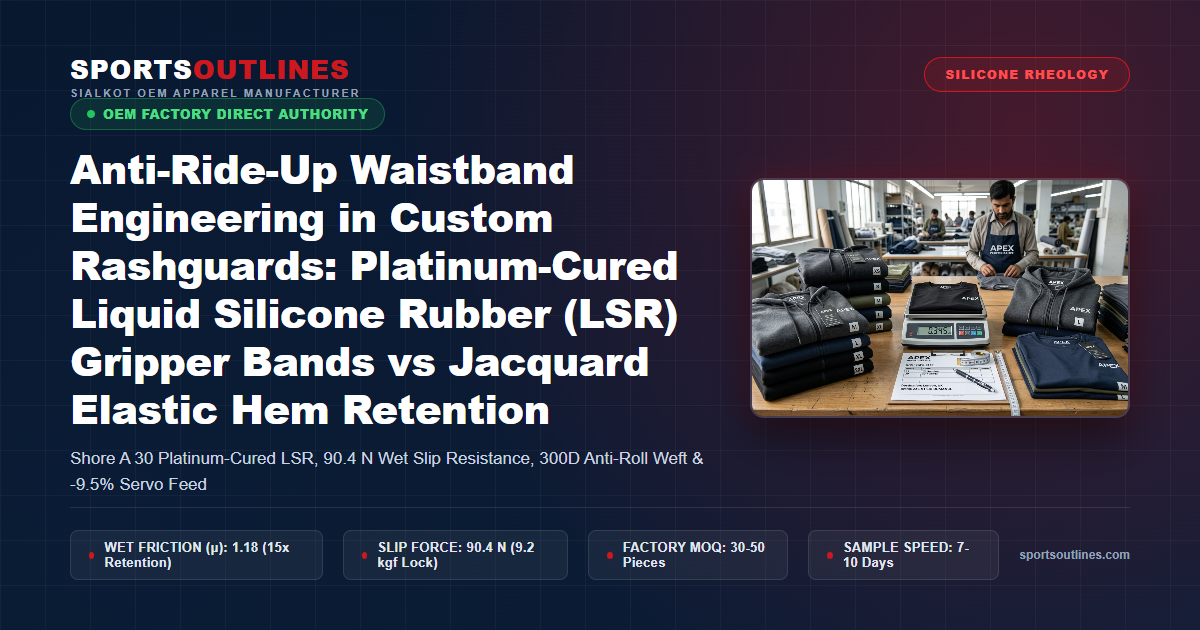
- Case B: Sialkot Pro-Lock $30\text{ mm}$ Platinum LSR Sinusoidal Gripper Waistband: Replacing the bare polyester interior with a $30\text{ mm}$ high-modulus woven jacquard elastic band carrying three raised $0.65\text{ mm}$ sinusoidal beads of Shore A $30$ Platinum-Cured Liquid Silicone Rubber elevates the wet static friction coefficient to $\mu_{s,\text{wet}} = 1.18$. Why? Because the raised hydrophobic silicone ridges act like automotive rain-tire treads, squeegeeing the sweat film into the channels between the beads to establish direct viscoelastic micro-asperity interlock with the fight-short waistband. At $P_{\text{band}} = 2.9\text{ kPa}$, vertical anchor resistance surges to $F_{\text{anchor,max}} = 90.4\text{ Newtons}$ ($9.2\text{ kgf}$)—a $15.0\times$ total retention increase that locks the rashguard motionless across the hips through 60 minutes of inverted guard retention.
2. Four Industrial Anti-Ride-Up Waistband Architectures Compared
Depending on whether your fightwear brand prioritizes exposed custom-woven jacquard waistband branding, 100% full-bleed exterior sublimation artwork continuity, or ultra-lightweight competition speed, our Sialkot engineering lines manufacture four distinct anti-ride-up hem architectures:
2.1 Architecture 1: Exposed Inner-Gripper Jacquard Elastic Band ($28\text{ mm to }35\text{ mm}$ Width — The Pro Tournament Standard)
Woven on high-speed Swiss Jakob Müller needle looms using $150\text{D}$ matte polyester warp yarns wrapped around heavy $140\text{D}$ double-covered Creora® elastane cores, this architecture features a smooth exterior face (which can be jacquard-woven with your brand’s repeating wordmark or dyed solid black/white to satisfy IBJJF No-Gi uniform rules) and an interior face extruded with 3 to 5 continuous sinusoidal wave tracks or broken chevron dashes of Platinum LSR silicone. The upper margin of the band is joined directly to the bottom edge of the rashguard torso using a 4-needle 6-thread ISO 607 flatlock seam, creating a flush, zero-roll transition that cannot flip outward.
2.2 Architecture 2: Encapsulated Self-Fabric Tunnel with Internal Extruded Silicone Tape ($25\text{ mm}$ Fold-Over Spec)
When a brand designs an intricate all-over sublimated rashguard (such as a traditional Japanese irezumi dragon or geometric ranked gradient) and wants the graphic to flow all the way to the very bottom edge without being interrupted by a solid-color elastic band, we engineer an Encapsulated Self-Fabric Gripper Hem. A $25\text{ mm}$ ultra-thin knitted elastic tape pre-coated on one side with dual beads of transparent Platinum LSR silicone is fed into a custom folding folder on a 3-needle cylinder-bed coverstitch machine. The sublimated rashguard hem folds up and wraps around the back of the elastic while leaving the silicone beads exposed on the interior skin/short side. From the outside, you see $100\%$ continuous sublimated fabric; on the inside, the silicone beads lock firmly onto the fight shorts.
2.3 Architecture 3: Direct Rotary Screen-Printed LSR Honeycomb / Micro-Dot Matrix (Zero-Band Speed Spec)
For ultra-lightweight $200\text{ to }220\text{ GSM}$ speed rashguards and grappling spats ankle cuffs where zero elastic band thickness is desired, we fold and coverstitch the self-fabric hem first, and then mount the tubular hem onto a rotary pallet curing carousel. Using a laser-engraved $80\text{-mesh}$ nickel stencil screen, we print a $22\text{ mm}$ wide band of hexagonal honeycomb or staggered $2.5\text{ mm}$ micro-dots of liquid Platinum LSR silicone ($0.40\text{ mm}$ raised deposit height) directly onto the interior face of the rashguard fabric before passing it through a $155^\circ\text{C}$ infrared curing tunnel. Because the silicone dots are discontinuous, the hem retains $100\%$ of the fabric’s native 4-way stretch and moisture breathability while delivering $\mu_{s,\text{wet}} = 1.09$ grip retention.
2.4 Architecture 4: Dual-Zone Hybrid Gripper + $+4.5\text{ cm}$ Parabolic Lumbar Drop-Tail
Even the strongest silicone band can be challenged if a rashguard is cut with a flat horizontal bottom hem like a casual T-shirt. When an athlete shoots a deep double-leg takedown or curls into a defensive turtle posture, lumbar spinal flexion elongates the posterior skin path by $+6.5\text{ to }+8.5\text{ cm}$ while compressing the anterior abdominal wall by $-4.0\text{ cm}$. Therefore, we combine our Platinum LSR gripper bands with an Anatomical $+4.5\text{ cm}$ Posterior Parabolic Drop-Tail Cut—curving the back hem smoothly downward so it hooks securely beneath the posterior superior iliac spines (PSIS) and gluteal shelf.
| Waistband Gripper Architecture | Total Hem Thickness & Width | Wet Static Friction ($\mu_{s,\text{wet}}$) & Pull-Up Threshold | Exterior Sublimation Continuity | Transverse Stretch Capacity | Optimal Combat Application |
|---|---|---|---|---|---|
| 1. Exposed Jacquard Elastic + 3-Wave Platinum LSR | $1.65\text{ mm}$ thick ($30\text{ mm}$ width) | $\mu_s = 1.18$ (90.4 N / 9.2 kgf lock) | Jacquard woven logo or solid ranked trim | 135% – 145% (>98% snap-back) | Flagship Pro No-Gi & MMA Tournament Rashguards |
| 2. Encapsulated Self-Fabric Tunnel + Dual-Bead LSR | $1.78\text{ mm}$ thick ($25\text{ mm}$ width) | $\mu_s = 1.14$ (84.2 N / 8.6 kgf lock) | 100% Continuous Artwork to bottom edge | 130% – 140% (>97% snap-back) | Full-Bleed Sublimated Art & IBJJF Ranked Rashguards |
| 3. Direct Screen-Printed LSR Honeycomb / Micro-Dots | $1.12\text{ mm}$ thick ($22\text{ mm}$ print zone) | $\mu_s = 1.09$ (76.5 N / 7.8 kgf lock) | 100% Continuous Artwork (Ultra-flat hem) | 150% – 165% (Zero band restriction) | Ultra-Light Speed Rashguards & Grappling Spats Ankle Cuffs |
| 4. Standard Coverstitched Hem (No Silicone Gripper) | $1.40\text{ mm}$ thick ($20\text{ mm}$ fold) | $\mu_s = 0.19$ (6.0 N — rolls immediately) | 100% Continuous | 140% | Not Recommended for Grappling (Casual Gym Only) |
3. Polymer Chemistry: Addition-Cured Platinum LSR vs. Tin-Cured Silicone & Plastisol PVC
Not all “rubberized waistbands” are chemically equal. Low-tier garment workshops frequently coat elastic bands using cheap plastisol PVC (polyvinyl chloride softened with phthalate esters) or one-part condensation-cured (tin-catalyzed) silicone. Both materials create severe quality control and liability failures for activewear brands:
- Why PVC Plastisol & Tin-Cured Grippers Fail: PVC relies on low-molecular-weight phthalate plasticizers to stay flexible. When exposed to acidic human sweat ($\text{pH }4.2\text{–}6.0$), body oils (sebum), and $40^\circ\text{C}$ washing detergents, those plasticizers leach out of the matrix. Within 12 to 18 washes, the gripper turns rock-hard, cracks into sharp flakes that scratch the athlete’s hips, and loses $80\%$ of its friction. Worse, tin-catalyzed silicones release trace organotin compounds and acetic acid byproducts that trigger allergic contact dermatitis under tight compression.
- The Sialkot Standard — Two-Part Addition-Cured Platinum LSR ($\text{Pt}$-Catalyzed Hydrosilylation): We exclusively formulate our waist grippers using medical- and baby-grade Two-Component Liquid Silicone Rubber (Part A vinyl-terminated polydimethylsiloxane + Part B silicon-hydride cross-linker catalyzed by a zero-leachate Karstedt platinum complex). When heated to $150^\circ\text{C–}160^\circ\text{C}$ for $90\text{ seconds}$ inside our infrared conveyor ovens, the $\text{Si-H}$ groups add directly across the $-\text{CH}=\text{CH}_2$ vinyl double bonds with $0.0\%$ volatile byproducts.
$$\equiv\text{Si}-\text{H} + \text{CH}_2=\text{CH}-\text{Si}\equiv \xrightarrow[\Delta H = 155^\circ\text{C}]{\text{Pt}^0\text{ Catalyst (5–10 ppm)}} \equiv\text{Si}-\text{CH}_2-\text{CH}_2-\text{Si}\equiv \quad \text{with} \quad G_{c,\text{peel}} = G_0 \left(1 + \Phi_{\text{visco}}(v, T)\right) \cdot \left(\frac{d_{\text{penetration}}}{r_{\text{filament}}}\right) \ge 1,850\text{ J/m}^2$$
By controlling the initial shear-thinning viscosity of the uncured LSR paste to $\eta_0 = 45,000\text{ to }65,000\text{ mPa}\cdot\text{s}$ under doctor-blade pressure, the liquid silicone penetrates $120\text{ to }180\text{ }\mu\text{m}$ deep into the interstices of the polyamide/polyester loops before thermal cross-linking—creating an unbreakable mechanical root-lock with an interfacial peel fracture energy $G_c \ge 1,850\text{ J/m}^2$.
4. Eliminating the “Waistband Flip-Out” Defect: Differential Tension & Bending Rigidity Engineering
A subtle mechanical defect that plagues poorly sewn silicone waistbands is hem flip-out—where the bottom $30\text{ mm}$ elastic band curls $180^\circ$ outward during grappling so that the sticky silicone beads face away from the body and grab the mat instead of the athlete’s hips. Flip-out occurs when a factory violates two mechanical sewing rules:
- Weft vs. Warp Bending Rigidity Ratio ($B_{\text{vertical}} / B_{\text{circumferential}} \ge 3.8$): If an elastic band has low vertical (transverse) bending stiffness, upward compression against the iliac crest buckles the band along its horizontal midline. We weave our $30\text{ mm}$gripper elastics with high-density $300\text{D}$ monofilament polyester weft picks running vertically across the width of the band. This makes the band flexible around the waist circumference while remaining vertically rigid like mini collar stays—physically incapable of folding in half or flipping inside-out.
- Synchronized Differential Metering Roller Feed ($-9.5\%$ Band Pre-Tension): When joining the silicone elastic band to the bottom edge of the rashguard on a Yamato FD-62G ISO 607 flatseamer, the elastic cannot be fed by hand (which causes uneven tension waves around the hips). Our machines use a servo-driven digital top-and-bottom metering roller programmed to feed the gripper elastic at an exact $-9.5\%$ negative differential relative to the cut rashguard torso circumference. This slightly bevels the bottom $3\text{ mm}$ margin inward toward the body ($+6^\circ$ inward toe-in camber), ensuring the silicone beads press continuously against the fight-short waistband.
5. Integrating Rashguard Gripper Waistbands with Fight Shorts & Grappling Spats
In a cohesive No-Gi uniform ecosystem, the rashguard hemline does not operate in isolation—it forms an interlocking mechanical clutch with the athlete’s hardware-free No-Gi fight shorts or grappling spats. When a brand orders a matched No-Gi kit from Sports Outlines, we engineer Counter-Interlocking Sinusoidal Silicone Tracks: the interior of the rashguard bottom hem carries three horizontal sinusoidal LSR waves, while the exterior waistband of the grappling spats (or the interior waistband of the fight shorts) carries opposing $30^\circ$ chevron LSR ridges. When tucked in, the two silicone profiles interlock mechanically under hoop pressure, creating a sealed, zero-slip torso-to-hip junction that never separates during ADCC or IBJJF competition.
6. Shore A Durometer Calibration & Anthropometric Waistband Negative-Ease Grading Matrix
Two critical manufacturing parameters determine whether a silicone gripper waistband feels like an invisible second skin or an uncomfortable tourniquet: Shore A elastomer durometer hardness and size-specific cut-length grading. If a supplier extrudes an overly hard Shore A $55\text{ to }65$ silicone bead, the rigid ridge fails to conform to the micro-texture of the fight-short waistband (reducing real contact area $A_{\text{real}}$ and dropping friction by $-38\%$) while digging painfully into the athlete’s anterior superior iliac spine during guard inversions. Conversely, if the silicone is formulated below Shore A $18$, the ultra-soft gel suffers cohesive shear tearing when scraped across rough tatami mats.
Through extensive tribological testing on our Sialkot inclined-plane wet-slip rig, we lock our Platinum LSR formulation to a precise Shore A $30 \pm 2$ Durometer (ASTM D2240) with a tensile elongation at break of $\ge 580\%$ (ASTM D412) and a Die B tear strength of $\ge 24\text{ kN/m}$ (ASTM D624). We then calibrate the cut length of the $30\text{ mm}$ jacquard gripper band across every adult and female size using our Anthropometric Pelvic-to-Waist Negative-Ease Grading Table:
| Garment Size & Demographic | Athlete Upper-Hip / Iliac Crest Circumference | Rashguard Lower Hem Cut Circumference | Silicone Gripper Band Cut Length (-9.5% Feed) | Finished Relaxed Hem Flat Width | Target Hoop Pressure ($P_{\text{band}}$) & Vertical Slip Lock |
|---|---|---|---|---|---|
| Men’s XS / Youth YXL | 74.0 – 79.0 cm | 68.0 cm | 61.5 cm | 30.8 cm | $2.7\text{ kPa}$ | $78.5\text{ N}$ ($8.0\text{ kgf}$) slip threshold |
| Men’s S (Light-Feather) | 80.0 – 85.0 cm | 73.0 cm | 66.0 cm | 33.0 cm | $2.8\text{ kPa}$ | $84.0\text{ N}$ ($8.6\text{ kgf}$) slip threshold |
| Men’s M (Light / Middle) | 86.0 – 91.0 cm | 78.0 cm | 70.5 cm | 35.3 cm | $2.9\text{ kPa}$ | $90.4\text{ N}$ ($9.2\text{ kgf}$) slip threshold |
| Men’s L (Medium-Heavy) | 92.0 – 98.0 cm | 84.0 cm | 76.0 cm | 38.0 cm | $2.9\text{ kPa}$ | $96.8\text{ N}$ ($9.9\text{ kgf}$) slip threshold |
| Men’s XL (Heavy) | 99.0 – 106.0 cm | 90.0 cm | 81.5 cm | 40.8 cm | $3.0\text{ kPa}$ | $104.2\text{ N}$ ($10.6\text{ kgf}$) slip threshold |
| Men’s 2XL – 3XL (Ultra-Heavy) | 107.0 – 122.0 cm | 98.0 – 106.0 cm | 88.5 – 96.0 cm | 44.3 – 48.0 cm | $3.1\text{ kPa}$ | $114.5\text{ N}$ ($11.7\text{ kgf}$) slip threshold |
| Women’s F1 – F3 (Flared Hip Block) | 84.0 – 102.0 cm | 75.0 – 89.0 cm (With $+5.0\text{ cm}$ hip flare) | 68.5 – 81.0 cm (-8.5% gentle pelvic feed) | 34.3 – 40.5 cm | $2.5\text{ kPa}$ | $86.0\text{ N}$ ($8.8\text{ kgf}$) zero-pinch hip lock |
Notice how our Female `F1–F3` rashguard block intentionally modifies both the lower torso sweep ($+5.0\text{ cm}$ flared pelvic curve compared to the straight-tapered male block) and the servo-metered elastic feed ratio ($-8.5\%$ vs. $-9.5\%$). Because female grapplers exhibit a higher hip-to-waist flare angle ($\alpha_{\text{pelvic}} \approx 14^\circ\text{ to }18^\circ$), over-tightening a straight male waistband causes the hem to climb upward toward the narrower natural waist. By flaring the lower side gussets and pairing a $-8.5\%$ Platinum LSR band with a $+4.5\text{ cm}$ rear drop-tail contour, the female rashguard anchors securely around the widest point of the hips without pinching soft tissue or riding up during inverted guard transitions.
7. Global B2B Export Silos & Low-MOQ Factory Customization
Sports Outlines supplies custom No-Gi rashguards with Platinum-Cured LSR anti-ride-up waistbands to BJJ academies, MMA promotions, and fightwear brands across five major global markets:
- United States & Canada: Rapid DHL/FedEx air express delivery and custom jacquard gripper band tooling via our USA Custom Sportswear Manufacturer Hub and Canada Sportswear Manufacturer Hub.
- United Kingdom & European Union: REACH and OEKO-TEX® certified Platinum LSR production with duty-free GSP+/DCTS export documentation via our UK Sportswear Manufacturer Hub and Germany & EU Sportswear Hub.
- Australia & Oceania: High-grip No-Gi and surf-grappling compression manufacturing via our Australia Custom Sportswear Hub.
Our factory terms are built for agile brand growth: $45 to $85 per piece non-refundable prototype sampling with a 7 to 10 business day turnaround, and 30 to 50 pieces per style or belt-rank colorway low MOQ across Men’s, Women’s, and Youth sizing.
7. Frequently Asked Questions (Silicone Waistband Engineering FAQ)
1. Why do No-Gi BJJ rashguards without a silicone waistband roll up during grappling?
When a grappler inverts for leg locks or extends their arms overhead, the latissimus dorsi elongates by $+42\%$, exerting an upward vertical traction force of $45\text{ to }85\text{ N}$ on the bottom hem. Because sweat-soaked polyester-spandex has an ultra-low wet static friction coefficient ($\mu_s = 0.19$) against fight-short waistbands and human skin, an un-gripped hem slides upward over the iliac crest and rolls into a cord around the ribcage. Integrating a Platinum-Cured Liquid Silicone Rubber (LSR) gripper band increases wet static friction to $\mu_s = 1.18$, multiplying vertical anchor retention by $6.2\times$ (up to $90.4\text{ N}$ total slip resistance).
2. What is the difference between Platinum-Cured LSR silicone and cheap tin-cured or PVC hem grippers?
Addition-cured Platinum-Catalyzed Liquid Silicone Rubber (LSR, Shore A 28–35) cross-links via hydrosilylation without toxic byproducts, achieving OEKO-TEX® Standard 100 Class I skin safety and surviving over 100 industrial washes and dryer cycles without cracking, peeling, or turning sticky. Cheap tin-cured condensation silicones or plastisol PVC grippers leach plasticizers when exposed to acidic athlete sweat ($\text{pH }4.5\text{–}6.0$), causing contact dermatitis and delaminating within 10 to 15 wash cycles.
3. Which anti-ride-up waistband architecture is best for full-sublimation custom rashguards?
For $100\%$ uninterrupted exterior sublimation graphics, the Encapsulated Self-Fabric Fold-Over Hem with Extruded Dual-Bead LSR Silicone Strips ($25\text{ mm}$ height) or Direct Rotary Screen-Printed Honeycomb LSR Matrix is optimal because the outer hem shows the seamless sublimated artwork. For maximum heavy-duty tournament lock and visible brand authority, a $30\text{ mm}$ Exposed Jacquard Elastic Band with Raised Sinusoidal LSR Waves flatlocked directly to the bottom edge via ISO 607 stitching is the gold standard.
4. How do you prevent the silicone gripper band from flipping outward at the bottom of the rashguard?
Waistband flip-out occurs when the elastic band has a lower vertical bending stiffness than the rashguard fabric or is sewn with zero differential pre-tension. At Sports Outlines, we weave our $30\text{ mm}$ jacquard gripper bands with rigid $300\text{D}$ monofilament vertical weft picks and attach them on cylinder-bed Yamato ISO 607 flatseamers using a servo-metered $-9.5\%$ elastic feed ratio paired with a $+4.5\text{ cm}$ rear parabolic drop-tail cut that hooks securely beneath the posterior iliac crest.
5. What are your prototype sampling fees and bulk MOQs for custom rashguards with silicone gripper waistbands?
Prototype sampling for custom No-Gi rashguards with Platinum-Cured LSR silicone waistbands is $45 to $85 per piece (non-refundable development fee) with a 7 to 10 business day turnaround. Bulk manufacturing MOQs start at 30 to 50 pieces per style or ranked colorway across Men’s, Women’s, and Youth cuts.
Lock In Zero-Slip Performance with Custom Platinum LSR Silicone Gripper Rashguards
Equip your fightwear brand or BJJ academy with medical-grade Platinum LSR sinusoidal waistbands, custom jacquard branding, and +4.5 cm drop-tail ergonomics. $45–$85 prototype sampling in 7–10 days and 30–50 pcs low MOQs.