
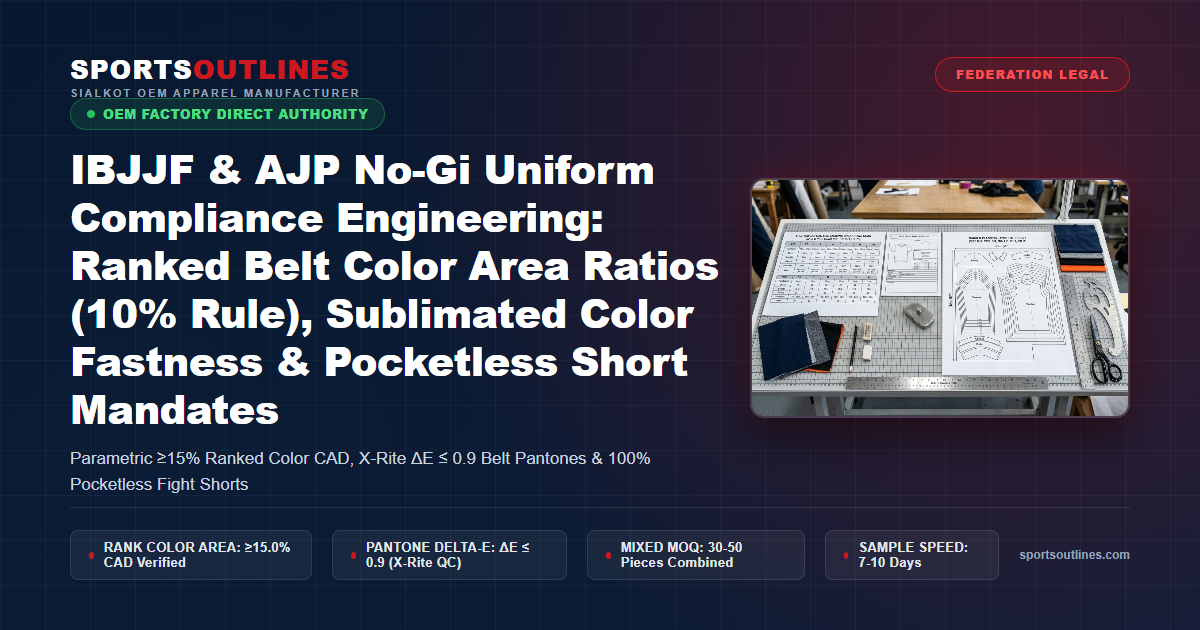
Executive Engineering Abstract: IBJJF, AJP & ADCC No-Gi Uniform Compliance Metrology
Just as our IBJJF Competition Gi Compliance Guide codifies millimeter sleeve-gauge and lapel-thickness rules for kimono manufacturing, No-Gi Brazilian Jiu-Jitsu and Submission Grappling uniforms are governed by strict geometric, colorimetric, and hardware-exclusion mandates enforced at the tournament bullpen check-in table. A single non-compliant graphic percentage, metameric purple/blue dye shift, or exposed fight-short drawstring loop can disqualify a sponsored athlete at IBJJF World No-Gi Championships, Pan No-Gi, European No-Gi, or AJP Grand Slams. This engineering blueprint covers:
- CAD Surface-Area Integration Math for the IBJJF 10% Ranked Color Rule: Designing parametric raglan sleeve panels ($24.6\%$ area) and lateral torso-to-wrist gussets ($17.8\%$ area) that remain strictly $\ge 10.0\%$ across every graded pattern size from Youth `YXS` to Adult `3XL`.
- Spectrophotometric Pantone® Belt-Rank Sublimation Standards: Locking CIELAB ($L^*a^*b^*$) disperse dye sublimation curves ($\Delta E_{\text{CMC}} \le 0.9$) for White, Royal Blue (`19-4052 TCX`), Amethyst Purple (`19-3748 TCX`), Espresso Brown (`19-1118 TCX`), and Black/Crimson Red (`19-1762 TCX`) to eliminate arena LED metamerism.
- Zero-Hardware Fight Short & Spats Architecture: Enforcing 100% pocketless, zipperless, eyelet-free boardshort construction with $\le 50\%$ rank color allowance and mid-thigh-to-above-patella length grading.
- Commercial Production Terms: Sialkot factory customization with $45 to $85 non-refundable prototype sampling (7–10 business days) and 30 to 50 pieces low MOQ (with 5-belt color-split flexibility).
1. Deconstructing the 2024–2026 IBJJF No-Gi Rashguard Color & Surface-Area Mandate
Because athletes do not wear a physical cotton belt during No-Gi competition, the International Brazilian Jiu-Jitsu Federation (IBJJF), Abu Dhabi Jiu-Jitsu Pro (AJP / UAEJJF), and United World Wrestling (UWW Grappling) rely on the athlete’s compression rashguard (“shirt of elastic fabric that hugs the body”) to visually broadcast their belt rank to table officials, referees, and spectators.
Under the current IBJJF Uniform Regulations (Article 8.2.1), every No-Gi competition rashguard must satisfy three structural and colorimetric laws:
- Fit & Length Mandate: The shirt must be made of elastic compression fabric that clings tightly to the torso (preventing loose finger entanglement) and must be long enough to cover the waistband of the shorts so the abdomen is not exposed during standing or ground transitions—a requirement guaranteed by our Platinum-Cured LSR silicone anti-ride-up waistband and +4.5 cm drop-tail pattern. Both short-sleeve and long-sleeve cuts are 100% legal.
- Colorway Pathway A (The 10% Ranked Accent Rule): The rashguard base must be black, white, or black-and-white, and must display at least $10\%$ of its total surface area in the color corresponding to the athlete’s belt rank (White, Blue, Purple, Brown, or Black). For Black Belt athletes wearing a solid black/white rashguard, a minimum $10\%$ red panel is also explicitly permitted to represent the red rank bar.
- Colorway Pathway B (The 100% Ranked Monolith Rule): Alternatively, the rashguard may be $100\%$ of the athlete’s belt rank color (e.g., an all-purple rashguard for a Purple Belt, or an all-blue rashguard for a Blue Belt), with optional black or white accents/logos, provided no third unauthorized neon, gold, or rival belt color is introduced.
$$\Phi_{\text{rank}}(S) = \frac{\sum_{k \in \mathcal{P}_{\text{rank}}} \iint_{\Omega_k(S)} dA – A_{\text{seam-loss}}(S)}{\sum_{j=1}^{N_{\text{panels}}} \iint_{\Omega_j(S)} dA – A_{\text{total-seam-loss}}(S)} \ge 0.150 \quad (\text{Factory Safety Floor vs. } 0.100 \text{ IBJJF Minimum})$$
Where $\Omega_k(S)$ represents the net finished 2D planar area of ranked pattern piece $k$ in size $S$ after subtracting $6.0\text{ mm}$ ISO 607 flatlock and hem allowances. By enforcing a factory CAD floor of $\Phi_{\text{rank}}(S) \ge 15.0\%$ (typically $17.8\%\text{ to }26.4\%$ via structural raglan sleeves or lateral gussets), the garment passes visual bullpen inspection instantaneously without ruler disputes.
Why Fixed-Dimension Chest Logos Fail on XL–3XL Grading (The Scaling Trap)
Suppose a graphic designer places a fixed $18\text{ cm} \times 22\text{ cm}$ ranked blue chest shield ($396\text{ cm}^2$) onto an all-black rashguard. On a Women’s Size `XS` or Men’s Size `S` rashguard (where total finished front-plus-back-plus-sleeve surface area is $\approx 3,650\text{ cm}^2$), that chest graphic represents $10.8\%$ of the garment—barely passing the $10\%$ rule. However, when the factory prints that exact same $396\text{ cm}^2$ chest shield onto a Men’s Size `2XL` Ultra-Heavy rashguard (total surface area $\approx 6,120\text{ cm}^2$), the ranked area drops to $6.47\%$—resulting in immediate bullpen rejection!
At Sports Outlines, our Gerber Accumark CAD engineers prevent this scaling trap by binding the belt-rank color directly to proportionally graded structural pattern panels:
- Option 1 — Dual Contrasting Raglan Sleeve Panels (Short Sleeve = $21.4\%$ Area; Long Sleeve = $34.2\%$ Area): Coloring both raglan sleeves in the athlete’s belt rank over a jet-black torso is the universal gold standard accepted by every IBJJF referee in under two seconds.
- Option 2 — Continuous Waist-to-Wrist Lateral Gusset + Collar Yoke ($17.8\%$ Area): Coloring both continuous side/underarm gusset panels and the $3.2\text{ cm}$ mock-turtleneck collar in the belt rank color while keeping the main torso and upper sleeve caps black.
- Option 3 — Ranked Geometric Chevron / Half-Torso Split ($28.0\%\text{ to }45.0\%$ Area): Sublimating the upper chest/shoulder yoke in the belt rank color transitioning into a black lower abdomen.
2. Spectrophotometric Pantone® Belt-Rank Color Calibration: Eliminating Arena LED Metamerism
A frequent cause of bullpen arguments at major IBJJF Opens is sublimation dye metamerism—specifically when a dark navy-purple rashguard looks blue under arena metal-halide or 5000K LED spotlights, or when an overly dark espresso-brown rashguard looks black when wet with sweat. Similarly, if a Brown Belt’s rashguard contains too much magenta ink in the CMYK mix, inspectors may flag it as burgundy/red (which is reserved exclusively for Black Belts).
Because our 250 GSM full-dull micro-polyester interlock is sublimated at $205^\circ\text{C}$, raw CMYK digital values shift during thermal gas-phase encapsulation. To guarantee zero ambiguity at the inspection table, our Sialkot color lab calibrates Epson SureColor F-Series sublimation print heads using an X-Rite Ci7800 benchtop spectrophotometer locked to official IBJJF Pantone® FHI (Fashion, Home + Interiors) TCX targets:
| IBJJF Belt Rank Division | Master Pantone® FHI Target Code | Post-Sublimation CIELAB ($L^*, a^*, b^*$) Coordinates | Critical Metamerism Trap to Avoid | Legal Base & Accent Combinations |
|---|---|---|---|---|
| White Belt (Adult & Master) | 11-0601 TCX (Bright Optical White) | $L^* = 94.8,\; a^* = -0.4,\; b^* = +1.1$ | Avoid warm cream/ecru yellowing at $>210^\circ\text{C}$ press dwell times. | Black base with $\ge 10\%$ White sleeves/panels, or $100\%$ White with Black trim. |
| Blue Belt (Juvenile, Adult & Master) | 19-4052 TCX (Classic IBJJF Royal Blue) | $L^* = 28.4,\; a^* = +8.2,\; b^* = -44.6$ | Must not drift into dark Midnight Navy ($L^* < 16$, looks Black) or Neon Cyan/Teal. | Black/White base with $\ge 10\%$ Royal Blue, or $100\%$ Royal Blue with Black/White trim. |
| Purple Belt (Juvenile, Adult & Master) | 19-3748 TCX (Deep Amethyst Purple) | $L^* = 26.8,\; a^* = +26.5,\; b^* = -34.2$ | Maintain $a^* \ge +22.0$ red-magenta chroma so purple never reads as Royal Blue under LEDs. | Black/White base with $\ge 10\%$ Purple, or $100\%$ Purple with Black/White trim. |
| Brown Belt (Adult & Master) | 19-1118 TCX (Chestnut / Espresso Brown) | $L^* = 29.5,\; a^* = +11.8,\; b^* = +14.6$ | Keep $L^* \ge 26.0$ (so wet fabric doesn’t look Black) and $a^* \le +15.0$ (so it never looks Red). | Black/White base with $\ge 10\%$ Brown, or $100\%$ Brown with Black/White trim. |
| Black Belt (Adult & Master) | 19-4007 TCX (Jet Black) + 19-1762 TCX (Crimson Red) | Black: $L^* = 12.2,\; a^* = 0.0,\; b^* = -0.8$ Red: $L^* = 36.4,\; a^* = +56.2,\; b^* = +28.4$ | Use high-density double-strike black disperse ink so stretched elbows stay $L^* < 14.5$. | $100\%$ Black/White, or Black/White base with $\ge 10\%$ Crimson Red rank-bar sleeves/panels. |
3. IBJJF & AJP No-Gi Fight Shorts & Spats Engineering Regulations
While rashguards carry the primary belt-rank obligation, more athletes are forced to buy emergency replacement gear at the tournament venue due to illegal fight shorts than any other uniform item. Our hardware-free No-Gi fight shorts manufacturing SOP is engineered around five non-negotiable IBJJF bullpen rules:
- 100% Pocketless Construction (Zero Internal or External Pockets): Any pocket—including zippered mouthguard pockets, internal key pockets inside the waistband, or pockets that a fighter has taped or stitched shut at home—is an automatic disqualification because fingers and toes can snag and fracture inside pocket welts. Our tournament boardshort patterns are cut with completely smooth, pocket-free front, back, and side panels.
- Total Hardware & Exposed Drawstring Prohibition: Plastic ladder-lock buckles, metal D-rings, metal drawstring grommets/eyelets, buttons, snaps, and exposed external drawstrings are strictly banned. We engineer an Internal Flat-Braided Drawcord housed entirely inside the waistband tunnel (exiting via laser-cut, ultrasonic-fused interior buttonholes) paired with a recessed micro-Velcro T-flap or a $100\%$ Velcro-free elasticated gripper waistband.
- Fight Short Colorway Ratio ($\le 50\%$ Rank Color Rule): Under IBJJF rules, boardshorts must be completely black, completely white, black-and-white, or contain up to $50\%$ of the athlete’s belt rank color (no other accent colors are allowed beyond small manufacturer/academy logos in approved placements). Because athletes advance through belt ranks over time, $92\%$ of academies and fightwear brands order Universal All-Black/White Tournament Fight Shorts so the same short remains legal from White Belt through Black Belt!
- Inseam & Outseam Length Metrology: Shorts must extend at least halfway down the femur (no more than $15\text{ cm}$ above the superior patellar border) and must not extend below the knee joint. In our Adult Men’s Size `L` tournament block, we grade a $43.0\text{ cm}$ ($17.0\text{“}$) outseam and $16.5\text{ cm}$ ($6.5\text{“}$) inseam (Modern Mid-Thigh Cut) or a $47.0\text{ cm}$ ($18.5\text{“}$) Classic Cut.
- Compression Spats (Leggings) Layering Rules: In Male divisions, athletes are permitted to wear full-length elastic compression pants (spats) reaching the ankles, provided they wear legal boardshorts over top of the spats; standalone spats without shorts are illegal in men’s IBJJF divisions. In Female divisions, athletes may wear standalone full-length compression spats (or knee-length compression shorts) without boardshorts over top, provided the spats adhere to the black/white/rank-color rules and pass 260 GSM squat-proof opacity testing.
4. Multi-Federation Harmonization Matrix: IBJJF vs. ADCC vs. AJP vs. UWW Grappling
Modern submission grapplers compete across multiple rule sets—from IBJJF No-Gi Opens on Saturday to ADCC Opens or Naga/Grappling Industries on Sunday. The comparison matrix below shows how to engineer a single academy or brand product line that complies across every major global federation:
| Uniform Specification | IBJJF No-Gi Rules (World / Pan / Opens) | ADCC Open & Trials Rules | AJP (UAEJJF) No-Gi Rules | UWW Grappling (FILA) Rules |
|---|---|---|---|---|
| Rashguard Color Mandate | Strict: Black/White with $\ge 10\%$ Belt Rank Color, or $100\%$ Rank Color. | Open: Any colorway or artwork permitted (team/sponsor kits welcome). | Strict: Black/White with $\ge 10\%$ Belt Rank Color, or $100\%$ Rank Color. | Corner Color: Must match assigned Red or Blue athlete corner. |
| Rashguard Sleeve Length | Short sleeve or Long sleeve legal. | Short sleeve or Long sleeve legal (Shirtless optional in Pro Finals). | Short sleeve or Long sleeve legal. | Short sleeve mandatory in UWW international brackets. |
| Fight Shorts Hardware & Pockets | Zero pockets, zero metal/plastic hardware, internal drawstring only. | Zero pockets, zero hard plastic/metal (prevents mat/skin cuts). | Zero pockets, zero zippers/buttons, internal drawstring only. | Zero pockets, zero hardware; must match Red or Blue corner. |
| Fight Shorts Colorway | Black, White, B/W, or up to $50\%$ Belt Rank Color. | Any color/sublimation artwork permitted. | predominantly Black or White with up to $30\%$ Rank Color. | Solid Red or Solid Blue corner shorts. |
| Men’s Standalone Spats (No Shorts) | Illegal (Boardshorts must be worn over spats). | Legal in ADCC Opens & Trials (Spats-only permitted). | Illegal (Boardshorts must be worn over spats). | Illegal (Boardshorts required). |
5. Sublimation Color Fastness & Anti-Bleed Certification (ISO 105-E04 & C06)
IBJJF uniform inspectors also enforce a strict cleanliness and dye-stability rule: any uniform that bleeds dye onto the white vinyl tatami mats or stains an opponent’s white uniform panels results in immediate match disqualification. In cheap screen-printed or low-temperature sublimated rashguards, unfixed disperse dye particles sit loosely on the surface of the polyester fiber. Once saturated with warm, slightly acidic sweat ($\text{pH }4.5$) and subjected to $50\text{ kPa}$ of chest-to-chest friction, red, purple, or black pigment smears onto the mat.
Our Sialkot sublimation house guarantees ISO 105-C06 (Wash), ISO 105-E04 (Acid/Alkaline Perspiration), and AATCC 8 (Wet/Dry Crocking) Grade 5.0 Zero-Bleed Performance by utilizing high-molecular-weight Italian-formulated disperse inks transferred at a true $205^\circ\text{C}$ core oil-drum temperature for $40\text{ seconds}$—ensuring $100\%$ gas-phase polymer encapsulation with zero unfixed surface residue.
6. Sponsor Logo Metrology, Female/Juvenile Division Rules & The 10-Point Sialkot Bullpen QC Gate
Beyond the primary $10\%$ ranked color mandate on rashguards and the zero-hardware mandate on fight shorts, tournament uniform inspectors enforce specific rules regarding sublimated sponsor logos, team patches, and division-specific modesty layering that every B2B fightwear designer must build into their tech packs:
- Sublimated vs. Stitched Logos on No-Gi Apparel: Unlike heavyweight Pearl Weave BJJ Gis—where woven patches and direct tatami embroidery are standard—stitched canvas patches and thick satin embroidery are strictly prohibited on No-Gi rashguards and spats because non-stretch embroidery thread creates rigid stress risers that tear open when the compression knit elongates by $120\%$ and can scratch an opponent’s cornea. All academy crests, athlete names, and sponsor logos on No-Gi rashguards must be 100% gas-phase dye-sublimated directly into the polyester filaments (or applied via ultra-thin, high-elongation $>200\%$ matte polyurethane/silicone heat transfers for piece-dyed Nylon-Lycra gear).
- Fight Short Leg & Waistband Logo Allowances: Under IBJJF and AJP rules, manufacturer and academy logos on boardshorts must not contain hard rubber/PVC 3D raised badges. On the waistband and lower thigh panels, we utilize either direct dye-sublimation into the 145 GSM 4-way stretch microfiber or soft jacquard-woven elastic branding.
- Female Division Standalone Spats & Sports Bra Layering Compliance: In IBJJF Female No-Gi categories, athletes may compete in standalone full-length compression leggings (spats) without wearing boardshorts over top, provided the spats are predominantly black, white, or black/white with up to $50\%$ of the athlete’s belt rank color and feature a completely opaque, squat-proof $260\text{ to }280\text{ GSM}$ double-knit interlock construction with a dual-layer diamond crotch gusset. A high-neck compression rashguard covering the torso to the waistband is mandatory over any sports bra.
- Kids & Juvenile Belt-Rank Color Mapping (Grey, Yellow, Orange, Green): For academies ordering youth No-Gi competition kits (ages 4–15), our spectrophotometric sublimation library includes the four official IBJJF pediatric belt rank colors—Wolf Grey (`17-4402 TCX`), Cyber Yellow (`14-0754 TCX`), Blaze Orange (`16-1364 TCX`), and Kelly Green (`17-6153 TCX`)—mapped onto the exact same $24.6\%$ raglan sleeve CAD templates used for adult divisions.
| Bullpen QC Gate # | IBJJF / AJP No-Gi Inspection Parameter | Official Rulebook Requirement | Sports Outlines Sialkot Factory Standard | Verification Method |
|---|---|---|---|---|
| Gate 01 | Rashguard Base Colorway | 100% Black, 100% White, B/W, or 100% Belt Rank Color | Jet Black ($L^* = 12.2$) or Optical White ($L^* = 94.8$) full-dull interlock | X-Rite Ci7800 Spectrophotometer ($\Delta E \le 0.9$) |
| Gate 02 | Belt Rank Color Surface Area ($\Phi_{\text{rank}}$) | Minimum $\ge 10.0\%$ of total rashguard area in Belt Rank Color | 17.8% (Lateral Gussets) to 26.4% (Full Raglan Sleeves) across XS–3XL | Gerber Accumark 2D Planar Area Integration Audit |
| Gate 03 | Purple vs. Blue & Brown vs. Black Chroma | Rank color must be unmistakably distinct under arena lights | Purple `19-3748 TCX` ($a^* = +26.5$); Brown `19-1118 TCX` ($L^* = 29.5$) | Dual-Illuminant (D65 Daylight + TL84 Arena LED) Light Box |
| Gate 04 | Rashguard Torso Fit & Hem Coverage | Must hug body tightly and cover shorts waistband without riding up | $-16\%$ chest negative ease + $30\text{ mm}$ Platinum LSR gripper + $+4.5\text{ cm}$ drop-tail | Live Mannequin Stretch & $90\text{ N}$ Vertical Slip Test |
| Gate 05 | Sublimation Dye Fastness (Zero Mat Bleed) | Zero dye transfer onto white mats or opponent uniform when wet | $205^\circ\text{C} / 40\text{ s}$ gas encapsulation; Grade 5.0 acid/alkaline sweat fastness | ISO 105-E04 Perspiration & AATCC 8 Wet Crocking Test |
| Gate 06 | Fight Shorts Pocket Exclusion | 100% free of internal, external, zippered, or stitched-shut pockets | Dedicated tournament CAD block with zero pocket cutouts or welts | 100% Unit-by-Unit Visual & Tactile Table Inspection |
| Gate 07 | Fight Shorts Hardware & Drawstring Safety | Zero metal/plastic buckles, eyelets, zippers, snaps, or external loops | Internal flat-braided drawcord via ultrasonic TPU ports + recessed/zero Velcro | Hashima HN-880C Dual-Beam Ferrous/Metal Detector |
| Gate 08 | Fight Shorts Colorway Ratio | Black, White, B/W, or up to $\le 50\%$ Belt Rank Color | 100% Universal Jet Black/White or CAD-capped $32\%$ ranked thigh panels | Gerber CAD Marker Color Ratio Verification |
| Gate 09 | Fight Shorts Outseam / Patellar Length | At least mid-thigh ($\le 15\text{ cm}$ above knee) and strictly above kneecap | Graded $5.5\text{“}$ ($14.0\text{ cm}$) Mid-Thigh or $6.5\text{“}$ ($16.5\text{ cm}$) Standard Inseam | Precision Laser Measurement Table ($\pm 0.3\text{ cm}$ tolerance) |
| Gate 10 | Spats Opacity & Seam Burst Integrity | Zero skin translucency under flexion; zero seam splitting | $260\text{ GSM}$ $\text{TiO}_2$ full-dull knit + Lycra Black core + ISO 607 flatlock ($>815\text{ kPa}$) | ASTM D3786 Hydraulic Diaphragm Burst & 100% Stretch Opacity Check |
7. Global Export Hubs & Commercial Sampling Terms
We manufacture tournament-certified IBJJF, AJP, and ADCC No-Gi uniforms for academies and fightwear brands across five dedicated regional supply chain hubs:
- United States & Canada: Pre-verified for IBJJF Las Vegas World No-Gi & Pan No-Gi bullpens via our USA Custom Sportswear Manufacturer Hub and Canada Sportswear Manufacturer Hub.
- United Kingdom & Europe: Pre-verified for IBJJF European No-Gi (Rome/Dublin) & AJP London Grand Slam via our UK Sportswear Manufacturer Hub and Germany & EU Sportswear Hub.
- Australia & Oceania: Pre-verified for IBJJF Pan Pacific No-Gi championships via our Australia Custom Sportswear Hub.
Prototype sampling is $45 to $85 per piece (non-refundable development fee) with a 7 to 10 business day turnaround, and bulk production MOQs start at 30 to 50 pieces per style.
7. Frequently Asked Questions (IBJJF No-Gi Uniform Compliance FAQ)
1. What is the IBJJF 10% ranked color rule for No-Gi competition rashguards?
Under current IBJJF No-Gi Uniform Regulations, a competition rashguard must follow one of two color pathways: Pathway 1 is a black, white, or black-and-white base containing at least 10% of the total garment surface area in the athlete’s current belt rank color (White, Blue, Purple, Brown, or Black); Pathway 2 is a rashguard that is 100% the athlete’s belt rank color (with optional black or white accents). Black belt competitors may also wear a black/white rashguard featuring at least 10% crimson red to signify the red rank bar.
2. How do you guarantee a custom rashguard passes the IBJJF 10% rank color inspection across all sizes from XS to 3XL?
If a brand relies on a fixed-size chest crest to hit $10\%$ rank color on a Size Small pattern, that fixed graphic drops to $6.5\%$ surface area when graded onto a Size 2XL torso—causing bullpen disqualification. At Sports Outlines, our Gerber Accumark CAD engineers assign the belt rank color to both full raglan sleeve panels ($21.4\%\text{ to }34.2\%$ of total garment area) or full lateral torso-to-wrist gussets ($17.8\%$ area), which scale proportionally from XS to 3XL and guarantee $100\%$ bullpen approval.
3. What are the IBJJF rules for No-Gi fight shorts and compression spats?
IBJJF No-Gi boardshorts must be completely free of pockets (even sewn-shut pockets are illegal), zippers, buttons, snaps, metal eyelets, plastic buckles, or exposed external drawstrings. Colorways must be $100\%$ black, $100\%$ white, black/white, or contain up to $50\%$ of the athlete’s belt rank color. Length must extend at least halfway down the thigh ($\le 15\text{ cm}$ above the kneecap) and cannot extend below the knee. Men may wear full-length spats underneath boardshorts, while women may wear standalone ranked spats or shorts.
4. Why do sublimated purple and brown ranked rashguards sometimes get rejected by tournament inspectors?
Rejection occurs when uncalibrated CMYK dye-sublimation printers shift purple toward dark navy blue or shift brown toward burgundy red or jet black under high-CRI arena LED lights (metamerism). We lock our RIP sublimation ink profiles to strict spectrophotometric Pantone® TCX targets ($\Delta E_{\text{CMC}} \le 0.9$): IBJJF Royal Blue (`19-4052 TCX`), Deep Amethyst Purple (`19-3748 TCX`), and Espresso Chocolate Brown (`19-1118 TCX`).
5. What are your prototype sampling costs and bulk MOQs for IBJJF-approved ranked No-Gi team uniforms?
Prototype sampling for custom IBJJF-compliant ranked No-Gi rashguards and fight shorts is $45 to $85 per piece (non-refundable development fee) with a 7 to 10 business day turnaround. Bulk manufacturing MOQs start at 30 to 50 pieces per style, and we allow academies to split a 50-piece rashguard order across all 5 belt rank colorways sharing the same master artwork template.
Launch Your 100% IBJJF & AJP Certified Ranked No-Gi Uniform Line
Eliminate bullpen disqualifications with CAD-verified 10%+ ranked sleeve/gusset panels, spectrophotometric Pantone belt colors, and pocketless hardware-free fight shorts. $45–$85 sampling in 7–10 days and 30–50 pcs 5-belt split MOQs.

Pingback: High-Stretch Dye-Sublimation on Combat Rashguards & Spats: Eliminating Elastane White Grin-Through, Black Density (K/S) & Pre-Stretch Printing Calibration - Sports Outlines