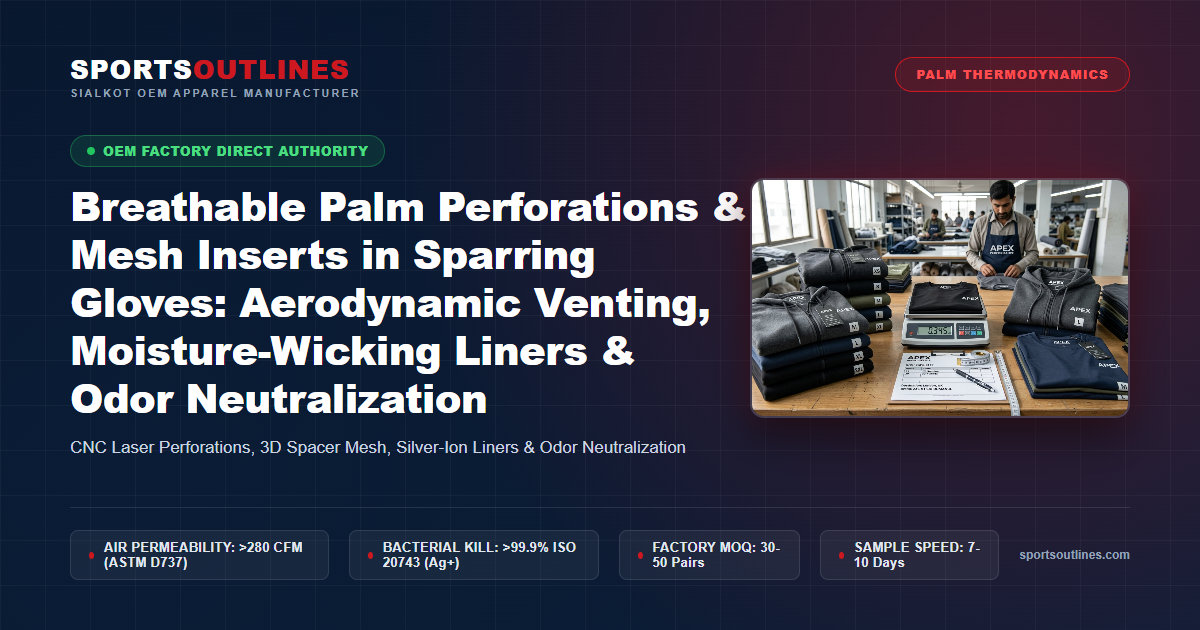
Executive Engineering Summary: Palm Microclimate Thermodynamics & Ventilation
During intense combat sports training, the microclimate inside a sealed boxing glove resembles a tropical incubator: palm skin temperatures reach $38.5^\circ\text{C}$ and relative humidity rapidly exceeds $95\%$, with the athlete excreting up to $35\text{ ml}$ of saline perspiration over a 60-minute sparring session. Without engineered ventilation, trapped sweat degrades internal impact foams, leaches fatliquoring oils from leather shells, and cultivates dense colonies of anaerobic bacteria that produce permanent foul odors. This technical manufacturing guide analyzes the thermodynamic engineering of boxing glove palm ventilation in Sialkot—contrasting CNC laser-cut leather perforations, 3D warp-knit spacer mesh inserts, antimicrobial silver-ion moisture-wicking liners, and integrated EVA grip bars to maintain thermal equilibrium without compromising structural glove durability.
1. Microclimate Thermodynamics: The Sweat Incubation Crisis
The human palm possesses one of the highest concentrations of eccrine sweat glands on the human body, exceeding $600\text{ glands/cm}^2$. During high-intensity anaerobic boxing rounds, sympathetic nervous system arousal and strenuous forearm muscular contractions trigger profuse perspiration.
In a traditional solid-leather glove with no palm ventilation, the internal air volume ($V \approx 320\text{ cm}^3$) becomes fully saturated within 8 to 12 minutes of active training:
- Thermal Trapping: Heat generated by metabolic hand exertion ($P \approx 15\text{ to }25\text{ Watts}$) and frictional energy absorption cannot dissipate through dense multi-layer foam and thick leather, driving internal temperatures up to $39^\circ\text{C}$.
- Vapor Pressure Gradient Stagnation: With internal relative humidity climbing above $95\%$, the partial water vapor pressure inside the glove equals or exceeds the skin surface vapor pressure ($P_{\text{skin}} \approx 6.6\text{ kPa}$). Evaporative sweat cooling completely halts, causing heavy thermal discomfort and grip slippage inside the glove.
- The Water-Weight Penalty: Trapped sweat is absorbed by porous internal padding and leather backings. A 14 oz glove can absorb between $45\text{ and }70\text{ grams}$ of moisture during a hard sparring workout, artificially increasing the glove’s swinging mass and accelerating fighter shoulder fatigue.
Thermodynamic Parameters of the Internal Glove Microclimate
$38.5^\circ\text{C}\text{ to }39.2^\circ\text{C}$ within 15 minutes of heavy bag striking.
$92\%\text{ to }98\%$ relative humidity; total cessation of evaporative cooling.
$20\text{ to }35\text{ ml}$ saline fluid per hour ($0.5\text{ to }1.2\text{ oz}$ weight gain).
$pH\ 4.2\text{ to }5.5$; acidic saline environment corroding adhesives and leather.
2. Chemical Pathology: Salt Crystallization & Bacterial Odor Colonization
Perspiration is not simply pure water; it is a complex biochemical cocktail containing sodium chloride ($\text{NaCl}$), urea, lactic acid, amino acids, and lipids. When sweat repeatedly saturates boxing equipment without adequate airflow:
- Collagen Fiber Embrittlement: As moisture slowly evaporates from closed gloves between training sessions, sodium chloride precipitates into sharp sub-microscopic mineral salt crystals. These crystals wedge between the collagen fiber bundles of the leather, acting like microscopic razor blades that slice collagen fibrils during subsequent glove flexes, leading to stiff, brittle leather that cracks under moderate strain.
- Fatliquor Stripping: Saline moisture leaches out the natural emulsified oils and synthetic fatliquors infused into the hide during tannery beamhouse processing. Deprived of lubricating lipids, the leather fibers seize and turn hard as dry cardboard.
- Acid Hydrolysis of Polypeptide Chains: When perspiration dries slowly in an enclosed microenvironment, lactic acid and dissolved salts concentrate, driving the surface $pH$ below 4.2. In this hyper-acidic microclimate, slow acid hydrolysis cleaves the cross-linked polypeptide chains of chrome-tanned leather, permanently degrading its modulus of elasticity and tensile tear resistance.
- Bacterial Fermentation & “Glove Stink”: The dark, warm, humid interior of a boxing glove is the ideal breeding ground for anaerobic bacteria (such as Brevibacterium linens and Corynebacterium) and fungi (Trichophyton). These microorganisms metabolize skin keratin and sweat amino acids, generating volatile fatty acids—chiefly isovaleric acid and butyric acid—which produce the foul, lingering stench characteristic of old gym gloves.
3. Aerodynamic Fluid Mechanics: Computational Airflow Modeling (CFD)
Air exchange inside a boxing glove does not rely on passive diffusion alone; it operates via dynamic convective pumping driven by punching velocity. When a fighter throws a punch at speeds between $8.0\text{ and }12.0\text{ m/s}$, the external airflow velocity creates a localized pressure differential ($\Delta P$) across the glove chassis according to Bernoulli’s principle:
\[ P + \frac{1}{2}\rho v^2 = \text{constant} \]
As the glove moves forward, high static pressure builds across the convex knuckle face, while a low-pressure wake zone forms along the concave palm curvature. By positioning ventilation apertures precisely along the negative-pressure palm vortex, air is naturally pulled out from the interior of the glove via the Venturi entrainment effect.
Simultaneously, during the fist clenching and unclenching cycle, the athlete’s hand acts like a mechanical diaphragm bellows. Squeezing the internal grip bar compresses the interior air volume by approximately $15\%$, forcing warm, humid air outward through the palm mesh. When the hand relaxes, cooler ambient gym air is drawn back inside, creating continuous pneumatic air renewal. Computational fluid dynamics modeling reveals that at typical punch cadence (60 to 90 strikes per minute), dynamic convective pumping achieves over $3.2$ full air volume replacements per minute when paired with 3D spacer mesh panels.
4. Laser Perforation Metallurgy: CNC Hole Patterns & Cauterized Margins
The most common method for introducing ventilation into full-leather gloves is precision palm perforation. However, punching holes into high-stress leather panels introduces severe engineering risks: each perforation is a potential stress concentration hole that can initiate tear propagation across the palm when the glove is cinched tightly.
| Perforation Zone | Hole Diameter & Spacing Pitch | Cutting Method | Airflow Permeability | Tear Prevention Safeguard |
|---|---|---|---|---|
| Central Palm Arch Array | $1.8\text{ mm}$ diameter; $5.5\text{ mm}$ triangular pitch | CNC dual-head $\text{CO}_2$ laser ($80\text{ W}$) | $45\text{–}60\text{ CFM}$ (Air exchange) | Laser thermal cauterization melts cut fibers; zero tear runs |
| Thumb Inner Web Weep Holes | 5 to 8 linear holes ($2.0\text{ mm}$ dia; $6.0\text{ mm}$ pitch) | Precision rotary punching die | $15\text{–}20\text{ CFM}$ | Reinforced with underlaid poly-cotton fusible interfacing tape |
| Fingertip Underside Ports | Micro-perforations ($1.2\text{ mm}$ dia; $4.0\text{ mm}$ pitch) | Laser perforation | $25\text{–}35\text{ CFM}$ | Placed strictly outside primary seam stitch margins ($>4.0\text{ mm}$) |
Thermal Cauterization vs Mechanical Die Punching
In low-tier factories, palm perforations are punched using crude mechanical rotary dies on clicker presses. Cold mechanical punching leaves ragged, frayed collagen margins at the hole edges. Under repetitive fist clenching, micro-cracks propagate between adjacent holes, creating large, ugly tears across the palm.
Sports Outlines utilizes automated CNC $\text{CO}_2$ laser cutting for all palm perforation patterns. The focused laser beam instantly vaporizes the leather at $1,200^\circ\text{C}$, thermally cauterizing the surrounding collagen proteins into a smooth, glassy perimeter rim. This microscopic fused border increases the hole margin tear strength by over $40\%$ compared to mechanical punch holes, completely eliminating hole-to-hole tear propagation even under extreme tensile strap cinch loads.
5. 3D Spacer Mesh Palm Inserts: Aerodynamic Convection Architecture
While perforations improve passive moisture evaporation, modern training gloves designed for high-humidity gym environments require active convective airflow. The cutting-edge industrial standard is the integration of a full 3D warp-knit spacer mesh palm insert.
Anatomy of 3D Warp-Knit Spacer Mesh (350 GSM)
A durable, abrasion-resistant hexagonal knitted mesh that withstands abrasive contact with gym floor mats, bag chains, and opponent equipment during clinch drills.
Thousands of vertical polyester monofilament micro-struts bridging the outer and inner faces. Creates an incompressible $3.0\text{ mm}$ open-air corridor that allows air to circulate freely even when the glove is clutched in a fist.
A soft, non-abrasive circular knit face that pulls liquid sweat away from the athlete’s palm skin and channels it into the open-air corridor for instantaneous evaporation.
| Performance Parameter | 3D Spacer Mesh Palm Insert | Laser-Perforated Cowhide Palm | Solid Unperforated Leather |
|---|---|---|---|
| Airflow Permeability (ASTM D737) | $>280\text{ CFM}$ (Continuous forced convection) | $45\text{–}65\text{ CFM}$ (Passive hole venting) | <1.5\text{ CFM}$ (Virtually impermeable) |
| Moisture Drying Time (50ml load) | $<90\text{ minutes}$ at room ambient | $6\text{ to }8\text{ hours}$ | $>24\text{ hours}$ (Moisture trapped in core) |
| Weight Reduction Benefit | $18\text{–}25\text{ grams}$ lighter per glove | $2\text{–}4\text{ grams}$ lighter | Standard baseline leather weight |
| Kick Blocking Durability | Moderate; requires lateral leather side rails | High (Full leather structural chassis) | Maximum (Heavy kickboxing standard) |
| Sanctioning Approval | Training & sparring only; prohibited in title fights | Permitted in select pro & amateur bouts | Mandatory for WBC, WBA, IBF world titles |
6. Seam Engineering: Mesh-to-Leather Joining & Edge Reinforcement
Joining an open 3D textile mesh to dense $1.1\text{ to }1.3\text{ mm}$ full-grain cowhide introduces severe shear stress differentials along the stitching boundary. Leather is inelastic with an ultimate tensile strength exceeding $26\text{ N/mm}^2$, whereas 3D warp-knit mesh exhibits multi-axial compliance. Without reinforced joint mechanics, the repeated tensile shock of clinching or catching hard roundhouse kicks causes needle pull-out or unraveling along the raw knit loops.
To prevent premature junction failure, our Sialkot manufacturing facilities implement a four-tier joining specification:
- Ultrasonic Margin Fusion: Prior to assembly sewing, the perimeter edges of the clicked mesh insert pass through a $35\text{ kHz}$ ultrasonic rotary welder. The high-frequency vibration melts the cut monofilament ends, fusing them into a solid $2.5\text{ mm}$ wide polymer collar that cannot fray or shed filaments into the glove interior.
- Underlaid Poly-Ripstop Stabilizing Tape: Beneath the junction line, a high-density $120\text{ GSM}$ polyester ripstop tape is laminated with waterborne polychloroprene adhesive. This load-distributing substrate acts as a mechanical buffer, preventing the needle holes from acting as tear perforations through the knit mesh face.
- Twin-Needle Interlocking Lockstitch: The leather-to-mesh seam is executed on synchronized twin-needle walking-foot sewing machines (Pfaff 1245 or Durkopp Adler 867) operating at $8\text{ to }10\text{ stitches per inch}$ (SPI). The stitch line utilizes T-70 bonded nylon thread with a gauge needle spacing of $3.2\text{ mm}$, providing redundant tensile hold down to the leather border.
- Stress-Relief Lateral Leather Rails: A structural $18\text{ mm}$ wide full-grain leather side rail is maintained along both the radial (thumb side) and ulnar (pinky side) glove margins. The 3D spacer mesh panel is confined strictly to the central concave arch of the palm, ensuring that all torsional and lateral impact forces during sparring blocks are carried entirely by the leather frame.
7. Internal Glove Liners: Silver-Ion Chemistry & Rapid Wicking Fibers
The inner lining is the only material in direct contact with the athlete’s hand. In budget manufacturing, cheap nylon taffeta or raw polyester fabrics are used. These non-breathable synthetics feel slimy when wet, cause severe friction blisters, and trap sweat odors indefinitely.
High-Performance Lining Architectures Engineered in Sialkot
- 1. Premium Poly-Satin Glide Fabric ($120\text{ GSM}$): Woven with ultra-fine continuous microfilaments in a dense 5-harness satin weave. It provides a luxurious, silky hand feel that glides smoothly over cotton hand wraps during insertion and removal, completely eliminating inner seam chafing.
- 2. Cross-Channel Wicking Fibers (Coolmax-Style PET): The polyester fibers feature a multi-lobed cross-sectional profile (tetrachannel) rather than round filaments. Through high capillary action, sweat is pulled along the micro-grooves and wicked away from the skin surface to the outer mesh panels at speeds exceeding $120\text{ mm/min}$.
- 3. Permanent Silver-Ion ($\text{Ag}^+$) Antimicrobial Infusion: To eliminate bacteria and mold growth, the lining fibers are treated with embedded silver nanoparticles during polymer extrusion (not a temporary wash-off surface coating). Positively charged silver ions ($\text{Ag}^+$) bind to the negative cell membranes of bacteria, puncturing the cell walls and interrupting cellular respiration. Under ISO 20743 testing, our antimicrobial liners demonstrate a $>99.9\%$ bacterial reduction rate (3-log kill) against Staphylococcus aureus and Klebsiella pneumoniae even after 50 intensive gym training cycles.
- 4. Hydrophobic Moisture Barrier Scrim: Directly between the wicking inner poly-satin liner and the internal impact foam stack (such as the multi-layer EVA and latex padding detailed in our Boxing Glove Foam Padding Engineering Guide), a microporous $45\text{ GSM}$ polyurethane membrane is bonded. This barrier permits water vapor transmission outward while preventing liquid sweat droplets from soaking deep into the shock-absorbing core, protecting the foam cells from enzymatic degradation.
8. The Internal Palm Grip Bar: Fist Stabilization & Air Circulation
A critical ergonomic element that intersects directly with palm ventilation is the Internal Grip Bar (Grab Bar). Situated horizontally across the palm beneath the proximal interphalangeal joints, the grip bar provides a mechanical fulcrum for the fingertips when clenching a fist.
Without a well-engineered grip bar, the palm leather collapses into a flat, loose sheet. When an athlete clenches their hand, the fingertips crush the palm ventilation holes against the palm skin, sealing off all airflow.
At Sports Outlines, our grip bars are engineered as ventilated anatomical components:
- High-Resilience EVA Core ($65\text{D}$ Shore): Formed as a cylindrical bar ($12.0\text{ mm}$ diameter, $90\text{ mm}$ length) with high compression-set resistance. It maintains its round profile under years of intense fist squeezing.
- Fluted Air Channel Architecture: In our vented sparring models, the EVA grip bar features longitudinal fluting grooves along its top and bottom surfaces. When the fighter’s fingers clamp down on the bar, the grooves act as pneumatic air tubes, funneling expelled air from the finger pockets directly toward the palm mesh insert.
- Structural Anchoring: The grip bar is encased in a reinforced leather or mesh sleeve and anchored into both the radial and ulnar side seams of the palm chassis with double-needle lockstitching, preventing the bar from twisting or dislodging during training.
- Ergonomic Hand Mould Synergy: The grip bar alignment is calibrated to match the pre-curved metacarpal arc established by our CNC 6061-T6 aluminium lasts (as detailed in our Boxing Glove Lasts & Mould Engineering Blueprint), allowing zero forearm muscle tension during rest phases between combinations.
9. Sialkot Line Balancing: Standard Allowed Minutes (SAM) for Palm Assembly
Integrating ventilated palm assemblies into mass production requires strict lean balancing to prevent factory line bottlenecks. At Sports Outlines, industrial engineering time-and-motion studies define exact Standard Allowed Minutes (SAM) across every manufacturing workstation:
- CNC Laser Perforation & Perimeter Cut: Vacuum bed positioning and 22-second dual-head laser cycle: $0.9\text{ SAM}$ per pair.
- Spacer Mesh Die-Clicking & Ultrasonic Edge Sealing: $35\text{ kHz}$ ultrasonic perimeter welding of raw mesh struts: $1.6\text{ SAM}$ per pair.
- Leather Side-Rail Reinforcement Lamination: Aligning and stitching 18mm full-grain leather load-bearing side rails: $2.4\text{ SAM}$ per pair.
- Fluted Grip Bar Insertion & Double Bartacking: Aligning cylindrical EVA core and securing into palm seams: $1.8\text{ SAM}$ per pair.
- Silver-Ion Poly-Satin Lining Overlocking: Sealing inner antimicrobial lining envelope and barrier scrim: $2.1\text{ SAM}$ per pair.
- Cuff Transition & Closure Joining: Sewing palm lower border into the hook-and-loop or lace-up wrist channel (explored in our Boxing Glove Wrist Support Engineering Analysis): $2.2\text{ SAM}$ per pair.
Total palm sub-assembly requires approximately $11.0\text{ SAM}$ per pair, ensuring fast cycle turnover while maintaining microscopic stitch accuracy and rigorous quality consistency across volume runs.
10. Industrial Manufacturing Workflow in Sialkot for Vented Palms
Integrating laser perforations, 3D spacer mesh panels, and technical wicking liners requires multi-stage precision engineering within our Sialkot manufacturing cells:
Step 1: Automated CNC Laser Cutting & Perforation Array
Palm leather panels are positioned on vacuum extraction beds beneath automated $\text{CO}_2$ laser heads. In a single 22-second pass, the laser cuts the outer panel perimeter, carves the central ventilation array, and cauterizes all hole margins with zero manual intervention.
Step 2: 3D Spacer Mesh Die-Cutting & Ultrasonic Edge Sealing
For mesh-palm models, rolls of 350 GSM polyester sandwich mesh are clicked into matching palm window inserts. The cut perimeter margins pass through $35\text{ kHz}$ ultrasonic rotary welding sonotrodes, sealing the raw monofilament struts into a neat, non-fraying edge.
Step 3: Leather Side-Rail Reinforcement Lamination
Because mesh lacks the high tensile rigidity of cowhide, full-grain leather side rails ($18\text{ mm}$ width) are stitched along both the radial and ulnar borders of the palm. This ensures that the glove retains full structural integrity during wrist strapping and heavy defensive blocks.
Step 4: Silver-Ion Lining Attachment & Grip Bar Encapsulation
The silver-treated poly-satin lining is overlocked to the internal face of the palm assembly. The fluted EVA grip bar is centered beneath the knuckle bridge and secured with double-needle lockstitching using T-70 bonded nylon thread.
Step 5: Attached Thumb Webbing & Inversion Seam Sewing
The thumb leather bridge and anti-eye gouge webbing (as specified in our Boxing Glove Attached Thumb Safety Guide) are securely joined into the radial palm margin. The entire palm chassis is then sewn inside-out to the main backhand knuckle shell on Durkopp Adler cylinder-arm sewing machines. Once turned, the glove is inspected on air-pressure test fixtures to verify unobstructed convective flow through the palm.
11. Quality Verification: ASTM D737 Air Permeability & Odor Chamber Testing
In our Sialkot quality testing lab, ventilated glove samples undergo standardized aerodynamic, mechanical, and microbiological verification before bulk export packaging:
| Quality Test | Testing Methodology & Apparatus | Standard Pass Requirement | Performance Objective |
|---|---|---|---|
| Air Permeability (ASTM D737) | Frazier air permeability tester at $125\text{ Pa}$ differential pressure | $\ge 250\text{ CFM}$ (Mesh) / $\ge 45\text{ CFM}$ (Perforated) | Guarantees rapid convective sweat vapor evacuation during training |
| Seam Tensile Shear (ISO 13935-2) | Tensile pull of mesh-to-leather joining seam at $100\text{ mm/min}$ | $>320\text{ N}$ before seam rupture | Prevents mesh tear-out when fighter catches heavy roundhouse kicks |
| Antimicrobial Activity (ISO 20743) | Bacterial inoculation of lining with Staphylococcus aureus | $>99.9\%$ kill rate after 24 hours incubation | Permanent elimination of odor-causing anaerobic bacterial colonies |
| Perspiration Dry Rate (AATCC 201) | Heated contact plate measuring evaporation rate of $0.2\text{ ml}$ water | $\ge 0.15\text{ ml/min}$ evaporation rate | Rapid internal drying between consecutive gym sessions |
| Flex Fatigue Resistance (ISO 5402) | Bally flexometer cycling perforated palm leather at $100\text{ cycles/min}$ | $\ge 50,000\text{ flex cycles}$ without hole margin micro-cracking | Guarantees long-term flex longevity in high-frequency sparring |
12. Post-Training Gear Longevity: Factory Maintenance Guidelines
Even with advanced ventilation systems, commercial fight brands must educate their end consumers on proper post-workout gear maintenance to prevent premature equipment degradation:
- Immediate Gear Bag Removal: Storing damp gloves inside an unventilated gym duffle bag creates an enclosed incubator that destroys leather fatliquors within 48 hours. Gloves should immediately be aired out in a well-ventilated room out of direct sunlight.
- Cedar Deodorizing Inserts: Utilizing natural red cedar chip glove dogs absorbs residual interior moisture through capillary wood action while infusing natural cedar wood aromatic terpenes that deter bacterial fermentation.
- Avoid Direct Heat or Radiators: Placing damp leather gloves on hot radiators or using high-heat blow dryers shrinks and bakes bovine collagen, turning the leather permanently brittle and stiff. Only ambient room air or specialized non-heated forced air boot/glove dryers should be utilized.
- Routine Leather Conditioner Applications: After heavy moisture exposure, gently applying a pH-neutral lanolin or beeswax emulsion restores natural lubricating lipids to perforated leather panels, preventing fiber embrittlement around the laser hole rims.
13. B2B Private Label Sourcing: Custom Ventilation & Low MOQ Scaling
Whether engineering world-title professional fight gloves with clean CNC laser palm perforations or ultra-breathable 3D spacer mesh sparring lines for high-volume commercial fitness gyms, Sports Outlines delivers championship-grade craftsmanship directly from Sialkot, Pakistan.
We support emerging combat brands, martial arts equipment companies, and gym franchises with agile cell manufacturing, providing low factory MOQs of just 30 to 50 pairs per style/colorway across 8 oz, 10 oz, 12 oz, 14 oz, 16 oz, and 18 oz specifications.
| Palm Architecture | Target Market & Application | Sample Development Fee | Production Unit FOB (30–50 MOQ) | Target Retail MSRP |
|---|---|---|---|---|
| Full 3D Spacer Mesh Palm | Heavy-bag, fitness boxing & high-heat gym sparring | $55 to $75 per pair (7–10 days) | $21.50 to $26.50 | $95.00 to $145.00 |
| CNC Laser-Perforated Leather | Championship fight gloves & luxury heritage sparring | $60 to $85 per pair (7–10 days) | $23.50 to $29.00 | $120.00 to $175.00 |
| Hybrid Vented Thumb + Arch Matrix | Kickboxing, Muay Thai & multi-discipline sparring | $65 to $85 per pair (7–10 days) | $25.00 to $31.00 | $130.00 to $190.00 |
Custom prototype sampling is delivered at a flat, non-refundable development fee of $45 to $85 per pair, with complete pattern digitization, laser perforation profiling, silver-ion lining integration, and dispatch delivered within 7 to 10 business days. Bulk production lead times are maintained at 25 to 30 business days, backed by strict AQL 1.5 pre-shipment inspection reporting.
Global Export & Trade Silo Network
Sports Outlines provides streamlined door-to-door DDP, CIF, and FOB air/sea freight logistics for combat sports promotions and retail brands across key international markets:
- Explore our North American logistics on the USA Sportswear & Combat Equipment Manufacturing Hub.
- Review British Boxing Board of Control (BBBofC) compliance via our UK Fight Gear & Apparel Sourcing Division.
- Access duty-free European Union trade benefits through our Germany & EU Combat Sports Production Portal.
- Connect with Oceanian fight promotions through our Australia Boxing Equipment Manufacturing Hub.
- Review Canadian cross-border import protocols via our Canada Combat Sports Manufacturing Center.
Launch High-Breathability Fight Gloves With Custom Palm Venting
From CNC laser-cauterized full-grain leather palms to 3D warp-knit spacer mesh sparring lines, Sports Outlines engineers moisture-resistant combat equipment directly from Sialkot, Pakistan. Prototype sampling from $45–$85 with low factory MOQs of 30–50 pairs.