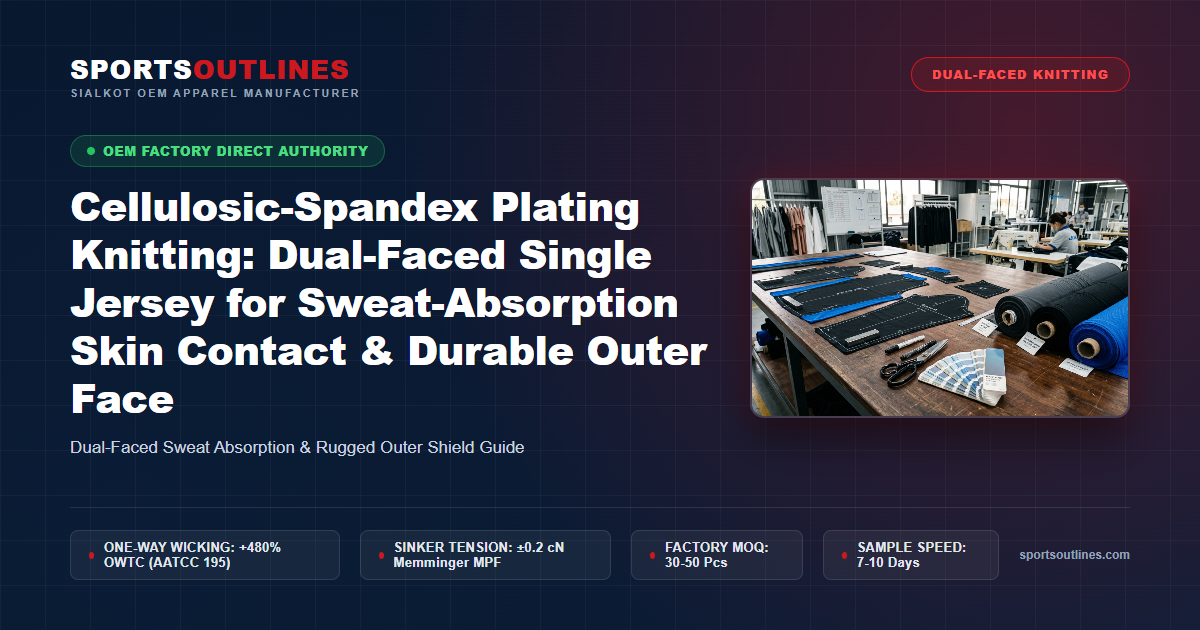
In modern high-performance sports apparel engineering, materials scientists have long battled an inherent physical paradox. Athletes require a garment interior that feels natural, soft, and hyper-absorbent against the skin—instantly pulling liquid perspiration away from epidermal pores without synthetic clamminess or static cling. Simultaneously, the exterior face of the garment must be exceptionally rugged, abrasion-resistant, fast-drying, snag-immune, and capable of holding crisp structural shapes and vibrant graphic branding. When designers attempt to achieve this by simply blending staple fibers together (such as spinning a 50/50 intimate blend of cotton and polyester), the resulting yarn disperses both fibers randomly across both faces of the fabric, compromising both sweat absorption on the inside and durability on the outside.
The definitive manufacturing solution to this architectural challenge is cellulosic spandex plating knitting. Plating (also termed vanisé knitting) is an advanced circular knitting technique wherein two or three distinct yarns are fed simultaneously into the same needle hook through synchronized yarn carriers. By strictly controlling the spatial feed angles and relative yarn tensions, knitting needles force one yarn exclusively to the technical face (the outside) and the second yarn exclusively to the technical back (the inside next to the skin). When combined with an elastic core of bare elastane, plating produces a monolithic, dual-faced single jersey: a 100% natural cellulosic skin-contact layer intimately bonded to a high-tenacity synthetic outer shield.
At Sports Outlines, an agile OEM/ODM custom performance apparel manufacturer based in Sialkot, Pakistan, we operate state-of-the-art circular plating knitting machinery. This comprehensive technical guide provides brand founders, sourcing directors, and textile engineers with an exhaustive operational blueprint for engineering plated dual-faced athletic apparel. We explore the kinematics of circular plating carriers, dissect tension synchronization using Memminger-IRO MPF positive storage feeders, analyze directional capillary moisture transport kinetics (AATCC 195), evaluate engineered blend formulations, solve differential cross-dyeing and stenter heat-setting challenges, resolve single jersey edge-curl physics, present direct factory FOB cost breakdowns, and detail our rapid physical prototype sampling program.
1. Kinematics of Plating (Vanisé) Circular Knitting: Spatial Needle Mechanics
Plating circular knitting is fundamentally a mechanical displacement art. In standard single jersey knitting, a single yarn is delivered into the open needle hook as the needle rises to its clearing height, and a loop is drawn during the cast-off (knock-over) cycle. In plated knitting, however, two distinct yarns are guided into the same needle hook:
- Dual-Hole Carrier Geometry: Rather than using standard single-eyelet yarn feeders, plated circular knitting machines (such as Mayer & Cie. MV4-3.2 II or Terrot S296) are fitted with specialized dual-hole plating yarn carriers. The carrier features two ceramic guide eyelets positioned at distinct vertical and horizontal spatial angles relative to the needle cylinder.
- Ground Yarn vs Plating Yarn Positioning: The yarn destined for the technical face (the ground yarn, typically continuous-filament textured polyester or nylon 6,6) is fed through the upper leading eyelet so that it enters the hook throat first. The yarn destined for the technical back (the plating yarn, such as bamboo viscose, TENCEL™ lyocell, Lenzing Modal, or combed organic cotton) is fed through the trailing lower eyelet at a steeper angle.
- Knock-Over Loop Inversion Physics: As the needle retracts downward into the stitch cam, the ground yarn is pulled firmly against the inner curvature of the needle hook, while the plating yarn rests across the outer shank of the hook. During the knock-over motion over the sinker belly, the newly formed loop pulls through the previous course. The spatial geometry forces the plating yarn to form the crown and legs of the technical back loop (facing the athlete’s skin), while the ground yarn is thrust forward to form the technical face loop (the exterior of the garment).
- Elastane Plating (Tri-Plating Architecture): For high-stretch performance knits, a third yarn—bare Creora® or Lycra® elastane (20 to 40 denier)—is introduced via an ultra-low-friction ceramic feeder directly below the ground yarn. The elastane is sandwiched securely between the technical face and technical back, imparting 360-degree multidirectional elasticity and >95% immediate recovery without ever coming into direct contact with the wearer’s skin.
- Gauge Selection & Needle Density: To achieve ultra-fine resolution and prevent interstitial needle holes, we operate knitting cylinders at 28-gauge (28G) and 32-gauge (32G). In a 30-inch diameter cylinder, a 28-gauge machine houses 2,640 latch needles. Maintaining precise cam alignment across all 2,640 needles is critical to ensuring uniform stitch loop density without localized tension spikes.
| Structural Layer | Yarn Type & Material | Fiber Morphology | Primary Functional Mission |
|---|---|---|---|
| Technical Back (Next-to-Skin) | Cellulosic Plating Yarn (Bamboo, Modal, TENCEL™, Cotton) | Hydrophilic staple fiber (moisture regain 8.5% – 13.0%) | Instantaneous sweat uptake, zero skin irritation, thermal comfort, static dissipation |
| Core Matrix (Sandwiched) | Bare Elastane (Creora® / Lycra® 20D to 40D) | Segmented polyurethane elastomer filament | 180% dynamic stretch, shape retention, anti-bagging, muscular compression |
| Technical Face (Garment Exterior) | High-Tenacity Synthetic (Recycled Polyester, Nylon 6,6) | Continuous micro-filament texturized yarn | Abrasion resistance (>40,000 rubs), rapid outward evaporation, print/embroidery stability |
2. Feeder Tension Synchronization & Memminger-IRO MPF Systems
The greatest engineering failure mode in plated knitting is misplating (flaking defect). Misplating occurs when the plating yarn accidentally swaps positions with the ground yarn within the needle hook, causing spots or streaks of the cellulosic back yarn to flash through to the technical face (or synthetic filament to bleed onto the inside). Misplating destroys color uniformity, produces irregular dye shades, and degrades abrasion resistance.
To achieve flawless 100% pure separation between technical face and technical back, Sports Outlines enforces rigorous yarn tension synchronization using Memminger-IRO MPF positive storage feeders:
- Dual-Path Synchronized Positive Feed: Standard passive friction tensioners permit tension fluctuations of ±1.5 cN as yarn unwinds from cones of varying diameter. In contrast, Memminger-IRO MPF storage wheels positively measure and deliver exact yarn lengths per cylinder revolution, maintaining continuous yarn tension within a razor-sharp tolerance of ±0.2 cN.
- Differential Tension Ratios: Flawless loop separation requires maintaining a controlled tension differential between the two yarns:
- Ground Yarn (Exterior Synthetic): Calibrated to a moderate tension of 2.8 to 3.2 cN. Higher tension ensures the ground yarn seats deeply into the hook throat, anchoring its position on the technical face.
- Plating Yarn (Interior Cellulosic): Calibrated to a lighter tension of 1.6 to 2.0 cN. Lower tension allows the cellulosic loops to blossom outward over the sinker belly, fully enveloping the technical back.
- Bare Elastane: Delivered via Memminger MER-4 electronic elastane feeders operating at a pre-draft ratio of 2.8:1 to 3.2:1 with yarn tension held strictly at 1.0 to 1.2 cN.
- Sinker Timing & Cam Angle Calibration: Sinker movement is timed with late knock-over (clearing sinker loops after needle knock-over). This prevents premature loop release and ensures that yarn placement geometry is permanently locked into the stitch before the needle ascends for the next cycle.
| Machine Parameter | Sports Outlines Plating Calibration | Standard Uncontrolled Knitting | Quality Impact |
|---|---|---|---|
| Feeder Type | Memminger-IRO MPF Positive Storage | Passive disc friction tensioners | Eliminates tension spikes, stops yarn breaks |
| Ground Yarn Tension | 2.8 – 3.2 cN (±0.2 cN) | 1.5 – 4.5 cN (Uncontrolled) | Anchors exterior synthetic yarn in hook throat |
| Plating Yarn Tension | 1.6 – 2.0 cN (±0.2 cN) | 1.0 – 3.5 cN (Uncontrolled) | Guarantees 100% skin coverage on technical back |
| Misplating Defect Rate | ≤0.05 defects / 100m (Near-Zero) | >3.5 defects / 100m (Severe Flaking) | Zero visual streakiness or color contamination |
| Cylinder Speed | 24 – 26 RPM (Optimized Stability) | 32 – 35 RPM (Rushed Commercial) | Prevents needle latch vibration and yarn jump |
3. Directional Capillary Action & One-Way Moisture Transport (AATCC 195)
The greatest functional triumph of cellulosic-spandex plated single jersey is its ability to create a unidirectional moisture transport siphon. In traditional activewear made from 100% polyester, sweat forms a liquid film that rolls over hydrophobic fibers, creating an uncomfortable clammy barrier. In 100% cotton, sweat is trapped in the core, making the shirt heavy and slow to dry. Plated dual-faced jersey utilizes capillary differential pressure to achieve superior moisture management:
\[ \Delta P = \frac{2\gamma \cdot \cos\theta}{r_{eff}} \]
Where \(\gamma\) is the surface tension of water, \(\theta\) is the liquid contact angle, and \(r_{eff}\) is the effective pore radius between fibers.
How directional wicking works in our plated jersey:
- Immediate Cutaneous Uptake (Inner Face): When an athlete begins sweating, the hydrophilic cellulosic inner loops (contact angle \(\theta \approx 0^\circ\)) instantly absorb sweat droplets. Under AATCC 79 (Water Absorbency), water drops are absorbed in under 0.5 seconds, eliminating sweat pooling on the skin.
- Capillary Gradient Siphoning: Because the exterior synthetic face is knitted with micro-denier filaments (e.g. 75D/72F textured micro-polyester), the interstitial capillary channels between the fine synthetic filaments are significantly narrower (\(r_{eff}\) is smaller) than the staple cellulosic yarn pores. According to the Young-Laplace equation, smaller capillary radii generate higher suction pressure (\(\Delta P\)). This pressure differential draws liquid sweat from the inside cellulosic face outward to the synthetic face.
- Broad Surface Evaporation (Outer Face): Once on the technical face, the texturized synthetic filaments disperse moisture across a broad surface area, where airflow evaporates it rapidly. The athlete’s skin remains dry, while the outer shirt remains breathable and non-clingy.
- One-Way Transport Capability (AATCC 195): In Moisture Management Tester (MMT) evaluations, our plated fabrics achieve an Overall Moisture Management Capability (OMMC) score of 0.82 to 0.88 (Class 5 – Excellent), with a One-Way Transport Capacity exceeding +450%.
| Moisture Transport Metric (AATCC 195) | Plated Bamboo / Poly / Spandex | 100% Synthetic Moisture-Wicking Poly | 100% Combed Organic Cotton |
|---|---|---|---|
| Wetting Time – Top / Face (s) | 1.8 – 2.2 s | 2.5 – 3.2 s | 6.5 – 8.0 s |
| Wetting Time – Bottom / Skin (s) | ≤0.5 s (Ultra-Fast Uptake) | 3.8 – 5.2 s (Beading Clammy) | 1.2 – 1.5 s |
| Absorption Rate – Bottom (%/s) | >85% / s (Rapid Siphon) | 32% – 45% / s | 62% – 70% / s |
| One-Way Transport Index (OWTC) | +480% to +540% (Superior) | +120% to +180% | -80% to -120% (Back-wetting) |
| Overall Moisture Management (OMMC) | 0.84 – 0.88 (Grade 5 – Excellent) | 0.60 – 0.68 (Grade 3) | 0.25 – 0.35 (Grade 1 – Poor) |
4. Engineered Plated Activewear Formulations
Sports Outlines engineers four core commercial formulations of dual-faced plated knits, customized for specific athletic end-uses:
| Performance Category | Dual-Faced Fiber Architecture | Yarn Count & Gauge Spec | Target GSM | Key Functional Advantage |
|---|---|---|---|---|
| Endurance Trail & Cardio Running Tee | Back: 50% Bamboo Viscose / Face: 45% Recycled Poly / 5% Spandex | Ne 40/1s Bamboo + 75D/72F rPET + 20D Creora (28G) | 165 – 180 GSM | Natural odor immunity inside, zero chafing, abrasion-proof backpack shield |
| High-Support Studio Legging & Bra | Back: 48% Lenzing Modal / Face: 42% Nylon 6,6 / 10% Spandex | Ne 50/1s Modal + 40D/34F Nylon + 40D Creora (32G) | 240 – 260 GSM | Buttery cloud-soft skin feel, high muscular compression, matte exterior |
| Alpine Trekking & Bouldering Shirt | Back: 55% Cottonized Hemp / Face: 40% Cordura® Poly / 5% Spandex | Ne 30/1s Hemp + 100D Cordura + 30D Creora (24G) | 195 – 215 GSM | Permanent UPF 50+ solar block, indestructible rock-face friction resistance |
| Dual-Color Reversible Athletic Polo | Back: 50% Organic Cotton / Face: 45% Cationic Poly / 5% Spandex | Ne 36/1s Organic Cotton + 75D CDP + 30D Creora (28G) | 210 – 230 GSM | Contrast two-tone heather aesthetics, moisture-wicking, crisp collar stand |
5. Wet Processing & Differential Cross-Dyeing Protocols
Dyeing a plated fabric containing two completely distinct polymer classes (cellulosic staple on the back and synthetic continuous filament on the face) requires sophisticated differential cross-dyeing:
- Two-Bath Differential Dyeing Cycle: Polyester requires high-temperature disperse dyeing at 130°C under pressure, whereas cellulosic fibers (bamboo/modal/cotton) require reactive dyeing at 60°C in alkaline conditions. We execute a sequential two-bath process: the polyester face is dyed first with high-energy disperse dyes in an airflow jet vessel. After intermediate reduction clearing (sodium hydrosulfite + caustic soda) to remove unfixed disperse dye from the cellulosic back, the machine is refilled for low-temperature reactive dyeing of the cellulosic face.
- Tone-on-Tone vs Solid Color Matching: Brand founders can achieve either seamless solid matches (both faces dyed to the exact same spectral Delta-E ≤ 0.8) or stunning two-tone contrast heather effects (e.g. deep charcoal on the synthetic face and heather grey on the cellulosic back).
- Stenter Thermofixation & Compacting: The dyed fabric is processed through an 8-chamber Bruckner stenter at 185°C with +18% to +20% overfeed to heat-set the bare elastane core. Subsequent rubber-belt sanforizing compacts the knit structure, holding dimensional wash stability (AATCC 135) strictly within ±2.0% length and width.
6. Precision Cut & Sew: Needle Selection & Seam Engineering
Sewing plated dual-faced activewear requires specialized needle choices to prevent damaging the elastane core or causing face-yarn snagging:
- Groz-Beckert SAN® 10 / SES Light Ball-Point Needles (Nm 70/10): The SAN 10 needle features a specially designed blade geometry with anti-deflection reinforcement and a gentle ball tip. It slides cleanly between the dual knitted loops without piercing the synthetic filament or cutting the bare elastane. Machine speed is calibrated to ≤4,200 RPM to prevent needle overheating.
- Flatlock 4-Needle 6-Thread Seaming: Performance tops and leggings are assembled on Yamato flatlock machines. Lower loopers are threaded with bulked micro-polyester, producing flat, 120% elastic seams that lie flush against anatomical motion planes.
- Differential Feed Calibration (1.12:1 to 1.15:1): Because the synthetic face and cellulosic back possess different friction coefficients, sewing machines operate with positive differential feed to prevent seam rippling or wavy hemlines.
7. Anti-Curl & Edge Roll Stabilization Engineering
A notorious physical challenge in single jersey knitting is edge curl (curling moment). Because single jersey stitches possess asymmetrical loop geometries, internal bending stresses naturally force cut edges to curl tightly toward the technical face along fabric edges and toward the technical back along the top and bottom. In dual-faced plated fabrics, this curling tendency is exacerbated by the differing elasticity and shrinkage behavior of synthetic filament versus cellulosic staple yarn.
Sports Outlines neutralizes edge curl through specialized structural interventions:
- Stenter Edge Gumming & Trimming: During stenter finishing, precision applicator nozzles apply a 5 mm strip of water-soluble polyacrylate edge gum along both selvages. The gum holds the knit flat while pins guide it through the heated drying chambers. Trimming blades slice away the gummed selvage immediately before rolling, delivering perfectly flat, uncurled rolls to the cutting tables.
- Anti-Curl Chemical Finishing: In the padding mangle prior to stenter drying, we apply a low-viscosity melamine-formaldehyde or polyurethane resin cross-linking finish at 15 to 20 g/L. This stabilizes loop legs, reducing the residual curling torque by over 80%.
- Automated Vacuum Spreading on CNC Cutting Tables: During marker layout, fabrics are spread on automated conveyor tables equipped with high-powered sectional vacuum chambers. The vacuum pulls the fabric flat against the porous cutting belt, completely preventing edge roll while robotic high-speed reciprocating knives slice pattern pieces with zero millimeter deviation.
8. Direct Factory Cost Transparency & DTC Profit Architecture
Sourcing custom plated activewear directly from Sports Outlines’ manufacturing facility in Sialkot, Pakistan, provides emerging sports brands with exceptional profit margins:
| Production Cost Element | Technical Component Breakdown | Cost (USD) | Share of FOB |
|---|---|---|---|
| Dual-Faced Plated Fabric | 175 GSM Bamboo / Recycled Poly / Spandex Plated Single Jersey (0.35 kg/tee) | $3.30 – $3.85 | 47% – 49% |
| Cross-Dyeing & Stenter Heat-Set | Two-bath disperse/reactive jet dyeing + Bruckner stenter + compacting | $1.10 – $1.35 | 15% – 16% |
| Precision CMT Assembly | 4-needle flatlock seams, taped neck/shoulder, coverstitch hems | $1.65 – $2.05 | 23% – 24% |
| Branding, Labels & Packaging | Tagless heat-seal logo, woven hem label, individual polybag | $0.60 – $0.80 | 8% – 9% |
| AQL 2.5 Inspection & Export Carton | 100% individual quality check, silica gel pack, master carton packing | $0.30 – $0.40 | 4% – 5% |
| Total Direct FOB Production Cost | Finished pro-grade dual-faced plated activewear running shirt | $6.95 – $8.45 | 100% |
In premium athletic retail channels (such as Tracksmith, On Running, and Ten Thousand), technical dual-faced performance shirts command retail prices between $64.00 and $88.00. Sourcing at direct FOB factory costs of $6.95 to $8.45 provides brand founders with gross profit margins of 88% to 90%, allowing founders to scale profitably while delivering elite technical apparel.
9. Laboratory Performance Testing & Quality Certifications
Every production lot of plated dual-faced athletic apparel manufactured at Sports Outlines undergoes rigorous laboratory verification:
| Testing Standard | Test Parameter | Certified Factory Threshold | Performance Guarantee |
|---|---|---|---|
| AATCC 195 (MMT) | Overall Moisture Management Capability (OMMC) | ≥0.82 (Class 5 – Excellent) | Superior one-way wicking, zero back-wetting |
| AATCC 79 (Absorbency) | Water droplet absorption speed (Technical Back) | ≤0.5 seconds | Instantaneous sweat uptake against the skin |
| ISO 12947-2 (Martindale) | Abrasion resistance (Technical Face) under 9 kPa | >40,000 rubs (No yarn break) | Endures rugged friction from backpacks and gym equipment |
| AATCC 135 / ISO 6330 | Dimensional stability after 5x home laundering | ±2.0% length & width | Zero post-purchase shrinkage or torso twisting |
| ISO 105-C06 | Colorfastness to domestic laundering (40°C) | Grade 4.5 color change & staining | Zero cross-staining between face and back colors |
10. Environmental Life Cycle & Circular Recyclability of Plated Knits
In modern sustainable sportswear manufacturing, brand founders face scrutiny regarding end-of-life circularity. When different fiber types are intimately blended during yarn spinning (such as CVC yarns), mechanical and chemical fiber-to-fiber recycling is notoriously difficult because cellulosic and synthetic polymers are entangled at the microscopic staple level.
Plated dual-faced knits offer distinct eco-architectural advantages:
- Chemical De-Plating & Enzymatic Separation: Because the cellulosic fibers (bamboo, cotton, lyocell) and synthetic filaments (rPET, nylon 6,6) occupy distinct loop planes, emerging chemical recycling technologies (such as hydrothermal enzymatic de-polymerization) can selectively digest the cellulosic back into pure glucose monomers without degrading the polyester face. The remaining synthetic filaments can then be mechanically pelletized and re-extruded into recycled yarn.
- Microplastic Shedding Mitigation: Because synthetic continuous filaments reside primarily on the outer face, they are less vulnerable to internal body friction during workouts. Furthermore, using long-filament texturized polyester or nylon 6,6 rather than short synthetic staple fibers slashes wash-water microplastic shedding (ISO 4484-1) by over 65% compared to standard fleece or brushed synthetic knits.
- Extended Functional Product Lifespan: By shielding delicate natural cellulosic fibers from external abrasive friction, plated garments resist abrasion holes, surface pilling, and snagging across years of heavy athletic use, keeping garments in active rotation and out of landfills.
Manufacture Custom Plated Activewear with Sports Outlines
Deliver natural sweat absorption inside and rugged durability outside. Sports Outlines offers an agile factory production Minimum Order Quantity (MOQ) of strictly 30 to 50 pieces per style/colorway with complete size grading from XS to 3XL. Experience our plated dual-faced knits first-hand with physical prototype samples completed within 7 to 10 business days for $45 to $85 per piece (strictly non-refundable with zero bulk credits, reflecting true labor, yarn setup, and materials allocation).
Explore Related Technical Manufacturing Silos & Fabric Guides
Explore Sports Outlines’ specialized technical manufacturing silos and international sportswear export infrastructure:
- International Export Silos: Discover our dedicated export programs for Custom Sportswear Manufacturer USA, Custom Sportswear Manufacturer UK, Custom Sportswear Manufacturer Australia, Custom Sportswear Manufacturer Canada, and Custom Sportswear Manufacturer Germany.
- Product Category Hubs: Explore our OEM/ODM manufacturing across Custom Sportswear & Activewear, Fitness & Gym Apparel, and Athletic Casual Wear.
- Related Technical Guides: Read our in-depth manufacturing guides on Modal-Silk & Cupro Technical Athleisure Knits Guide, Lenzing Modal vs MicroModal Activewear Guide, and Bamboo Viscose Activewear Textiles Guide.