Direct Manufacturer Answer: How to Manufacture Custom Goalkeeper Jerseys Factory Direct
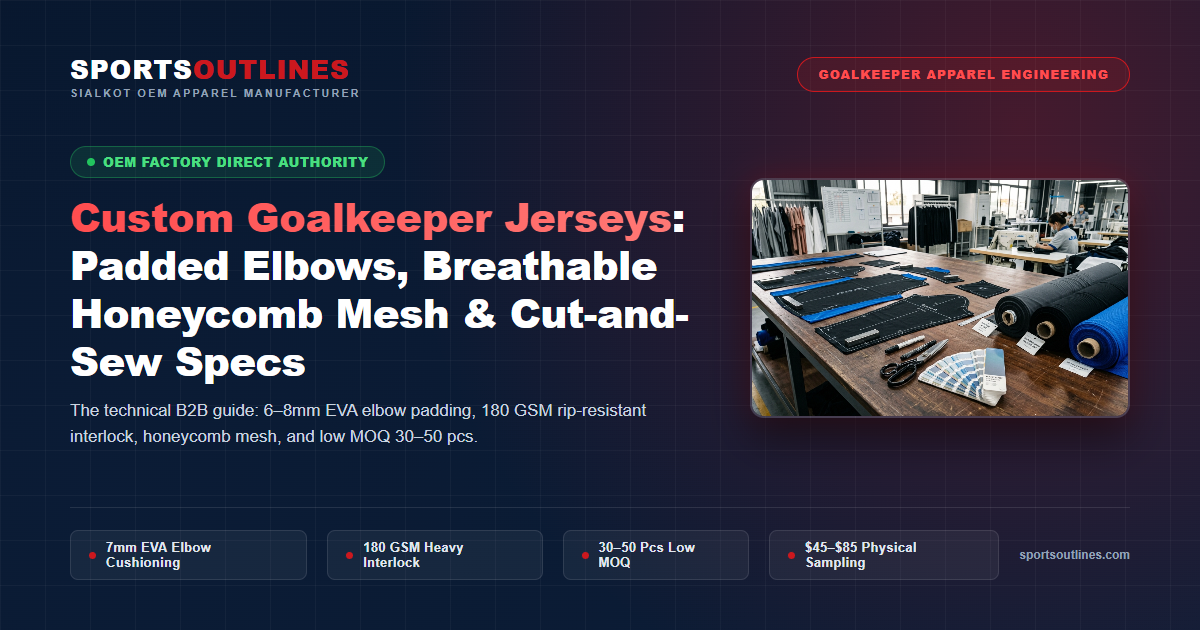
High-performance custom goalkeeper jerseys require specialized hybrid textile engineering: 180–200 GSM heavy-denier polyester interlock across the chest and forearms for friction resistance, laminated 6mm–8mm high-density thermoformed EVA foam padding on elbows and shoulders with articulated diamond quilting, and 150 GSM honeycomb mesh side panels for thermal regulation. Factory direct manufacturing in Sialkot, Pakistan utilizes Italian Kiian sublimation printing on flat unpadded pattern pieces prior to foam bonding to ensure permanent color fidelity. True factory low MOQ is 30 to 50 goalkeeper jerseys per design with mixed sizing (Youth YM to Adult 3XL). Pre-production physical samples cost $45 to $85 per piece with a 7 to 10 business day turnaround.
- Impact Protection: 6mm–8mm high-density EVA foam cushions with double-needle lockstitch flex grooves.
- Body Fabric: 180 GSM heavy micro-poly interlock + 150 GSM honeycomb mesh side flanks.
- Low MOQ Flexibility: 30–50 pieces per style with mixed adult and youth sizing.
- Physical Prototyping: $45–$85 per sample in 7–10 days for padding and fit sign-off.
- Direct Sourcing Contact: WhatsApp factory direct at +92 316 7932595 or sportsoutlines.com.
In soccer teamwear sourcing, the goalkeeper jersey is by far the most technically demanding garment in the kit bag. Unlike outfield players who experience primarily convective wind cooling during open sprints, goalkeepers subject their apparel to violent kinetic turf impact, continuous diving friction across artificial 3G turf and abrasive dry grass, and sharp temperature fluctuations between low-activity positioning and explosive physical saves.
At Sports Outlines in Sialkot, Pakistan, our athletic apparel engineers produce professional-tier goalkeeper kits for club academies, semi-pro leagues, and private goalkeeper apparel brands across North America, Europe, and Australasia. This comprehensive manufacturing white paper details the engineering principles of modern keeper wear: EVA foam density selection, articulated pattern quilting, abrasion resistance testing, wrist cuff glove clearance, and factory-direct low MOQ sourcing economics.
1. Impact Cushioning Science: EVA vs PU Memory Foam on Elbows
The defining mechanical feature of a goalkeeper jersey is protective arm cushioning. When a 75kg goalkeeper dives onto firm ground or abrasive turf, their olecranon elbow joint absorbs substantial impact energy. If padding is too thin (under 4mm), bone bruising and joint bursitis occur. If padding is too thick (over 12mm) or unsegmented, it impairs elbow flexion, causing glove cuff bunching and restricting arm speed.
At Sports Outlines, we utilize 7mm closed-cell EVA foam that is pre-laminated between the outer face polyester and an interior tricot lining. We then execute a computerized CNC stitching pattern forming an articulated diamond matrix (45° angle quilting). This geometric quilt pattern creates natural hinge lines that wrap snugly around the olecranon process whether the keeper’s arm is fully locked or bent at 90 degrees during a catch.
2. Hybrid Fabric Paneling: Heavy Interlock vs Honeycomb Breathability
A standard outfield soccer jersey (140 GSM) cannot endure goalkeeper duties; the friction of diving on turf tears through light yarns within 3 to 4 matches. Conversely, making the entire jersey from 220 GSM heavyweight knit causes severe overheating. The solution is multi-zone hybrid paneling:
- Zone A – High-Abrasion Zones (Forearms, Elbows, Shoulders): 180 to 200 GSM high-twist micro-interlock with tight circular knit construction. High tensile warp and weft yarn density resists turf burn and snagging.
- Zone B – Torso & Chest (Core Impact): 160 GSM lightweight interlock that accepts high-visibility sublimation graphics and sponsor logos without stiffness.
- Zone C – Ventilation Flanks (Side Panels, Lower Underarms, Back Collar): 150 GSM 3D Honeycomb Hex-Mesh. The open cellular structure promotes rapid convective heat transfer, allowing heat buildup to vent during quiet match phases.
- Zone D – Forearm & Wrist Cuffs: High-elastane 1×1 rib knit (95% poly / 5% spandex) engineered to fit tightly around the lower wrist. This prevents the sleeves from sliding down over the latex palms of goalkeeper gloves, ensuring uncompromised ball grip.
3. Sublimation Printing on Padded Garments: The Manufacturing Sequence
Many amateur clothing factories ruin padded goalkeeper jerseys by attempting to sublimate across pre-padded assembled panels. Subjecting 7mm EVA foam to a 205°C (400°F) flatbed heat press causes the foam cells to melt, collapse, and permanently harden into rigid cardboard. At Sports Outlines, our production engineering team follows a strict 4-step sequence:
- Flat Laser Cutting: All fabric panels are digitally laser cut from unprinted white polyester rolls according to CAD pattern files.
- Full-Dye Disperse Sublimation: The flat, unpadded fabric panels pass through the heat press with Italian Kiian sublimation transfer paper at 205°C for 35 seconds. Complete molecular dye penetration occurs while the fabric is completely flat.
- Precision Foam Insertion & CNC Quilting: Pre-cut 7mm EVA foam pads are aligned beneath the printed sleeve panels. Computerized lockstitch machines sew the diamond articulation pattern through the fabric and foam.
- Garment Assembly & Overlocking: The pre-padded and pre-sublimated sleeves are joined to the honeycomb mesh flanks and torso panels using 4-needle 6-thread reinforced stitching.
This exact sequence ensures that the jersey retains razor-sharp graphic registration, zero color smearing, and pristine, plush foam resiliency. For more details on our dye sublimation setup, read our technical breakdown on Sublimation vs Screen Printing for Sports Uniforms and Flatlock Stitching vs Seamless Apparel Assembly.
4. Sizing Curves & Arm Span Grading for Modern Goalkeepers
Goalkeepers possess unique anthropometric requirements compared to outfield players. Because goalkeepers frequently wear padded compression base layer undershirts and padded sliding shorts underneath their match jersey, standard slim-fit football grading will choke their upper chest and armpits. Our pattern blocks incorporate a **”Semi-Relaxed Athletic Contour”**:
5. Sourcing Economics: Unit Costs, Low MOQ & Prototype Sampling
Because each soccer squad typically requires only 2 to 3 goalkeepers per 20 outfield players, sports apparel brands often struggle to meet factory MOQs for keeper jerseys. Big factories in East Asia refuse orders under 300 goalkeeper pieces, forcing brands into generic catalog stock. Sports Outlines solves this by offering a **low MOQ of 30 to 50 goalkeeper pieces**, which can be ordered standalone or integrated directly into bulk outfield team kit production runs.
The Physical Sampling Protocol: We produce physical pre-production prototype samples for $45 to $85 per piece within 7 to 10 business days. This sample allows you to inspect EVA foam density, feel the elbow articulation during diving drills, verify neon Pantone color visibility, and test laundering durability. For comprehensive details on our low MOQ production workflows, review our guide on Low MOQ Clothing Manufacturing for Sportswear.
Start Your Custom Goalkeeper Jersey Manufacturing
Collaborate with specialized sports apparel engineers in Sialkot, Pakistan. Share your vector design artwork or Tech Pack for instant quote generation and prototype development.
Explore International Logistics & Country Sourcing
- USA Sourcing Hub – Express duty-free Section 321 air shipping.
- UK Sourcing Hub – Direct delivery to British goalkeeping brands and academies.
- Australia Sourcing Hub – UPF 50+ fabrics for extreme UV turf matches.
- Canada Sourcing Hub – Thermal padded goalkeeper base layers.
- Germany Sourcing Hub – Bundesliga-standard goalkeeper gear and gloves.
- Check out our Why Global Brands Source Sportswear from Sialkot report.