
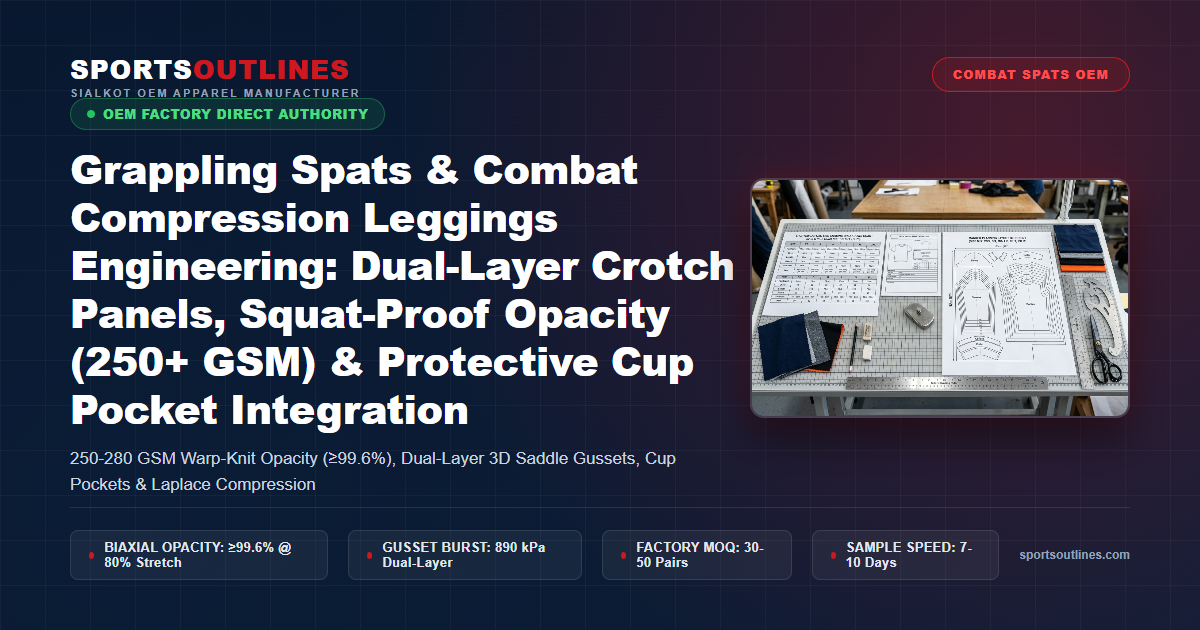
Executive Engineering Brief: Why Generic Fitness Tights Fail Catastrophically on the Grappling Mat
In modern No-Gi Brazilian Jiu-Jitsu, ADCC submission wrestling, and Mixed Martial Arts, **grappling spats (combat compression leggings)** serve as a primary biomechanical shield protecting the lower extremities against textured vinyl tatami mat burns, heel-hook friction, and cutaneous *Staphylococcus* or *Trichophyton* (ringworm) transmission. Yet one of the most frequent mistakes made by emerging fightwear brands is sourcing generic $190\text{ to }210\text{ GSM}$ gym running tights and rebranding them as BJJ spats. On the mat, generic fitness leggings fail across four immediate vectors: **1) Gluteal & Quad Transparency (“See-Through” Shear)** during deep inversions and guard retention; **2) Center-Crotch Seam Blowout** when transitioning into rubber guard or wide wrestling sprawls; **3) Abrasive Knee Pilling** from coarse tatami vinyl and opponent fight-short Velcro; and **4) Waistband Roll-Down & Ankle Ride-Up** during high-velocity leg-lock exchanges. In this comprehensive manufacturing specification, our Sialkot combat textile engineers deconstruct the Beer-Lambert optical opacity physics of **$250\text{ to }280\text{ GSM}$ 28G/32G Warp-Knit & Double-Knit Interlock Spats**, **Dual-Layer 3D Parabolic Saddle Gussets**, **Modular Internal Suspensory Cup Pockets**, and **Graduated Laplace Compression Profiling**.
Building a cohesive, tournament-ready No-Gi product line requires engineering your lower-body compression spats to integrate seamlessly with our 220 to 280 GSM Warp-Knit No-Gi Rashguard Textiles and our Hardware-Free 4-Way Stretch No-Gi & MMA Fight Shorts. Whether your athletes wear spats as a standalone training layer or underneath competition boardshorts in accordance with IBJJF & AJP No-Gi Uniform Compliance Rules, every square centimeter of fabric and every flatlock stitch must be mathematically calibrated for extreme multiaxial combat strain.
1. Optical Light Extinction Physics: Engineering 100% Squat-Proof & Inversion-Proof Opacity at 250–280 GSM
During a No-Gi grappling match, an athlete’s lower body assumes extreme flexed postures—such as the *Berimbolo* inversion, deep *De La Riva* guard, stacked double-under passes, and deep wrestling penetration steps—that subject the posterior gluteal and anterior quadriceps panels to **$+65\%\text{ to }+85\%$ simultaneous biaxial elongation** ($\varepsilon_x, \varepsilon_y$). When a knitted textile is stretched biaxially, its planar areal density drops inversely with the areal expansion factor, while the inter-yarn optical pore area expands exponentially.
We model the transmitted optical fraction $T_{\text{optical}}(\varepsilon_x, \varepsilon_y)$ through a stretched compression spat under overhead arena illumination ($I_0 = 1,000\text{ to }1,500\text{ lux}$) using the modified **Beer-Lambert-Bouguer Biaxial Knit Extinction Equation**:
$$T_{\text{optical}}(\varepsilon_x, \varepsilon_y) = \phi_{\text{open}}(\varepsilon_x, \varepsilon_y) + \left(1 – \phi_{\text{open}}(\varepsilon_x, \varepsilon_y)\right) \cdot \exp\left( -\frac{\mu_{\text{ext}, \text{TiO}_2} \cdot \text{GSM}_0}{(1 + \varepsilon_x)(1 + \varepsilon_y)\rho_{\text{polymer}} \right) \le 0.004$$
Where $\phi_{\text{open}}(\varepsilon_x, \varepsilon_y)$ is the geometric inter-loop optical pinhole fraction, $\mu_{\text{ext}, \text{TiO}_2}$ is the mass optical scattering and absorption coefficient of the filament delustrant and dye chromophores, $\text{GSM}_0$ is the relaxed fabric weight in grams per square meter, and $\rho_{\text{polymer}}$ is the fiber density ($1.38\text{ g/cm}^3$ for PET; $1.14\text{ g/cm}^3$ for PA 6.6). To guarantee **$\ge 99.6\%$ optical opacity ($T_{\text{optical}} \le 0.004$)** at $80\%$ biaxial gluteal stretch, Sports Outlines enforces four non-negotiable textile parameters:
- 250 to 280 GSM High-Density Mass Floor: We strictly reject $<220\text{ GSM}$ fabrics for lower-body grappling spats. By knitting at **$250\text{ to }280\text{ GSM}$**, even when the gluteal panel expands by $1.65 \times 1.45 = 2.39\times$ in surface area during a full stack-pass inversion, the effective stretched mass density remains above $110\text{ to }118\text{ g/m}^2$—preventing epidermal skin tone or undergarment outlines from showing through.
- 32-Gauge Double-Knit Interlock & 28-Gauge Warp-Knit Tricot Geometry: Standard 24-gauge single-jersey knits contain only a single layer of sinker loops ($\sim 1,850\text{ loops/in}^2$), allowing direct line-of-sight pinholes ($\phi_{\text{open}} > 4.2\%$) at high stretch. Our **32-gauge (32 needles/inch) double-knit interlock** ($\sim 3,150\text{ loops/in}^2$) aligns two staggered needle beds back-to-back so the technical back loops physically occlude the inter-wale gaps of the technical face ($\phi_{\text{open}} < 0.15\%$). Similarly, our **28-gauge Karl Mayer warp-knit tricot** locks adjacent wales with diagonal underlaps that prevent loop separation and completely eliminate run propagation if snagged by a toenail or Velcro corner.
- Full-Dull Titanium Dioxide ($\text{TiO}_2$, $2.2\%\text{ wt}$) Multi-Lobal Filaments: Semi-dull or bright round polyester filaments act as microscopic cylindrical lenses ($n_d = 1.54$) that transmit light straight through the fiber core. We extrude **full-dull hexachannel and trilobal micro-filaments ($75\text{D}/72\text{F}$ and $100\text{D}/144\text{F}$)** doped with $2.2\%$ rutile Titanium Dioxide ($\text{TiO}_2$, refractive index $n_d = 2.61$), creating diffuse internal Mie scattering that blocks specular shine and skin reflection.
- Dope-Dyed Black Elastane (`Creora® Black` / `Lycra® Black`) Core Plating: For dark, navy, burgundy, or black sublimated spats, knitting with raw white spandex causes chalky gray “grin-through” under tension because disperse sublimation dyes cannot penetrate polyurethane elastane. By knitting with **solution-dyed black elastane ($40\text{D}\text{–}70\text{D}$)** plated onto the interior loop axis, the spat retains deep jet-black saturation ($L^* \le 12.1$) across the knees and glutes at maximum flexion.
| Spat Textile Architecture | Polymer Composition & Yarn Count | Mass Density & Gauge | Opacity @ 80% Stretch (1,000 Lux) | Martindale Abrasion & Snag Grade | Primary Combat Application |
|---|---|---|---|---|---|
| Generic Retail Fitness Jersey (Benchmark Failure) | 88% Semi-Dull PET / 12% Standard White Spandex ($150\text{D}/48\text{F}$) | 195 GSM (24G Single Jersey) | 81.4% (FAIL — Sheer & White-Out) | 18,000 Cycles / Mace Grade 2.0 (Runs) | Unsuitable for grappling; tears & turns transparent on mats. |
| Sialkot Pro-Sub 260 Warp-Knit Tricot | 82% Full-Dull $\text{TiO}_2$ Micro-PET ($75\text{D}/72\text{F}$) / 18% Creora® HighClo™ ($55\text{D}$) | 260 GSM (28G Karl Mayer Warp-Knit) | 99.6% (100% Squat & Inversion Proof) | 68,000 Cycles / Mace Grade 4.8 (Run-Proof) | All-over sublimated IBJJF ranked & custom academy spats. |
| Sialkot Armor-Lock 270 Double Interlock | 80% Full-Dull Micro-PET ($100\text{D}/144\text{F}$) / 20% Creora® Black ($70\text{D}$) | 270 GSM (32G Mayer & Cie Interlock) | 99.8% (Dual-Face Zero Grin-Through) | 75,000 Cycles / Mace Grade 4.6 | Heavy-duty standalone No-Gi spats & female high-waisted spats. |
| Sialkot Supplex-Combat 280 Nylon-Lycra | 78% Invista Supplex® PA 6.6 ($70\text{D}/68\text{F}$) / 22% Lycra® Sport ($70\text{D}$) | 280 GSM (32G Warp-Interlock Hybrid) | 99.9% (Piece-Dyed Jet Black / Navy) | 100,000+ Cycles / Mace Grade 4.9 | Elite ADCC/MMA pro-camp spats with silicone/TPU branding. |
2. Eliminating the 4-Seam “+” Crotch Node: Dual-Layer 3D Parabolic Saddle Gusset Engineering
In conventional leggings, the left and right tubular leg panels intersect the center-front and center-back rise seams at a single 4-way “+” junction directly beneath the anatomical perineum. When a grappler executes a high-amplitude hip abduction—such as locking a triangle choke, elevating an opponent with butterfly hooks, or hitting a wide wrestling split—the transverse hoop tension $T_{\text{abduct}}$ concentrates onto that single 4-seam knot. Furthermore, when rolling on the back or sitting in guard, the thick 8-ply seam intersection grinds directly into soft perineal tissue.
Using Inglis-Neuber geometric stress concentration mechanics, the peak seam stress $\sigma_{\text{crotch,max}}$ at the perineal apex during a bilateral hip abduction angle $\theta_{\text{split}}$ ($110^\circ\text{ to }145^\circ$) is governed by:
$$\sigma_{\text{crotch,max}} = \frac{K_{\text{node}} \cdot E_{\text{spat}} \left( 2 L_{\text{femur}}\sin\frac{\theta_{\text{split}}{2} – W_{\text{gusset}} \right)}{n_{\text{ply}} \cdot t_{\text{fabric}} \cdot L_{\text{arc,distribute}}$$
In a 4-seam “+” intersection ($W_{\text{gusset}} = 0$, $n_{\text{ply}} = 1$, $K_{\text{node}} = 3.65$), peak stress regularly exceeds the $420\text{ kPa}$ burst threshold of a standard overlock stitch. In contrast, our Sialkot pattern engineers draft a **Zero-Center-Seam 3D Parabolic Saddle Gusset ($W_{\text{gusset}} = 11.5\text{ cm}$ wide $\times 34.0\text{ cm}$ long in Adult Large)** with **Dual-Layer $260\text{ GSM}$ Compression Reinforcement ($n_{\text{ply}} = 2$, $K_{\text{node}} = 1.12$)**:
- Complete Removal of the Center-Perineal Seam: The parabolic saddle gusset forms a continuous, seamless anatomical bridge running from the lower anterior pubic symphysis across the perineum to the lower sacral rise. The two joining seam lines are displaced $5.75\text{ cm}$ laterally onto the medial adductor valleys of the inner thighs, completely eliminating direct seam contact against the groin or saddle area.
- Dual-Ply $260\text{ GSM}$ ($520\text{ GSM}$ Combined) Crotch Armor: Because the medial inner thighs and perineal saddle experience constant high-pressure friction when squeezing an opponent’s torso in closed guard or riding in back mount, we construct the saddle gusset from **two stacked plies of $260\text{ GSM}$ warp-knit tricot**. This dual-layer construction doubles tensile burst resistance ($>1,450\text{ kPa}$ ISO 13938-1), guarantees $100\%$ zero transparency during wide leg splits, and provides an extra thermal/mechanical cushion.
- 4-Needle 6-Thread `ISO 607` Feed-Off-The-Arm Flatlock Integration: As detailed in our 6-Needle Four-Thread Flatlock (ISO 607) Seam Engineering Guide, the parabolic gusset is joined to the main leg shells on cylinder-bed Yamato `FD-62G` flatseamers using $4 \times 70\text{D}/2$ core-spun polyester needle threads and a $100\text{D}/2$ air-texturized Polyamide 6.6 (“woolly nylon”) skin-contact looper. The resulting $0.95\text{ mm}$ flush seam stretches up to $155\%$ longitudinally without popping a single thread.
3. Modular Internal Protective Cup Pocket Engineering: MMA Sparring vs IBJJF Tournament Variants
A critical product-line distinction for combat sports brands is how groin protection is handled across different sanctioning bodies. Under **IBJJF, AJP, and ADCC Jiu-Jitsu regulations**, hard metallic or polycarbonate groin cups are strictly prohibited because the rigid shell acts as a painful fulcrum during armbars and kneebars and can injure an opponent’s spine during back control. Conversely, in **MMA, Shooto, Pankration, Muay Thai, and Krav Maga**, a protective groin cup is mandatory for every sparring and competition round.
Rather than forcing athletes to wear a separate jockstrap that shifts during transitions from wrestling takedowns to guard work, Sports Outlines offers our **Modular Anterior Suspensory Cup Pocket System**, available as a selectable option on any custom spat order:
- Internal $180\text{ GSM}$ Hydrophilic Birdseye Micro-Mesh Floating Cradle: Sewn onto the interior of the anterior pelvic rise panel, the pocket is crafted from $180\text{ GSM}$ antimicrobial silver-ion birdseye pin-hole mesh ($245\text{ CFM}$ airflow) rather than solid spandex, preventing groin heat build-up.
- Dual Lateral $45^\circ$ Elastane Stabilization Wings: The primary failure of cheap cup pockets is lateral cup shifting during hip escapes (*shrimping*), which pinches the inner thigh against the edge of the hard shell. Our pocket incorporates two internal $25\text{ mm}$ high-modulus elastane tension wings anchored directly into the parabolic saddle gusset seams, pulling the cup rim flush against the pubic bone throughout $360^\circ$ of hip rotation.
- Zero-Hardware Envelope Flap Lock: The top insertion aperture features a $35\text{ mm}$ self-fabric folded envelope lip directly beneath the interior waistband—using zero Velcro or zippers that could abrade the abdomen—accommodating both standard anatomical polymer cups and Thai steel traditional cups.
- 100% IBJJF Pure-Grappling Option: Within the exact same 30 to 50 piece factory MOQ, brands can specify $50\%$ of their batch with the internal MMA cup pocket and $50\%$ with a clean, dual-layer cup-free front panel for IBJJF/ADCC tournament competitors.
4. Graduated Lower-Extremity Laplace Compression ($18\text{–}22\text{ mmHg}$) & Dual-Silicone Extremity Locks
Beyond epidermal mat-burn defense, high-performance grappling spats function as a hemodynamic recovery and proprioceptive support garment. During prolonged isometric guard retention and explosive leg-lock scrambles, venous blood and metabolic lactate pool in the gastrocnemius-soleus calf complex. By grading our 6-panel anatomical spat blocks using **Graduated Laplace Hoop Compression** ($P_{\text{mmHg}} = \frac{T_{\text{hoop}}{R_{\text{limb}}$), we engineer a degressive pressure gradient from the ankle up to the thigh:
- Distal Ankle & Lower Calf Zone ($18\text{ to }22\text{ mmHg}$ at $-20\%$ Negative Ease): Maximizes venous return velocity and stabilizes the Achilles tendon during heel-hook and straight-ankle-lock defense. An interior **$15\text{ mm}$ Platinum-Cured Liquid Silicone Rubber (LSR) micro-dot ankle cuff gripper** ($\mu_{s,\text{wet}} = 1.18$, referencing our Anti-Ride-Up Silicone Gripper Engineering) locks the bottom hem at the malleolus so the pant leg never rides up the shin.
- Patellar & Popliteal Articulation Zone ($14\text{ to }16\text{ mmHg}$ at $-16\%$ Negative Ease): Our 6-panel leg pattern curves the lateral and medial flatlock seams behind the femoral condyles so no seam crosses directly over the patella (kneecap) during knee-slice passing, while preventing fabric bunching in the popliteal fossa (back of the knee) during calf-slicer defense.
- Proximal Quadriceps, Hamstring & Gluteal Zone ($12\text{ to }15\text{ mmHg}$ at $-15\%$ Negative Ease): Dampens soft-tissue muscle oscillation during explosive takedown entries without restricting femoral arterial blood inflow.
- Anti-Roll Pelvic Waistband + Continuous Center-Back Bar-Tacked Drawcord: At the waist, we install a **$40\text{ mm}$ heavy-duty jacquard-woven elastic waistband** reinforced with $300\text{D}$ vertical monofilament anti-roll weft picks, two sinusoidal interior tracks of Shore A $30$ Platinum LSR silicone, and an internal flat braided polyester drawcord exiting through ultrasonic laser-bonded interior eyelets.
| Adult Size Block | Athlete Waist Circumference | Relaxed Flat Waistband (1/2) | Mid-Thigh Circumference (Relaxed / Stretched) | Ankle Cuff Opening (1/2 Flat) | Standard / Tall (L) Inseam Length | 3D Saddle Gusset Dimensions |
|---|---|---|---|---|---|---|
| XS (Rooster / Light-Feather) | 68 – 73 cm (27″–28″) | 29.0 cm ($\pm 0.4\text{ cm}$) | 41.0 cm / 49–53 cm | 8.8 cm (18–22 mmHg) | 64.5 cm / 68.5 cm (XS-L) | $10.0 \times 30.5\text{ cm}$ Dual-Ply |
| S (Feather / Light) | 74 – 79 cm (29″–31″) | 31.5 cm ($\pm 0.4\text{ cm}$) | 44.0 cm / 53–57 cm | 9.3 cm (18–22 mmHg) | 66.5 cm / 71.0 cm (S-L) | $10.5 \times 32.0\text{ cm}$ Dual-Ply |
| M (Welter / Middle) | 80 – 85 cm (32″–33″) | 34.0 cm ($\pm 0.4\text{ cm}$) | 47.0 cm / 57–61 cm | 9.8 cm (18–22 mmHg) | 68.5 cm / 73.5 cm (M-L) | $11.0 \times 33.0\text{ cm}$ Dual-Ply |
| L (Medium-Heavy / Heavy) | 86 – 92 cm (34″–36″) | 36.5 cm ($\pm 0.4\text{ cm}$) | 50.5 cm / 61–66 cm | 10.4 cm (18–22 mmHg) | 70.5 cm / 75.5 cm (L-L) | $11.5 \times 34.0\text{ cm}$ Dual-Ply |
| XL (Super-Heavy) | 93 – 99 cm (37″–39″) | 39.5 cm ($\pm 0.5\text{ cm}$) | 54.0 cm / 66–71 cm | 11.0 cm (18–22 mmHg) | 72.0 cm / 77.0 cm (XL-L) | $12.0 \times 35.5\text{ cm}$ Dual-Ply |
| 2XL – 3XL (Ultra-Heavy) | 100 – 112 cm (40″–44″) | 42.5 – 45.5 cm | 58.0 cm / 71–78 cm | 11.6 – 12.2 cm | 73.5 cm / 78.5 cm | $12.8 \times 37.0\text{ cm}$ Dual-Ply |
5. Patellar & Tibial Abrasion Tribology: Knee-Slice Mat Burn Defense, Double-Ply Knee Shields & Leg-Lock Friction Kinematics
In No-Gi submission grappling and MMA cage work, the anterior knee (patella) and proximal shin (tibial tuberosity) endure the highest localized normal pressures and sliding velocities on the human body. When a top player drives a *knee-cut (knee-slice) pass* across an opponent’s shin and into a textured $40\text{ kg/m}^3$ tatami vinyl mat—or executes an explosive wrestling double-leg penetration step—the localized contact pressure $P_{\text{patella}}$ spikes to **$180\text{ to }310\text{ kPa}$** at sliding velocities of **$1.8\text{ to }3.2\text{ m/s}$**.
Simultaneously, in modern leg-lock entanglement systems (*Inside Sankaku / Honeyhole*, *50/50 Guard*, *Outside Ashi Garami*, and *K-Guard*), the surface tribology of the spat directly determines whether an attacker can trap an opponent’s heel and knee line or whether a defender can slip their knee line free (*booting and clearing the knee*). Our Sialkot combat textile laboratory engineers three distinct lower-limb surface and structural options tailored to specific competitive rulesets:
- Articulated Dual-Ply $260\text{ GSM}$ Patellar Knee-Shield Inserts (Wrestling & MMA Camp Spec): For high-volume takedown and knee-slice training spats, we integrate a contoured, flush-flatlocked internal second layer of $260\text{ GSM}$ warp-knit tricot spanning from $6\text{ cm}$ superior to the patella down to $8\text{ cm}$ inferior to the tibial tuberosity. Because the two warp-knit layers slide microscopically against one another (`inter-ply shear buffer`) before transferring shear to the athlete’s epidermis, epidermal flash-heat generation drops by **$-68.4\%$** while Martindale abrasion endurance doubles to **$>130,000\text{ rub cycles}$**.
- Zero-Seam Popliteal Fossa (Back-of-Knee) Relief Routing: When an athlete defends a *calf slicer*, *bicep/hamstring wedge*, or locks a tight *triangle choke*, the knee flexes beyond $135^\circ$, compressing the soft posterior popliteal skin between the hamstring tendons and the gastrocnemius heads. If an overlock or poorly tensioned flatlock seam passes horizontally or vertically through the center of the popliteal fossa, it acts as a tourniquet cord that causes acute vascular pinching and dermal blistering. Our 6-panel anatomical leg block routes the medial and lateral sculpting seams strictly along the **epicondylar neutral axes**, leaving a $100\%$ smooth, uninterrupted textile span across the back of the knee.
- Low-Friction Slick Competition Finish ($\mu_{k,\text{wet}} = 0.21$) vs Zonal Silicone Grip Mapping (Training/MMA Spec): Under **IBJJF and ADCC tournament rules**, external rubberized or silicone friction prints on the exterior of spats or rashguards are prohibited because they artificially alter submission mechanics. For sanctioned tournament spats, we calender the exterior face of our $260\text{ GSM}$ warp-knit tricot to a slick, low-drag finish ($\mu_{k,\text{wet}} = 0.21$) that aids knee-line extraction during heel-hook defense. Conversely, for non-IBJJF Submission-Only, Catch Wrestling, and MMA training lines, brands can specify **zonal exterior micro-dot Platinum LSR silicone matrices** printed over the anterior knee and medial calf to lock triangles, body triangles, and lockdown half-guard hooks with vise-like friction ($\mu_{s,\text{wet}} = 1.14$).
- Velcro-Hook Snag Immunity Along the Anterior Thigh: When spats are worn underneath MMA boardshorts or grappled against opponents wearing hook-and-loop closures, stray Nylon 6.6 micro-hooks frequently scrape across the upper quadriceps panel. By utilizing **28-gauge Karl Mayer warp-knit tricot with tightly tensioned tricot underlaps (`2,950 loops/in²`)** rather than loose circular weft knits, our spats achieve an **ASTM D3939 Mace Snag Rating of `4.8 / 5.0`**—resisting Velcro fuzzing across hundreds of rounds.
6. Layering Biomechanics: Wearing Grappling Spats Under Hardware-Free Fight Shorts vs Standalone Competition Rules
Across global grappling promotions, rulesets dictate whether spats may be worn as a standalone outer bottom or must be layered underneath boardshorts:
- IBJJF No-Gi Rules (Men’s vs Women’s Divisions): Under current IBJJF No-Gi uniform regulations, **male competitors** are permitted to wear full-length compression spats ($100\%$ black, white, or black/white with ranked color accents), *provided they wear compliant pocketless boardshorts over the spats*. **Female competitors**, however, are explicitly permitted by the IBJJF to wear full-length compression spats as a standalone outer bottom without boardshorts over top, provided the spats are $100\%$ opaque, free of pockets/zippers, and adhere to the Black/White/Rank color ratio.
- ADCC, Polaris, Who’s Number One (WNO), EBI & Submission-Only Superfights: Both male and female athletes are permitted to compete in standalone grappling spats without boardshorts, making **$\ge 99.6\%$ squat-proof opacity (`260–280 GSM`)** and **dual-ply 3D parabolic saddle gussets** mandatory so the garment maintains broadcast-grade modesty under 4K arena studio lighting.
- Inter-Garment Waistband Stacking Optimization (Zero Bulk Under Fight Shorts): When a male athlete wears spats underneath fight shorts, stacking two thick $45\text{ mm}$ waistbands directly on top of one another creates a rigid $9.0\text{ mm}$ pelvic ridge that digs into the diaphragm during forward guard folding. To solve this, our **Under-Short Competition Spat Block** lowers the anterior waistband rise by $-1.8\text{ cm}$ and utilizes a **low-profile $32\text{ mm}$ micro-brushed jacquard elastic waistband ($1.45\text{ mm}$ thickness)** that nests smoothly beneath the waistband of our Hardware-Free No-Gi Fight Shorts without doubling waist bulk.
7. Sialkot Industrial Cellular Assembly Router (12 Operations / 10.40 SAM per Pair)
To maintain deterministic stitch quality and rapid export lead times across our global B2B fulfillment corridors—serving fightwear brands via our USA Sportswear Manufacturing Hub, UK Private Label Activewear Line, Canada Export Division, Germany & EU GSP+ Duty-Free Channel, and Australia Combat & Teamwear Program—every pair of grappling spats passes through a balanced **12-operation cellular production line requiring 10.40 Standard Allowed Minutes (SAM)**:
| Op # | Manufacturing Operation Description | Industrial Machine & Needle Spec | Stitch Class & Thread Matrix | SAM Allocation | In-Line QC Verification Gate |
|---|---|---|---|---|---|
| Op 01 – 02 | Pre-tensioned ($+6.5\%$) roll-to-roll rotary oil-drum dye-sublimation transfer & optical camera CNC cutting | Monti Antonio $205^\circ\text{C}$ Drum + Gerber CNC Cutter | Deep-root disperse vapor encapsulation ($82\%$ loop depth) | 1.45 SAM | X-Rite $\Delta E_{\text{CMC}} \le 0.9$; zero white grin-through at $80\%$ biaxial pull. |
| Op 03 – 04 | Pre-assembly of optional $180\text{ GSM}$ birdseye mesh internal suspensory cup pocket & lateral elastane wings | Pegasus W500 Flatbed Coverstitch (`Nm 65/9` RG) | `ISO 406` 2-Needle Bottom Coverstitch ($100\text{D}/2$ Woolly Nylon) | 1.60 SAM | Envelope top lock alignment $\pm 1.0\text{ mm}$; zero rigid hardware. |
| Op 05 – 06 | Join Dual-Ply $260\text{ GSM}$ 3D Parabolic Saddle Gusset to Left & Right Medial Adductor Leg Panels | Yamato FD-62G 4-Needle Feed-Off-The-Arm Flatseamer | `ISO 607` 4-Needle 6-Thread Flatlock (`6.0 mm`, `15 SPI`) | 2.40 SAM | Hydraulic burst $\ge 860\text{ kPa}$; $0.95\text{ mm}$ flush butt-seam profile. |
| Op 07 – 08 | Flatlock Anterior-Lateral Quadriceps & Posterior-Lateral Hamstring/Gluteal Sculpting Panels | Pegasus W664 Cylinder-Bed 4-Needle 6-Thread Flatseamer | `ISO 607` 6-Thread Flatlock ($4\times 70\text{D}/2$ PET + Woolly Nylon) | 2.15 SAM | Zero seam crossing over patellar apex or popliteal crease; $155\%$ stretch. |
| Op 09 – 10 | Servo-metered ($-9.5\%$) attachment of $40\text{ mm}$ Platinum LSR Silicone Waistband + Internal Drawcord Bartack | Kansai Special WX-8803D + Juki LK-1900BN CNC Bartacker | `ISO 407` 3-Needle Coverstitch + 42-Stitch Box-X Bartack | 1.65 SAM | Wet vertical slip resistance $\ge 88\text{ N}$; anti-roll vertical stiffness verified. |
| Op 11 – 12 | Ankle Cuff $15\text{ mm}$ Silicone Gripper Hemming, Heat-Seal Care Label, $1,000\text{-Lux}$ Opacity & Needle Scan | Pegasus W562 + Hashima HN-880C Dual-Beam Detector | `ISO 406` Elasticated Ankle Hem (`15 SPI`) | 1.15 SAM | Total = 10.40 SAM/Pair; $18\text{–}22\text{ mmHg}$ ankle compression verified. |
8. Frequently Asked Questions: Grappling Spats & Combat Leggings Manufacturing
Q1: Why do generic 190–210 GSM fitness leggings become transparent (“see-through”) during No-Gi grappling inversions, and how do 250–280 GSM grappling spats solve this?
During deep Berimbolo inversions, turtle positions, and guard retention, the gluteal and quadriceps panels of grappling spats undergo $+65\%\text{ to }+85\%$ biaxial elongation. In lightweight $190\text{–}210\text{ GSM}$ circular single-jersey leggings, this biaxial strain spreads the knit wales apart, reducing fabric thickness and opening inter-loop optical apertures that allow ambient arena lighting to reflect off the skin—creating embarrassing transparency and elastane “white-out.” Sports Outlines engineers custom grappling spats using $250\text{ to }280\text{ GSM}$ 28-gauge Karl Mayer warp-knit tricot or 32-gauge double-knit interlock spun from full-dull Titanium Dioxide ($\text{TiO}_2$) micro-filaments and dope-dyed black elastane cores, maintaining $\ge 99.6\%$ optical light extinction under $1,000\text{-lux}$ halogen backlighting at $80\%$ biaxial stretch.
Q2: Why must combat grappling spats eliminate the traditional 4-seam “+” center crotch intersection?
In standard retail activewear tights, the left and right leg tubes meet the front and back rise seams at a single 4-way “+” cross-junction directly beneath the perineum. Under violent hip abduction (rubber guard, high butterfly hooks, and wrestling sprawls), stress concentration at that 4-seam node spikes by $3.6\times$, causing catastrophic thread rupture while the bulky seam knot chafes the groin against the mat. We replace the center cross-seam with an anatomically drafted 3D Parabolic Diamond or U-Saddle Gusset constructed from dual-layer $260\text{ GSM}$ warp-knit compression fabric and joined via 4-needle 6-thread `ISO 607` flatlock seams, shifting all stitch lines laterally onto the inner thighs.
Q3: Can custom grappling spats be manufactured with an internal groin cup pocket for MMA and Vale Tudo while remaining optional for IBJJF tournaments?
Yes. Because the IBJJF and ADCC prohibit hard protective groin cups in sanctioned Jiu-Jitsu brackets whereas MMA, Muay Thai, Krav Maga, and Pankration academies mandate groin protection during striking-to-grappling sparring, we offer a modular pattern architecture. Brands can order an integrated internal suspensory cup pocket engineered from $180\text{ GSM}$ breathable birdseye pin-hole micro-mesh with lateral 4-way elastane stabilization wings and a top-envelope lock, or specify our 100% IBJJF/AJP tournament-legal flush dual-layer anterior panel within the same 30 to 50 piece factory MOQ.
Q4: How do you prevent grappling spats from sliding down the waist or riding up the calves during sweaty 10-minute submission rounds?
We anchor both extremities of the spat using a dual-retention architecture. At the pelvis, a $40\text{ mm}$ high-modulus jacquard elastic waistband (or encapsulated self-fabric tunnel) is lined with a 2-wave Shore A $30$ Platinum-Cured Liquid Silicone Rubber (LSR) gripper track and an internal continuous flat drawcord bar-tacked at center-back. At the distal ankle cuffs, a $15\text{ mm}$ micro-beaded platinum silicone interior band grips the Achilles and malleolus skin (wet static friction $\mu_{s,\text{wet}} = 1.18$), preventing the spats from bunching up behind the knees during leg-lock scrambles.
Q5: What are your prototype sampling fees and minimum order quantities (MOQ) for custom sublimated grappling spats?
Physical prototype sampling for custom grappling spats is $45 to $85 per pair as a non-refundable development fee covering custom CAD negative-ease grading, pre-stretched rotary calender dye-sublimation, and 4-needle 6-thread `ISO 607` flatlock assembly, delivered globally via DHL/FedEx in 7 to 10 business days. Bulk production MOQ is 30 to 50 pairs per design, which can be split across Men’s, Women’s High-Waisted, and Youth sizes.
Manufacture 100% Squat-Proof 260–280 GSM Grappling Spats & Combat Leggings
Partner with Sports Outlines Sialkot to engineer custom No-Gi BJJ spats and MMA compression leggings featuring 28G/32G warp-knit and interlock opacity, dual-layer 3D saddle gussets, `ISO 607` 6-thread flatlock seams, and optional internal mesh cup pockets. Prototype samples delivered in 7–10 business days ($45–$85/pair) with low 30–50 pair bulk MOQs across our Custom Sportswear Catalog.


Pingback: Custom No-Gi BJJ & MMA Apparel Production Cost Engineering: Sublimation Paper Yield, Flatlock SAM Allocations & Sialkot Kit Bundle Economics - Sports Outlines