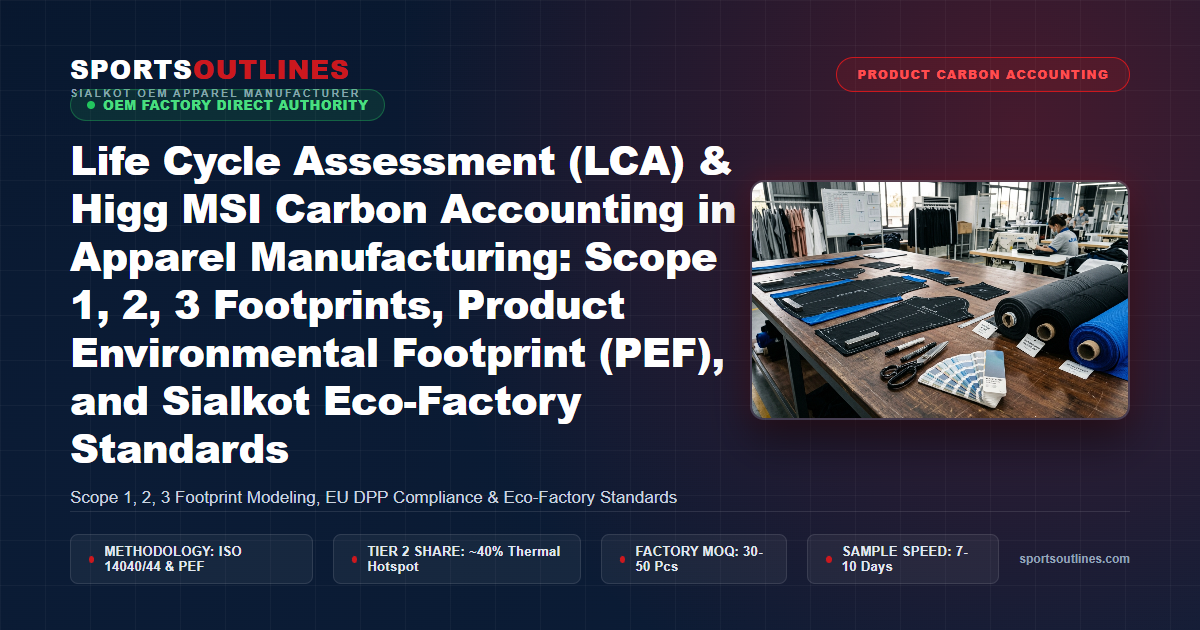
For decades, sustainability in the sportswear industry was dominated by aspirational marketing narratives, self-declared eco-labels, and vague claims of “planet-friendly” manufacturing. Today, that era of unchecked rhetoric has decisively ended. Propelled by strict international legislative mandates—such as the European Union’s Corporate Sustainability Due Diligence Directive (CSDDD), the EU Ecodesign for Sustainable Products Regulation (ESPR), France’s AGEC environmental labeling decree, and the upcoming Digital Product Passport (DPP)—global activewear brands must now provide empirical, mathematically verified scientific proof of their environmental footprint or face severe market exclusion, product recalls, and punitive civil fines.
The gold standard for quantifying environmental impact is Life Cycle Assessment (LCA), governed internationally by ISO 14040 and ISO 14044 standards, and operationalized across the global apparel value chain through the Cascale Higg Materials Sustainability Index (Higg MSI) and Higg Facility Environmental Module (Higg FEM). Mastering carbon accounting across Scope 1, Scope 2, and Scope 3 emissions is no longer an optional public relations exercise; it is an existential operational requirement for technical sportswear brands seeking retail distribution in Europe, North America, and Australia. At Sports Outlines, operating our high-precision cut-and-sew technical manufacturing hub in Sialkot, Pakistan, we assist forward-thinking sportswear brands in calculating, auditing, and aggressively reducing their product-level environmental footprints. We provide custom physical prototype sampling at $45 to $85 per piece (non-refundable, 7–10 business days turnaround) and scalable factory production starting at low minimum order quantities (MOQ) of just 30 to 50 pieces per style/colorway.
LCA & Higg MSI Carbon Accounting: Technical Navigation Directory
- 1. The International Regulatory & Retail Mandate
- 2. ISO 14040 / 14044 Life Cycle Assessment Methodology
- 3. The Cascale Higg Suite: MSI, FEM & FSLM Architecture
- 4. System Boundaries: Cradle-to-Gate vs Cradle-to-Grave
- 5. Scope 1, 2, and 3 Emissions Across Apparel Tiers
- 6. Product Environmental Footprint (PEF) & EU DPP
- 7. Factory Decarbonization: Solar, Steam & Heat Recovery
- 8. Sialkot Eco-Factory Standards & Primary Data Collection
- 9. Engineering Matrix: Fiber Environmental Profiles
- 10. Case Study: 320 GSM Hoodie vs 220 GSM Leggings
- 11. Low-MOQ Sourcing & Commercial Factory Terms
- 12. Technical Sourcing FAQ
1. The International Regulatory & Retail Mandate: Why Carbon Accounting is Mandatory in Sportswear
For decades, apparel brands calculated company-level greenhouse gas emissions primarily for corporate responsibility reports or investor pitches. However, between 2024 and 2026, international regulatory bodies enacted binding statutory requirements that penalize inaccurate or unsubstantiated environmental metrics:
- European Union ESPR (Ecodesign for Sustainable Products Regulation): Establishes ecodesign requirements across textiles, setting maximum allowable environmental impact thresholds per garment, mandating durability and recyclability metrics, and making Digital Product Passports (DPP) legally enforceable for garments sold within the 27 EU member states.
- EU Corporate Sustainability Due Diligence Directive (CSDDD): Compels medium and large enterprises operating in the EU to identify, prevent, and remediate adverse environmental impacts across their global upstream value chain, including Scope 3 tier-by-tier emissions.
- California Climate Corporate Data Accountability Act (SB 253 & SB 261): Requires US companies doing business in California with annual revenues exceeding $1 billion to publicly disclose all Scope 1, Scope 2, and Scope 3 emissions annually, with mandatory third-party assurance. Major athletic retailers (Nike, Under Armour, Lululemon, Dick’s Sporting Goods) now require their supplier networks to report primary factory-level emissions data.
- The EU Green Claims Directive: Imposes statutory prohibitions against unsubstantiated environmental claims. Any brand claiming a product has “low carbon impact,” is “eco-conscious,” or “sustainable” must validate that assertion using certified Life Cycle Assessment methodologies backed by verified independent audits.
2. ISO 14040 / 14044 Life Cycle Assessment Methodology
The fundamental scientific foundation for all environmental product declarations is the International Organization for Standardization (ISO) LCA series: ISO 14040 (Principles and Framework) and ISO 14044 (Requirements and Guidelines).
An ISO-compliant Life Cycle Assessment proceeds through four interconnected phases:
The Four Structural Phases of an ISO 14040/44 LCA
- Goal and Scope Definition: Clarifies the exact research question, the target audience, the system boundary (e.g., Cradle-to-Gate), and the Functional Unit (e.g., “One pair of men’s technical compression running tights, size Medium, worn for an intended service life of 100 wash cycles”).
- Life Cycle Inventory (LCI): Exhaustive quantitative data compilation of all physical inputs (raw materials, water, chemicals, electrical energy, thermal steam, fuel) and physical outputs (airborne emissions, wastewater effluent, solid production scrap) across every tier of manufacturing.
- Life Cycle Impact Assessment (LCIA): Translating raw inventory data into recognized environmental damage categories using scientific characterization models (e.g., ReCiPe 2016, EF 3.1, TRACI 2.1). Midpoint categories include Global Warming Potential (GWP₁₀₀ in $kg\text{ CO}_2e$), Freshwater Eutrophication ($kg\text{ P }eq$), Water Scarcity ($m^3\text{ world-eq}$), and Abiotic Resource Depletion ($MJ$).
- Interpretation & Sensitivity Analysis: Identifying critical environmental hotspots, assessing data uncertainty, and formulating engineering interventions to reduce footprint metrics.
3. The Cascale Higg Suite: MSI, FEM & FSLM Architecture
While ISO 14040 provides universal scientific rules, conducting custom, standalone LCAs for every single garment style in a 500-SKU sportswear catalog is financially prohibitive ($15,000 to $30,000 per bespoke LCA study). To provide a scalable, industry-standardized mechanism, Cascale (formerly the Sustainable Apparel Coalition) and Worldly developed the Higg Index suite:
- Higg Materials Sustainability Index (Higg MSI): The apparel sector’s premier materials LCA database. Higg MSI compiles cradle-to-gate environmental impact data across five core categories: Global Warming Potential, Eutrophication, Water Scarcity, Fossil Fuel Depletion, and Chemistry. It calculates a single standardized MSI Score per kilogram of raw textile material (fiber, yarn, fabric, trim, and packaging). Designers and product developers utilize Higg MSI to simulate material substitutions—for instance, evaluating the exact carbon delta between virgin Nylon 6,6 vs recycled ocean nylon vs bio-based Sorona® before ordering yardage.
- Higg Facility Environmental Module (Higg FEM): Evaluates factory-level operational sustainability at Tier 1 (cut-and-sew) and Tier 2 (dyeing and knitting) facilities. Higg FEM scores seven environmental parameters: Environmental Management Systems (EMS), Energy & Greenhouse Gas Emissions, Water Use, Wastewater Effluent, Air Emissions, Waste Management, and Chemical Management. A verified Higg FEM score is the primary threshold global retailers use to approve manufacturing partners.
- Higg Product Module (Higg PM): Synthesizes materials data from Higg MSI with factory-level primary processing data from Higg FEM, calculating the comprehensive cradle-to-grave or cradle-to-gate footprint of an individual finished garment.
4. System Boundaries: Cradle-to-Gate vs Cradle-to-Grave
A critical source of confusion in sportswear carbon claims stems from the definition of the System Boundary. The boundary defines where environmental accounting starts and ends:
For commercial activewear sourcing between brand and manufacturing partner, Cradle-to-Gate is the definitive boundary. A manufacturer in Sialkot cannot control whether a consumer in Berlin washes their gym shirt in cold water or tumble dries it on high heat for 60 minutes; therefore, the factory’s contractual responsibility and primary LCA data delivery encompass every process up to the exit gate of our manufacturing facility.
5. Scope 1, Scope 2, and Scope 3 Emissions Across Apparel Tiers
Under the Greenhouse Gas (GHG) Protocol Corporate Standard, emissions are categorized into three scopes. In the performance apparel sector, emissions are distributed across four distinct industrial tiers:
The Anatomy of Apparel GHG Scopes & Supply Chain Tiers
- Scope 1 (Direct Emissions): Fuel burned on-site within factory-owned assets (e.g., diesel generators, natural gas boilers for garment steam pressing, factory fleet transport). Typically represents 3% to 8% of total cradle-to-gate garment emissions.
- Scope 2 (Indirect Grid Electricity Emissions): Emissions generated from off-site power generation purchased and consumed by the facility (e.g., regional utility grid electricity powering sewing machines, cutting lasers, and factory HVAC). Typically accounts for 7% to 15% of cradle-to-gate emissions.
-
Scope 3 (Upstream Supply Chain Emissions): For an activewear brand, Scope 3 accounts for an overwhelming 80% to 90% of total corporate carbon footprint. It encompasses:
- Tier 4 (Raw Material Extraction): Petrochemical crude extraction, refining, or agricultural cotton cultivation.
- Tier 3 (Raw Material Processing): Polymerization of PET/Nylon chips, staple fiber extrusion, and yarn ring/vortex spinning.
- Tier 2 (Material Manufacturing): Circular/warp knitting, scouring, high-pressure jet dyeing, heat-setting stenters, and chemical finishing. (The single largest energy hotspot in textile manufacturing, responsible for over 50% of Scope 3 emissions due to thermal steam requirements!)
- Tier 1 (Finished Garment Assembly): Cutting, sewing, bonding, embroidery, packaging, and logistics.
6. The European Union Product Environmental Footprint (PEF) & Digital Product Passports (DPP)
In the European market, the European Commission developed the Product Environmental Footprint Category Rules (PEFCR) for Apparel and Footwear. The PEF framework is explicitly designed to harmonize environmental declarations across 16 midpoint impact categories, eliminating consumer confusion generated by competing private eco-labels.
Under the EU Ecodesign regulation, by 2026–2027, every physical garment placed on the European market must incorporate a Digital Product Passport (DPP). Accessed via an on-garment QR code or NFC tag, the DPP displays verified product information to customs officials, recyclers, and consumers:
- Exact fiber composition and verified recycled/bio-based percentage by mass.
- Cradle-to-gate Global Warming Potential ($kg\text{ CO}_2e$) calculated in accordance with PEFCR standards.
- Full Tier 1 through Tier 4 geographic provenance (manufacturing country and certified facility IDs).
- Material recyclability score and instructions for post-consumer disassembly and mono-material sorting.
- Chemical compliance declarations (Zero Oeko-Tex Standard 100 Class 1 SVHC substances; ZDHC Level 3 MRSL compliance).
7. Factory Decarbonization: Solar, Steam & Heat Recovery Levers
Achieving meaningful reductions in garment carbon intensity requires aggressive engineering interventions at Tier 1 and Tier 2 factory levels. Generic carbon offsets (planting trees) no longer satisfy regulatory compliance or retail buyer audits.
The primary operational levers for direct factory decarbonization include:
Core Factory Engineering Decarbonization Levers
- On-Site Rooftop Solar PV Generation: Eliminates Scope 2 fossil grid electricity. Sialkot enjoys exceptional solar irradiance (>5.2 kWh/m²/day). Transitioning factory rooftops to grid-tied solar photovoltaic arrays offsets up to 75% of daytime manufacturing power requirements.
- Direct-Drive Servo Motors: Replacing conventional clutch motors across industrial 4-needle flatlock, overlock, and lockstitch machines reduces electrical power consumption by 60% to 70% while reducing motor heat generation and factory ambient cooling loads.
- Flue-Gas Waste Heat Recovery (Economizers): In Tier 2 dyehouses, boiler exhaust gases pass through heat-exchange economizers, preheating boiler feedwater from 25°C to 85°C. This captures waste thermal energy, slashing natural gas and biomass boiler consumption by 14% to 18%.
- Condensate Recovery Loops: Closed-loop return of clean, hot steam condensate from finishing stenters and garment pressing tables directly back to the boiler feed tank saves both thermal energy and demineralized process water.
8. Sialkot Eco-Factory Standards & Primary Data Collection at Sports Outlines
Sialkot, Pakistan is globally renowned as the manufacturing epicenter of world-class technical sportswear, producing match balls, Olympic combat gear, and high-performance teamwear for top sports brands. In recent years, Sialkot has transformed into a leader in industrial environmental responsibility, featuring state-of-the-art green industrial parks, rainwater harvesting facilities, and community solar plants.
At Sports Outlines, we maintain rigorous internal data collection infrastructure that replaces generic “industry average” LCA databases with Primary Factory Data:
- Sub-Metered Electrical Logging: Dedicated smart IoT electrical sub-meters track energy consumption across individual manufacturing cells (automated laser cutting tables, flatlock assembly lines, silicone heat-transfer stations, and air compression networks).
- Fabric Cutting Optimization & Scrap Mass Tracking: Advanced CAD nesting algorithms achieve fabric yield efficiencies exceeding 86% to 89%. Every scrap of cutting room off-cut is weighed, categorized by fiber type (polyester, nylon, elastane, cotton), and diverted to certified secondary recycling partners, preventing landfill disposal.
- Tier 2 Mill Verification: We source exclusively from dyeing and knitting mills that operate certified Biological Wastewater Treatment Plants (ETPs) achieving ZDHC ClearStream wastewater discharge standards, ensuring zero harmful aromatic amines or alkylphenol ethoxylates (APEOs) enter aquatic ecosystems.
9. Technical Engineering Matrix: Environmental Impact Profiles Across Activewear Fibers
The following cradle-to-gate benchmark matrix compiles standardized environmental impact metrics (based on Higg MSI and ISO 14044 peer-reviewed LCA datasets) per 1.0 kg of raw textile fiber:
10. Empirical Case Study: Cradle-to-Gate Carbon Modeling of a 320 GSM French Terry Hoodie vs 220 GSM Compression Leggings
To illustrate how Life Cycle Assessment functions in real factory production, consider two benchmark activewear garments manufactured on our production lines in Sialkot, Pakistan. Both garments were modeled under ISO 14044 cradle-to-gate parameters, evaluating raw material extraction through final factory export packing:
Garment Baseline Specifications & Material Breakdowns
Garment A: 320 GSM French Terry Pullover Hoodie
- Fabric Composition: 80% Combed Organic Cotton / 20% Recycled Polyester (rPET).
- Finished Garment Weight: 620 grams (Size L).
- Cutting Efficiency (Yield): 84.5% (Scrap: 114 g diverted to mechanical recycling).
- Hardware & Trims: 100% cotton braided drawcord, OEKO-TEX certified metal aglets.
Garment B: 220 GSM High-Modulus Compression Leggings
- Fabric Composition: 75% ECONYL® Regenerated Nylon 6 / 25% ROICA™ Eco-Smart Spandex.
- Finished Garment Weight: 210 grams (Size M).
- Cutting Efficiency (Yield): 87.2% (Scrap: 31 g diverted to chemical depolymerization).
- Hardware & Trims: Bonded elastic core waistband, reflective silicone logos.
This comparative empirical analysis reveals profound engineering realities for athletic brand directors:
- Mass Drives Absolute Footprint: Despite organic cotton possessing a favorable raw fiber footprint per kilogram compared to nylon, the 620-gram heavyweight hoodie generates nearly 2.9 times more total carbon emissions (4.66 kg vs 1.62 kg CO₂e) than the 210-gram compression tights. Lightweighting and garment mass optimization are the most potent tools for absolute emissions reduction.
- Tier 2 Wet Processing Dominance: In both silhouettes, Tier 2 wet processing accounts for approximately 40% of cradle-to-gate emissions due to the massive thermal enthalpy required to heat industrial dye liquors to 130°C and vaporize water in drying stenters. Implementing low-liquor ratio jet dyeing (1:4 vs 1:10) and recovering boiler flue heat directly reduces total garment carbon by 12% to 15%.
11. Low-MOQ Sourcing & Commercial Factory Terms at Sports Outlines
Traditionally, accessing primary LCA data and verified Higg FEM audited manufacturing facilities was the exclusive privilege of multi-billion-dollar athletic corporations. Independent athletic brands were forced to rely on unverified intermediaries who could not provide transparent emissions disclosures.
Sports Outlines dismantles these barriers by combining verified environmental accountability with agile low-MOQ manufacturing:
Sports Outlines Commercial Sourcing Protocol
- Physical Prototype Development: We engineer precision physical prototype samples with full technical fabric certification data for $45 to $85 per piece, delivered within a rapid 7 to 10 business days turnaround. In strict accordance with standard factory operating policies, prototype development fees are non-refundable and cannot be applied as credits against subsequent bulk purchase orders.
- Accessible Factory Minimum Order Quantities (MOQ): While large industrial conglomerates enforce 1,000+ unit MOQs, our production facility supports emerging sports brands with a low factory MOQ of just 30 to 50 pieces per style/colorway, with complete size grading (XS to 3XL).
- Cradle-to-Gate Environmental Documentation: For custom production runs, we provide primary energy, material, and packaging data sheets that allow your compliance team to plug verified numbers directly into Higg PM or third-party LCA carbon accounting platforms.
- End-to-End In-House Manufacturing: Precision CAD automated pattern generation, computerized fabric cutting, 4-needle 6-thread flatlock stitching, bonded seam taping, and OEKO-TEX certified screen and heat-transfer printing—all housed within our audited facility in Sialkot.
Global Export & Regional Distribution Hubs
Sports Outlines manufactures and exports certified low-carbon performance sportswear worldwide. Discover our specialized regional manufacturing guides:
Related Technical Guides in Textile Science & Sustainability
- Post-Consumer Textile-to-Textile Mechanical & Chemical Recycling in Sportswear (#261)
- Bio-Based & Circular Elastane (ROICA™ Eco-Smart & Lycra® EcoMade) in Activewear (#262)
- Carbon-Capture Synthetic Fibers (LanzaTech Industrial Flue-Gas Fermentation) (#263)
- Dope-Dyeing (Solution Dyeing) in Synthetic Sportswear: 85% Water Reduction (#264)
- Design for Disassembly (DfD) in Performance Sportswear: Monomaterial Construction (#265)
- Seaweed Kelp Yarns & Alginate Biopolymers in Activewear (#266)
- Mycelium Leather & Fungal Hyphae Bio-Composites in Performance Outerwear (#267)
- Agricultural Waste Fibers in Athleisure (Agraloop™, Banana & Pineapple) (#268)
- Mass Balance Chain of Custody & ISCC PLUS Certification in Sportswear (#269)
12. Frequently Asked Questions (FAQ): LCA & Carbon Accounting in Apparel
What is the difference between an ISO 14040 Life Cycle Assessment and a Higg MSI calculation?
An ISO 14040/14044 Life Cycle Assessment is a comprehensive, standalone scientific investigation covering custom primary data across all supply chain stages, typically requiring independent critical peer review. The Higg Materials Sustainability Index (Higg MSI) is a standardized industry tool that uses pre-compiled background LCA datasets to calculate cradle-to-gate impact scores for textile materials. Higg MSI allows brands to quickly benchmark material choices (such as organic cotton vs recycled polyester) without commissioning expensive custom LCA studies for every fabric.
Why are Scope 3 emissions the biggest challenge for activewear brands?
For performance activewear brands, Scope 1 (factory boilers) and Scope 2 (purchased electricity) represent less than 15% of total carbon footprint. Over 85% of total greenhouse gas emissions occur within Scope 3—specifically Tier 2 textile wet processing (dyeing, finishing, and heat-setting) and Tier 3 polymer synthesis. Because brands do not own these upstream facilities, they cannot directly control their energy sources unless they partner with transparent manufacturers like Sports Outlines who enforce audited Tier 2 environmental standards and sub-metered energy tracking.
How will the EU Digital Product Passport (DPP) impact sportswear manufacturing by 2026?
The EU DPP will require all garments sold in the European Union to carry a digitally accessible record (via QR code) detailing verified fiber composition, cradle-to-gate carbon footprint (Global Warming Potential), factory geographic origin, chemical certifications, and end-of-life recyclability data. Garments lacking verified supply chain traceability and empirical LCA data will be barred from commercial import into EU customs territory.
Can Sports Outlines provide verified energy and emissions data for our brand’s sustainability report?
Yes. For all commercial manufacturing orders, Sports Outlines provides primary factory gate data, including electrical energy sub-metering, certified fabric cutting efficiency and waste diverted from landfills, water usage metrics, and Tier 2 textile mill verification records. This empirical data allows your brand’s compliance team to fulfill Scope 3 reporting requirements with primary data rather than generic estimates.
What is the sampling turnaround and bulk MOQ for eco-certified sportswear at Sports Outlines?
Sports Outlines engineers custom physical prototype samples for $45 to $85 per piece with a rapid turnaround of 7 to 10 business days. Per standard company policy, sample development fees are non-refundable and cannot be applied as credits against subsequent bulk purchase orders. For bulk manufacturing, our factory supports accessible minimum order quantities (MOQ) of just 30 to 50 pieces per style/colorway, complete with custom size grading from XS to 3XL.
Engineer Low-Carbon, Audit-Ready Performance Sportswear with Sports Outlines
Decarbonize your activewear catalog with primary LCA factory data, Higg FEM compliance, and low-impact certified textiles. Physical prototype development from $45–$85/piece (7–10 days) and factory bulk production starting at just 30–50 pieces per style.