Direct Manufacturer Answer: How to Source Custom Reversible Basketball Practice Pinnies Factory Direct
Manufacturing professional-grade reversible basketball practice pinnies and scrimmage vests requires dual-ply micro-mesh (120–140 GSM per layer) or single-ply bonded double-face jacquard engineered with independent dye barriers to eliminate bleed-through between opposing dark and light colorways (e.g., Black/White or Navy/Gold). Garments feature waistband drop-needle bottom hems with 2.5 cm open access slits allowing screen printers or embroiderers easy hooping, paired with reinforced 4-needle overlock neck and armhole bindings that withstand 350+ Newtons of aggressive jersey-tugging tension during competitive scrimmages. Sports Outlines in Sialkot, Pakistan offers factory direct low MOQ starting at 30 to 50 reversible units per design across Youth YS to Adult 3XL. Pre-production physical prototype samples cost $45 to $85 per piece completed and delivered in 7 to 10 business days.
- Fabric Specification: Dual-Ply 130 GSM Diamond Micro-Mesh (100% Polyester) or Single-Ply Interlock Mesh.
- Bleed Prevention: Calender heat transfer at 205°C with high-density anti-migration barrier paper.
- Edge Construction: 25mm double-folded rib-knit binding with 4-needle 6-thread structural topstitching.
- Decoration Options: Full all-over sublimation on both plies, breathable screen print, or silicone vinyl.
- Factory Low MOQ: 30–50 reversible jerseys per style/colorway with complete custom sizing splits.
- Physical Prototype Sampling: $45–$85 per sample set delivered in 7–10 days for opacity & weight validation (no free credits).
- Direct Factory Sourcing: WhatsApp factory direct at +92 316 7932595 or sportsoutlines.com.
In elite basketball development—from NCAA Division 1 training facilities and European EuroLeague academies to top-tier AAU club circuits—the practice pinny is the single highest-frequency garment in the equipment room. While game uniforms are worn for 30 to 40 competitive fixtures per year, practice scrimmage pinnies endure over 250 grueling multi-hour training sessions involving high-intensity contact drills, box-out battles, aggressive jersey tugs, and daily commercial laundry cycles.
Yet athletic directors and teamwear apparel brands constantly face frustrating sourcing failures with off-the-shelf catalog pinnies: flimsy 80 GSM eyelet meshes that tear along armhole seams within three weeks, dark dye bleeding through to the white reverse side under heavy sweat saturation, and stiff, unbreathable rubberized vinyl numbers that peel off after ten washes.
At Sports Outlines in Sialkot, Pakistan, we engineer custom reversible basketball practice pinnies as professional-grade training equipment. This comprehensive technical B2B manufacturing guide breaks down dual-ply micro-mesh construction, zero-bleed dye sublimation physics, collar and armhole tensile reinforcement, B2B wholesale pricing economics, and low MOQ factory sourcing workflows.
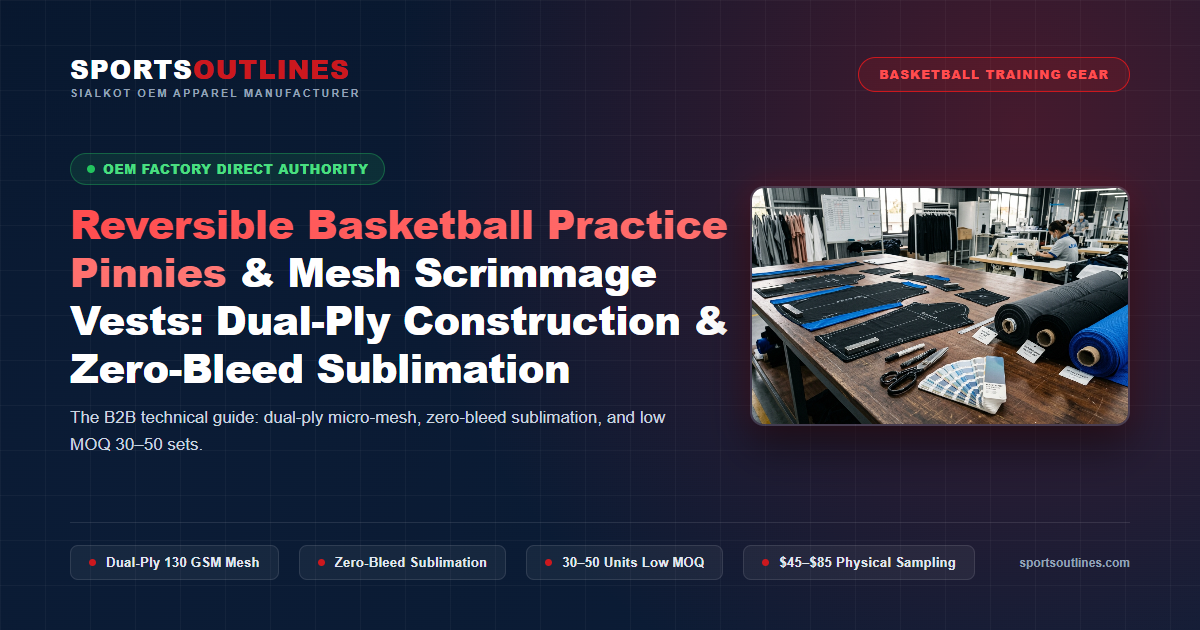
1. Dual-Ply Construction vs Single-Ply Bonded Mesh: Structural Engineering Comparison
The primary engineering decision when designing a reversible basketball pinny is choosing between a true dual-ply two-layer assembly and an engineered single-ply double-faced jacquard knit:
- Dual-Ply Separate Shell Architecture (The Industry Standard): Consists of two completely independent layers of lightweight 120–135 GSM micro-mesh cut from identical pattern markers. The two shells are joined only at the collar band, armhole edges, and optionally along the side seams, leaving the bottom hem unattached (or joined with a bottom waistband binding featuring open hooping access). This allows each ply to move independently, reducing friction against compression base layers and maximizing airflow between layers.
- Single-Ply Double-Faced Jacquard Interlock: A specialized high-tech knitting technique where two different yarn sets are knitted simultaneously on a double-knit machine to create a single-layer fabric (180–210 GSM) featuring one face in White and the reverse in a dyed color. While lighter overall, single-ply fabrics suffer from higher risk of ‘grinning’ (the white yarns showing through the dark side when stretched) and cannot support contrasting complex all-over sublimated graphics on both sides without strike-through dye contamination.
- The Sports Outlines Micro-Pore Dual-Ply Solution: We utilize dual-ply 130 GSM micro-diamond mesh. The cumulative 260 GSM total garment weight is carefully distributed across both layers, ensuring 100% optical opacity while microscopic diamond perforations (0.8 mm diameter) facilitate continuous chimney-effect thermoregulation.
2. Zero-Bleed Dye Sublimation Physics: Ink Penetration Control
The most frequent technical failure in custom reversible basketball uniforms is strike-through dye migration. When a dark colorway (such as Navy Blue or Jet Black) is printed on Layer A, improper heat press calibration causes gaseous disperse dyes to penetrate completely through the fabric fibers, staining the interior and ghosting onto the white or yellow reverse side of Layer B:
- Calender Heat Press Dwell Time & Temperature Precision: At Sports Outlines, disperse dye sublimation is executed on industrial Monti Antonio rotary heat calenders calibrated strictly to 205°C (±1°C) at 4.2 bar hydraulic pressure with an exact 28-second dwell time. This transfers 99.2% of the ink from the transfer paper into the polyester polymer chain without melting filament cross-sections or vaporizing dye beyond the outer face.
- High-Density 90 GSM Barrier Sublimation Paper: We utilize specialized tacky sublimation paper with high clay coating density. The adhesive coating locks fabric fibers during pressing, preventing thermal shrinkage and preventing vaporized ink molecules from diffusing out of the reverse face.
- Independent Panel Sublimation Before Assembly: We NEVER sublimate pre-sewn reversible garments. Each front and back panel for Side 1 (Dark) and Side 2 (Light) is printed, heat-pressed, and cooled as separate cut pattern pieces. They are inspected under 1,000-lux daylight lamps before being sewn together back-to-back in our assembly lines. This guarantees 100% zero dye migration between opposite sides.
3. Collar & Armhole Binding Architecture: Tensile Tear Resistance
During intense collegiate full-court scrimmages, defensive guards grab jerseys during drive-and-kick actions, while forwards yank pinnies in rebounding scrums. The necklines and armholes of reversible pinnies bear the brunt of this mechanical shear stress:
- 25mm Fold-Over Polyester Rib Binding: Rather than cheap self-fabric tape, we knit heavy-duty 220 GSM 1×1 polyester rib bindings. The binding is machine-folded over both layers of mesh simultaneously, encapsulating raw edges within a clean 4-layer sandwich.
- 4-Needle 6-Thread Interlock Stitching: Assembled on automated Yamato flatlock machines, the seam incorporates four needle threads and two looper threads with high-tenacity core-spun poly thread. This produces a flat seam profile that stretches up to 135% without thread snaps.
- Stress-Point Bartack Reinforcement: Triangular bar-tack clusters (42 stitches per bar-tack) are anchored at the lower armhole curves and the intersection of the front and back necklines, preventing seam blowout under sudden shock loads.
4. Bottom Hem Engineering: Individually Finished Drop Hems for Post-Decoration Access
For team dealers, screen printers, and sports apparel brands, a major practical frustration is receiving reversible pinnies where the bottom hems of both layers are sewn together shut. When a decorator attempts to screen print or heat press a player number on the white side, the heat and ink bleed through to the dark side, or the garment cannot be threaded onto a standard embroidery hoop:
- The Sports Outlines Open-Hem Access System: Each layer’s bottom hem is folded inward and hemmed independently with a 20mm double-needle coverstitch. The two layers hang freely at the bottom, joined only at the side seams up to 5.0 cm above the hem.
- Screen Print Hooping Simplicity: Decorators can slide a single layer onto a manual or automatic screen print platen, allowing crisp numbers and sponsor logos to be printed on either side without ink touching the opposing shell.
- Heat Transfer Independence: Direct heat film or CAD-cut vinyl can be applied at 160°C without scorching the reverse sublimation artwork.
5. Embellishment & Numbering Technologies for Scrimmage Pinnies
Depending on your brand’s market positioning and budget, Sports Outlines supports three distinct embellishment methodologies for reversible practice pinnies:
6. Complete Factory Manufacturing Workflow in Sialkot
From vector tech pack confirmation to master carton air dispatch, our Sialkot manufacturing pipeline executes a rigid 7-stage quality-controlled process:
- CAD Digital Pattern Grading (Day 1): Patterns are graded across Youth (YS–YXL) and Adult (AS–A3XL) size curves. Cut markers are calculated to ensure symmetrical matching between Side 1 and Side 2 pattern panels.
- Independent Paper Sublimation Printing (Days 2–3): Inks are transferred onto transfer paper at 1440 DPI resolution. Side 1 and Side 2 graphics are processed on separate print queues with unique color profiles.
- Precision Rotary Heat Calendering (Day 4): Micro-mesh fabric rolls are fed through rotary calender presses at 205°C, bonding dye molecules deep within the polyester filaments.
- Automated Vision Laser Cutting (Day 5): High-speed optical CNC laser tables scan registration marks and cut panels with ±0.2 mm accuracy, heat-sealing edges to prevent fiber fraying.
- Garment Assembly & Rib Binding (Days 6–8): Technicians join front and back shoulder seams, insert dual-layer rib neckline bindings, bind armholes with 4-needle overlock stitching, and independently hem drop bottom hems.
- Reversible Dual-Face Quality Audit (Day 9): Quality controllers check each garment on both sides for dye strike-through, seam tension, sizing tolerances, and label placement.
- Packaging & Global Air Dispatch (Day 10): Garments are steam-pressed, folded to reveal Side 1 front logo, packed in individual frosted polybags, and boxed in heavy corrugated export cartons for DHL/FedEx air freight.
7. B2B Sourcing Economics: Unit Costs, Low MOQ Tiers & Profit Margins
Sports Outlines provides direct factory pricing for custom reversible practice pinnies, enabling teamwear brands, screen printers, and sports clubs to capture healthy 68% to 76% gross profit margins:
Sample Policy Transparency: To inspect the zero-bleed opacity, binding tension, micro-diamond mesh hand-feel, and sizing proportions on actual players before entering volume production, Sports Outlines crafts physical prototype samples for $45 to $85 per piece, delivered via express air courier in 7 to 10 business days. This fee covers individual digital sublimation film generation, single-piece rotary pressing, precision laser cutting, master seamstress labor, and air freight. In alignment with transparent sustainable manufacturing practices, we do not provide speculative free CAD mockups or sample credits against bulk purchase orders.
8. Technical Sizing Spec Sheet: Youth to Adult Grading Matrix
Because reversible pinnies are worn over t-shirts, compression gear, or sports bras during practice, patterns are drafted with generous athletic chest allowances (+6.0 to 8.0 cm ease) and deep armhole drop curves. Measurements in centimeters (tolerance ±1.0 cm):
9. Physical Testing & Quality Control Protocols
To guarantee that reversible pinnies endure the harshest tournament warm-up and practice cycles, our Sialkot quality laboratory subjects every production batch to rigorous testing:
- Snagging Resistance (ASTM D3939 Mace Test): Fabric samples undergo 600 rotations in a mace snagging tester. Our micro-diamond knit must achieve Grade 4.0 or higher with zero pulled loops.
- Colorfastness to Perspiration (ISO 105-E04): Dark-printed panels paired against white panels are soaked in acidic and alkaline artificial sweat solutions at 37°C for 4 hours. No staining onto the white fabric is permitted (Grade 4.5+).
- Tensile Seam Rupture (ASTM D1683): Armhole rib seams are clamped and pulled under pneumatic tension. Seams must resist over 350 Newtons of force before structural failure.
- Accelerated Laundering Wash Test (AATCC 61): Garments endure 10 consecutive commercial wash-and-dry cycles at 60°C to verify zero edge curling, dimensional stability (±2% shrinkage max), and collar retention.
10. Laundry Management & Heavy Salt-Wash Resilience in Athletic Facilities
High-performance basketball teams operate rigorous commercial laundry protocols. Practice pinnies are washed daily in industrial washer-extractors using chlorine-free oxygen bleaches, quaternary ammonium sanitizers, and high-heat tunnel dryers. Flimsy retail-grade practice vests quickly degrade under this punishing regimen:
- Hydrophobic Polyester Micro-Yarn Longevity: Because our 130 GSM micro-diamond mesh is 100% extruded polyester, moisture absorption is under 0.4%. Perspiration minerals, body salts, and skin oils cannot penetrate the internal core of the fibers, releasing completely in standard 40°C warm washes without fiber stiffening.
- Dimensional Shrinkage Control Under Hot Tumble Drying: Many polyester meshes shrink asymmetrically along the warp direction when subjected to 75°C industrial dryers, causing the outer ply to cup or ripple against the inner ply. Sports Outlines heat-sets all greige knit fabrics on computerized stenter frames at 195°C prior to printing. This pre-shrinks the knit matrix, guaranteeing under 1.5% residual shrinkage after 50 commercial laundry cycles.
- Chemical Bleed Lock During Sanitizing Washes: Even under heavy oxygen bleach dosing, our disperse sublimation inks remain thermally locked within the synthetic polymers, preventing dye molecules from leaching into the rinse water and staining the white reverse side.
11. Sublimation Vector Artwork Prep & Symmetrical Alignment Guide
Creating production-ready artwork files for dual-ply reversible teamwear requires precise graphic design practices to avoid misalignment between sides:
- Symmetrical Vector Outlines: Adobe Illustrator (.AI) or vector PDF files must provide separate artboards for Side 1 (Dark) and Side 2 (Light). All crests, numbers, and chest wordmarks should be built with identical center-chest vertical anchor points so that chest graphics sit at identical heights when the jersey is flipped inside out.
- Pantone Solid Coated (PMS) Matching: Every custom colorway must reference standard Pantone PMS codes. Our digital RIP color management software utilizes custom spectrophotometer ICC profiles calibrated to our 130 GSM micro-mesh, achieving an exact color delta under ΔE 1.2 across both plies.
- Bleed Margins for Optical Laser Cutting: Sublimation transfer graphics include 15mm external bleed margins past the pattern cut line. This ensures that when our automated vision laser tables cut curved armhole and collar edges, no white unprinted fabric halos appear on the perimeter of dark-colored shells.
Explore Related Sialkot Factory Manufacturing Silos:
- Custom Basketball Uniforms Manufacturing Guide — Reversible mesh & dazzle game uniforms.
- Custom Basketball Shorts Manufacturing Guide — Pro mesh, dazzle linings, and 9-inch athletic inseams.
- Tackle Twill Basketball Jerseys Guide — Heavy zig-zag embroidery for varsity programs.
- Sportswear Fabric GSM Selection Guide — Choosing 130 GSM mesh vs 160 GSM interlock.
- Contact Sports Outlines Factory — Request a wholesale quote or order a physical sample.
Ready to Manufacture Custom Reversible Basketball Practice Pinnies?
Partner directly with Sialkot’s specialized teamwear factory. Enjoy low MOQ of 30–50 reversible units, zero-bleed dye sublimation, open-hem hooping access, and rapid 7–10 day physical sampling.
Frequently Asked Questions: Sourcing Custom Reversible Practice Pinnies
How do you prevent dark sublimation ink from bleeding onto the white reverse side?
We sublimate each fabric panel as separate, unsewn cut pieces using high-density 90 GSM barrier paper and rotary calender presses at 205°C. The two completed layers are only sewn together after printing and inspection, guaranteeing 100% zero dye bleed.
What is the factory minimum order quantity (MOQ) for reversible pinnies?
Our factory direct low MOQ is 30 to 50 reversible units per style/colorway across mixed Youth and Adult sizing breakdowns.
How much does a physical sample prototype cost and what is the turnaround time?
A physical prototype sample costs between $45 and $85, completed in 7 to 10 business days for complete physical evaluation of fabric hand feel, binding strength, and zero-bleed opacity.
Are the bottom hems sewn together or left open for hooping access?
We finish each layer’s bottom hem individually with double-needle coverstitching. The layers hang freely at the bottom, allowing screen printers and embroiderers easy hooping access.
What fabric weight is recommended for basketball scrimmage pinnies?
We recommend dual-ply 130 GSM micro-diamond mesh. The cumulative 260 GSM garment weight provides full opacity, snag resistance, and high ventilation without excessive thermal load.
Can we put completely different designs and sponsor logos on each side?
Yes, 100%. Because both plies are printed independently prior to assembly, you can feature completely different colors, team names, sponsor logos, and player numbers on Side 1 and Side 2 at no extra charge.
Do you manufacture matching reversible basketball shorts as well?
Yes. We manufacture matching dual-ply reversible basketball shorts with 2-inch multi-needle elastic waistbands, interior drawstrings, and graded 7-inch to 9-inch inseams.
How durable are the armhole bindings against physical grabbing in drills?
Our 25mm polyester rib bindings are sewn with 4-needle 6-thread flatlock stitching and reinforced with triangular bar-tacks, tested to withstand over 350 Newtons of tensile pulling force.