Direct Manufacturer Answer: How to Manufacture Custom Field Hockey Goalkeeper Smocks
Manufacturing professional custom field hockey goalkeeper smocks requires specialized pattern drafting that accounts for the massive dimensional bulk of rigid composite chest protectors, high-density foam shoulder caps, and articulating plastic elbow guards. Unlike outfield player jerseys, goalkeeper smocks are engineered with an oversized 3D ergonomic silhouette featuring +10 to +14 cm chest ease and expanded raglan sleeve circumference to ensure zero binding across the chest plate during explosive diving saves. The outer shell is built from a heavy-duty 175 to 190 GSM abrasion-resistant micro-interlock or reinforced tear-resistant warp-knit polyester treated to withstand repetitive high-speed friction burns against watered artificial turf pitches without melting, ripping, or fraying. To comply fully with International Hockey Federation (FIH) Tournament Regulations, goalkeeper smocks must feature high-visibility colors that strictly contrast with both the field players of both teams and the opposing goalkeeper, complete with minimum 20 cm contrasting back numerals and 7 to 10 cm front center numbers. Factory direct low MOQ at our Sialkot manufacturing plant starts at 30 to 50 pieces per style/design with mixed sizing curves from Youth YM to Adult 3XL. Pre-production physical prototype samples are delivered for $45 to $85 per custom smock within 7 to 10 business days.
- Armor Clearance Fit: Patterned with +12 cm chest ease, extra-wide bicep openings, and lowered armholes to slip over rigid chest armor.
- Textile Engineering: 180 GSM Heavy-Gauge Polyester Interlock (tested to 50,000+ Martindale cycles against turf friction).
- FIH Contrast Compliance: High-chroma fluorescent and primary palettes engineered to contrast clearly against both teams’ kits.
- Sleeve & Wrist Architecture: Full-length or 3/4 sleeves with elasticized 30 mm cuffs that sit securely above goalie hand protectors.
- Seam Reinforcement: 5-thread safety overlock stitching with bartacked 7 cm side splits to allow full leg-kicker flexibility.
- Factory Low MOQ: 30–50 pieces per teamwear order with customized youth and adult size grading.
- Physical Prototype Sampling: $45–$85 per custom piece in 7–10 days (strict zero credit/refund policy).
- Direct Sourcing Communication: WhatsApp factory direct at +92 316 7932595 or sportsoutlines.com.
In modern field hockey, the goalkeeper stands as the ultimate defensive barrier against solid polyurethane composite balls traveling at velocities exceeding 140 kilometers per hour. To survive point-blank drag-flicks, sliding split saves, and chaotic penalty corner scuffles, keepers wear an extensive exoskeleton of protective gear: molded body armors, plastic elbow protectors, high-density foam kickers, and massive composite hand gauntlets.
The goalkeeper smock is the outer skin that encapsulates this entire protective armor system. When clubs attempt to order generic oversized football or outfield hockey jerseys for their keepers, catastrophic fit failures occur: sleeves bunch painfully around elbow pads, tight shoulder seams restrict arm raising when glove-stopping high aerial shots, and thin 140 GSM fabrics rip open after a single diving save across abrasive synthetic turf pitches.
For club equipment directors, national federation kit managers, school sports masters, and private label hockey brands across the UK, the Netherlands, Germany, Australia, New Zealand, the USA, and Canada, sourcing legitimate, professionally engineered field hockey goalkeeper smocks requires deep manufacturing expertise.
At Sports Outlines in Sialkot, Pakistan, our dedicated athletic apparel tailoring workshop manufactures specialized goalkeeper smocks for premier league clubs, university varsity programs, and boutique sportswear labels worldwide. This comprehensive B2B technical guide explains body-armor ease calculations, 180 GSM tear-resistant textile engineering, International Hockey Federation (FIH) tournament contrast regulations, seam construction, size grading matrices, and low factory MOQ economics.
1. Biomechanical Pattern Drafting: The Armor Clearance Equation
A field hockey goalkeeper body armor features dense closed-cell EVA foam and hard polyurethane chest plates that add 5.0 to 7.0 cm of rigid forward depth to the torso. Standard outfield jerseys drafted for human body measurements will pull taut against the breastplate, flattening the neckhole against the throat and choking the keeper whenever they drop into a low readiness crouch:
Chest Circumference Ease (+10 cm to +14 cm)
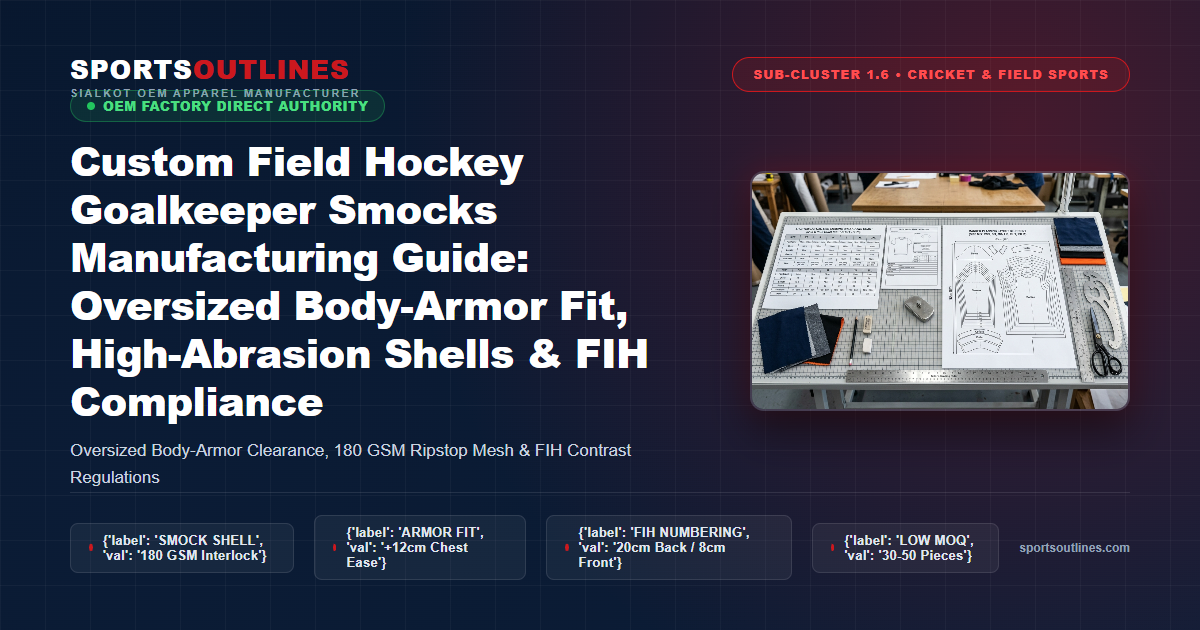
In our CAD pattern grading, goalkeeper smocks are engineered with an intentional +10.0 cm to +14.0 cm chest circumference ease compared to standard outfield jerseys of the same labeled size. For example, while an Adult Large outfield hockey smock features a half-chest measurement of 49.5 cm, an Adult Large Goalkeeper Smock is drafted at 62.0 cm (+12.5 cm half-width ease). This dimensional buffer allows the garment to drape smoothly over rigid chest protectors without creating tension across the back yoke.
Deep Armhole & Raglan Sleeve Angle
Set-in sleeves with standard vertical armhole seams fail on goalkeepers because the rigid shoulder caps of the chest armor force the seam upward, cutting painfully into the axillary armpit fold. We draft our goalie smocks with a modified deep raglan sleeve pattern angled at 55 degrees from the neckline down to the lower ribcage. This eliminates upper shoulder seams entirely, allowing the fabric to glide smoothly across the rounded contours of external shoulder caps as the goalkeeper extends their arms overhead to tip drag-flicks over the crossbar.
Wrist Cuff Architecture for Hand Gauntlet Clearance
Field hockey goalkeepers wear specialized foam hand protectors: a rectangular blocking gauntlet on the left hand and a contoured stick-gripping gauntlet on the right hand. Loose, floppy sleeve cuffs will bunch inside the gauntlets or snag on wrist straps. We offer two specialized cuff solutions:
- 30 mm Elasticized Low-Profile Cuffs: Features an enclosed high-tension elastic core that hugs the forearm securely above the wrist joint, preventing sleeves from sliding down over the gloves.
- 3/4 Anatomical Sleeve Length: Cuts the sleeve precisely at the mid-forearm (8.0 cm above the styloid wrist bone), completely eliminating any bulk around the glove interface.
2. Textile Engineering: 180 GSM Heavy Interlock vs. Outfield Meshes
Outfield hockey tops prioritize extreme breathability and featherweight hand-feel (150–160 GSM). However, on a goalkeeper, this lightweight fabric is an operational liability:
The High-Density 180 GSM Micro-Interlock Solution
We manufacture our custom field hockey goalkeeper smocks from 180 to 190 GSM heavy-gauge double-knit interlock polyester. By utilizing a double-knit circular knitting structure with 75D/72F micro-filaments, the textile achieves an ultra-dense, tight surface lattice:
- Turf Friction Resistance: Tested to 50,000+ Martindale abrasion cycles (ISO 12947-2). When a keeper slides 3 meters across artificial turf to smother a breakaway, the heat generated by ground friction is dispersed without burning through the yarns.
- Snag & Tear Resistance: Outfield open-hole mesh easily catches on rough hook-and-loop Velcro straps found on chest protectors and leg guards. Our smooth-faced interlock weave eliminates open yarn loops, preventing snagging and thread pulls.
- Complete Opacity Over Black Armors: Most commercial protective body armors are molded from charcoal black or dark grey EVA foam. Our 180 GSM heavyweight interlock delivers 100% optical opacity, preventing dark armor pads from casting ugly shadows beneath vibrant fluorescent team jerseys.
3. International Hockey Federation (FIH) Contrast & Numbering Rules
Field hockey has the strictest goalkeeper uniform regulations in international team sport. Under FIH Rule 4.3 (Goalkeeper Uniforms), a goalkeeper MUST wear a shirt that:
- Color-contrasts distinctly with the shirt of their own outfield players.
- Color-contrasts distinctly with the shirt of the opposing outfield players.
- Color-contrasts distinctly with the shirt of the opposing goalkeeper.
The Dual-Smock Requirement
Because of these three-way contrast requirements, competitive hockey clubs cannot operate with a single goalkeeper jersey. Every goalkeeper must possess at least two contrasting smocks (typically one high-visibility fluorescent tone like neon orange, safety yellow, or electric pink, and one deep primary tone like royal blue, rich purple, or forest green). In our factory ordering protocol, we allow clubs to split their 30–50 piece MOQ across multiple goalkeeper colorways sharing the identical vector design pattern.
FIH Numbering & Identification Specifications
FIH regulations mandate clear numerical visibility from the technical official’s table and broadcast cameras:
- Back Number: Centered back numeral must measure between 16.0 cm and 20.0 cm in vertical height, with a stroke width of at least 3.0 cm.
- Front Center Number: Unlike outfielders who can place numbers on the right chest, goalkeepers MUST display a prominent number measuring between 7.0 cm and 10.0 cm centered directly on the front chest, ensuring identification when standing face-forward in the cage.
- High-Contrast Borders: All numbers printed onto multi-colored or sublimated graphic smocks must feature a bold 4.0 mm contrasting outline border (e.g., white numeral with black outer stroke).
4. Seam Engineering & Reinforcement Construction
The intense pulling and ground drag experienced by goalkeeper smocks rapidly unravels cheap commercial single-needle stitching. In our Sialkot manufacturing facility, we implement aerospace-grade teamwear seam specifications:
- 5-Thread Heavy Safety Overlock: All primary side seams, sleeve insets, and shoulder raglans are assembled with 5-thread high-tensile safety overlock stitching rated to 320 N breaking force. This combines a structural chainstitch with an overedge wrap to eliminate seam bursting under load.
- Bartacked Side Hem Splits: The 7.5 cm lateral hem splits are reinforced at the top vertex with a 42-stitch high-density triangular bar-tack, preventing tearing when the smock is snagged on leg pads during splits.
- Reinforced Ribbed Neckband: The 25 mm circular neckband is knitted with double-ply poly-elastane yarn and joined with twin-needle topstitching over an internal twill neck tape, preventing neckline stretching after hundreds of dressings over bulky helmets.
5. Standard Points of Measure (POM) & Goalkeeper Size Matrix
Our standardized Points of Measure (POM) chart accounts for the physical volume of chest protectors across junior development leagues up to elite senior professional divisions:
6. Laboratory Quality Standards & Artificial Turf Durability Testing
Every production run of custom goalkeeper smocks undergoes strict laboratory validation to certify mechanical resilience against high-friction sliding impacts on synthetic hockey turf pitches:
7. B2B Sourcing Economics: Unit Costs, Sampling Rules & Low Factory MOQ
Because field hockey clubs typically only need 2 to 4 goalkeeper jerseys per team, big athletic brands force clubs to buy stock plain jerseys with generic heat-pressed numbers. At Sports Outlines, we allow clubs and teamwear distributors to combine goalkeeper smocks with their outfield kit orders or order them standalone starting at just 30 to 50 pieces per style with split colorways and sizing:
Physical Prototype Sampling Policy: $45–$85 in 7–10 Business Days
Before cutting full club or brand production lots, we produce an individual physical pre-production sample smock for hands-on evaluation over the goalkeeper’s actual body armor. Physical prototype samples cost $45 to $85 per custom piece. This fee covers specialized oversized CAD pattern engineering, high-definition digital dye sublimation paper printing, calendar heat press transfer, 5-thread safety stitching, and lab quality audits over a 7 to 10 business day timeline. We enforce a firm zero-refund and zero-credit policy on all sampling fees. Once tested and approved over the armor, the physical prototype serves as the master production standard.
Pre-Shipment Packaging & Protective Master Carton Packing
Following final inspection under high-intensity optical light tables, every goalkeeper smock is conditioned through an industrial steam tunnel at 140°C. Smocks are folded over moisture-absorbing tissue inserts, tagged with custom branded recycled swing tags and EAN-13 barcodes, and heat-sealed in individual 40-micron recyclable frosted zip polybags. Team batches are packed into 5-ply export master cartons with silica gel packs to prevent moisture condensation during air-cargo transit to the UK, Australia, Europe, and North America.
Manufacture Custom Field Hockey Goalkeeper Smocks
Equip your field hockey club, school, or sportswear brand with heavy-duty goalkeeper smocks engineered in Sialkot. Engineered with +12 cm body-armor ease, 180 GSM tear-resistant interlock, and full FIH tournament contrast compliance. Low MOQ of 30–50 pieces and 7–10 days physical sampling.
8. Frequently Asked Questions (FAQ) — Custom Goalkeeper Smocks Manufacturing
1. Why can’t a goalkeeper just wear a larger size of the standard outfield jersey?
Standard outfield jerseys are graded proportionally; a larger size becomes excessively long and baggy in the sleeves while remaining too narrow in the chest and armholes for rigid chest armor and elbow pads. Dedicated goalie smocks feature specialized dimensional ease (+12 cm chest ease, wide biceps) while maintaining proper length.
2. What are the official FIH regulations for field hockey goalkeeper smocks?
FIH Rule 4.3 mandates that a goalkeeper must wear a shirt that contrasts in color with both their own team, the opposing outfield players, and the opposing goalkeeper. Smocks must have 16–20 cm back numerals and 7–10 cm front chest numerals.
3. Why is 180 GSM heavyweight interlock better than open mesh for goalkeeper smocks?
Open mesh easily catches on rough Velcro armor straps and tears during turf slide tackles. 180 GSM double-knit interlock provides superior turf friction resistance (50,000+ Martindale cycles) and complete opacity over dark black chest protectors.
4. How do you prevent smock sleeves from interfering with goalkeeper gloves?
We engineer low-profile 30 mm elasticized cuffs that sit securely above the wrist bone, or produce 3/4-length sleeves that end at the mid-forearm, preventing fabric bunching inside hand gauntlets.
5. What is the minimum order quantity (MOQ) for custom goalkeeper smocks?
Our factory direct low MOQ is 30 to 50 pieces per style. You can split this volume across multiple goalkeeper colorways (e.g., neon orange and electric blue) and sizes to equip multiple club squads.
6. How much does a physical sample prototype cost, and what is the turnaround time?
A physical custom prototype sample costs $45 to $85 per smock. Manufacturing turnaround is 7 to 10 business days for oversized CAD patterning, sublimation printing, and 5-thread assembly, followed by 4 to 6 business days for air delivery.
7. Can we include custom numbers and goalkeeper player names without extra fees?
Yes. Through digital dye-sublimation printing, individual player names, squad numbers, and sponsor logos are infused directly into the fabric at zero extra cost.
8. Why are side split hems necessary on goalkeeper smocks?
Side split hems (7.5 cm height with bar-tacks) prevent the lower hem of the smock from riding up or catching on padded goalie shorts when performing full lateral split saves.
9. Does the collar easily stretch to pull over protective throat guards?
Yes. We engineer an expanded 22.5 cm elasticized ribbed collar that stretches easily over throat collars and neck guards without tearing or losing shape memory.
10. Can you manufacture matching padded goalkeeper shorts and kicker covers?
Yes. In addition to smocks, our factory manufactures sublimated nylon outer covers for goalkeeper padded shorts and heavy-duty kicker covers with reinforced strapping.
Explore Related Field Sports & Teamwear Manufacturing Guides:
Complete your club kit program with our factory guides on Custom Field Hockey Uniforms, Custom Cricket Whites, Custom Cricket Sweaters, or browse our Full Sportswear Catalog.