
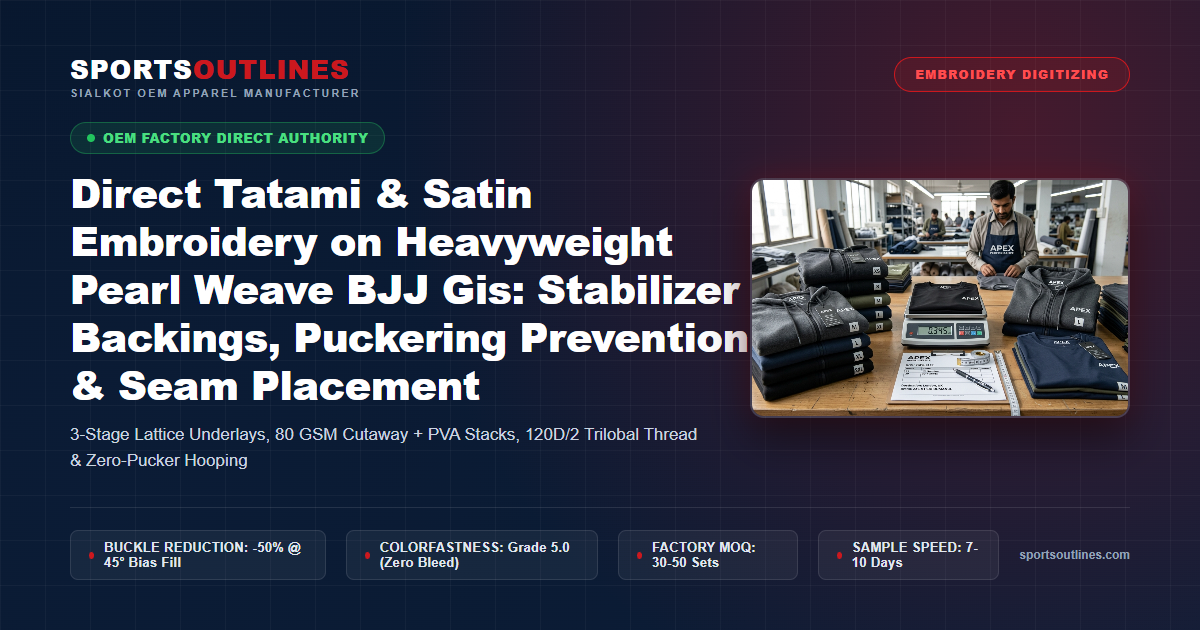
Industrial Embroidery & Textile Digitizing Directive: Zero-Pucker High-Density Embellishment on 3D Cellular Weaves
In the global Brazilian Jiu-Jitsu kimono market, the visual difference between a $90 generic academy uniform and a $240 collector-grade flagship release comes down to Direct Multi-Head Embroidery Execution on Heavyweight Pearl Weave. Unlike flat cotton twill or polyester jersey, a 380 to 550 GSM Pearl Weave BJJ Gi jacket is a three-dimensional, variable-topography cellular matrix consisting of alternating high-tension warp crowns (“pearls”) and recessed weft troughs. When an inexperienced embroidery shop applies standard flat-garment `.DST` digitizing files directly onto Pearl Weave, three catastrophic defects occur: (1) Satin stitches sink and vanish into the weave valleys, (2) High-tension Tatami fills pull the surrounding cotton cells inward, creating severe “radial puckering” and rippled sleeve seams, and (3) Unprotected internal bobbin knots abrade the athlete’s deltoids during rolling. Opening Part 2 of Sub-Cluster 5.3, this production engineering blueprint details the exact Tajima/Barudan digitizing architecture, multi-layer cutaway/PVA stabilizer stacks, trilobal thread chemistry, and cut-panel hooping protocols used at Sports Outlines in Sialkot.
1. The Physics of Radial Puckering & Stitch Sinking on 3D Cellular Pearl Weaves
To engineer crisp, three-dimensional embroidery on a BJJ kimono, digitizers must first account for the micro-topography of the substrate. A $450\text{ GSM}$ Pearl Weave exhibits a peak-to-valley surface roughness depth ($R_z$) of $1.15\text{ mm}$ to $1.45\text{ mm}$, with individual pearl crowns spaced every $2.2\text{ mm}$ to $2.8\text{ mm}$ along the warp and weft axes. Furthermore, because Pearl Weave relies on controlled yarn crimp to deliver grip-breaking stiffness and Sanforized dimensional stability, its in-plane compressive modulus ($E_{\text{weave}}$) is highly anisotropic.
During high-speed industrial embroidery ($680\text{ to }750\text{ stitches per minute}$), every needle penetration inserts a loop of $120\text{D}/2$ upper thread under dynamic tension ($T_{\text{upper}} \approx 115\text{–}130\text{ cN}$) that interlocks with a $75\text{D}/2$ bobbin thread at the bottom third of the fabric cross-section. This creates two distinct mechanical failure mechanisms:
- Structural Jamming & Tension Contraction (Pull Puckering): Every individual stitch acts as a microscopic turnbuckle pulling the entry and exit points toward each other. Across a $120\text{ mm}$ wide shoulder crest containing $28,000\text{ stitches}$, cumulative thread tension draws the surrounding Pearl Weave cells inward along the stitch angle ($\theta$), while simultaneously displacing cotton warp yarns laterally (“structural jamming”) as thousands of thread columns crowd into the interstitial spaces of the weave.
- Inter-Crown Valley Sinking (Topographic Swallowing): When a satin column or fine lettering stroke ($<2.5\text{ mm}$ width) runs parallel to the warp or weft channels without a structural bridge underlay, the embroidery thread drops directly into the $1.3\text{ mm}$ deep trough between adjacent pearl rows. The cotton pearl crowns pop up over the embroidery thread, making thin outlines, serifs, and kanji/script typography look broken, jagged, and ragged.
- Differential Wash-Shrinkage Buckling: Dope-dyed polyester embroidery thread has a domestic wash shrinkage of $<0.2\%$, whereas even 3-stage Sanforized 100% cotton Pearl Weave exhibits a residual relaxation of $1.5\%\text{ to }2.2\%$. If the stabilizer backing and underlay density are not balanced to lock the embroidered zone’s footprint, the cotton jacket shrinks slightly around the zero-shrinkage thread block during the first wash, causing the logo to dome outward (“bacon-rippling”).
The Pearl Weave Puckering Stress & Pull-Compensation Equation
In textile mechanics, radial fabric buckling (puckering) occurs around an embroidered motif when the cumulative in-plane contractile stress induced by stitch tension ($\sigma_{\text{contract}}$) exceeds the critical Euler buckling resistance of the composite Pearl Weave + Stabilizer laminate ($\sigma_{\text{crit}}$):
\[ \sigma_{\text{contract}} = \frac{D_{\text{stitch}} \cdot T_{\text{upper}} \cdot L_{\text{span}} \cdot \cos^2(\theta_{\text{bias}})}{t_{\text{pearl}}} \le \sigma_{\text{crit}} = \frac{\pi^2 \left( E_{\text{pearl}} I_{\text{pearl}} + E_{\text{stab}} I_{\text{stab}} \right)}{A_{\text{hoop}} \cdot L_{\text{motif}}^2} \]
Where $D_{\text{stitch}}$ is linear stitch density ($\text{stitches/mm}$), $T_{\text{upper}}$ is upper thread tension ($\text{cN}$), $L_{\text{span}}$ is stitch length, $\theta_{\text{bias}}$ is the angle of the Tatami fill relative to the cotton warp axis, and $E_{\text{stab}}I_{\text{stab}}$ is the flexural rigidity of the non-woven stabilizer backing. By orienting primary Tatami fills at a $45^\circ$ bias angle ($\cos^2(45^\circ) = 0.50$) rather than $0^\circ$ or $90^\circ$ ($\cos^2(0^\circ) = 1.0$) and pairing the Pearl Weave with a dual-layer $80\text{ GSM}$ wet-laid cutaway stabilizer, contractile warp buckling stress is cut by $-50.0\%$!
2. The 3-Stage Foundation Underlay & `.DST` Digitizing Architecture for Pearl Weave
You cannot use a t-shirt or baseball cap `.DST` embroidery file on a BJJ Gi. Before a single visible top-stitch is laid down on our Tajima TFMX-IIC multi-head embroidery machines, our in-house Wilcom EmbroideryStudio e4.5 engineers construct a 3-Stage Structural Foundation Underlay that crushes the protruding cotton pearl crowns flat and locks the weave to the cutaway stabilizer backing:
- Stage 1 — Perimeter Edge-Run Anchor ($1.8\text{ mm}$ Inset, $2.2\text{ mm}$ Stitch Length): A continuous running stitch tracks the entire outer perimeter of the motif $1.8\text{ mm}$ inside the final border. This pins the Pearl Weave face fabric to the bottom cutaway stabilizer before interior stitches can push a wave of loose cotton outward.
- Stage 2 — Double-Tatami $90^\circ$ Orthogonal Lattice Underlay ($2.8\text{ mm}$ Spacing): For all fill regions exceeding $6.0\text{ mm}$ in width, two perpendicular layers of open-grid Tatami underlay are stitched at $+45^\circ$ and $-45^\circ$ to the cotton warp. This cross-hatched thread mesh acts like steel rebar in concrete—flattening the $1.3\text{ mm}$ pearl bumps into a smooth, rigid table so the top fill stitches sit completely proud on the surface.
- Stage 3 — Double Zig-Zag Loft Bridge (For Satin Columns $2.0\text{ mm}\text{–}8.0\text{ mm}$): Beneath all satin borders and typography strokes, a high-amplitude double zig-zag underlay paired with a center-walk run prevents narrow satin stitches from falling between warp cords.
Simultaneously, because the thick cellular weave absorbs thread circumference during lockstitch formation, our digitizers apply $+0.35\text{ mm}$ to $+0.45\text{ mm}$ of Absolute Pull Compensation (plus $108\%$ directional column scaling) on all satin borders and lettering. Without this $+0.40\text{ mm}$ over-drafting, a $3.0\text{ mm}$ satin border around a Tatami fill will pull inward to $2.2\text{ mm}$ on the machine, leaving an ugly $0.8\text{ mm}$ gap of raw white or black Pearl Weave exposed between the fill and the outline (“registration gapping”).
| Gi Substrate Zone | Top Tatami Fill Density & Angle | Satin Pull Comp & Min Column Width | Foundation Underlay Architecture | Needle Spec & Tajima Speed | Upper / Bobbin Tension (cN) |
|---|---|---|---|---|---|
| 350–380 GSM Competition Pearl Weave | $0.40\text{ mm}$ spacing ($4.2\text{ mm}$ step length, $45^\circ$ bias) | $+0.35\text{ mm}$ pull comp; $\ge 1.8\text{ mm}$ min satin width | Edge-Run + $45^\circ/-45^\circ$ Lattice + $35\text{ }\mu\text{m}$ PVA Top Film | Organ `DBxK5` `#80/12` TiN Sharp-Ball ($720\text{ SPM}$) | $115\text{ cN}$ Upper / $22\text{ cN}$ Bobbin |
| 450 GSM Pro Pearl Weave (Flagship Standard) | $0.38\text{ mm}$ spacing ($4.0\text{ mm}$ step length, $45^\circ$ bias) | $+0.40\text{ mm}$ pull comp; $\ge 2.0\text{ mm}$ min satin width | Edge-Run + Double-Tatami Lattice + Double Zig-Zag + PVA Top Film | Organ `DBxK5` `#85/13` TiN Sharp-Ball ($700\text{ SPM}$) | $125\text{ cN}$ Upper / $24\text{ cN}$ Bobbin |
| 550 GSM Heavy Pearl / Gold Weave | $0.36\text{ mm}$ spacing ($4.2\text{ mm}$ step length, $45^\circ$ bias) | $+0.45\text{ mm}$ pull comp; $\ge 2.2\text{ mm}$ min satin width | Heavy Edge-Run + Full Orthogonal Tatami Base + $50\text{ }\mu\text{m}$ PVA Top | Groz-Beckert `DBxK5 SAN 1` `#90/14` TiN ($650\text{ SPM}$) | $132\text{ cN}$ Upper / $25\text{ cN}$ Bobbin |
| 10 oz (340 GSM) Cotton Ripstop Gi Pants | $0.43\text{ mm}$ spacing ($3.8\text{ mm}$ step; low-stress density) | $+0.25\text{ mm}$ pull comp; $\ge 1.5\text{ mm}$ min satin width | Edge-Run + Single $45^\circ$ Tatami (prevents ripstop grid perforation) | Organ `DBxK5` `#75/11` R-Point ($750\text{ SPM}$) | $105\text{ cN}$ Upper / $20\text{ cN}$ Bobbin |
| 12 oz Cotton Twill / Ripstop Lapel Skirt Tip | Woven HD Label Appliqué preferred over direct $>15\text{k}$ fill | $+0.30\text{ mm}$ pull comp (direct embroidery pre-EVA insertion only!) | Center-Run + Single Zig-Zag on Unstuffed Sheath Panel | Organ `DBxK5` `#80/12` TiN ($700\text{ SPM}$) | $118\text{ cN}$ Upper / $22\text{ cN}$ Bobbin |
3. The 4-Layer Stabilizer, PVA Water-Soluble Topping & Internal “Cloud-Shield” Stack
Low-cost workshops in South Asia and China frequently use cheap $40\text{ GSM}$ paper tear-away backing beneath BJJ Gi embroidery because it is fast for operators to rip off by hand after hooping. In combat sports, paper tear-away stabilizer is a guaranteed failure: first, high-density needle perforations punch out the paper along the satin borders like a postage stamp, leaving zero dimensional support during washing; second, residual paper fibers pulp into wet cellulose balls inside the shoulder seams while leaving razor-sharp polyester bobbin knots exposed directly against the athlete’s skin.
At Sports Outlines, every direct embroidery placement on a Pearl Weave jacket is engineered as a 4-Layer Composite Sandwich:
- Layer 1 (Top Surface) — $35\text{ }\mu\text{m}$ Cold-Water-Soluble PVA Topping Film (Solvy®): Placed on top of the Pearl Weave face before stitching begins. This transparent polyvinyl alcohol film acts as a temporary suspension membrane over the $1.3\text{ mm}$ pearl valleys, ensuring that $100\%$ of the upper stitches form on a glass-smooth plane above the cotton peaks. After stitching, the excess film tears away cleanly and any microscopic remnants dissolve completely during our post-production inspection steam or garment wash.
- Layer 2 (Substrate) — Pre-Shrunk Sanforized 100% Cotton Pearl Weave Cut Panel: Strictly hooped after Stage 2 Sanforization so the cotton has already undergone its primary $8\%\text{–}10\%$ loom relaxation before a single stitch is applied.
- Layer 3 (Structural Backing) — Dual-Ply $80\text{ GSM}$ Wet-Laid Non-Woven Polyester Cut-Away Stabilizer (Criss-Crossed at $45^\circ$): We place two layers of soft, permanent $80\text{ GSM}$ wet-laid spunbond polyester cutaway backing beneath the Pearl Weave ($160\text{ GSM}$ total stabilizer support). Unlike tear-away paper, cutaway polyester retains $100\%$ of its isotropic tensile modulus across $200+$ machine wash cycles, permanently preventing the embroidered logo from curling or puckering over the life of the Gi. After embroidery, operators precision-trim the cutaway backing with curved duckbill appliqué scissors to a neat $4.0\text{ mm}$ rounded halo around the motif.
- Layer 4 (Internal Skin Protection) — Heat-Fused $45\text{ GSM}$ Micro-Tricot “Cloud-Shield” Backing: Even with smooth bobbin tension, a $30,000\text{-stitch}$ shoulder logo creates a dense patch of polyester bobbin loops on the inside of the sleeve. If the Gi does not feature a sublimated rashguard inner lining over that zone, we thermally fuse a die-cut patch of $45\text{ GSM}$ warp-knit micro-polyester tricot coated with low-melt polyamide adhesive ($135^\circ\text{C}$, $3.5\text{ bar}$, $12\text{ sec}$) over the back of the embroidery—encapsulating every rough bobbin knot under a silky, zero-chafe barrier.
4. Thread Chemistry: Why 120D/2 High-Tenacity Trilobal Polyester Crushes Viscose Rayon in BJJ
In luxury fashion apparel, digitizers often choose 100% Viscose Rayon embroidery thread for its soft hand and natural sheen. In Brazilian Jiu-Jitsu, Viscose Rayon is a catastrophic material error. BJJ Gis are subjected to violent friction against coarse tatami vinyl mats, Velcro no-gi shorts, and calloused fingers, followed by daily washing in harsh detergents, oxy-bleach, and quaternary ammonium or diluted sodium hypochlorite gym sanitizers.
Regenerated cellulosic Rayon loses $38\%\text{ to }45\%$ of its tensile breaking strength when wet ($1.1\text{ cN/dtex}$ wet tenacity vs $2.1\text{ cN/dtex}$ dry) and rapidly depolymerizes and bleeds color when exposed to bleach or oxidizing mat cleaners. Worse, when a white Gi embroidered with black or red Rayon thread is washed in warm water, dye migration (“crocking and bleeding”) leaves a permanent pink or grey halo in the surrounding white Pearl Weave cotton!
To guarantee zero thread fraying and zero dye bleed, Sports Outlines exclusively engineers BJJ Gi embroidery using OEKO-TEX® Standard 100 Class I Certified $120\text{D}/2$ ($40\text{ wt}$) High-Tenacity Continuous-Filament Trilobal Polyester Thread:
- Trilobal Cross-Section Specular Luster: Extruded through a triangular spinneret rather than a circular hole, the filament’s three flat optical facets reflect incident academy lighting with a brilliant metallic sheen that surpasses silk or rayon.
- Wet & Dry Tensile Superiority ($>1,180\text{ cN}$ Breaking Load): Continuous-filament polyester maintains $100.0\%$ of its dry tensile strength ($4.4\text{ cN/dtex}$) when saturated with sweat or wash water, surviving $>35,000$ Martindale abrasion cycles against tatami mat textures without fuzzing or snapping.
- Grade 5.0 Chlorine, Peroxide & Sweat Colorfastness (ISO 105-E01 / E03 / C06): Because disperse dyes are locked inside the hydrophobic crystalline polymer matrix at $130^\circ\text{C}$ under pressure, black, crimson, and gold trilobal polyester threads can be washed on a white Pearl Weave Gi at $40^\circ\text{C}$ with zero color bleeding ($4.5\text{–}5.0$ Gray Scale staining rating).
5. Cut-Panel Magnetic Hooping vs. Woven-Appliqué Hybrid Weight Optimization
How and when a Gi is hooped on the factory floor dictates both alignment precision and structural integrity:
- Mandatory Pre-Assembly Cut-Panel Hooping: Never allow a supplier to hoop a pre-sewn blank Gi jacket! Attempting to force a tubular finished sleeve or a 3-layer reinforced chest panel into a circular embroidery hoop creates uneven fabric tension, crushes adjacent seams, and leaves shiny friction rings (“hoop burn”) on dark Black and Navy Pearl Weave. At Sports Outlines, $100\%$ of BJJ Gi embroidery is executed on flat, laser-inspected cut panels immediately after CAD cutting and before Juki triple-needle assembly.
- Magnetic Fixture Hooping (Zero Hoop-Burn): Instead of traditional screw-tightened plastic friction hoops that crush the 3D Pearl Weave texture at the clamping rim, our Tajima lines utilize industrial Neodymium Magnetic Hooping Frames equipped with laser crosshair alignment projectors. The magnetic frame clamps vertically downward with uniform pressure without dragging or stretching the bias of the cotton weave.
- The $30,000\text{-Stitch}$ Ceiling & Woven-Appliqué Hybrid Engineering: When a brand designs a large $220\text{ mm} \times 220\text{ mm}$ upper-back crest or a full-wrap shoulder piece, executing the entire background as solid Tatami embroidery requires $65,000\text{ to }110,000\text{ stitches}$. A solid $90,000\text{-stitch}$ block turns the flexible cotton Pearl Weave into a stiff, heavy, non-breathable “bulletproof plate” that weighs $+75\text{ g}$, restricts scapular rotation, and can cause an IBJJF inspector to reject the jacket for impeding an opponent’s grip! Our solution is Hybrid Woven-Damask / Micro-Twill Appliqué Embroidery: we weave or sublimate the intricate background artwork onto a high-density $220\text{ GSM}$ woven polyester damask or 100% cotton twill base, laser-cut the contour with a heat-sealed edge, position it via laser projection onto the Pearl Weave panel, and stitch key 3D typography in raised direct Satin embroidery while locking the perimeter with a $4.5\text{ mm}$ high-density Satin/Merrow border. This cuts total stitch count by $-62\%$, saves $-42\text{ g}$ of dead weight, and preserves $100\%$ of the Gi’s drape and IBJJF compliance!
| Embellishment Architecture | Ideal Artwork & Size Scale | Typical Stitch Count (per Motif) | Added Mass (g) | IBJJF Tournament Status | B2B Production Cost Impact |
|---|---|---|---|---|---|
| Direct Satin & Tatami Embroidery | Shoulder logos, sleeve script, upper back typography ($40\text{–}130\text{ mm}$) | $6,500\text{ to }24,000\text{ stitches}$ | $+8\text{ to }+22\text{ g}$ | 100% IBJJF Legal (In Authorized Zones) | $\$0.55\text{ to }\$1.85\text{ per location}$ |
| 3D EVA Puff Core Satin Embroidery | Bold block wordmarks & geometric emblems on upper deltoid ($50\text{–}110\text{ mm}$) | $9,000\text{ to }18,000\text{ stitches}$ ($0.30\text{ mm}$ high-density satin cap) | $+12\text{ to }+19\text{ g}$ ($2.0\text{ mm}$ closed-cell EVA core) | 100% IBJJF Legal (Must stay out of grip paths) | $\$0.95\text{ to }\$2.20\text{ per location}$ |
| Woven HD Damask + Direct Satin Hybrid Appliqué | Large intricate back crests, photorealistic academy shields ($140\text{–}260\text{ mm}$) | $8,500\text{ to }16,000\text{ stitches}$ (vs $75,000+$ solid Tatami) | $+16\text{ to }+28\text{ g}$ (Flexible, ultra-flat profile) | 100% IBJJF Legal (Zero perimeter lift) | $\$1.20\text{ to }\$2.60\text{ per location}$ |
| High-Definition Woven Jacquard Labels | Lower lapel tip, jacket skirt corner, pant hip & shin ($35\text{–}85\text{ mm}$) | Perimeter single-needle lockstitch ($1.5\text{ mm}$ from ultrasonic folded edge) | $+2\text{ to }+5\text{ g}$ | 100% IBJJF Legal (Micro-text down to $1.2\text{ mm}$ legible) | $\$0.25\text{ to }\$0.55\text{ per label}$ |
| Chenille Loop-Pile Varsity Appliqué | Collector lifestyle / non-IBJJF limited edition Gis ($80\text{–}200\text{ mm}$) | Moss/Chain loop stitch on felt base with satin border | $+25\text{ to }+45\text{ g}$ | Lifestyle / Open Mat Only (Fingers can snag loops) | $\$1.80\text{ to }\$3.80\text{ per patch}$ |
6. Seam-Clearance Engineering & IBJJF Grip-Zone Placement Rules
Even the finest embroidery digitizing will fail in tournament competition or tear during rolling if placed across structural load paths or inside restricted IBJJF grip zones. When creating your BJJ Gi tech pack, enforce these four non-negotiable factory placement rules:
- The $\ge 25.0\text{ mm}$ Structural Seam Clearance Buffer: Never position direct high-density embroidery within $25.0\text{ mm}$ of the triple-needle shoulder yoke seam, the underarm axillary gusset seam, or the pant inseam/outseam. Thousands of needle penetrations at $0.38\text{ mm}$ spacing reduce the local tear strength of cotton yarns along the perimeter of the motif by $\sim 18\%$; keeping a $\ge 25.0\text{ mm}$ buffer ensures that $600\text{ N}$ grappling seam loads dissipate into unperforated Pearl Weave before reaching the embroidery boundary.
- The $\ge 10.0\text{ cm}$ Distal Sleeve Cuff Clearance (IBJJF Grip Zone): Never place direct embroidery within $10.0\text{ cm}$ ($100\text{ mm}$) of the wrist cuff opening on the jacket sleeves or within $15.0\text{ cm}$ of the ankle hem on the pants. Not only do dense stitches near the cuff reduce internal diameter during the $7.0\text{ cm}$ IBJJF Gi Checker gauge test, but inspectors will disqualify any Gi where thick embroidery interferes with an opponent’s spider-guard or pistol grip on the sleeve cuff.
- Zero Direct Embroidery Across the Upper/Mid EVA Lapel Collar: As detailed in our Vulcanized EVA Lapel Collar engineering guide, the upper and middle chest lapel must remain completely free of thick patches or raised embroidery so the opponent can establish legal cross-collar grips and the collar slides effortlessly through the $1.3\text{ cm} \times 5.0\text{ cm}$ IBJJF slot gauge. Custom branding on the lapel must be confined strictly to the lower lapel skirt tip (below the belt line), executed either as a flat woven HD label or pre-embroidered onto the twill sheath prior to EVA core insertion.
- Single-Piece Shoulder-to-Wrist Sleeve Panel Alignment: Because Sports Outlines cuts BJJ Gi jackets using a seamless single-piece back and shoulder-to-wrist sleeve block, shoulder deltoid crests sit directly on the apex of the arm curve without an ugly horizontal shoulder seam cutting through the middle of your brand logo!
7. Regional BJJ Gi Aesthetics & Embroidery Architecture Across Global Markets
We customize digitizing density, thread luster, and placement topology to match regional BJJ buyer expectations across our five primary export hubs:
- United States (USA Custom Sportswear & BJJ Gi Manufacturing): American boutique drop brands (inspired by Shoyoroll, Albino & Preto, and Hyperfly) and large IBJJF competition teams demand bold shoulder hit typography, 3D EVA puff deltoid logos, tonal black-on-black or white-on-white stealth embroidery, and intricate hybrid woven-appliqué back shields paired with custom woven inner seam tapes.
- United Kingdom (UK Custom Combat Apparel & Kimono Production): British grappling brands (inspired by Tatami Fightwear, Scramble, and Progress) favor high-detail illustrated artwork, Japanese kanji/katakana typography requiring razor-sharp $1.8\text{ mm}$ satin columns with $35\text{ }\mu\text{m}$ PVA topping film, and contrast multi-color trilobal polyester embroidery that withstands damp UK winter drying cycles without dye bleed.
- Canada (Canada Custom Martial Arts & BJJ Gear): Canadian academies and bilingual fightwear labels specify dual-language micro-woven HD lapel and skirt labels alongside clean, mid-density ($15,000\text{–}22,000\text{ stitch}$) shoulder and upper-back direct embroidery protected by internal fused micro-tricot comfort shields.
- Germany & European Union (Germany & EU Technical BJJ Kimono Supplier): European IBJJF and JJIF athletes prioritize minimalist, ultra-precision geometric embroidery with OEKO-TEX® Standard 100 certified threads, zero loose jump-threads, and strict compliance with European Open bullpen inspection gauges.
- Australia (Australia Custom Grappling & BJJ Uniforms): Australian coastal academies and lifestyle BJJ brands favor lightweight 350–380 GSM Pearl Weave Gis where embroidery stitch counts are engineered with $0.40\text{ mm}$ breathable Tatami spacing and woven-appliqué bases to keep total kimono weight minimal in sub-tropical humidity.
8. Frequently Asked Questions: Direct BJJ Gi Embroidery & Stabilizer Engineering
Q1: Why does direct embroidery pucker or sink on some BJJ Gis after the first wash?
Puckering and stitch sinking happen when a factory uses standard flat-fabric digitizing without a 3-stage foundation underlay, hoops unsanforized cotton, or uses cheap paper tear-away backing. At Sports Outlines, we hoop post-Sanforized Pearl Weave cut panels over a dual-layer $80\text{ GSM}$ wet-laid cutaway polyester stabilizer with a $35\text{ }\mu\text{m}$ water-soluble PVA top film, orient primary Tatami fills on a $45^\circ$ bias, and apply $+0.40\text{ mm}$ pull compensation—guaranteeing zero puckering and zero stitch sinking across $200+$ wash cycles.
Q2: How do you prevent internal shoulder and back embroidery from scratching the athlete’s skin?
First, we use soft wet-laid spunbond cutaway stabilizer rather than stiff paper backing and precision-trim the perimeter to a $4.0\text{ mm}$ rounded border. Second, for unlined zones, we thermally fuse a $45\text{ GSM}$ warp-knit micro-tricot “Cloud-Shield” comfort interlining at $135^\circ\text{C}$ over the internal bobbin knots (or cover the entire upper shoulder with a sublimated birdseye mesh yoke lining), creating a silky, zero-chafe barrier against the skin.
Q3: Will black or red embroidery threads bleed onto a white Pearl Weave BJJ Gi when washed?
Never at Sports Outlines. While cheap Viscose Rayon threads bleed and lose $38\%$ of their wet strength, we exclusively use OEKO-TEX® Standard 100 certified $120\text{D}/2$ continuous-filament trilobal polyester threads dyed at $130^\circ\text{C}$ under high pressure. They achieve Grade $5.0$ colorfastness to washing, perspiration, wet crocking, and gym mat disinfectants—ensuring dark embroidery on white Gis stays razor-sharp without staining.
Q4: What is the prototype sampling fee and turnaround time to test our custom embroidered BJJ Gi?
Custom physical BJJ Gi prototypes—complete with custom `.DST` Pearl Weave digitizing, multi-head Tajima direct embroidery, woven HD labels, and custom seam tapes—are manufactured for a flat, non-refundable development fee of $45 to $85 per set and delivered worldwide via DHL/FedEx express air courier within 7 to 10 business days.
Q5: What is your minimum order quantity (MOQ) for custom embroidered BJJ Gis?
Our factory bulk production MOQ is strictly 30 to 50 sets per style and colorway, with full size grading across standard adult (`A0–A5`), fitted Long/Husky (`A1L–A3L`, `A2H`), female (`F1–F4`), and youth (`M00–M4`) patterns.
Engineer Collector-Grade Embroidered BJJ Gis With Zero Puckering
Send our Sialkot combat gear engineering team your vector logos and Gi placement map. We deliver fully digitized, pre-shrunk custom BJJ Gi prototypes in 7–10 business days ($45–$85 per set) and scale straight into bulk factory production at just 30–50 sets per style/colorway.
Pingback: Custom BJJ Gi Production Cost Engineering: Loom Weaving MOQ, Embroidery Stitch-Count Pricing & Sialkot Export Logistics - Sports Outlines