Direct Manufacturer Answer: How to Manufacture Custom Tennis Court Windbreakers & Warmup Shells
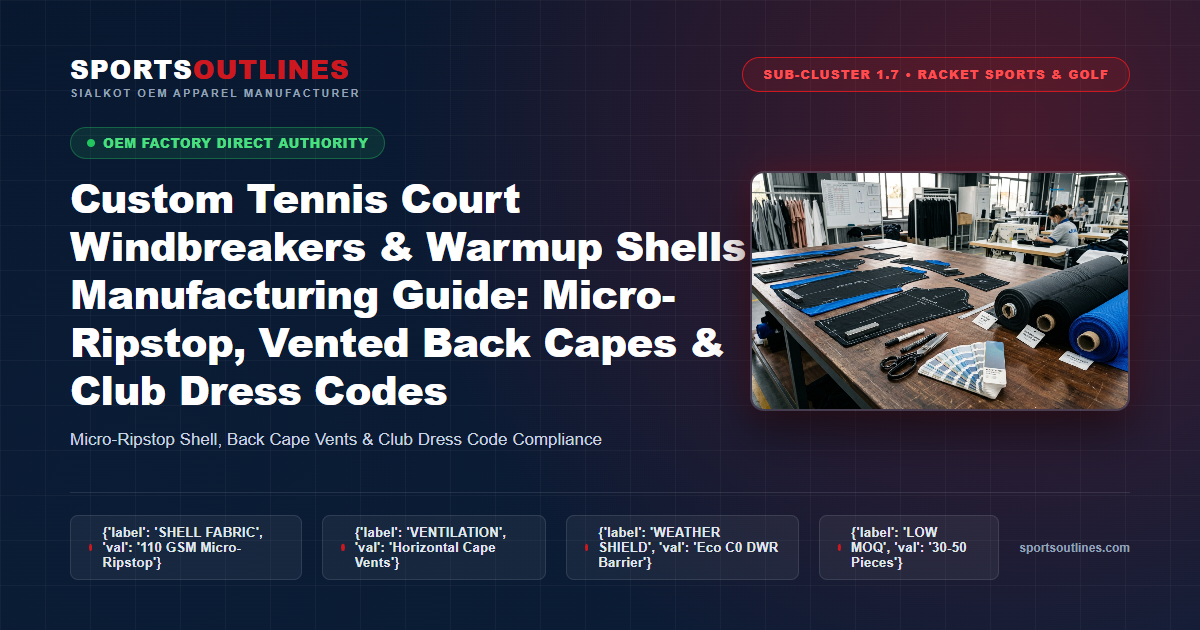
Manufacturing tournament-caliber custom tennis court windbreakers and warmup shells requires featherweight windproof barrier engineering, high-velocity thermal ventilation for intense baseline rallies, and strict alignment with private club dress codes. Professional tennis warmup shells are constructed from 105 to 115 GSM high-tenacity micro-ripstop polyester or nylon (100% micro-denier woven) with an eco-friendly C0 DWR fluorocarbon-free water-resistant coating and an inner lining of featherweight 75 GSM open-hole moisture-wicking tricot mesh. Because players must execute high-velocity overhead serves without jacket ballooning or shoulder restriction, jackets incorporate curved raglan sleeves with underarm stretch panels, dual horizontal back storm-flap ventilation capes, and a low-profile stand collar that frames the neck without flapping in gusty outdoor breezes. Hardware features YKK/SBS reverse coil full-front zippers with interior storm flaps and zipper garages, paired with concealed elastic cuffs and single-handed shockcord waist adjusters. Outerwear is fully compliant with International Tennis Federation (ITF) branding dimensions and traditional lawn club all-white dress regulations. Factory direct low MOQ at our Sialkot facility starts at 30 to 50 pieces per style/colorway with split youth (YS–YXL) and adult (XS–3XL) size curves. Pre-production physical prototype samples cost $45 to $85 per custom jacket delivered in 7 to 10 business days.
- Shell Construction: 110 GSM Micro-Ripstop High-Tenacity Polyester with C0 DWR water-resistant barrier.
- Thermal Ventilation: Horizontal back cape storm vents lined with 75 GSM open-hole tricot mesh.
- Overhead Mobility: Curved raglan sleeves with 4-way stretch poly-spandex underarm gussets.
- Hardware Engineering: YKK/SBS reverse-coil zippers with interior storm plackets and molded cord locks.
- Club Compliance: 100% compliant with ITF commercial logo dimensions and country club white standards.
- Factory Direct Low MOQ: 30–50 windbreakers per team order with split adult and junior sizes.
- Physical Prototype Sampling: $45–$85 per custom piece in 7–10 days (strict zero credit/refund policy).
- Direct Sourcing Communication: WhatsApp factory direct at +92 316 7932595 or sportsoutlines.com.
Competitive tennis is played across unpredictable outdoor elements: chilly early spring morning tournament duals, gusty coastal sea breezes, and cool autumn evening changeovers.
When tennis players warm up before a match, keeping their shoulder rotator cuffs, elbow tendons, and core torso warm is essential to prevent acute muscle strains. However, playing active baseline points in standard heavy streetwear jackets or generic nylon windbreakers creates major performance hazards: stiff fabrics rustle loudly during strokes, air fills the torso like a parachute on backward sprint retreats, and non-breathable fabrics trap boiling sweat against the skin within ten minutes of warm-up drills.
For tennis academy directors, collegiate varsity programs, country club pro shops, and independent activewear entrepreneurs across the United States, Canada, the United Kingdom, and Australia, sourcing legitimate tournament-grade tennis court windbreakers with low factory MOQs is crucial for market success.
At Sports Outlines in Sialkot, Pakistan, our specialized outerwear manufacturing workshop produces bespoke tennis windbreakers, warmup shells, and court presentation jackets for prestigious clubs and emerging sportswear brands. This technical manufacturing guide breaks down micro-ripstop textile physics, overhead serve sleeve ergonomics, back-vent aerodynamics, ITF regulatory rules, Points of Measure (POM), laboratory quality testing, and low MOQ production economics.
1. Textile Engineering: Micro-Ripstop Polyester vs. Taffeta Weaves
Choosing between ripstop and taffeta weaves determines whether a tennis windbreaker remains silent, featherlight, and tear-resistant during match conditions:
The High-Tenacity Micro-Ripstop Weave
Standard promotional windbreakers use stiff 60D taffeta that makes loud swishing noises during swings and tears easily if caught on court perimeter fences. Our 105 to 115 GSM micro-ripstop utilizes ultra-fine 30D micro-denier polyester yarns woven with an interwoven crosshatch grid of high-tenacity reinforcement threads every 3 mm. This grid structure stops accidental tears from propagating, yielding puncture resistance exceeding 190 N (ASTM D2261) while weighing only 110 grams per square meter. The fabric has an ultra-soft peach-skin hand feel that remains silent during aggressive swing mechanics.
Fluorine-Free C0 DWR Water-Repellency
To protect athletes from court spray and passing rain showers without relying on persistent hazardous PFAS chemicals, we treat the outer shell with bio-based C0 durable water repellent chemistry. Cured at 165°C, this finish molecularly bonds to the micro-filaments, causing water droplets to form beads with contact angles exceeding 110 degrees and roll off effortlessly (AATCC 22 Grade 90 spray rating).
Open-Hole Tricot Mesh Lining (Anti-Static & Anti-Cling)
Unlined shell jackets cling directly to bare arms once perspiration begins. We line our tennis windbreakers with featherweight 75 GSM hydrophilic open-hole tricot mesh. The mesh creates an internal micro-climate barrier that lifts the cool shell fabric away from moist skin, facilitating continuous lateral air circulation across the upper torso.
Calendered Thermal Cire Windproofing Mechanics
To achieve absolute windblocking performance without adding heavy, non-breathable polyurethane coatings that cause excessive perspiration buildup, we process the micro-ripstop fabric through high-temperature hydraulic calender rollers (Cire finish). Under 40 tons of pressure at 180°C, the outer microscopic fiber yarns are flattened slightly, closing air gaps between warp and weft yarns. This mechanical densification drops fabric wind permeability below 10 CFM (ASTM D737) without adding a single gram of polymer weight, keeping biting cross-court winds from chilling the athlete while preserving total breathability.
2. Technical Fabric Comparison for Custom Tennis Warmup Outerwear
The table below illustrates the mechanical properties across the primary shell and lining fabrics engineered in our Sialkot factory:
3. Biomechanical Upper-Body Tailoring: Overhead Serves & Back-Cape Aerodynamics
A tennis serve requires full humeral abduction and upward thoracic extension. Standard jacket cuts severely bind the arms and bunch up at the waist:
- Curved Raglan Shoulder Patterning: By replacing vertical shoulder seams with diagonal raglan seams, we allow the player to extend their hitting arm directly overhead without pulling the jacket hem out of position.
- Dual Horizontal Back Cape Vents: Across the upper thoracic spine, we build an overlapping storm flap cape vent lined with open-hole tricot mesh. When an athlete sprints forward to retrieve a drop shot, the pressure differential creates an exhaust effect, venting trapped body heat without allowing cold headwinds to enter.
- Underarm Stretch Spandex Gussets: In the high-sweat armpit zone, we insert a 140 GSM poly-spandex stretch mesh diamond that allows 360-degree rotational flexibility and rapid moisture evacuation.
- Low-Profile Stand Collar with Chinguard: The collar measures 6.0 cm in height, maintaining thermal neck protection without brushing against the jawline during groundstroke backswings. A soft zipper garage prevents metal sliders from chilling the skin.
During aggressive backward sprints to track down deep topspin lobs, standard oversized jackets billow outward like parachutes, creating measurable aerodynamic drag that robs the player of critical split-second positioning. Our jacket architecture features an articulated semi-fitted athletic silhouette with curved lateral torso panels and elasticized rear waistband gathers. This aerodynamic contouring channels outdoor headwinds smoothly around the athlete’s body, minimizing drag while maintaining total freedom for explosive shoulder rotation.
4. Tournament Rules & Traditional Lawn Club Dress Code Compliance
Tennis outerwear must navigate strict commercial branding rules and historic club tradition:
- ITF Commercial Regulation Limits: Under International Tennis Federation Grand Slam and Tour rules, manufacturer logos on warmup jackets cannot exceed 19.5 cm² (3 sq. in.). Sleeve and back team lettering must conform to standardized sizing matrices. We engineer all custom outerwear to strict millimeter tolerances to ensure zero compliance infractions.
- Traditional All-White Dress Codes: Historic tennis clubs (such as grass court lawn tennis venues in the UK and eastern USA) enforce strict 90%+ white clothing regulations. We manufacture optical-white jackets using UV-stabilized yarns that resist yellowing over time, accented with subtle tonal micro-piping or understated 10 mm club crests.
- Ball Storage & Secure Pockets: Warmup shells feature dual deep front slash pockets (22 cm depth) equipped with concealed reverse-coil zippers that safely store practice balls, vibration dampeners, or personal items without spilling onto the court surface during drills.
- Non-Reflective Hardware Finishes: All exposed zipper sliders and drawcord toggles feature matte powder-coated or rubberized non-glare finishes. Under harsh outdoor midday sun, reflective chrome zippers can cast blinding flashes into opponents’ eyes, violating tournament code-of-conduct guidelines.
For NCAA and intercollegiate varsity tennis squads, team jackets must strictly separate athletic department logos from institutional sponsors. We engineer specialized embroidery stabilizer backings beneath the left chest to support heavy 12,000-stitch university crests without puckering the featherweight 110 GSM micro-ripstop shell, ensuring a smooth, wrinkle-free presentation on court arrival.
5. Technical Points of Measure (POM) & Size Grading Matrix
The table below specifies our CAD grading matrix for custom tennis court windbreakers across adult unisex athletic sizing:
6. Laboratory Quality Assurance & Durability Benchmarks
To guarantee that custom tennis windbreakers withstand demanding outdoor weather and commercial laundering, each production batch passes strict laboratory testing:
7. B2B Sourcing Economics: Unit Costs, Margin Analysis & Sampling
For commercial brand owners, tennis academies, and country club pro shop managers, understanding volume cost structures and profit potential is essential:
Physical Prototype Sampling Policy: $45–$85 in 7–10 Business Days
Before placing bulk club or brand orders, we produce a physical prototype sample tailored to your exact tech pack specifications. Physical prototype samples cost $45 to $85 per custom piece. This fee covers digital pattern drafting, micro-ripstop cutting, cape vent assembly, zipper hardware integration, and lab water-repellency audits over a 7 to 10 business day turnaround. We maintain a firm zero-refund and zero-credit policy on all sampling fees. Once approved, the physical prototype represents the definitive production benchmark for bulk manufacturing.
Export Finishing & Outerwear Retail Packaging
Every completed windbreaker undergoes high-pressure steam tunnel conditioning to remove fold marks, is equipped with custom printed recycled hangtags and extra zipper slider pouches, and is folded over tissue supports inside 40-micron recyclable frosted zip bags with desiccant silica packets. Master cartons are 5-ply export grade (40 units per box, under 16 kg gross weight) shipped via express DHL/FedEx air freight to pro shops and warehouses globally.
8. Recycled Ocean Nylon & Sustainable Weather-Shield Performance
To support progressive athletic brands committed to circular sustainability, Sports Outlines crafts custom tennis windbreakers utilizing Global Recycled Standard (GRS) certified 100% recycled nylon (ECONYL) and recycled polyester micro-ripstop yarns. Extruded from post-consumer plastic containers and recovered ocean waste, these sustainable fabrics match virgin synthetic fibers in tensile tear strength, lightweight drape, and colorfastness ratings exceeding Grade 4.5.
Furthermore, our DWR water-repellent shell coatings are 100% fluorine-free (C0 chemistry), eliminating hazardous persistent perfluorinated chemicals (PFAS) while ensuring raindrops and court mist bead off cleanly. This green technical package allows tennis brands to market an authentic sustainability story that resonates strongly with premium country club memberships.
Ultrasonic Welded Seam Taping & Waterproof Pockets
For varsity tennis squads playing in wet coastal climates, needle punctures along shoulder seams can allow moisture penetration during heavy downpours. In our elite competition line, we offer hot-air seam sealing tape (Bemis 3-ply) applied over critical shoulder and neck joinings. This thermal tape completely seals needle micro-holes, providing impermeable water defense while maintaining a featherlight, flexible drape across the upper torso.
Self-Packing Pocket Geometry & Racquet Bag Portability
Tournament tennis players travel with 6 to 12 racquets, multiple string reels, and hydration packs, leaving minimal space inside equipment bags. We engineer our windbreakers with a self-stowage reversible zipper system located inside the left front slash pocket. The entire 110 GSM windbreaker folds neatly into its own pocket cavity, zipping shut into a compact 14×18 cm pouch with an integrated elastic hanging clip. This allows varsity squads to clip their warmup jackets to the exterior d-rings of their racquet bags, saving valuable interior luggage volume and keeping outerwear wrinkle-free between venue transits. The pouch exterior is also stamped with a water-resistant ID card window for personal player identification.
Manufacture Custom Tennis Court Windbreakers & Shells
Equip your tennis academy, varsity team, or luxury athletic brand with tournament-grade court windbreakers engineered in Sialkot. Featuring 110 GSM micro-ripstop, ventilated back capes, C0 DWR weather shielding, and low MOQ of 30–50 pieces with 7–10 days physical sampling.
9. Frequently Asked Questions (FAQ) — Custom Tennis Windbreaker Manufacturing
1. Why is micro-ripstop preferred over standard nylon taffeta for tennis windbreakers?
Micro-ripstop incorporates high-tenacity reinforcement threads every 3 mm that stop rips from expanding, yields puncture resistance exceeding 190 N, and has a soft peached finish that remains silent during aggressive overhead swings, unlike loud, stiff taffeta.
2. How does the horizontal back cape storm vent regulate body temperature?
The back cape vent overlaps across the upper thoracic spine with an interior lining of open-hole mesh. As the player runs forward, forward momentum pushes air through the jacket and exhausts hot humid air out the back without letting cold headwinds penetrate.
3. What is the minimum order quantity (MOQ) for custom tennis windbreakers?
Our factory direct low MOQ is 30 to 50 pieces per style/colorway. You can mix common youth and adult size curves (YS to 3XL) within the same order run.
4. How much does a physical sample prototype cost, and what is the turnaround time?
A physical custom prototype sample costs $45 to $85 per piece delivered in 7 to 10 business days. This fee covers pattern drafting, micro-ripstop cutting, cape vent assembly, hardware integration, and lab tests. We maintain a firm zero-refund and zero-credit policy on all sampling fees.
5. Are your tennis windbreakers compliant with ITF commercial logo regulations?
Yes. We calibrate all chest and sleeve logos to remain within the ITF 19.5 cm² threshold, ensuring zero disqualification risks at sanctioned national and international opens.
6. Can you manufacture all-white windbreakers for strict lawn tennis club dress codes?
Yes. We produce pristine optical-white jackets treated with UV-resistant optical brighteners that stay bright white without yellowing over time, accented with subtle tonal embroidery or micro-piping.
7. What zipper brands and hardware specifications do you utilize?
We utilize certified YKK or SBS reverse-coil full-front zippers with internal windproof storm flaps and fleece chinguards that protect the neck from chafing.
8. Does the DWR water-repellent coating wash out over time?
No. Our fluorine-free C0 DWR is heat-cured at 165°C, retaining an AATCC 22 Grade 80+ spray rating through 20+ commercial wash cycles.
9. How does the mesh lining prevent static electricity and clamminess?
Our 75 GSM tricot mesh lining creates a 1.5 mm air buffer between the shell and skin, promoting air circulation, dissipating static cling, and preventing the wet fabric from adhering to arms.
10. Can you match windbreakers with custom tennis polos and match track pants?
Yes. We provide complete color and branding synchronization, matching custom Pantone shades, logos, and trims across polos, skirts, shorts, and warmup outerwear shells.
Explore Related Racket Sports & Teamwear Manufacturing Guides:
Complete your club uniform collection with our factory guides on Custom Padel Tracksuits, Custom Tennis Polos, Custom Sideline Rain Jackets, or browse our Full Sportswear Catalog.