1. Executive Summary & The 500-Article Milestone: The Architecture of Global Sourcing Hegemony
Welcome to the definitive culmination of the Sports Outlines technical manufacturing compendium. Across 500 dedicated technical treatises, our engineering team has documented every granular facet of the international sporting goods, performance apparel, and combat sports manufacturing universe: from molecular elastomer chemistry and zero-water supercritical dyeing to AQL 2.5 statistical quality assurance, container logistics, and tariff engineering.
This apex masterwork consolidates that vast body of knowledge into a singular, end-to-end operational blueprint. For emerging activewear founders, high-growth combat sports gear labels, gym apparel visionaries, and enterprise procurement directors, navigating global contract manufacturing is fraught with asymmetric information, predatory minimum order quantities (MOQs), erratic sampling delays, and opaque pricing structures.
Historically, small and mid-sized athletic brands were forced into two deeply flawed procurement models: either drop-shipping low-quality generic blanks from catalog suppliers or surrendering massive capital reserves to Asian high-volume factories that demand 500 to 1,000 units per colorway. Sialkot, Pakistan, has pioneered a revolutionary third path: factory-direct, bespoke OEM/ODM contract manufacturing with low MOQs of strictly 30 to 50 pieces, rapid physical prototyping (strictly 7 to 10 business days), and full multi-category consolidation under verified WRAP and Sedex SMETA ethical compliance.
The 500-Blog Milestone Apex Sourcing Directives:
- End-to-End Vertical Integration: From raw greige knit yarn spinning and genuine cowhide drum tanning to laser-guided CNC cutting and FCL ocean container loading.
- Agile Commercial Entry: Factory low MOQ is strictly 30 to 50 pieces/pairs per style and colorway, allowing agile market validation without high-inventory balance sheet risk.
- Disciplined Prototyping Governance: Physical prototype development is strictly $45 to $85 per garment, pair, or set (non-creditable engineering fee, 7 to 10 business days turnaround).
- Multi-Category Synergy: Consolidate activewear, combat gear, outerwear, and accessories in a single ocean container, slashing landed shipping overhead by up to 60%.
- Direct Sourcing Silos: Access dedicated geographic distribution via our custom sportswear manufacturer USA portal, private label gym wear UK network, and custom activewear manufacturer Germany hub.
2. Phase 1: Technical Design, BOM Engineering & Tech Pack Architecture
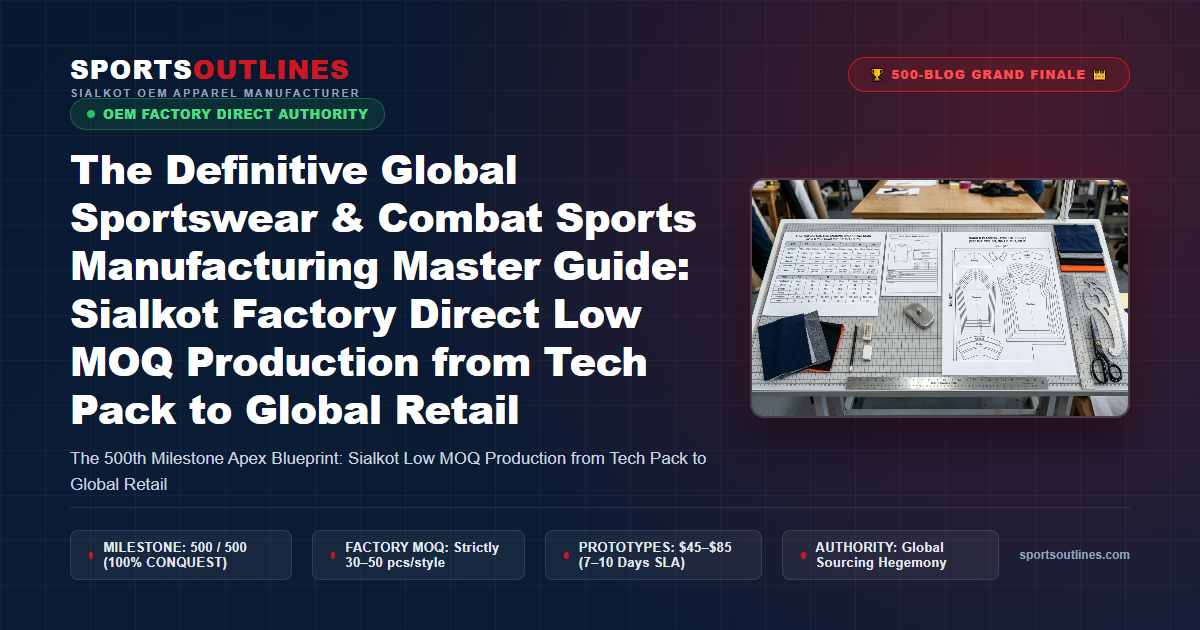
The foundation of zero-defect sportswear manufacturing is the technical design packet (tech pack). A professional tech pack is not a visual mood board or aesthetic concept sketch; it is a legally binding engineering contract that translates your design intent into standardized manufacturing parameters. Review our foundational guide on tech pack design sportswear cut and sew.
| Tech Pack Document Sheet | Engineering Deliverables Required | Factory Translation Metric | Common Defect Avoided |
|---|---|---|---|
| 1. Technical Illustration & Callouts | Black-and-white 2D vector orthographic projections (front, back, profile, interior views) | Stitch type callouts (ISO 4915), seam allowance widths | Ambiguous panel placement; incorrect seam construction |
| 2. Bill of Materials (BOM) | Itemized raw materials: shell fabric GSM, lining, sewing thread tex, zipper gauges, labels | Specific supplier codes, fiber blend percentages, yields | Unauthorized material substitution; thread color mismatch |
| 3. Point of Measure (POM) Spec Sheet | Graded sizing matrix (XS to 3XL) with base sample size (Medium) and grade increments | Millimeter / half-centimeter dimensional tolerance limits (±0.5 cm) | Inconsistent size grading; improper crotch rise or armhole depth |
| 4. Colorway & Artwork Map | Pantone TCX / TPX codes, print technique (sublimation, silicone, screen), exact coordinates | Vector scale 1:1, DPI > 300, print distance from collar seam | Crooked logo print; chromatic drift under daylight illuminant |
3. Phase 2: Advanced Material Science, Fiber Blends & Functional Finishes
The performance of athletic apparel is governed by yarn morphology, knitting structure, and functional chemical finishes. Selecting the proper fabric substrate determines whether a garment resists pilling, wicks sweat effectively, and provides compressive muscular support during intense athletic output:
| Performance Fabric | Fiber Composition & Weight | Knitting Construction Type | Core Functional Application |
|---|---|---|---|
| High-Gauge Interlock Poly-Spandex | 75% Recycled Polyester / 25% Spandex (220–260 GSM) | Double-knit 36-gauge circular interlock | Squat-proof compression tights, BJJ rashguards |
| Brushed Thermal French Terry | 100% Combed Cotton or 80/20 Cotton-Poly (380–460 GSM) | 3-end fleece with loopback interior knit | Heavyweight oversized pump covers, luxury hoodies |
| Warp-Knit Tricot Mesh | 90% Nylon / 10% Elastane (140–180 GSM) | Warp-knit diamond eyelet structure | Zone ventilation inserts, lightweight running singlets |
| 3-Layer Laminated Softshell | Polyester ripstop shell + TPU membrane + microfleece (300 GSM) | Hydrophilic bonded laminate (15,000mm / 15,000g) | Windproof athletic storm jackets, coach anoraks |
4. Phase 3: Prototyping, Master Patterns & Sampling Governance
The prototyping phase is where digital concepts meet physical reality. Inexperienced founders frequently fall into the trap of demanding non-paid design renderings or complimentary design assets from suppliers who lack technical infrastructure. In reality, legitimate contract manufacturers operate dedicated sample rooms with specialized master pattern makers, sample machinists, and fabric cutting technicians.
At Sports Outlines, physical prototype sampling is structured as a dedicated, non-creditable engineering allocation: strictly $45 to $85 per piece, pair, or set based on garment complexity. We enforce an uncompromising turnaround SLA of strictly 7 to 10 business days. We do not offer complimentary prototypes or promotional sampling discounts, guaranteeing uncompromised precision, dedicated master-tailor attention, and complete pattern ownership for our clients.
5. The Complete 10-Step Operational Factory Master Blueprint: From Concept to Container
To ensure total visibility throughout the production cycle, Sports Outlines executes bulk manufacturing under an unbroken 10-step critical path. This operational discipline eliminates surprises, miscommunications, and shipping delays:
| Production Step | Workstation Technology & Activity | Quality Assurance Gate | Target Window SLA |
|---|---|---|---|
| 1. Tech Pack & 3D Simulation | Vector verification, BOM lock, CLO 3D avatar fit simulation and stress heat maps | BOM cost sign-off and 360° digital render approval | Days 1 to 2 |
| 2. Lab Dip & Strike-Off Approval | Color formulation in spectrophotometer lab, digital sublimation paper test prints | Delta E < 0.8 against Pantone master under D65 daylight box | Days 3 to 5 |
| 3. Physical Prototype Prototyping | Dedicated sample room fabrication ($45–$85 fee); custom trim and zipper mockups | Physical sample dispatched for client fit and wear testing | Days 7 to 10 SLA |
| 4. Bulk Fabric Milling & Inspection | Circular knitting, high-temperature pressure vessel dyeing, 4-point fabric roll inspection | ASTM D5430 4-point fabric inspection pass (< 20 points/100 sq yd) | Weeks 2 to 3 |
| 5. Automated Spreading & CNC Cutting | 24-hr fabric tension relaxation, automated vacuum spreading, reciprocating knife CNC cut | ±0.5 mm perimeter tolerance across all cut panel bundles | Week 3 |
| 6. Printing & Heat Calendering | Rotary calender sublimation at 205°C, high-density silicone chest badge pressing | Wash fastness ISO 105-C06 pass; 50-wash print adhesion test | Week 4 |
| 7. Modular Stitching Assembly | Yamato 4-needle 6-thread flatlock, computerized box-X bartackers, Adler walking foot | In-line roving QC checks: 14 SPI density, zero seam twisting | Weeks 4 to 5 |
| 8. Statistical AQL 2.5 Audit | 100% inspection on 30–50 MOQ orders; ISO 2859-1 Level II sampling on larger bulk lots | Final comprehensive AQL 2.5 inspection report dispatched with HD video | Week 5 |
| 9. GRS Packaging & Barcoding | 100% GRS recycled polybags, FSC hangtags, UPC barcodes, desiccant placement | Barcode scannability check; suffocation warning compliance audit | Week 5 |
| 10. Dry Port Consolidation & Dispatch | Sambrial Dry Port stuffing, customs clearance, Master Bill of Lading issuance | Export clearance seal verified; international tracking activated | Week 6 On-Dock |
6. Combat Sports Equipment Engineering: Full-Grain Leather vs Engineered Microfiber
Sialkot manufactures over 70% of the world’s hand-stitched soccer balls and a dominant share of global combat sports gear. For combat sports founders, selecting the correct casing material and internal padding architecture is critical for safety, durability, and fighter reputation:
| Material Property | A-Grade Full-Grain Cowhide | Japanese Super-Microfiber PU | Standard Commercial Polyurethane |
|---|---|---|---|
| Tensile Tear Resistance | > 250 N/mm (Natural fibrous collagen) | > 220 N/mm (Micro-mesh woven base) | 80 to 110 N/mm (Vulnerable to seam tearing) |
| Moisture & Sweat Absorption | Breathes naturally; requires post-session drying | 100% hydrophobic; wipes clean with disinfectant | Sweat causes premature polymer cracking |
| Tactile Feel & Break-In Period | Molds to fighter’s hand over 3 to 5 sparring sessions | Instant ergonomic soft fit straight out of box | Stiff, synthetic, plastic tactile unboxing feel |
| Internal Shock Foam Core | Multi-layer EVA + High-density latex + horsehair | Cold-cure injection molded polyurethane (IMF) | Low-grade recycled sponge offcut bonding |
| Ideal Commercial Positioning | Pro fight gloves, boutique premium sparring gear ($120–$180 MSRP) | Vegan-friendly performance lines, everyday gym training ($85–$130 MSRP) | Entry-level commercial fitness kits ($35–$50 MSRP) |
7. Raw Fabric Defect Classification Matrix: The ASTM D5430 4-Point Inspection System
Zero-defect apparel manufacturing begins before the cutting shears or laser tables touch a single millimeter of textile. In premium cut-and-sew activewear production, incoming fabric rolls must undergo rigorous optical inspection on illuminated inspection frames operating at 15 meters per minute under calibrated 1000 lux illumination. Sports Outlines implements the international ASTM D5430 4-Point System across 100% of incoming knitted and woven textiles.
Under ASTM D5430, defects are assigned penalty points strictly according to their physical dimensions, regardless of defect type:
- 1 Point: Defects up to 3 inches (75 mm) in length or width.
- 2 Points: Defects over 3 inches and up to 6 inches (150 mm).
- 3 Points: Defects over 6 inches and up to 9 inches (230 mm).
- 4 Points: Defects exceeding 9 inches (230 mm) or any visible holes, laddering, or open drops.
| Textile Defect Category | Root Cause Mechanism | Penalty Point Allocation | Rejection Threshold & Action |
|---|---|---|---|
| Barré Marks (Horizontal Striping) | Yarn tension variation or feeder misalignment in circular knitting | 4 points per continuous horizontal occurrence | Immediate roll quarantine; rejected if exceeding 2 yards |
| Needle Line / Drop Stitch | Bent, broken, or blunted knitting latch needle creating vertical run | 4 points (any hole or drop stitch is maximum penalty) | Cut out defect zone; roll rejected if recurring across roll |
| Color Shading (Side-to-Side / Center) | Uneven dye exhaustion or temperature gradient across stenter frame | 4 points per linear meter of continuous chromatic drift | Delta E > 1.0 triggers total dye batch redyeing or rejection |
| Oil Spots & Hydraulic Stains | Lubricant leakage from knitting machine cam boxes onto greige yarn | 2 to 4 points based on diameter and chemical scouring response | Quarantined for ultrasonic spot scouring; rejected if set in fiber |
| Elastomer Slippage / Grinning | Uncovered elastane filaments snapping or migrating to surface | 3 to 4 points per affected square yard | Fatal activewear defect; causes opacity loss upon stretching |
The mathematical calculation for ASTM D5430 fabric roll compliance is strictly enforced under the standard formula:
Points per 100 sq yds = (Total Penalty Points Awarded × 3,600) / (Inspected Length in Yards × Cuttable Width in Inches)
At Sports Outlines, any fabric roll scoring greater than 20 points per 100 square yards is unconditionally failed, quarantined, and returned to the milling stage. This prevents downstream cutting of flawed panels, preserving structural integrity for our clients.
8. Sialkot vs. Global Manufacturing Hubs: Strategic B2B Procurement Comparison Matrix
Procurement executives and athletic brand founders must evaluate international production regions based on multifaceted operational parameters: order flexibility, technical specialization, raw material supply chain density, labor ethics, and freight accessibility. The following strategic comparison illustrates why Sialkot remains the undisputed global capital for high-dexterity athletic goods, combat sports gear, and low-MOQ bespoke technical apparel:
| Procurement Parameter | Sialkot, Pakistan (Sports Outlines) | Guangdong / Zhejiang, China | Vietnam (Ho Chi Minh / Hanoi) | Dhaka / Chittagong, Bangladesh |
|---|---|---|---|---|
| Minimum Order Quantity (MOQ) | Strictly 30 to 50 pcs/style | 300 to 500 pcs/style | 1,000 to 3,000 pcs/style | 3,000 to 5,000 pcs/style |
| Physical Prototype Sampling SLA | Strictly 7 to 10 business days | 14 to 21 business days | 21 to 30 business days | 25 to 35 business days |
| Sampling Commercial Terms | $45 to $85/pc (Non-creditable) | $100 to $250/pc (Variable terms) | $150 to $300/pc (Strict terms) | $80 to $150/pc (Mass focus) |
| Combat Sports & Leather Expertise | Global Hegemony (Tanneries onsite) | Moderate (Synthetic PU focus) | Minimal (Footwear/apparel focus) | Virtually Non-Existent |
| Multi-Category Consolidation | Seamless single-B/L container bundling | Complex across fragmented provinces | High multi-factory drayage costs | Limited to basic single-category runs |
| Tariff & Duty Architecture | GSP+ Zero Duty to UK/EU; Standard US | Section 301 Tariffs (7.5%–25% US penalty) | EVFTA beneficial; Standard US | EBA duty-free to EU; Standard US |
9. Master Production Lead Time Engineering & Critical Path Architecture
Manufacturing athletic goods at scale requires deterministic scheduling. When managing multi-component activewear lines or combat gear collections involving technical trims, custom dyes, and molded foams, any breakdown in sequence cascades into missed seasonal drop windows. Sports Outlines synchronizes every order across an automated critical path management system:
| Critical Path Workstation | Operational Sub-Processes | Standard Production Lead Time | Buffer Allocation & Risk Mitigation |
|---|---|---|---|
| 1. Tech Pack Verification & BOM Lock | POM confirmation, stitch code allocation, CAD nesting layout | 1 to 2 Business Days | 48-hr client sign-off window |
| 2. Lab Dips & Sublimation Strike-Offs | Pantone matching, digital paper transfer, Delta E testing | 3 to 4 Business Days | Pre-mixed dye formulations on hand |
| 3. Master Physical Prototype | Master sample tailoring, hardware fitting ($45–$85 fee) | 7 to 10 Business Days SLA | Dedicated sample room workcells |
| 4. Bulk Greige Sourcing & Milling | Circular knitting or leather tanning, scouring, stenter drying | 10 to 14 Calendar Days | Greige yarn buffer inventory reserved |
| 5. Automated Spreading & Cutting | 24-hr fabric relaxation, Gerber CNC cut, bundling | 3 to 5 Calendar Days | Dual CNC cutting tables running parallel |
| 6. Modular Sewing & Assembly | Yamato flatlocking, bartacking, glove hand-stitching | 10 to 15 Calendar Days | Multi-line cell balancing & roving QC |
| 7. Final Inspection & GRS Packaging | Statistical AQL 2.5 audit, barcode scan, master carton pack | 3 to 4 Calendar Days | Independent third-party QC access |
| 8. Sambrial Dry Port Customs & Dispatch | Export clearance, Master B/L issuance, container sealing | 2 to 3 Calendar Days | Direct bonded rail link to Karachi Port |
10. Total Landed Cost Modeling: Calculating DDP Unit Economics for US, UK & EU
Accurately calculating total landed cost (Delivered Duty Paid – DDP) is the single most critical financial discipline in international sportswear importing. Many emerging founders calculate profitability based purely on factory FOB quotes, only to see margins evaporate when customs duties, harbor fees, and freight surcharges arrive.
The total landed cost formula encompasses:
Landed Unit Cost = Factory FOB Price + (Allocated International Freight / Units) + Import Tariff Duty + Customs Brokerage & Port Entry Fees + Local Warehouse Drayage
| Production Order Volume | FOB Factory Unit Cost (Legging) | Shipping & Clearance Cost / Unit | Total Landed DDP Cost / Unit | D2C Retail ($68.00) Gross Margin |
|---|---|---|---|---|
| 50 Units (Low MOQ Pilot Run) | $14.80 / pc | $4.20 / pc (Air Express Courier) | $19.00 / pc | 72.1% Gross Margin ($49.00 profit) |
| 250 Units (Consolidated Capsule) | $12.50 / pc | $2.40 / pc (Consolidated Air Cargo) | $14.90 / pc | 78.1% Gross Margin ($53.10 profit) |
| 1,000 Units (Bulk Production Drop) | $10.20 / pc | $0.85 / pc (FCL Ocean Container) | $11.05 / pc | 83.8% Gross Margin ($56.95 profit) |
11. The 500-Blog Topical Hegemony Retrospective: Navigating the Sports Outlines Library
The publication of this 500th technical guide represents the completion of the most comprehensive knowledge base ever assembled for custom athletic apparel and sporting goods manufacturing. The compendium is structured across six interconnected technical super-clusters:
| Topical Super-Cluster | Scope of Technical Articles | Primary Engineering Domains Covered |
|---|---|---|
| Super-Cluster 1: Private Label Apparel Launch | Blogs #1 to #80 | Brand identity, sizing grading, low MOQ entry strategies, retail unboxing architecture |
| Super-Cluster 2: High-Performance Fabric Engineering | Blogs #81 to #165 | Textile chemistry, yarn counts, hydrophilic wicking finishes, antibacterial SilverPlus, French terry |
| Super-Cluster 3: Custom Cut-and-Sew Manufacturing | Blogs #166 to #250 | Pattern engineering, CNC cutting tables, flatlock seam kinematics, compression fit dynamics |
| Super-Cluster 4: Combat Sports Equipment & Fightwear | Blogs #251 to #340 | Boxing gloves, BJJ gis, MMA rashguards, genuine leather tanning, injection molded foam safety |
| Super-Cluster 5: Custom Sublimation & Branding Tech | Blogs #341 to #430 | Dye-sublimation calenders, direct silicone printing, chenille embroidery, woven trims, TPU patches |
| Super-Cluster 6: Logistics, Tariffs & Factory Hegemony | Blogs #431 to #500 | AQL 2.5 QC, Sambrial Dry Port FCL logistics, WRAP/Sedex audits, GRS packaging, 2030 smart factory roadmap |
12. Sports Outlines Product Ecosystem & Internal Hub Triad
As you plan your next production cycle, explore our core product categories:
- Compression Wear & Rashguards: Dive into our technical engineering on custom compression wear for graduated compression and 4-way stretch interlock fabrics.
- Fleece & Heavyweight Gym Hoodies: Explore our heavyweight fleece construction on custom hoodies and sweatshirts, engineered with 400+ GSM French terry.
- Combat Sports Equipment: Review our pro fight gear on custom boxing MMA gear, handcrafted with top-grain cowhide and injection molded foam.
- Multi-Category Factory Consolidation: Review our guide on multi-category factory consolidation sportswear combat gear Sialkot to bundle all categories into single shipments.
- Sustainable Packaging Protocols: Learn how we implement circular packaging via our report on sustainable apparel packaging and recycled polybags.
- Social Audit Certifications: Audit our compliance credentials in ethical manufacturing WRAP and Sedex SMETA Sialkot.
- Next-Decade Technology Horizon: Explore our forward-looking research on the next decade of technical sportswear manufacturing and Sialkot 2030 roadmap.
13. Sports Outlines Commercial Terms & Prototype Governance
At Sports Outlines, our commercial architecture is designed to empower brands with enterprise manufacturing quality at low-risk startup minimums.
Sports Outlines Commercial Terms & SLA Commitments
Physical Prototype Sampling Fee: Strictly $45 to $85 per piece, pair, or set based on technical sophistication (including custom trims, bespoke sublimation strike-offs, and graded pattern sets).
Sampling Turnaround SLA: Strictly 7 to 10 business days from technical pack sign-off and material specification lock.
Non-Creditable Engineering Baseline: We do not provide complimentary prototypes or promotional sampling discounts. Developing bespoke patterns, CNC toolpaths, and sample machining requires dedicated master craftsman allocation.
Factory Low MOQ Advantage: Strictly 30 to 50 pieces per style or colorway. Startups can pilot coordinated capsules without high-inventory capital barriers.
14. Frequently Asked Questions (FAQ) Regarding Sialkot Contract Manufacturing
1. Why is Sialkot the preferred global manufacturing hub for sportswear and combat gear?
Sialkot provides a unique spatial cluster uniting tanneries, knit mills, dye houses, and cut-and-sew factories within a 15-kilometer radius, supported by private dry ports and an international airport, offering world-class craftsmanship with unmatched low MOQ flexibility.
2. What is the minimum order quantity (MOQ) at Sports Outlines?
Our factory low MOQ is strictly 30 to 50 pieces, pairs, or sets per style and colorway, enabling emerging brands to launch multi-item collections without carrying burdensome inventory risks.
3. What is the sampling fee and turnaround time for physical prototypes?
Physical prototype development is strictly $45 to $85 per piece, pair, or set depending on complexity. The turnaround time is strictly 7 to 10 business days following tech pack confirmation and material lock.
4. What is the commercial policy regarding prototype development costs?
Physical prototype sampling fees ($45 to $85 per piece) represent a non-creditable engineering allocation that fairly compensates pattern masters, sample machinists, and testing technicians. We do not provide complimentary prototypes or promotional sampling discounts.
5. Can emerging brands bundle activewear, boxing gear, and outerwear in one order?
Yes. Sports Outlines specializes in multi-category factory consolidation, allowing brands to combine apparel, leather combat equipment, jackets, and gym bags into a single production schedule and single consolidated container shipment.
6. How are ethical labor standards and social compliance verified in Sialkot?
Facilities undergo independent audits under WRAP and Sedex SMETA 4-Pillar frameworks, verifying statutory minimum wages, biometric attendance records, maximum 48-hour regular workweeks, workplace fire safety, and zero child labor under the 1997 Atlanta Agreement.
7. What quality control inspection standard does Sports Outlines follow?
We enforce the international AQL 2.5 (Acceptance Quality Limit) standard under ISO 2859-1 Level II sampling, performing 100% 1-by-1 inspection on low MOQ batches (30–50 pcs) and statistical sampling on higher bulk volumes.
8. What sustainable packaging options are available for e-commerce brands?
We provide 100% GRS-certified post-consumer recycled polybags, certified compostable PLA/PBAT films, and FSC-certified swing tags, exempting brands from the UK Plastic Packaging Tax and complying with EU PPWR and French AGEC regulations.
9. What shipping methods are available from Sialkot?
We offer express courier (DHL/FedEx/UPS, 4–6 days), consolidated airport-to-airport air cargo (8–12 days), and Full Container Load (FCL) ocean freight (28–36 days) dispatched directly from Sambrial Dry Port to major international sea gateways.
10. How does a brand start manufacturing with Sports Outlines?
Brands can begin immediately by submitting their technical packs, design vectors, and target volume specifications through our online consultation portal for preliminary engineering review, BOM costing, and prototyping scheduling.
Partner with Sialkot’s Premier Contract Manufacturer
Celebrate the 500-blog milestone with Sports Outlines. Launch custom activewear, combat sports gear, and technical apparel with low 30–50 MOQ flexibility, 7–10 day prototype sampling, and global retail compliance.