
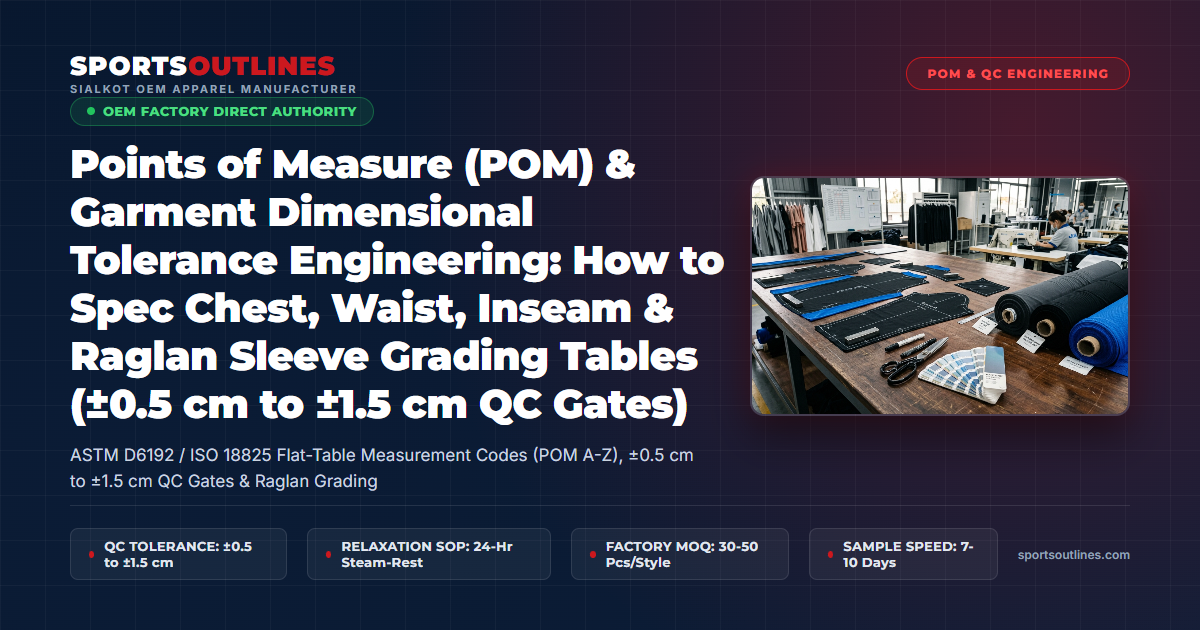
Super-Cluster 6 • Sub-Cluster 6.1 • Metrology, ASTM D6192 Flat Measurement Physics & AQL 2.5 QC Tolerances
Executive Technical Summary: Alphanumeric POM Datum Mapping, Elastomeric Relaxation Kinematics & Tiered ±0.5 cm to ±1.5 cm Inspection Tolerances
In industrial apparel manufacturing, a garment cannot be evaluated on a live human body during final quality control—it must be measured laid flat in a zero-tension relaxed state on a calibrated steel-rule inspection table after 24 hours of post-steam conditioning. A Points of Measure (POM) Specification & Tolerance Sheet (`Sheet 5` of the 8-Sheet Sportswear Tech Pack) establishes the exact anatomical start-and-end nodes (`POM-A` through `POM-Z`), the straight-line vs. contour-curve tape path, the graded target dimensions across `XS` to `3XL`, and the statistically valid allowable dimensional tolerance ($\pm\Delta L_{\text{tol}}$). This B2B metrology guide details how to specify upper-body, raglan-sleeve, and lower-body compression/woven POMs, eliminate “Half-Width vs. Full-Circumference” disasters, and calibrate $\pm 0.5\text{ cm}$ to $\pm 1.5\text{ cm}$ QC pass/fail gates.
Direct Manufacturer Answer: How Should Sportswear Points of Measure (POM) and Tolerances Be Specified?
All horizontal garment circumferences (Chest, Waist, Hip, Thigh, Bicep, Cuff) must be specified as 1/2 Flat Measurements (`Laid Flat, Edge-to-Edge`) rather than 3D body circumferences, anchored by explicit datum offsets (e.g., “1/2 Chest Width measured `2.5 cm` (`1.0″`) straight below armhole pit intersection”). Because textile knits and wovens exhibit elastic recovery and thermal steam shrinkage during pressing, every POM requires a tiered dimensional tolerance: `±0.3 cm to ±0.5 cm` for small precision trims (collar rib height, cuff height, neck drop), `±1.0 cm` (`±3/8″`) for primary widths (1/2 chest, 1/2 waist, 1/2 hip), and `±1.2 cm to ±1.5 cm` (`±1/2″`) for long vertical lengths (HPS body length, CB sleeve length, pant inseam).
- Low MOQ Precision: Factory-direct 30–50 pieces per style/colorway with 100% pre-shipment POM verification under ISO 2859-1 AQL 2.5.
- Physical Fit Prototyping: Custom pre-production samples built to your exact POM table in 7–10 business days ($45–$85/pc non-refundable sample fee).
- Direct Metrology Desk: Request our graded POM templates via Factory RFQ Portal or WhatsApp +92 316 7932595.
For activewear founders, teamwear athletic directors, and technical apparel buyers across the United States, United Kingdom, Canada, Germany, and Australia, poorly defined Points of Measure are the #1 root cause of customer sizing returns in e-commerce. If a brand specifies “Chest = 54 cm” without defining whether the tape measure sits directly at the armpit seam intersection (`0.0 cm` below armhole) or `2.5 cm` (`1.0″`) below the armhole along the tapered side seam, two different inspectors will record a `1.8 cm to 2.5 cm` discrepancy on the exact same shirt.
Even worse, if a founder copies a consumer “Body Size Chart” (`Chest: 102–107 cm for Size L`) into a factory tech pack without converting it into flat garment dimensions—and fails to account for whether the garment is a `-15%` negative-ease compression rashguard or a `+18%` positive-ease oversized street pump-cover hoodie—the pattern room cannot draft a functional block. At Sports Outlines, our Sialkot CAD pattern masters and final QC inspectors operate under strict ASTM D6192 / ISO 18825 flat-garment metrology standards. This guide provides the complete mathematical and operational handbook for writing bulletproof POM tables.
1. The Fundamental Distinction: Anthropometric Body Girth vs. 1/2 Flat Garment POM
Before writing a single number in `Sheet 5`, a technical designer must separate two completely different coordinate systems: 3D Anthropometric Body Circumference ($C_{\text{body}}$) (what you publish on your Shopify product page to help consumers pick their size) and 2D Laid-Flat Garment Half-Measurement ($\text{POM}_{1/2\text{-flat}}$) (what the pattern master drafts in Gerber AccuMark and what the QC inspector measures with a flat steel tape):
POM_1/2_Flat = ( C_body * (1 + Ease_Factor) ) / 2 where Ease_Factor in [-0.22 (Compression), +0.28 (Oversized Streetwear)]
Consider a standard adult male athlete with a `104.0 cm` (`41.0″`) 3D chest circumference (`Base Size Large`). Depending on the engineered silhouette and textile modulus, the exact same `Size Large` athlete requires five radically different `1/2 Chest Width (POM-A)` specifications on the factory tech pack:
- Second-Skin Compression Rashguard (`250 GSM 80/20 Warp-Knit Poly-Spandex`, `-15.4%` Negative Ease): Full relaxed garment chest circumference = `88.0 cm` $\rightarrow$ `1/2 Flat Chest POM = 44.0 cm` (`17.3″`). The 4-way stretch elastomer expands `+18.2%` when worn to deliver `15–18 mmHg` of muscle-stabilizing Laplace compression.
- Fitted Training / Gym Muscle Tee (`190 GSM 92/8 Cotton-Elastane Single Jersey`, `-2.0%` Zero/Micro-Negative Ease): Full garment chest circumference = `102.0 cm` $\rightarrow$ `1/2 Flat Chest POM = 51.0 cm` (`20.1″`). Hugs the pectorals and deltoids while allowing natural ribcage expansion.
- Standard Athletic Team Jersey (`160 GSM 100% Polyester Interlock/Birdseye Mesh`, `+7.7%` Athletic Ease): Full garment chest circumference = `112.0 cm` $\rightarrow$ `1/2 Flat Chest POM = 56.0 cm` (`22.0″`). Necessary because `100%` polyester mesh has only mechanical stretch (`8–10%`) and must drape cleanly over the torso without clinging.
- Regular Fit Pullover Hoodie (`340 GSM 80/20 CVC Brushed Fleece`, `+13.5%` Layering Ease): Full garment chest circumference = `118.0 cm` $\rightarrow$ `1/2 Flat Chest POM = 59.0 cm` (`23.2″`). Accommodates a base-layer tee underneath.
- Oversized Drop-Shoulder “Pump Cover” Streetwear Hoodie (`460 GSM 100% Combed Cotton French Terry`, `+25.0%` Boxy Ease): Full garment chest circumference = `130.0 cm` $\rightarrow$ `1/2 Flat Chest POM = 65.0 cm` (`25.6″`) paired with a `64.0 cm` dropped shoulder width.
| Sportswear Silhouette Category | Typical Fabric & Elastane % | Engineered Ease Factor (`%`) | Size `L` Athlete Body Chest (`3D`) | Size `L` Tech Pack `1/2 Chest POM` | Size `L` Tech Pack `HPS Length POM` |
|---|---|---|---|---|---|
| No-Gi BJJ / MMA Compression Rashguard | `250 GSM` 80/20 Warp-Knit Poly-Spandex | `-14.0% to -18.0%` (Negative Ease) | `104.0 cm` (`41.0″`) | `43.5 cm – 45.0 cm` | `68.5 cm` (Anti-ride-up length) |
| Women’s High-Support Sports Bra | `260 GSM` 75/25 Nylon 6,6 / Lycra® Interlock | `-16.0% Bust / -20.0% Underband` | `94.0 cm` Bust (`Size M`) | `39.5 cm` Bust / `33.0 cm` Band | `32.5 cm` (HPS to bottom band) |
| Tapered Aesthetic Gym Muscle Tee | `195 GSM` 95/5 Combed Cotton / Spandex | `-2.0% Chest / +4.0% Waist` | `104.0 cm` (`41.0″`) | `51.0 cm` Chest / `49.0 cm` Hem | `74.0 cm` (Scalloped drop-tail) |
| Sublimated Soccer / Basketball Jersey | `155 GSM` 100% Micro-Polyester Jacquard | `+7.5% to +10.0%` (Athletic Ease) | `104.0 cm` (`41.0″`) | `56.0 cm – 57.5 cm` | `75.0 cm` (Standard match cut) |
| Oversized Boxy “Pump Cover” Hoodie | `450 GSM` 100% Cotton Diagonal French Terry | `+23.0% to +27.0%` (Boxy Drop-Shoulder) | `104.0 cm` (`41.0″`) | `64.0 cm – 66.0 cm` | `72.0 cm` (Slightly cropped boxy) |
| 3-Layer Waterproof Alpine Shell Jacket | `175 GSM` 3L Nylon Ripstop + ePTFE Membrane | `+16.0% to +20.0%` (Mid-Layer Clearance) | `104.0 cm` (`41.0″`) | `60.5 cm – 62.5 cm` | `76.5 cm` ( Front) / `81.0 cm` (Back) |
2. Upper-Body & Raglan Sleeve POM Engineering (`POM-A` through `POM-M`)
Upper-body garments (jerseys, rashguards, tees, hoodies, and technical jackets) require at least 12 standardized Points of Measure so the CAD pattern master can lock the torso taper, armhole depth, sleeve pitch, and collar aperture simultaneously. Pay special attention to the geometric difference between Set-In Sleeves (which have a distinct shoulder-crown seam) and Raglan or Saddle Sleeves (where the sleeve panel extends all the way to the collar band):
- `POM-A` — 1/2 Chest Width (`2.5 cm / 1.0″ Below Armhole`): Lay the garment completely flat, smooth out wrinkles without stretching the knit, and measure horizontally from left side-seam fold to right side-seam fold at a vertical distance of exactly **`2.5 cm` (`1.0″`) straight down from the bottom of the armhole pit intersection**. Why `2.5 cm` below the pit instead of directly across the pit seams? Because the underarm overlock/flatlock intersection (`4-way seam junction`) contains up to `8 to 12 layers` of folded seam allowance that form a rigid bump; measuring `2.5 cm` below that bump captures the true flat fabric panel width with `±0.1 cm` repeatability.
- `POM-B` — 1/2 Waist Width & `POM-C` — 1/2 Bottom Sweep / Hem Width: Measure `1/2 Waist Width` horizontally across the narrowest torso taper point (always specify the exact vertical distance down from HPS, e.g., “`42.0 cm` down from HPS in Base Size L” so inspectors don’t guess where the waist sits). Measure `1/2 Bottom Hem Width` straight along the bottom edge from left corner to right corner (if ribbed, measure along the top join seam of the rib AND along the bottom folded edge of the rib).
- `POM-D` — Front Body Length from High Point Shoulder (`HPS`): Place the zero-end of the steel tape at the High Point Shoulder (`HPS` — the exact intersection where the inner collar seam meets the shoulder seam) and measure vertically down parallel to Center Front (`CF`) to the bottom edge of the front hem. If the garment has a scalloped or drop-tail back hem, add **`POM-D2` (Back Body Length from HPS to Lowest Back Hem Drop)**.
- `POM-E` — Across Shoulder Width (`Set-In Sleeve Only`): Measure straight across from the left shoulder-crown seam intersection to the right shoulder-crown seam intersection along the top edge. Crucial Rule: If the garment is a Raglan Sleeve (like a BJJ rashguard, baseball henley, or track jacket), `POM-E` does not exist! Never list an “Across Shoulder” POM on a raglan garment without specifying a virtual vertical drop line (e.g., `12.0 cm` down from HPS), or better yet, omit `POM-E` and control the upper silhouette via `POM-F2` (Center-Back Raglan Sleeve Length) and `POM-H` (Raglan Armhole Diagonal Seam Length).
- `POM-F1` (Set-In Sleeve Length) vs. `POM-F2` (Raglan Sleeve Length from `CB` or `HPS`): On a set-in sleeve, measure from the top shoulder-crown seam straight down the outer folded edge of the sleeve to the cuff edge (`POM-F1`). On a raglan sleeve, measure either from the Center Back (`CB`) neck seam over the shoulder curve down to the cuff edge (`CB Raglan Sleeve Length`, typically `84.0–89.0 cm` for a Size L long sleeve) or from `HPS` along the top fold of the sleeve to the cuff (`HPS Raglan Sleeve Length`, typically `75.0–79.0 cm`). Always state explicitly whether the measurement originates at `CB` or `HPS`!
- `POM-G` — Armhole Depth (`Straight` vs. `Curved`) & `POM-I` — 1/2 Bicep Width: Specify `Armhole Depth (Straight)` by measuring in a straight diagonal line from the top shoulder point (`HPS` on raglans, or outer shoulder tip on set-in sleeves) to the bottom pit intersection. Specify `1/2 Bicep Width` perpendicular to the outer sleeve fold at a fixed distance of **`2.5 cm` (`1.0″`) down from the underarm pit intersection** along the under-sleeve seam.
| POM Code | Point of Measure Description (Fitted Athletic Tee — `cm`) | `XS` | `S` | `M` | `L` (Base) | `XL` | `2XL` | `3XL` | QC Tol (`±cm`) |
|---|---|---|---|---|---|---|---|---|---|
| `POM-A` | 1/2 Chest Width (`2.5 cm` below armhole pit, laid flat) | 45.0 | 47.5 | 50.0 | 52.5 | 55.5 | 58.5 | 61.5 | `±1.0 cm` |
| `POM-B` | 1/2 Waist Width (`42.0 cm` down from HPS in Base L) | 42.0 | 44.5 | 47.0 | 49.5 | 52.5 | 55.5 | 58.5 | `±1.0 cm` |
| `POM-C` | 1/2 Bottom Sweep / Hem Width (Straight across bottom edge) | 44.5 | 47.0 | 49.5 | 52.0 | 55.0 | 58.0 | 61.0 | `±1.0 cm` |
| `POM-D` | Front Body Length from High Point Shoulder (`HPS`) to Hem | 68.0 | 70.0 | 72.0 | 74.0 | 76.0 | 78.0 | 80.0 | `±1.5 cm` |
| `POM-E` | Across Shoulder Width (Seam-to-Seam at top crown) | 41.5 | 43.0 | 44.5 | 46.0 | 48.0 | 50.0 | 52.0 | `±0.8 cm` |
| `POM-F` | Short Sleeve Length from Top Shoulder Crown to Cuff Edge | 20.0 | 21.0 | 22.0 | 23.0 | 24.0 | 25.0 | 26.0 | `±0.8 cm` |
| `POM-G` | Armhole Depth Straight (Shoulder Tip to Pit Intersection) | 21.5 | 22.5 | 23.5 | 24.5 | 25.7 | 26.9 | 28.1 | `±0.8 cm` |
| `POM-I` | 1/2 Sleeve Bicep Width (`2.5 cm` down from pit, perpendicular) | 18.0 | 19.0 | 20.0 | 21.0 | 22.2 | 23.4 | 24.6 | `±0.6 cm` |
| `POM-J` | 1/2 Sleeve Cuff Opening (Laid flat along bottom edge) | 15.0 | 15.8 | 16.6 | 17.4 | 18.4 | 19.4 | 20.4 | `±0.5 cm` |
| `POM-K` | Inside Neck Width (HPS to HPS straight across inner seam) | 17.5 | 18.0 | 18.5 | 19.0 | 19.6 | 20.2 | 20.8 | `±0.5 cm` |
| `POM-L` | Front Neck Drop (Imaginary HPS line to Top Edge of CF Rib) | 7.8 | 8.2 | 8.6 | 9.0 | 9.4 | 9.8 | 10.2 | `±0.5 cm` |
| `POM-M` | Collar Rib Height (Visible finished rib band width) | 2.0 | 2.0 | 2.0 | 2.0 | 2.0 | 2.0 | 2.0 | `±0.3 cm` |
3. Lower-Body POM Engineering: Joggers, Shorts, Leggings & Saddle Gussets (`POM-N` through `POM-Z`)
Lower-body athletic silhouettes—including tapered French Terry joggers, 8-row shirred-elastic Muay Thai trunks, 2-in-1 running shorts, and high-waisted squat-proof leggings—introduce three complex metrology variables that must be explicitly defined in `Sheet 5`:
3.1 Dual Waistband Specification: `1/2 Waist Relaxed` vs. `1/2 Waist Fully Extended`
Whenever a pant or short utilizes an encased or multi-needle shirred elastic waistband (such as a Kansai Special 4-needle or 8-needle waistband), specifying only the Relaxed waist width is insufficient. If a factory uses a low-modulus or over-gathered elastic band, the relaxed waist may measure `38.0 cm` on the table, yet fail to stretch past `44.0 cm`—preventing the athlete from pulling the garment over their `51.0 cm` hips! Therefore, every elasticated waistband requires two paired POM rows:
- `POM-N1` — 1/2 Waist Width Relaxed (`Zero Tension`): Measured straight across the top edge of the waistband after 24 hours of off-machine relaxation (e.g., `39.0 cm ± 1.0 cm` in Size Large).
- `POM-N2` — 1/2 Waist Width Extended (`At 60 N / 6.1 kgf Pull Load`): Measured while pulling the waistband laterally to its full fabric-gather stop limit (must exceed the `1/2 High Hip POM` by at least `+1.5 cm` so the garment pulls cleanly over the pelvis; e.g., `53.5 cm ± 1.5 cm` in Size Large).
3.2 Measuring Front Rise, Back Rise & Inseam When a Diamond/Parabolic Crotch Gusset Is Present
High-performance grappling spats, MMA fight shorts, BJJ Gi pants, and gusseted gym joggers replace the traditional 4-way crotch cross-seam with a 3D Diamond or Parabolic Saddle Gusset to prevent perineal blowout during deep squats and high kicks. When a crotch gusset is present, there is no single “crotch point intersection”! You must instruct the pattern master and QC inspector to establish the Virtual Gusset Centerline Datum:
- Fold the Gusset in HalfLongitudinally: Lay the pant flat so the center fold line of the diamond/saddle gusset forms the bottom crotch edge.
- `POM-Q` (Front Rise Including Waistband) & `POM-R` (Back Rise Including Waistband): Measure along the contoured front/back rise seam from the top edge of the waistband down to the exact longitudinal center of the crotch gusset (or specify “Excluding Gusset: to Top Front/Back Gusset Join Seam” plus a separate “`POM-S` Gusset Width & Length”).
- `POM-T` (Inseam Length) vs. `POM-U` (Outseam Total Length Including Waistband): Measure `Inseam` from the center of the crotch gusset (or lateral gusset-to-leg point, explicitly stated) down the inner leg seam to the bottom cuff edge. On short-inseam garments (`3″–5″` running shorts or Muay Thai trunks), always include `Outseam Total Length Including Waistband` because a `0.8 cm` rise shift dramatically changes visual thigh coverage.
| POM Code | Lower-Body Point of Measure (Tapered Gym Jogger — `cm`) | `XS` | `S` | `M` | `L` (Base) | `XL` | `2XL` | `3XL` | QC Tol (`±cm`) |
|---|---|---|---|---|---|---|---|---|---|
| `POM-N1` | 1/2 Waist Width Relaxed (Top edge of waistband, flat) | 33.5 | 36.0 | 38.5 | 41.0 | 44.0 | 47.0 | 50.0 | `±1.0 cm` |
| `POM-N2` | 1/2 Waist Width Extended (Full gather stretch @ 60 N) | 45.0 | 47.5 | 50.0 | 52.5 | 55.5 | 58.5 | 61.5 | `±1.5 cm` |
| `POM-P` | 1/2 Hip / Seat Width (`20.0 cm` down from top of waistband) | 46.5 | 49.0 | 51.5 | 54.0 | 57.0 | 60.0 | 63.0 | `±1.0 cm` |
| `POM-Q` | Front Rise Including Waistband (`5.0 cm` WB to Crotch Center) | 27.5 | 28.5 | 29.5 | 30.5 | 31.7 | 32.9 | 34.1 | `±0.8 cm` |
| `POM-R` | Back Rise Including Waistband (`5.0 cm` WB to Crotch Center) | 35.5 | 36.5 | 37.5 | 38.5 | 39.7 | 40.9 | 42.1 | `±0.8 cm` |
| `POM-T` | Inseam Length (Crotch Center to Bottom Edge of Ankle Cuff) | 71.0 | 72.5 | 74.0 | 75.5 | 77.0 | 78.0 | 79.0 | `±1.5 cm` |
| `POM-V` | 1/2 Thigh Width (`2.5 cm` below crotch point, perpendicular) | 28.0 | 29.5 | 31.0 | 32.5 | 34.2 | 36.0 | 37.8 | `±0.8 cm` |
| `POM-W` | 1/2 Knee Width (`33.0 cm` down from crotch point in Base L) | 18.5 | 19.5 | 20.5 | 21.5 | 22.7 | 24.0 | 25.2 | `±0.6 cm` |
| `POM-X` | 1/2 Ankle Cuff Opening Relaxed (Bottom edge of rib cuff) | 10.5 | 11.0 | 11.5 | 12.0 | 12.6 | 13.2 | 13.8 | `±0.5 cm` |
4. The Physics of Dimensional Tolerances (`±0.5 cm` to `±1.5 cm`): Why Textiles Are Not CNC Aluminum
First-time apparel founders coming from mechanical engineering or industrial design sometimes ask why garment POMs carry a `±1.0 cm` (`±3/8″`) chest tolerance instead of `±0.1 mm`. Unlike rigid metal or injection-molded plastic, knitted and woven textiles are viscoelastic polymer networks that undergo three physical transformations during manufacturing:
- Spreading & Cutting Elastic Relaxation (`Δε_relax ≈ 0.4% to 0.9%`): Even when fabric rolls are unrolled and relaxed on cutting tables for 24 hours prior to CNC knife cutting, high-elastane interlocks (`20–25% Spandex`) and heavy French Terry loops (`450 GSM`) experience minor residual loop recovery after cutting.
- Monti Antonio Sublimation Calender Thermal Shrinkage (`ΔS_thermal ≈ 1.8% to 2.6%`): When cut polyester or poly-spandex panels pass through a $204^\circ\text{C}$ rotary oil-drum sublimation press for 38 seconds, amorphous polyester chains relax thermally. Our CAD pattern masters pre-expand sublimation patterns by `+2.2% warp / +1.8% weft`, leaving a residual lot-to-lot variance of `±0.4%`.
- Sewing Feed-Dog Differential & Steam Pressing Recovery: Overlock and flatlock feed dogs pull top and bottom fabric plies under operator guidance, followed by vacuum-table steam finishing (`110°C`) and a mandatory 4-to-24-hour ambient cooling rest before final QC measurement.
To prevent adjacent sizes from overlapping (where the upper tolerance limit of a `Size M` equals the lower tolerance limit of a `Size L`), industrial dimensional tolerances must strictly satisfy the Half-Grade-Increment Inequality:
Tolerance_Max (POM_i) <= 0.40 * Grade_Increment (Delta_G_i) => Zero Size-Overlap Guarantee
For example, since the `1/2 Chest Width` grade increment between `Size M` (`50.0 cm`) and `Size L` (`52.5 cm`) is $\Delta G = 2.5\text{ cm}$, a tolerance of $\pm 1.0\text{ cm}$ ensures a `Size M` garment never exceeds `51.0 cm` and a `Size L` garment never drops below `51.5 cm`—maintaining a clean `0.5 cm` separation buffer across every size in the bulk run.
| POM Dimension Class | Woven Outerwear & Shorts Tol | 4-Way Stretch Compression Tol | Heavyweight Fleece / Gi Cotton Tol | AQL 2.5 Defect Classification If Exceeded |
|---|---|---|---|---|
| Collar Rib, Cuff Height & Placket Width (`< 6 cm`) | `±0.2 cm` (`±1/16″`) | `±0.3 cm` (`±1/8″`) | `±0.3 cm` (`±1/8″`) | Minor Defect (`1–2 mm` over); Major (`>3 mm` over) |
| Neck Width, Neck Drop & Cuff Opening (`6–20 cm`) | `±0.4 cm` (`±3/16″`) | `±0.5 cm` (`±3/16″`) | `±0.5 cm` (`±3/16″`) | Major Defect if head/hand passage is restricted |
| Armhole, Bicep, Thigh, Knee & Rises (`20–42 cm`) | `±0.6 cm` (`±1/4″`) | `±0.8 cm` (`±5/16″`) | `±0.8 cm` (`±5/16″`) | Major Defect (`AQL 2.5`) if outside tolerance |
| 1/2 Chest, 1/2 Waist, 1/2 Hip & Shoulder (`42–68 cm`) | `±0.8 cm` (`±5/16″`) | `±1.0 cm` (`±3/8″`) | `±1.2 cm` (`±1/2″`) | Mandatory Major Defect (`AQL 2.5` Primary Fit Gate) |
| HPS Body Length, Raglan Sleeve & Pant Inseam (`68–95 cm`) | `±1.0 cm` (`±3/8″`) | `±1.2 cm` (`±1/2″`) | `±1.5 cm` (`±5/8″`) | Mandatory Major Defect (`AQL 2.5` Primary Length Gate) |
5. Frequently Asked Questions (FAQ): Sportswear POM & Dimensional Tolerances
Q1: Should I write my tech pack POM table in centimeters (`cm`) or inches (`in`)?
Both are fully supported on our Gerber AccuMark CAD workstations, though we strongly recommend decimal centimeters (`cm` to `0.1 cm` precision) or decimal inches (`in` to `0.125″` precision) rather than complex fractions like `13/16″`. Decimal centimeters eliminate fraction-conversion rounding errors during multi-size grading and international QC inspections.
Q2: Why is 1/2 Chest Width always measured `2.5 cm` (`1 inch`) below the armhole instead of right at the armpit seam?
The exact underarm pit intersection is a bulky 4-way seam junction where the front panel, back panel, and two sleeve seams meet, creating a folded fabric ridge that distorts tape placement. Dropping `2.5 cm` (`1.0″`) straight below the pit intersection lands the steel tape on smooth, flat single-ply fabric, guaranteeing repeatable measurements across all inspectors.
Q3: How much does a physical fit sample cost to test my POM table on a live model before bulk production?
Pre-production prototype sampling is strictly $45–$85 per piece/pair/set as a non-refundable development fee with a 7–10 business days production turnaround. Every physical sample is delivered with an attached Sialkot QC Measurement Report recording the exact Target Spec vs. Actual Measured POM across every row.
Q4: What is your bulk MOQ across graded sizes (`XS` to `3XL`) once my POM table is locked?
Our low factory MOQ is strictly 30–50 pieces per style/colorway, and you can split those 30–50 units freely across up to 5–7 graded sizes (`XS, S, M, L, XL, 2XL, 3XL`) at zero extra pattern grading surcharge.
Q5: Can I send you a physical reference garment that fits perfectly so your CAD team can extract the exact POM table?
Yes! Many B2B brands ship us a benchmark garment via DHL/FedEx to Sialkot. Our pattern masters perform a non-destructive 32-point digital metrological audit, extract the exact `1/2 Flat POM` baseline, apply your requested fit adjustments (e.g., `+1.5 cm` body length or `-1.0 cm` waist taper), and generate a complete `XS–3XL` graded POM sheet for your approval.
Need a Precision Graded POM Table & Physical Fit Prototype for Your Sportswear Line?
Partner with Sialkot’s engineering-driven sportswear manufacturer. We draft Gerber AccuMark graded POM tables, produce physical fit prototypes in 7–10 business days ($45–$85/pc non-refundable sample fee), and manufacture bulk orders at 30–50 pieces per style with 100% documented dimensional QC.


Pingback: Tech Pack & Product Development Cost Engineering: Avoiding the $3,000 Revision Loop, Split-Sizing 30-50 MOQ Allocation & Speed-to-Market ROI - Sports Outlines