
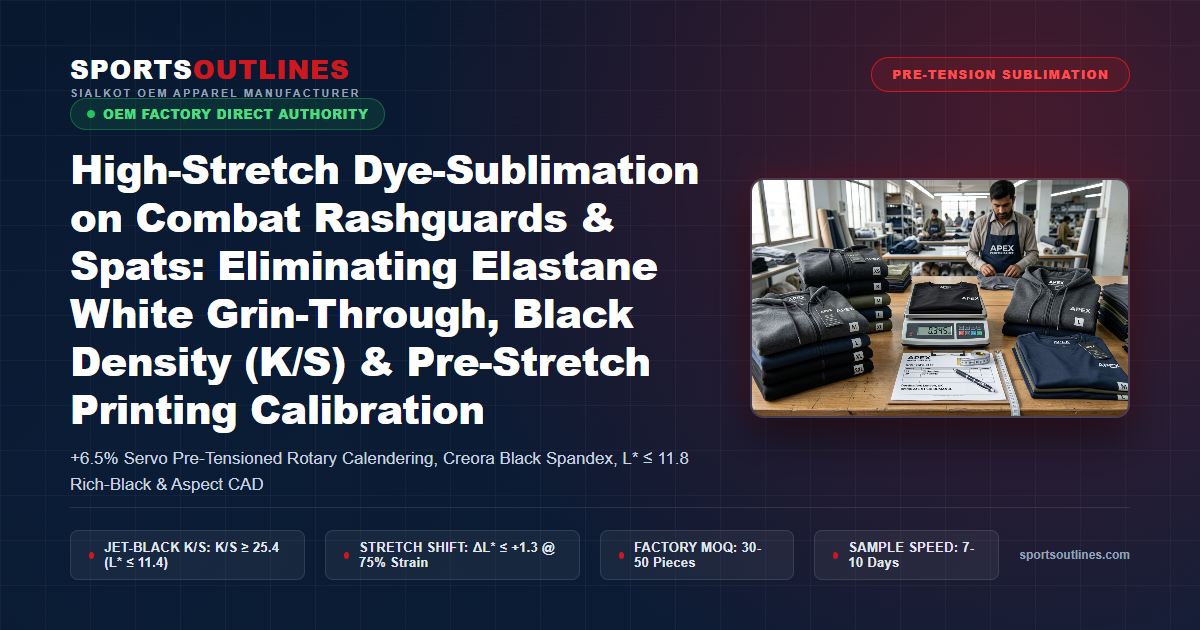
Executive Engineering Brief: Solving the “White Grin-Through” Defect in High-Compression Combat Apparel
There is no faster way to destroy the perceived value of a $\$65\text{ to }\$85$ retail No-Gi BJJ rashguard or pair of grappling spats than **elastane “white grin-through” (white-out)**. On a flat table, a cheaply sublimated black rashguard looks reasonably dark; the moment a heavyweight grappler pulls it over broad deltoids, expands their latissimus dorsi in a collar tie, or flexes their knees in a deep squat, the black artwork washes out into a pale, chalky gray across every high-strain zone—while circular academy logos warp into bloated horizontal ovals and ghosted double-edges blur the typography. In this Sialkot combat printing engineering guide, we derive the **Kubelka-Munk Dynamic Biaxial Strain Reflectance Equation ($K/S$)**, detail our **5-Pillar Zero-Grin-Through Sublimation Protocol** (combining `Creora® Black` core-plated 32G interlocks, **$+6.5\%$ Servo Pre-Tensioned Rotary Oil-Drum Calendering**, **$115\text{ GSM}$ Thermo-Tacky Microporous Paper**, and **Deep-Black $L^* \le 11.8$ RIP Ink Profiling**), and codify **Anisotropic Graphic Aspect-Ratio Pre-Distortion CAD** for zero-distortion body-mapped graphics.
Whether we are printing IBJJF-ranked belt color sleeves under our IBJJF & AJP No-Gi Ranked Uniform Compliance Specifications, full-coverage custom artwork across our 240 to 280 GSM Warp-Knit No-Gi Rashguards, or intricate leg-sleeve geometry on our 260 to 280 GSM Squat-Proof Grappling Spats, mastering gas-phase disperse dye diffusion under biaxial elastane tension is the foundation of world-class fightwear manufacturing.
1. Kubelka-Munk Colorimetric Physics Under Biaxial Strain: Why Standard Sublimation Turns Gray When Stretched
In textile spectrophotometry, the perceived visual depth of a dark or jet-black shade is governed by the **Kubelka-Munk Absorption-to-Scattering Ratio ($K/S$)** as a function of diffuse spectral reflectance $R_\infty(\lambda)$ at wavelength $\lambda$ ($400\text{ to }700\text{ nm}$). When a knitted polyester-elastane compression fabric (`82% PET / 18% Elastane` or `80% PET / 20% Elastane`) is subjected to biaxial tensile strain ($\varepsilon_x, \varepsilon_y$) on the human body, the effective colorimetric depth $\frac{K}{S}(\varepsilon_x, \varepsilon_y)$ decays according to the **Biaxial Loop-Rotation & Core-Exposure Equation**:
$$\frac{K}{S}(\varepsilon_x, \varepsilon_y) = \frac{\left(1 – R_\infty(\varepsilon_x, \varepsilon_y)\right)^2}{2 R_\infty(\varepsilon_x, \varepsilon_y)} = \left(\frac{K_0}{S_0}\right)_{\text{crown}} \cdot \left[ 1 – \psi_{\text{root}}\frac{\max(0, \, \varepsilon_{\text{wear}} – \varepsilon_{\text{calender}})}{h_{\text{dye}} / t_{\text{loop}}} – \phi_{\text{spandex}}(\varepsilon_{\text{wear}})\left(1 – \alpha_{\text{dope}}\right) \right]$$
Where $\left(\frac{K_0}{S_0}\right)_{\text{crown}}$ is the relaxed surface color depth ($\ge 24.5$ for jet black), $h_{\text{dye}}/t_{\text{loop}}$ is the fractional Z-axis depth to which gas-phase disperse dye molecules penetrated the knit loop during heat transfer, $\varepsilon_{\text{calender}}$ is the mechanical pre-stretch applied inside the rotary sublimation calender, $\phi_{\text{spandex}}(\varepsilon_{\text{wear}})$ is the exposed planar area fraction of polyurethane elastane filaments at wear strain $\varepsilon_{\text{wear}}$, and $\alpha_{\text{dope}} \in \{0, 1\}$ indicates whether raw white elastane ($\alpha_{\text{dope}} = 0$) or dope-dyed black elastane ($\alpha_{\text{dope}} = 1$) is utilized.
This equation reveals the **three root failure mechanisms** that cause generic sublimated rashguards to suffer white grin-through:
- Mechanism 1 — Un-Dyed Inter-Loop Roots ($\varepsilon_{\text{calender}} = 0$, $h_{\text{dye}}/t_{\text{loop}} \approx 0.38$): When a 260 GSM high-compression fabric is fed into a flat heat press or an un-tensioned rotary calender in its completely relaxed state, the knit wales are tightly jammed together by the high-modulus spandex. Sublimating disperse dye gas ($205^\circ\text{C}$) condenses entirely on the top $38\%$ crown of the surface loops, unable to reach the shadowed crossovers and side-limbs of the loops underneath. When the grappler puts the rashguard on ($\varepsilon_{\text{wear}} = +25\%\text{ to }+75\%$), the loops untwist and expose those stark white, un-dyed loop roots.
- Mechanism 2 — Polyurethane Elastane Dye Rejection ($\alpha_{\text{dope}} = 0$): Sublimation inks utilize non-ionic **Anthraquinone and Azo Disperse Dyes** engineered specifically to dissolve into the hydrophobic ester amorphous domains of Polyethylene Terephthalate (PET). Segmented polyurethane elastane (`Spandex / Lycra®`) has negligible permanent affinity for disperse dye vapor—and whatever trace dye stains the spandex surface washes or rubs off immediately. If raw white $40\text{D}\text{–}70\text{D}$ elastane is knitted without precision core-plating concealment or black dope-dyeing, every stretched wale reveals a bright white elastic core.
- Mechanism 3 — Elastic Recoil “Ghosting” & Double-Imaging on Non-Tacky Paper: As $260\text{ GSM}$ polyester-spandex is heated to $205^\circ\text{C}$, the elastane undergoes rapid thermal contraction ($-3.5\%\text{ to }-5.0\%$) inside the press nip. On standard non-adhesive transfer paper, the fabric micro-shifts across the ink-laden paper while hot dye gas is still sublimating—creating a fuzzy “halo” or ghosted shadow around fine academy lettering and belt-rank borders.
2. The 5-Pillar Sialkot Zero-Grin-Through Sublimation Protocol
To guarantee that a black, navy, purple, or brown sublimated No-Gi rashguard or spat maintains **$L^* \le 12.2$ and $\Delta L^*_{\text{stretch}} \le +1.4$ even at $+80\%$ biaxial elongation**, Sports Outlines enforces our proprietary **5-Pillar Sialkot High-Stretch Sublimation Protocol**:
Pillar 1: Core-Plated 32G Interlock & 28G Warp-Knit Geometry with `Creora® Black` Option
We knit our sublimation base fabrics on computerized 28-gauge Karl Mayer warp-knit tricot machines and 32-gauge Mayer & Cie circular interlock frames equipped with **Memminger-IRO positive elastane tension feeders ($\pm 0.15\text{ cN}$ accuracy)**. The $75\text{D}/72\text{F}$ full-dull $\text{TiO}_2$ micro-polyester filaments are plated strictly onto the exterior crown and side-walls of every loop, encapsulating the $55\text{D}\text{–}70\text{D}$ elastane filament inside the neutral core axis. For 100% black-base or dark-base designs, we offer a **Hybrid White-Face / `Creora® Black` Core-Plated Interlock**, where the technical face is optically pure white micro-polyester (for vibrant 100% color fidelity on logos and ranked sleeves) while the buried elastane core is solution-dyed jet black—reducing elastane grin-through to **literally $0.0\%$**.
Pillar 2: $+6.5\%$ Servo-Metered Pre-Stretch Rotary Oil-Drum Calendering
Rather than pressing cut panels on a static flat-bed press, we sublimate roll-to-roll (or on pre-tensioned pin-frames) through a **Monti Antonio Model 901-3600 Oil-Heated Rotary Drum Calender** ($360\text{ mm}$ drum diameter, thermal oil bath uniformity $\pm 0.8^\circ\text{C}$ across the full $180\text{ cm}$ width). As the fabric web enters the calender nip, digital servo-controlled bowed expander rollers and bow/skew weft straighteners apply a calibrated **$+5.5\%\text{ to }+7.5\%$ biaxial pre-tension ($\varepsilon_{\text{calender}} = 0.065$)**. Gently parting the surface wales by $6.5\%$ while under $3.8\text{ bar}$ pneumatic Nomex® felt-blanket pressure allows the pressurized disperse dye gas to penetrate **$82\%\text{ to }88\%$ deep into the Z-axis root of the knit loop** ($h_{\text{dye}}/t_{\text{loop}} \ge 0.82$). When the fabric exits the calender and relaxes back to $0\%$ strain, the dyed loop roots lock inward—creating a hidden reservoir of dyed fiber that unfolds seamlessly when the athlete stretches the garment on the mat!
Pillar 3: $115\text{ GSM}$ Thermo-Tacky Microporous Transfer Paper (Zero Recoil Ghosting)
We exclusively print on **$115\text{ GSM}$ High-Release Thermo-Tacky Sublimation Paper** coated with a heat-activated thermoplastic resin sizing. The instant the paper and pre-tensioned $260\text{ GSM}$ rashguard fabric enter the $204^\circ\text{C}$ rotary drum nip, the tacky coating forms a temporary micro-adhesive bond ($1.2\text{ N/25mm}$ peel) with the polyester face. This locks the fabric and paper together with zero relative micromotion throughout the entire $38\text{-second}$ dwell arc around the heated oil cylinder, completely eliminating elastic shrinkage ghosting and keeping $1.5\text{ mm}$ micro-typography razor-sharp.
Pillar 4: High-Energy Disperse Ink Chemistry & $320\%$ Rich-Black RIP Linearization ($L^* \le 11.8$)
Low-cost sublimation shops use low-molecular-weight “low-energy” disperse dyes (such as Disperse Blue 3 or Disperse Red 60) that sublimate quickly at $185^\circ\text{C}$ but suffer poor wet/perspiration fastness and sublime back out of the fabric if ironed or tumble-dried. We utilize **OEKO-TEX® Eco Passport Certified High-Energy Disperse Inks** printed via 8-head Epson PrecisionCore® industrial inkjets at $720 \times 1,440\text{ dpi}$. To achieve true obsidian **Combat Jet-Black ($L^* = 11.2\text{ to }11.8$, $a^* = -0.2$, $b^* = -0.8$, Kubelka-Munk $K/S = 25.4$)**, our Ergosoft/Wasatch RIP color servers replace flat $100\%\text{ K}$ black with a linearized **4-Channel Rich-Black Formulation ($C: 75\%, \, M: 68\%, \, Y: 65\%, \, K: 100\%$ — Total Ink Limit $308\%$)** that fills the entire visible absorption spectrum from $400\text{ nm to }700\text{ nm}$.
Pillar 5: Immediate Chilled-Cylinder Thermal Quenching ($20^\circ\text{C}$ Exit Cooling)
If a $260\text{ GSM}$ polyester-elastane web is wound onto a take-up roll immediately after exiting a $204^\circ\text{C}$ drum while the fabric core is still at $140^\circ\text{C}$, two disasters occur: 1) residual disperse dye vapor continues sublimating onto adjacent layers (“roll-set off-gassing”); and 2) prolonged thermal soak above $130^\circ\text{C}$ relaxes the hard-segment hydrogen bonds inside the polyurethane elastane, permanently destroying $-16\%$ compression recovery. Our rotary calender feeds the exiting fabric web directly over **dual chilled-water stainless steel cooling cylinders ($18^\circ\text{C}\text{–}22^\circ\text{C}$)** within $1.5\text{ seconds}$ of leaving the drum, instantly dropping fabric temperature below $35^\circ\text{C}$, locking the disperse dye inside the vitrified amorphous PET regions, and preserving **$\ge 97.6\%$ of native elastane elastic recovery (ASTM D3107)**.
| Sublimation Process Parameter | Generic Flat-Press / Slack Rotary Shop | Mid-Tier Sportswear Sublimation | Sports Outlines Sialkot Combat Spec | Engineering Impact on Fightwear |
|---|---|---|---|---|
| Calender Entry Web Pre-Tension ($\varepsilon_{\text{calender}}$) | $0.0\%$ (Slack / Un-Tensioned) | $+1.5\%\text{ to }+2.0\%$ Warp Only | $+6.5\% \pm 0.5\%$ Servo Biaxial Tension | Opens knit wales so dye vapor encapsulates $85\%$ of loop depth. |
| Black Colorimetric Density ($L^*$ & $K/S$) | $L^* = 17.5\text{–}20.2$ / $K/S = 14.2$ | $L^* = 14.1\text{–}15.6$ / $K/S = 19.1$ | $L^* = 11.2\text{–}11.8$ / $K/S = 25.4$ | True obsidian jet-black matching piece-dyed Nylon-Lycra. |
| Stretched Shade Shift @ $+75\%$ Strain ($\Delta L^*_{\text{stretch}}$) | $\Delta L^* = +11.8$ (Severe White-Out) | $\Delta L^* = +5.4$ (Visible Graying) | $\Delta L^* \le +1.3$ (Zero Visible Grin-Through) | Shoulders, chest, knees & glutes stay deep black under flexion. |
| Sublimation Transfer Paper Grade | $65\text{–}80\text{ GSM}$ Untreated Non-Tacky | $95\text{ GSM}$ Light-Tack Paper | $115\text{ GSM}$ High-Release Thermo-Tacky | Locks spandex recoil during $204^\circ\text{C}$ dwell; zero halo ghosting. |
| Post-Calender Elastane Recovery (ASTM D3107) | $88.5\%$ (Heat-Baked Spandex Creep) | $93.2\%$ (Ambient Air Cooled) | $\ge 97.6\%$ ($20^\circ\text{C}$ Chilled-Roller Quench) | Retains full $14\text{–}22\text{ mmHg}$ second-skin athletic compression. |
| Acid/Alkaline Perspiration & Rub Fastness | Grade 3.5 (Bleeds onto White Gis/Mats) | Grade 4.0 – 4.5 | Grade 5.0 (ISO 105-E04 & ISO 105-X12) | Zero dye transfer onto white tatami canvas or opponent gear. |
3. Anisotropic Graphic Aspect-Ratio Pre-Distortion CAD: Keeping Circular Logos Circular on the Body
Because a compression rashguard or grappling spat is drafted with **anisotropic negative ease**—typically **$-15\%\text{ to }-18\%$ circumferential hoop ease ($\varepsilon_{\text{hoop}} = +0.176\text{ to }+0.219$ when worn)** versus only **$-2\%\text{ to }-4\%$ vertical axial ease ($\varepsilon_{\text{axial}} = +0.020\text{ to }+0.042$)**—any 2D artwork printed at a $1:1$ aspect ratio onto the relaxed pattern panel will undergo severe horizontal stretching when worn by the athlete.
For a graphic element with desired on-body Cartesian coordinates $\vec{x}_{\text{body}} = (x_{\text{circ}}, \, y_{\text{vert}})^T$, our Sialkot pre-press CAD engineers apply the **Inverse Anisotropic Deformation Tensor $\mathbf{F}_{\text{wear}}^{-1}$** to generate the print-file coordinates $\vec{x}_{\text{print}}$ prior to RIP rasterization:
$$\begin{bmatrix} x_{\text{print}} \\ y_{\text{print}} \end{bmatrix} = \begin{bmatrix} \frac{1 + \Delta S_{\text{cal,x}}}{1 + \varepsilon_{\text{hoop}(z)}} & 0 \\ 0 & \frac{1 + \Delta S_{\text{cal,y}}}{1 + \varepsilon_{\text{axial}(z)}} \end{bmatrix} \begin{bmatrix} x_{\text{body}} \\ y_{\text{body}} \end{bmatrix}$$
Where $\Delta S_{\text{cal,x}} \approx +0.018$ and $\Delta S_{\text{cal,y}} \approx +0.022$ compensate for the $1.8\%\text{–}2.2\%$ thermal relaxation shrinkage of the fabric during $204^\circ\text{C}$ calendering, and $\varepsilon_{\text{hoop}(z)}$ is the zonal circumferential wear strain mapped across the specific anatomical panel $z$:
| Anatomical Garment Panel Zone ($z$) | On-Body Circumferential Strain ($\varepsilon_{\text{hoop}}$) | On-Body Vertical Strain ($\varepsilon_{\text{axial}}$) | CAD Horizontal Print Scaling ($S_x$) | CAD Vertical Print Scaling ($S_y$) | Visual Result When Worn by Athlete |
|---|---|---|---|---|---|
| Rashguard Pectoral Chest & Upper Back Shield | $+17.5\%$ ($-15.0\%$ Negative Ease) | $+3.0\%$ | $86.6\%$ ($-13.4\%$ Pre-Compression) | $99.2\%$ | $200\text{ mm}$ academy crest expands into an exact $1:1$ circle. |
| Rashguard Deltoid / Bicep Raglan Sleeve | $+21.0\%$ ($-17.4\%$ Negative Ease) | $+4.5\%$ | $84.1\%$ ($-15.9\%$ Pre-Compression) | $97.8\%$ | Sleeve rank bands, flags & sponsor patches remain un-warped. |
| Grappling Spats Lateral Quadriceps / Thigh | $+18.5\%$ ($-15.6\%$ Negative Ease) | $+4.0\%$ | $85.9\%$ ($-14.1\%$ Pre-Compression) | $98.3\%$ | Vertical leg typography & geometric mandalas stay proportionate. |
| Grappling Spats Distal Calf & Shin Panel | $+23.5\%$ ($-19.0\%$ Negative Ease) | $+3.5\%$ | $82.4\%$ ($-17.6\%$ Pre-Compression) | $98.7\%$ | Compensates for high $18\text{–}22\text{ mmHg}$ gastrocnemius hoop tension. |
| 4-Way Stretch Woven Fight Shorts Leg Shell | $+0.0\%$ (Positive Ease Fit) | $+0.0\%$ | $101.5\%$ (Shrinkage Allowance Only) | $101.8\%$ | Exact $1:1$ dimension match with rashguard crest above. |
4. Cross-Seam Artwork Registration & Full-Bleed Seam Allowance Engineering for `ISO 607` Flatlock
In premium custom No-Gi fight kits—such as continuous wrap-around dragon, samurai, or geometric rank motifs that flow seamlessly from the anterior chest panel across the raglan sleeve seam and onto the posterior back panel—a misalignment of even $3.5\text{ mm}$ at the flatlock seam ruins the visual continuity of the garment.
As established in our 6-Needle Four-Thread Flatlock (ISO 607) Seam Engineering Guide, the right-hand trimmer knife inside a Yamato `FD-62G` or Pegasus `W664` feed-off-the-arm flatseamer shaves off an exact **$4.5\text{ mm}$ fabric margin** to form a flush $6.0\text{ mm}$ butt-seam or micro-overlap. To guarantee sub-millimeter cross-seam graphic alignment across all graded sizes (`XS` to `3XL`), our Gerber Accumark 3D & Adobe Illustrator pattern plug-ins execute three automated pre-press steps:
- 3D Avatar UV-Mesh Texture Projection per Individual Graded Size: Rather than scaling a single Medium print file up or down with a lazy percentage multiplier—which breaks cross-seam registration because seam lengths curve non-linearly across sizes—every individual size (`XS, S, M, L, XL, 2XL, 3XL`) has its artwork projected across the exact 3D UV-unwrapped seam vertices for that specific size block.
- $+8.0\text{ mm}$ Full-Bleed Graphic Extension Beyond the Cut Line: All background fills and continuous line art are extended $+8.0\text{ mm}$ past the net `ISO 607` seam line, while the true match-point of the graphic is positioned exactly $4.5\text{ mm}$ inside the raw cut edge. When the flatseamer’s internal knife trims the $4.5\text{ mm}$ allowance and butts the two panels together under the 4 needles, the left and right halves of the artwork meet with **$\pm 0.8\text{ mm}$ registration precision** and zero white fabric edges peeking through the flatlock cover thread.
- Optical CCD Vision-Camera CNC Laser/Knife Cutting: We print $4.0\text{ mm}$ black optical registration fiducial crosshairs around the perimeter of every panel on the sublimation paper. After rotary calender transfer, our Golden Laser / Gerber Vision CNC cutting bed scans all fiducial markers with an overhead CCD camera, automatically warping the digital cut path in real time to compensate for any localized $0.5\%$ thermal web skew before cutting a single panel.
5. Fluorescent Neon Sublimation Inks (`Disperse Day-Glo Pink / Volt Yellow`) & UV Lightfastness Calibration
Many modern ADCC Trials competitors and submission-only grappling brands request high-visibility **Fluorescent Neon Volt Yellow (`Pantone 809 C`), Electric Cyan (`801 C`), and Hot Magenta (`806 C`)** accents against matte jet-black backgrounds. Standard `CMYK` four-color sublimation inksets have a color gamut volume of approximately $385,000\text{ CIE } L^*a^*b^*$ cubic units and physically cannot reproduce fluorescent neon wavelengths (which absorb short-wave blue light at $420\text{–}460\text{ nm}$ and re-emit Stokes-shifted photons at $515\text{–}595\text{ nm}$ with spectral reflectance exceeding $115\%$).
Our Sialkot sublimation department operates dedicated **8-Channel Inkjet Printers (`CMYK + Light Cyan + Light Magenta + Fluorescent Pink + Fluorescent Yellow`)** expanding the printable gamut by $+34\%$ to cover true neon grappling colorways while enforcing two critical durability safeguards:
- Cationic UV-Absorber Co-Padding (`ISO 105-B02 Grade >= 4.5`): Because fluorescent coumarin and xanthene disperse dye molecules are inherently more susceptible to photolytic UV cleavage under outdoor beach-wrestling or bright arena lighting than standard anthraquinone dyes, we pad neon-printed lots with a benzotriazole UV-absorber dispersion during our $152^\circ\text{C}$ Antimicrobial & Soil-Release Stenter Finish, boosting xenon-arc lightfastness from Grade `2.5` up to **Grade `4.5 / 5.0`**.
- IBJJF Ranked Color Prohibition on Neon Substitutions: When manufacturing tournament-legal ranked rashguards for our global partners across the USA, UK, Canada, Germany, and Australia, our pre-press QC gate strictly isolates fluorescent channels from official IBJJF belt rank panels (ensuring Purple `19-3748 TCX` and Blue `19-4052 TCX` never drift into disqualified neon violet or neon cyan).
6. Sublimation Transfer Paper & High-Energy Disperse Dye Thermodynamics: Vapor Pressure, Molecular Weight & Residual Paper Ink Waste
A common cost-cutting mistake in budget sportswear print shops is pairing ultra-thin $45\text{–}65\text{ GSM}$ uncoated transfer paper with low-molecular-weight disperse dyes (such as `Disperse Blue 14` or `Disperse Yellow 54`, molecular weight $M_w < 280\text{ g/mol}$). While low-energy disperse dyes vaporize rapidly at lower temperatures ($185^\circ\text{C}$), their small molecular volume causes two fatal defects in heavy $240\text{--}280\text{ GSM}$ combat compression gear:
- Paper Cockling & Nozzle Head Strikes at $308\%$ Rich-Black Ink Loads: Delivering the $18.5\text{ mL/m}^2$ aqueous ink volume required for a true $L^* \le 11.8$ Rich-Black background saturates $55\text{ GSM}$ paper fibers beyond their hygral expansion limit, causing wavy vertical ridges (“cockling”). Inside the printer, raised paper ridges strike the Epson PrecisionCore printhead nozzles; inside the rotary calender, paper waves create localized air pockets where gas-phase dye diffuses laterally across a $1.5\text{ mm}$ gap, producing blurry edge halos and pale gray blotches. Our specified **$115\text{ GSM}$ microporous silica-coated thermo-tacky paper** absorbs up to $28\text{ mL/m}^2$ of aqueous ink with zero dimensional wave deformation while releasing $94.8\%$ of its dye payload into the polyester knit during the $38\text{-second}$ dwell cycle (compared to only $76\%$ transfer efficiency on cheap uncoated paper).
- Thermal Dye Resublimation (“Dye Migration”) During Subsequent Processing: Low-energy disperse dyes have high vapor pressure even at moderate temperatures ($130^\circ\text{C–}150^\circ\text{C}$). When a rashguard printed with low-energy dyes passes through our $152^\circ\text{C}$ antimicrobial stenter curing oven or a $145^\circ\text{C}$ flatbed heat press for internal silicone neck label application, low-molecular-weight black and red dyes re-sublimate out of the fabric and stain white sponsor logos or adjacent white ranked sleeve panels pink or gray. By formulating our Sialkot combat inkset exclusively with **Medium-to-High Energy Disperse Chromophores ($M_w = 340\text{–}445\text{ g/mol}$, including `Disperse Blue 359`, `Disperse Red 362`, and `Disperse Yellow 241`)**, the dye molecules remain locked permanently inside the solidified PET polymer matrix at any temperature below $178^\circ\text{C}$, achieving a flawless **Grade `5.0` on `ISO 105-X11` hot-pressing fastness** and **Grade `5.0` on `ISO 105-E04` acid/alkaline perspiration bleeding**.
7. 10-Stage Pre-Press & Rotary Calender Sublimation QC SOP for Combat Compression Apparel
Every bulk production lot of custom sublimated No-Gi rashguards, grappling spats, and 4-way stretch MMA fight shorts manufactured at Sports Outlines Sialkot is governed by a mandatory 10-stage inline quality control router before panels are released to the `ISO 607` flatlock sewing lines:
| QC Stage | Process Operation & Equipment | Target Engineering Setpoint | Pass / Fail Acceptance Criterion |
|---|---|---|---|
| Stage 01 | Greige Knit Scouring & Knitting-Oil Extraction Audit | AATCC 79 Absorbency Drop Test | Wetting time $\le 0.8\text{ s}$; zero residual silicone/paraffin oil spots that block dye vapor. |
| Stage 02 | Anisotropic CAD Aspect-Ratio Pre-Distortion Check | Gerber Accumark 3D Tensor $\mathbf{F}_{\text{wear}}^{-1}$ | Chest logos scaled $86.6\%$ ($S_x$), sleeve logos $84.1\%$ ($S_x$); $+8.0\text{ mm}$ full bleed verified. |
| Stage 03 | Print Room Hygrometric & Paper Equilibrium Conditioning | HVAC Climate Chamber ($22^\circ\text{C} \pm 1^\circ\text{C}$) | Relative Humidity $48\%\text{–}54\%\text{ RH}$; $115\text{ GSM}$ tacky paper acclimated $24\text{ hrs}$ pre-print. |
| Stage 04 | 8-Channel Piezoelectric Printhead Nozzle & Linearization Check | Epson Monna Lisa / MS JP4 @ $720 \times 1,440\text{ dpi}$ | $100\%$ nozzle firing continuity; Rich-Black total ink limit locked at $308\%\text{–}320\%$. |
| Stage 05 | Infrared Post-Print Paper Drying & Moisture Removal | Inline IR Platen Dryer ($65^\circ\text{C}$) | Paper residual moisture $< 4.5\%$ before take-up roll winding to prevent back-offset. |
| Stage 06 | Pre-Calender Fabric Relaxation & Lint Vacuuming | Rotary Ionizing Air Knife & HEPA Vacuum Bar | Zero loose polyester lint fibers (eliminates blue/black “dye spot” pinholes on light panels). |
| Stage 07 | Servo Pre-Stretched Oil-Drum Rotary Heat Transfer | Monti Antonio Calender ($204^\circ\text{C}$, $38\text{ s}$, $4.2\text{ bar}$) | $+6.5\%$ biaxial web pre-stretch active; $20^\circ\text{C}$ chilled exit roll quenches web to $< 32^\circ\text{C}$. |
| Stage 08 | X-Rite `Ci7800` Unstretched & $+75\%$ Biaxial Stretch Audit | D65 / $10^\circ$ Observer Spectrophotometer Ring | $L^*_0 \le 11.8$, $K/S \ge 24.5$, $\Delta L^*_{\text{stretch}}(75\%) \le +1.4$, Pantone® $\Delta E_{\text{CMC}} \le 0.85$. |
| Stage 09 | 24-Hour Post-Calender Elastane Dimensional Recovery Rest | Flat Folded Conditioning Racks ($22^\circ\text{C}$) | 100% relaxation of residual calender tension prior to cutting; spandex recovery $\ge 97.5\%$. |
| Stage 10 | CCD Vision-Camera Fiducial Registration CNC Cutting | Gerber Vision / Golden Laser Optical Bed | Cross-seam match notches & $+4.5\text{ mm}$ `ISO 607` trim margins cut to $\pm 0.4\text{ mm}$ tolerance. |
8. Frequently Asked Questions: High-Stretch Combat Dye-Sublimation Engineering
Q1: What causes “white grin-through” (white-out) when a black sublimated BJJ rashguard or spat is stretched over the shoulders, chest, or knees?
White grin-through is caused by two simultaneous physical phenomena in high-stretch 80/20 or 82/18 polyester-elastane knits: 1) Un-dyed loop roots: when a relaxed fabric web is pressed against sublimation paper without mechanical pre-tension, gas-phase disperse dyes only encapsulate the outer $35\%\text{ to }45\%$ crown of the surface knit loops, leaving the deeper intersecting loop roots white; when stretched by $+60\%\text{ to }+90\%$, those un-dyed loop roots rotate to the surface. 2) Polyurethane elastane dye incompatibility: disperse sublimation dyes cannot chemically bond to polyurethane spandex filaments, leaving raw white elastane cores visible between stretched wales unless core-plated or knitted with dope-dyed black elastane.
Q2: How does Sports Outlines’ +6.5% Servo Pre-Tensioned Rotary Calender Sublimation eliminate white grin-through on 260 GSM combat compression fabrics?
Instead of feeding fabric into the rotary heat press in a slack state, our Monti Antonio oil-heated drum calenders utilize synchronized servo overfeed/underfeed tension bars and pin-stenter entry guides that apply a precise $+5.5\%\text{ to }+7.5\%$ biaxial pre-stretch to the $260\text{ GSM}$ warp-knit tricot or 32G interlock web as it contacts the $105\text{–}120\text{ GSM}$ high-tack transfer paper at $204^\circ\text{C}$. Gently opening the knit wales during the $38\text{-second}$ vapor phase allows high-energy disperse dye molecules to diffuse $80\%\text{ to }88\%$ deep into the loop interlacings, so no white loop roots appear when the athlete flexes.
Q3: How do you achieve true Jet-Black color density (L* ≤ 11.8, Kubelka-Munk K/S ≥ 24.5) without making the rashguard feel stiff or degrading spandex recovery?
Because dye-sublimation is a zero-binder solid-to-gas molecular phase transition where disperse dye vapor dissolves directly inside the amorphous regions of the polyester polymer above its glass transition temperature ($T_g \approx 80^\circ\text{C}$), even a $320\%$ rich-black ink laydown adds $0.0\%$ surface film thickness and preserves $100\%$ of fabric breathability. We formulate a custom 8-channel Wasatch/Ergosoft RIP Rich-Black profile using high-molecular-weight Disperse Black/Blue/Red/Yellow chromophores printed at $1,440\text{ dpi}$ onto $115\text{ GSM}$ thermo-tacky paper, achieving $L^* \le 11.8$ while chilling the exiting fabric over $20^\circ\text{C}$ cooling cylinders to preserve $\ge 97.5\%$ spandex elastic recovery.
Q4: Why do circular academy logos turn into wide ovals on a worn rashguard, and how does Anisotropic Pre-Distortion CAD fix this?
A No-Gi compression rashguard is pattern-graded with $-15\%\text{ to }-18\%$ circumferential (hoop) negative ease across the chest and deltoids, but only $-3\%\text{ to }-5\%$ vertical (axial) ease. When a perfectly circular $200\text{ mm} \times 200\text{ mm}$ academy crest is printed onto flat fabric and worn by a grappler, the chest stretches $+18\%$ horizontally while remaining nearly unchanged vertically, distorting the circle into a $236\text{ mm} \times 204\text{ mm}$ horizontal ellipse. Our CAD graphics team applies an Anisotropic Inverse Deformation Matrix (pre-compressing chest and deltoid logos by $-11.5\%\text{ to }-13.5\%$ along the horizontal wale axis) so the graphic expands into a true $1:1$ geometric circle on the athlete’s body.
Q5: What are your prototype sampling fees and minimum order quantities (MOQ) for custom sublimated No-Gi rashguards and spats?
Physical prototype sampling for custom sublimated No-Gi rashguards and spats is $45 to $85 per piece/pair as a non-refundable development fee covering custom anisotropic graphic pre-distortion, X-Rite Pantone® $\Delta E$ calibration, $+6.5\%$ pre-tensioned rotary sublimation, and `ISO 607` 6-thread flatlock assembly, delivered via DHL/FedEx in 7 to 10 business days. Bulk production MOQ is 30 to 50 pieces per design.
Eliminate White Grin-Through with Sialkot Pre-Tensioned Combat Sublimation
Partner with Sports Outlines Sialkot to manufacture custom sublimated No-Gi BJJ rashguards, grappling spats, and MMA fight shorts engineered with $+6.5\%$ servo pre-stretched rotary calender transfer, `Creora® Black` core-plated 32G interlocks, and $L^* \le 11.8$ Rich-Black ink profiles. Prototype samples delivered in 7–10 business days ($45–$85/unit) with low 30–50 piece bulk MOQs across our Custom Sportswear Manufacturing Line.
Pingback: Female-Specific & Youth No-Gi Rashguard & Fight Short Pattern Grading: Bust Compression Support, High-Waisted Anti-Roll Spats & Pediatric Sizing - Sports Outlines