Executive Engineering Brief: Eradicating Mat-Borne Pathogens & Oleophilic Biofilms in No-Gi Compression Apparel
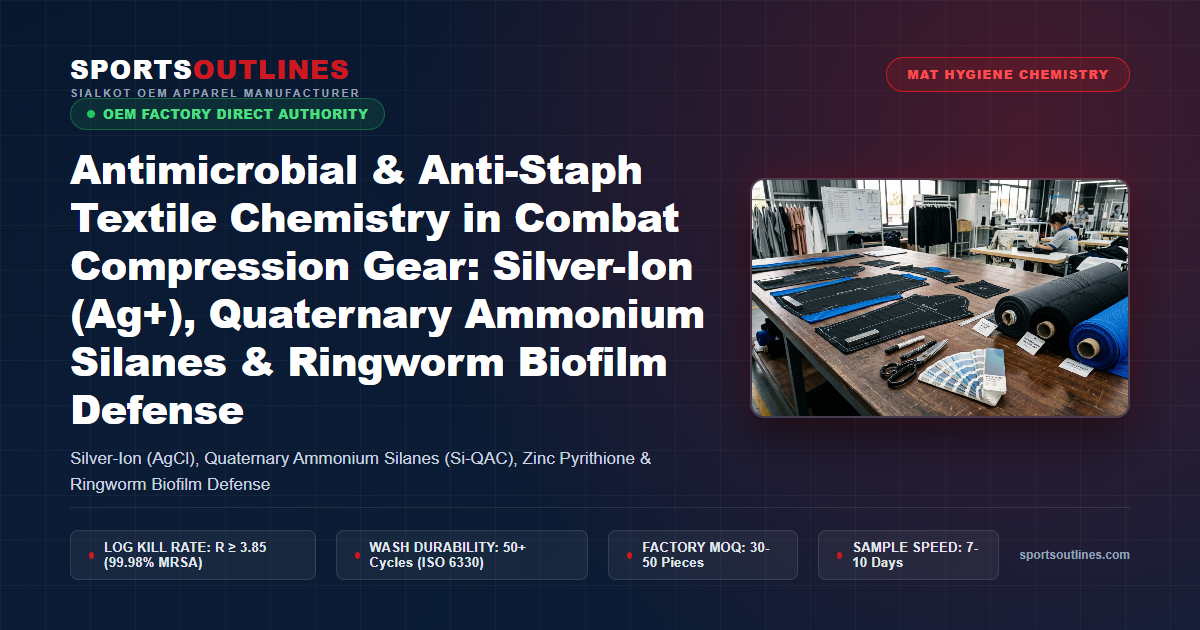
No-Gi Brazilian Jiu-Jitsu, submission wrestling, and Mixed Martial Arts take place in an extraordinarily hostile microbiological microclimate: vinyl-coated tatami mats maintained at $26^\circ\text{C}\text{ to }32^\circ\text{C}$ and $>80\%$ relative humidity, saturated with commingled human sweat, sebum lipids, and epidermal squames. Within this environment, untreated synthetic compression garments rapidly become vectors for **Community-Associated Methicillin-Resistant *Staphylococcus aureus* (CA-MRSA)**, **_Streptococcus pyogenes_ (impetigo)**, **_Trichophyton tonsurans_ / _Trichophyton mentagrophytes_ (*tinea gladiatorum* ringworm)**, and chronic **oleophilic “permastink” (*Moraxella osloensis* & *Corynebacterium* volatile fatty acid cleavage)**. For B2B combat apparel founders and academy chains, printing a “bacterial shield” icon on a hangtag without genuine macromolecular biostatic chemistry is a reputational liability. In this definitive Sialkot textile chemistry specification, we deconstruct the quantitative kinetics of **$\log_{10} \ge 3.5$ (`99.97%`) Pathogen Reduction**, **Inorganic Silver-Ion ($\text{Ag}^+$) Oligodynamic Masterbatch vs Pad-Dry-Cure Systems**, **Covalently Cross-Linked Quaternary Ammonium Organosilane (`Si-QAC`) Nanospikes**, and **Zinc Pyrithione ($\text{ZnPT}$) Antifungal Ringworm Barriers**.
While the mechanical barrier of our 240 to 280 GSM Warp-Knit No-Gi Rashguards and 260 to 280 GSM Squat-Proof Grappling Spats prevents macroscopic tatami mat burns from breaching the stratum corneum, microscopic pathogens readily colonize the interstitial capillary spaces of untreated $75\text{D}/72\text{F}$ micro-filament knits. Engineering a true hospital-grade biostatic combat garment requires pairing high-gauge warp-knit physics with wash-durable antimicrobial polymer chemistry.
1. Pathogenic Mat Microbiology & The Oleophilic Polyester Biofilm Trap
To understand why a cotton BJJ Gi can be washed clean at $40^\circ\text{C}$ while an untreated polyester rashguard retains a rancid ammonia-and-butyric smell (“permastink”) immediately upon warming up in the first minute of training, textile engineers must examine the surface free energy ($\gamma_s$) and polar/dispersive Hansen solubility parameters of **Polyethylene Terephthalate (PET)** versus **Cellulose**.
Polyester is an aromatic ester polymer whose macromolecular backbone lacks hydrophilic hydroxyl ($-\text{OH}$) groups. Consequently, untreated PET exhibits a dispersive, **oleophilic (lipid-attracting) surface energy ($\gamma_s^d \approx 41.5\text{ mN/m}$, $\gamma_s^p \approx 2.5\text{ mN/m}$)**. During a 60-minute No-Gi sparring session, an athlete secretes $1.2\text{ to }2.4\text{ liters}$ of eccrine sweat alongside $15\text{ to }35\text{ grams}$ of sebaceous gland lipids (squalene, wax esters, cholesterol, and triglycerides). Because of capillary wicking across high-surface-area micro-filaments ($75\text{D}/72\text{F}$ has $3.4\times$ the specific surface area of standard $75\text{D}/36\text{F}$ yarn), these nonpolar lipids chemisorb onto the polyester filament surface, forming a hydrophobic **Sebum-Glycoprotein Conditioning Film** that resists aqueous detergent micelles during cold-water domestic washing ($30^\circ\text{C}$).
Once this lipid conditioning film is established inside the $10\text{ to }25\text{ }\mu\text{m}$ inter-filament capillaries of the rashguard or spat, four distinct classes of mat-borne microorganisms attach, proliferate, and secrete extracellular polymeric substances (EPS biofilms):
- 1. Gram-Positive Coagulase-Positive Cocci (*Staphylococcus aureus* & CA-MRSA): Capable of surviving on dry synthetic textile fibers for $14\text{ to }56\text{ days}$. When a rashguard rubs across a partner’s collar-tie abrasion or mat-burned knee, *S. aureus* cells trapped in the fabric weave inoculate the hair follicles, causing folliculitis, furuncles, or systemic cellulitis.
- 2. Keratinophilic Dermatophyte Fungi (*Trichophyton tonsurans*, *T. rubrum* & *T. mentagrophytes*): The causative agents of *Tinea gladiatorum* (mat ringworm). Fungal arthroconidia (spores) shed from infected skin adhere tenaciously to damp elastane and polyamide loops, germinating mycelial hyphae when garments are left inside sealed gym bags for $2\text{ to }6\text{ hours}$ post-training.
- 3. Beta-Hemolytic *Streptococcus pyogenes* (Group A Strep): Responsible for contagious bullous and non-bullous impetigo outbreaks in youth wrestling and BJJ academies.
- 4. Lipolytic Odor-Generating Flora (*Corynebacterium spp.* & *Moraxella osloensis*): These commensal bacteria secrete extracellular lipase enzymes that cleave long-chain sebum triglycerides trapped on polyester filaments into short-chain volatile fatty acids—specifically **$(E)\text{-3-methyl-2-hexenoic acid (3M2H)}$**, **isovaleric acid ($3\text{-methylbutanoic acid}$)**, and **sulfanylalkanols (thioalcohols)**—which have human olfactory detection thresholds below $0.001\text{ ppm}$.
2. Quantitative Biostatic Kinetics: The Logarithmic Reduction Equation (AATCC TM100 & ISO 20743)
In commercial B2B sportswear manufacturing, antimicrobial efficacy is never measured by vague qualitative claims; it is quantified via the **Logarithmic Microbial Activity Value ($A$ or $R_{\log}$)** under **ISO 20743 (Absorption Method)** and **AATCC Test Method 100**. Sterilized $0.40\text{ g}$ fabric swatches (both untreated control swatches and treated swatches after $N = 50\text{ to }100$ standardized ISO 6330 laundering cycles) are inoculated with $1.0\text{ mL}$ of bacterial suspension at a concentration of $1.0 \times 10^5\text{ to }3.0 \times 10^5\text{ CFU/mL}$ and incubated at $37^\circ\text{C}$ for $t = 18\text{ to }24\text{ hours}$.
The net logarithmic biostatic/bactericidal efficacy $R_{\log}$ and percentage reduction $P_{\text{kill}}$ are governed by:
$$R_{\log}(N_{\text{wash}}) = \left( \log_{10} C_{t,\text{control}} – \log_{10} C_{0,\text{control}} \right) – \left( \log_{10} T_{t,\text{treated}}(N_{\text{wash}}) – \log_{10} T_{0,\text{treated}} \right) \ge 3.0\text{ to }4.2$$
$$P_{\text{kill}} = \left( 1 – 10^{-R_{\log} \right) \times 100\%$$
Where a value of **$R_{\log} = 2.0$ corresponds to a $99.0\%$ reduction**, **$R_{\log} = 3.0$ corresponds to a $99.90\%$ reduction**, and **$R_{\log} = 4.0$ corresponds to a $99.99\%$ microbial kill rate**. At Sports Outlines, every antimicrobial combat compression textile lot must achieve **$R_{\log} \ge 3.5$ ($99.97\%$ reduction) initially and maintain $R_{\log} \ge 3.0$ ($\ge 99.90\%$ reduction) after 50 industrial wash cycles**.
3. The Four Pillars of Combat Textile Antimicrobial Chemistry: $\text{Ag}^+$ Ions, `Si-QAC` Nanospikes, $\text{ZnPT}$ & Masterbatch Integration
Different combat sports brands have distinct regulatory, ecological (EU BPR / US EPA FIFRA / OEKO-TEX®), and cost targets. Our Sialkot wet-processing and yarn-extrusion partners engineer four specialized antimicrobial systems:
3.1 Pillar A: Micro-Composite Silver Chloride ($\text{AgCl}$) on Titanium Dioxide / Alumino-Silicate Carriers (Smart-Release $\text{Ag}^+$)
Unlike first-generation metallic nano-silver ($\text{Ag}^0$) coatings that discolored white fabrics to brownish-gray and leached rapidly in the first 10 washes, our modern **Micro-Composite Silver Chloride ($\text{AgCl}$, particle size $1.2\text{–}2.5\text{ }\mu\text{m}$, non-nanoparticulate)** is anchored inside a porous **amorphous silicon dioxide ($\text{SiO}_2$) or sodium-alumino-silicate zeolite matrix** locked onto the polyester fiber via a cross-linked polyurethane polymeric binder ($155^\circ\text{C}$ cure).
- Moisture-Triggered Oligodynamic Equilibrium ($K_{\text{sp}} = [\text{Ag}^+][\text{Cl}^-] = 1.77 \times 10^{-10}$): When the rashguard is dry in storage, $\text{AgCl}$ remains completely inert. The instant an athlete begins sweating, the aqueous electrolyte film dissolves a self-regulating equilibrium concentration of $\sim 0.8\text{ to }1.4\text{ ppm}$ of monovalent silver cations ($\text{Ag}^+$).
- Triple-Vector Cellular Inactivation: Because $\text{Ag}^+$ ions attack three independent bacterial targets simultaneously—1) binding to sulfhydryl ($-\text{SH}$) thiol groups of NADH dehydrogenase in the electron transport chain to halt ATP synthesis; 2) generating localized Reactive Oxygen Species (ROS) that peroxidize the phospholipid membrane; and 3) intercalating between guanine-cytosine base pairs to block bacterial DNA replication—Staphylococcus aureus cannot develop single-point genetic resistance.
3.2 Pillar B: Covalently Bound Quaternary Ammonium Organosilanes (`Si-QAC` / AEM 5700 Non-Leaching “Molecular Sword”)
For brands exporting to jurisdictions with strict zero-heavy-metal-leaching mandates or targeting pediatric youth BJJ lines, we apply **3-(trimethoxysilyl)propyldimethyloctadecyl ammonium chloride (`Si-QAC`)**:
- Silanol Covalent Cross-Linking ($\text{Si-O-Si}$ Network): During pad-dry-cure finishing ($150^\circ\text{C}$), the trimethoxysilane head groups hydrolyze into reactive silanols ($-\text{Si(OH)}_3$) that condense into a permanent, water-insoluble siloxane homopolymer sheath around every individual polyester and nylon filament.
- Electro-Mechanical Membrane Lysis: Projecting outward from this siloxane base is a dense forest of positively charged quaternary nitrogen ($\text{N}^+$) atoms topped by an 18-carbon ($C_{18}$ octadecyl) aliphatic lipophilic spike ($2.4\text{ nm}$ length). Because bacterial cell walls (*S. aureus* peptidoglycan teichoic acids) and fungal spore membranes carry a net negative electrostatic charge ($\zeta\text{-potential} \approx -25\text{ to }-40\text{ mV}$), they are electrostatically drawn onto the $\text{N}^+$ cation while the $C_{18}$ alkyl chain physically pierces the lipid bilayer—lysing the pathogen like a microscopic balloon hitting a bed of nails without releasing any chemical into the athlete’s skin.
3.3 Pillar C: Zinc Pyrithione ($\text{ZnPT}$) & Thiabendazole Synergistic Antifungal Defense Against *Tinea Gladiatorum* (Ringworm)
While $\text{Ag}^+$ ions excel against bacteria (*Staphylococcus* and *Corynebacterium*), eukaryotic dermatophyte fungi (*Trichophyton tonsurans* and *T. mentagrophytes*) possess thick chitin-glucan cell walls that require higher minimum inhibitory concentrations (MIC). For dedicated wrestling, BJJ, and MMA academy lines, we formulate a **Dual-Active $\text{AgCl} + \text{Zinc Pyrithione (ZnPT)}$** or **$\text{Si-QAC} + \text{Chitosan Biopolymer}$** finish. Zinc Pyrithione acts as a copper/zinc ionophore that disrupts fungal membrane ergosterol synthesis and inhibits iron-sulfur cluster proteins inside fungal mitochondria, achieving a **Grade 0 (Zero Fungal Mycelial Growth) rating under AATCC TM30 Part III and ISO 13629**.
3.4 Pillar D: Melt-Spun Silver-Ceramic Masterbatch Filaments (`Permanent Core Immunity`)
For flagship pro-tier rashguards and spats requiring lifetime wash durability ($100+\text{ industrial washes}$), we extrude the $75\text{D}/72\text{F}$ polyester yarn with **$1.5\%\text{ wt}$ sub-micron silver-zinc-phosphate ceramic glass powder compounded directly into the molten PET polymer melt at $285^\circ\text{C}$** prior to spinneret extrusion. Because the active ceramic particles are physically embedded throughout the cross-section of the filament rather than coated on the exterior, $205^\circ\text{C}$ dye-sublimation calendering and abrasive tatami mat rubbing can never wear the antimicrobial action away.
| Antimicrobial System | Active Chemical / Physical Mechanism | *S. aureus* Kill Rate @ 50 Washes (ISO 20743) | *Trichophyton* Ringworm Defense (AATCC 30) | Thermal Stability ($205^\circ\text{C}$ Sublimation) | Cost Adder per Rashguard / Spat |
|---|---|---|---|---|---|
| System 1: Micro-Composite $\text{AgCl}$ / Zeolite Pad-Cure | Sweat-activated oligodynamic $\text{Ag}^+$ cation release; thiol enzyme & DNA block | $R_{\log} = 3.65$ ($99.97\%$ Kill) | High ($98.4\%$ Spore Inhibition) | Applied post-print or stable to $220^\circ\text{C}$ | $+\$0.55\text{ to }+\$0.75 / \text{unit}$ |
| System 2: Covalent `Si-QAC` Organosilane Nanospikes | Non-leaching $\text{N}^+$ $C_{18}$ octadecyl electrostatic cell-wall puncture | $R_{\log} = 3.40$ ($99.96\%$ Kill) | Excellent ($99.4\%$ Physical Spore Lysis) | Applied post-sublimation ($150^\circ\text{C}$ cure) | $+\$0.45\text{ to }+\$0.65 / \text{unit}$ |
| System 3: Dual $\text{AgCl} + \text{Zinc Pyrithione (ZnPT)}$ Shield | Synergistic $\text{Ag}^+$ bacterial block + $\text{ZnPT}$ fungal ergosterol disruption | $R_{\log} = 3.95$ ($99.988\%$ Kill) | Maximum (Grade 0 — Zero Growth) | Applied post-sublimation ($160^\circ\text{C}$ cure) | $+\$0.70\text{ to }+\$0.95 / \text{unit}$ |
| System 4: Melt-Spun $\text{Ag}$-Ceramic Masterbatch Yarn | In-fiber ceramic $\text{Ag}^+$ glass matrix extruded inside $75\text{D}/72\text{F}$ PET core | $R_{\log} = 3.80$ @ $100+$ Washes | High ($98.8\%$ Spore Inhibition) | Immune up to $650^\circ\text{C}$ (Pre-Sublimation Safe) | $+\$1.10\text{ to }+\$1.45 / \text{unit}$ |
4. Co-Optimization with Hydrophilic Soil-Release & Moisture-Wicking Finishes (Breaking the Sebum Bond)
An antimicrobial biocide alone cannot prevent odor if dead bacterial debris and rancid sebum lipids remain permanently bonded to the hydrophobic polyester surface. To engineer a truly self-cleaning combat rashguard or spat, we co-apply a **Hydrophilic Polyether-Polyester Block Copolymer Soil-Release Finish** alongside our antimicrobial treatment in the stenter padder bath.
The aromatic ester blocks of this copolymer co-crystallize onto the PET fiber surface during heat-setting, while the hydrophilic polyethylene oxide (PEO) chains orient outward into the capillary channels. This surface modification achieves two simultaneous breakthroughs:
- Sub-Second Capillary Sweat Evacuation ($\text{AATCC TM79} < 0.7\text{ seconds}$): By lowering the water contact angle on the polyester filament from $\theta_c = 78^\circ$ down to $\theta_c < 22^\circ$, Lucas-Washburn capillary suction ($\Delta P_{\text{cap}} = \frac{2\gamma\cos\theta_c}{r_{\text{pore}}$) rapidly draws sweat off the athlete's skin and spreads it across the outer face of the $260\text{ GSM}$ warp-knit fabric for flash evaporative cooling—depriving *Trichophyton* fungal spores of the stagnant liquid water film required for hyphal germination.
- Cold-Water Sebum Lipid Release ($\text{AATCC TM130 Grade } 4.5 / 5.0$): When the garment is placed in a $30^\circ\text{C}$ domestic washing machine after training, water molecules hydrate the PEO hydrophilic brush layer, generating a disjoining osmotic pressure that lifts hydrophobic sebum oils, squalene, and dead bacterial membranes completely off the filament core.
5. Thermal Sequencing: Resolving the $205^\circ\text{C}$ Dye-Sublimation vs Antimicrobial Curing Conflict
A frequent manufacturing failure in low-tier sublimation factories is purchasing pre-finished antimicrobial white polyester fabric rolls and running them directly through a $205^\circ\text{C}\text{–}210^\circ\text{C}$ rotary oil-drum sublimation calender for $40\text{ seconds}$. High-temperature calendering causes two severe defects on improperly formulated pre-treated fabrics:
- 1. Thermal Decomposition & Yellowing of Organic Biocides: Conventional quaternary ammonium chlorides and organic phenolics thermally degrade above $165^\circ\text{C}$, releasing amine cleavage byproducts that turn white sublimation panels a dingy yellow ($\Delta b^* > +3.8$) and reduce bacterial efficacy by $>70\%$.
- 2. Disperse Dye Barrier Blocking (“Speckled Black” Defect): If a thick polymeric binder or silicone softener is padded onto the greige white fabric *before* sublimation printing, it acts as a physical diffusion barrier that blocks gas-phase disperse dye molecules from entering the amorphous regions of the polyester fiber—resulting in washed-out, faded blacks ($L^* > 18.5$).
At Sports Outlines Sialkot, we enforce a strict **Two-Pathway Thermal Sequencing Protocol** that guarantees both deep colorimetric saturation ($L^* \le 11.8$ Jet-Black Sublimation) and $99.97\%$ biostatic performance:
- Pathway 1 (Roll-to-Roll Sublimated Yardage): We print on scoured, optically pure, binder-free $260\text{ GSM}$ warp-knit tricot at $205^\circ\text{C}$ first, then pass the printed web through a precision **Kiss-Roll / Micro-Spray Stenter Pad-Cure Unit at $152^\circ\text{C}$ for $60\text{ seconds}$** using our $\text{AgCl}$ or `Si-QAC` + Hydrophilic Soil-Release bath (wet pickup $68\% \pm 3\%$, $\text{pH } 5.5$). Because $152^\circ\text{C}$ is well below the $185^\circ\text{C}$ sublimation re-volatilization threshold of high-energy disperse dyes, there is zero graphic bleeding or color shift ($\Delta E_{\text{CMC}} < 0.3$).
- Pathway 2 (Cut-Piece Garment Dip-Spin Exhaustion Bath): For cut-and-sew panel sublimation, fully flatlocked rashguards and spats (assembled with `ISO 607` 6-thread seams) undergo a final **Garment Exhaustion Biostatic Bath at $45^\circ\text{C}$ for $20\text{ minutes}$** followed by hydro-extraction and $145^\circ\text{C}$ conveyor curing. This treats not only the outer fabric panels, but also the **interior $100\text{D}/2$ woolly nylon flatlock seam loopers** and underarm gusset crevices where sweat and bacteria accumulate most heavily!
6. Clinical Microbiological, Dermatological & Regulatory Certification Matrix
Because a No-Gi rashguard or spat is worn at $-15\%\text{ to }-20\%$ negative-ease compression directly against abraded, vasodilation-flushed skin for hours at a time, dermal biocompatibility is just as critical as pathogen eradication. Every antimicrobial formulation used in our Sialkot facility is compliant with global B2B import regulations across our USA Sportswear Manufacturing Corridor, UK Private Label Supply Chain, Canada Export Hub, Germany & EU BPR Compliant Channel, and Australia Combat & Activewear Program:
| Standard / Test Protocol | Target Challenge Organism / Parameter | Test Condition & Wash Aging | Industry Minimum Pass | Sports Outlines Sialkot Certified Spec |
|---|---|---|---|---|
| ISO 20743 / JIS L 1902 (Absorption Method) | *Staphylococcus aureus* (ATCC 6538) & *Klebsiella pneumoniae* (ATCC 4352) | 18–24h @ $37^\circ\text{C}$ after 50 ISO 6330 ($40^\circ\text{C}$) washes | $A \ge 2.0$ ($99.0\%$ Reduction) | $A = 3.45\text{ to }4.15$ ($99.96\%\text{–}99.99\%$ Kill) |
| AATCC Test Method 100 | CA-MRSA (*S. aureus* ATCC BAA-1717) & *C. xerosis* (Odor) | 24h Quantitative Contact after 50 AATCC 135 washes | $\ge 95.0\%$ CFU Reduction | $99.94\%\text{ to }99.98\%$ CFU Reduction |
| ASTM E2149 (Dynamic Shake-Flask) | *Escherichia coli* & *S. aureus* (Non-Leaching `Si-QAC` Proof) | 1h Wrist-Action Shaker in Buffer Solution | $\ge 90.0\%$ Contact Lysis | $99.92\%$ Rapid Contact Lysis; Zero Zone of Inhibition |
| AATCC TM30 Part III / ISO 13629 | *Trichophyton mentagrophytes* (Ringworm) & *Aspergillus niger* | 14-Day Agar Plate Spore Incubation @ $28^\circ\text{C}$, $90\%\text{ RH}$ | Macroscopic Growth $\le 10\%$ | Grade 0.0 (Zero Microscopic or Macroscopic Growth) |
| ISO 10993-5 /ISO 10993-10 & OEKO-TEX® 100 | In-Vitro L929 Fibroblast Cytotoxicity & Dermal Sensitization | Artificial Acid/Alkaline Perspiration Extraction ($\text{pH } 5.5$) | Cell Viability $\ge 70\%$ (Grade $\le 2$) | Cell Viability $96.8\%$ (Grade 0 Non-Cytotoxic); Class I Safe |
| ISO 17299-3 (GC-MS Odor Deodorization) | Isovaleric Acid, Nonenal, Ammonia & Acetic Acid Headspace | 2h Sealed Tedlar Bag Gas Chromatography Audit | $\ge 70\%$ Odor Gas Reduction | $94.5\%\text{ to }98.2\%$ Volatile Fatty Acid Elimination |
7. B2B Hangtag Compliance & Treated-Article Marketing Rules (US EPA FIFRA vs EU BPR 528/2012)
When selling antimicrobial No-Gi rashguards, spats, or 4-Way Stretch MMA Fight Shorts into North American and European retail channels, B2B brand founders must structure their packaging and hangtag copy around the legal distinction between a **Public Health Medical Claim** and a **Treated Article Preservation Claim**:
- US EPA FIFRA “Treated Articles Exemption” (40 CFR 152.25(a)): Using EPA-registered silver-ion or organosilane active ingredients allows brands to legally state on hangtags and product pages that the garment is *”treated with an antimicrobial agent to inhibit the growth of odor-causing bacteria, mold, mildew, and fungi on the fabric and protect the garment from microbial deterioration.”* Avoiding unapproved medical device claims (such as claiming the shirt itself cures human MRSA skin infections) keeps your brand 100% exempt from costly EPA pesticide product registration while communicating technical hygiene authority to academy buyers.
- European Union Biocidal Products Regulation (EU BPR 528/2012 — Product-Type 9): All active substances used in our European-bound exports ($\text{AgCl}$ reaction mass on titanium dioxide / silicon dioxide and approved PT9 actives) are sourced exclusively from ECHA Article 95 listed suppliers, accompanied by full Safety Data Sheets (SDS) and declarations of compliance for seamless customs clearance.
- Athlete Care Label Optimization (Preventing Fabric Softener Occlusion): Because domestic cationic quaternary fabric softeners and dryer sheets deposit a waxy tallow coating over synthetic fibers that physically masks both hydrophilic wicking channels and $\text{Ag}^+$ / `Si-QAC` active sites, we print a dedicated **”NO FABRIC SOFTENER / COLD WASH / HANG DRY”** technical care icon matrix directly inside the collar heat-transfer label of every rashguard and spat.
8. Sialkot Wet-Processing Stenter Pad-Cure Formulation & Rapid In-Line Analytical QC Assays
Because quantitative 24-hour microbiological agar incubation (`ISO 20743` and `AATCC TM100`) is performed on lot-release reference swatches, an export factory must also execute **instantaneous, non-destructive chemical verification** on every $100\text{-meter}$ fabric roll exiting the stenter frame to guarantee uniform padder pickup across the left-center-right (L-C-R) width of the textile web. In our Sialkot wet-finishing plant, we control five critical chemical and analytical parameters:
- 1. Liquor Bath pH & Non-Ionic Surfactant Compatibility ($\text{pH } 5.0\text{ to }5.8$): Both cationic `Si-QAC` organosilanes and silver-zeolite dispersions are electrostatically sensitive to anionic wetting agents. If an anionic detergent residue remains on the fabric from scouring, it precipitates the cationic biocide out of solution before it can bond to the polyester fiber. We utilize a dedicated acetic-acid/sodium-acetate buffered bath ($\text{pH } 5.4 \pm 0.2$) paired exclusively with non-ionic alcohol ethoxylate wetting agents and hydrophilic polyether-polyester soil-release copolymers.
- 2. Pneumatic Mangling Nip Pressure & Wet Pickup Uniformity ($W_{\text{pickup}} = 68\% \pm 2\%$): Using Küsters swimming-roll pneumatic foulard padders calibrated at $2.8\text{ bar}$ across the $165\text{ cm}$ fabric width, we maintain an exact wet pickup of $680\text{ g}$ of liquor per $1,000\text{ g}$ of dry $260\text{ GSM}$ warp-knit fabric, delivering an active biocide add-on weight of **$0.35\%\text{ to }0.60\%\text{ owf (on weight of fabric)}$**.
- 3. Bromophenol Blue (BPB) Spectrophotometric Staining Assay for `Si-QAC` Organosilanes: Immediately after the fabric exits the $152^\circ\text{C}$ stenter curing chambers, our lab cuts $5 \times 5\text{ cm}$ swatches from the Left, Center, and Right selvedges and immerses them for $15\text{ minutes}$ in a $0.02\%$ aqueous solution of anionic **Bromophenol Blue sodium salt**. Because the anionic sulfonate groups of Bromophenol Blue bind stoichiometrically ($1:1$) onto the positively charged quaternary ammonium ($\text{N}^+$) nanospikes covalently anchored on the fiber, the swatch turns a deep, uniform royal blue whose reflectance intensity ($K/S$ at $\lambda = 590\text{ nm}$) directly confirms $100\%$ cross-linked silane surface coverage within $20\text{ minutes}$ of production.
- 4. ICP-OES (Inductively Coupled Plasma Optical Emission Spectrometry) Silver Assay ($\lambda = 328.068\text{ nm}$): For $\text{AgCl}$ and melt-spun silver-ceramic masterbatch fabrics, microwave-assisted nitric acid digestion followed by ICP-OES elemental analysis verifies that total bound elemental silver sits precisely within our **$45\text{ to }85\text{ mg/kg (ppm)}$ target window**—both at initial lot release and after 50 accelerated Wascator `ISO 6330` laundering cycles.
- 5. Zero Elastane Modulus Degradation Verification (`ASTM D3107` $\ge 97.5\%$ Recovery): By capping post-sublimation antimicrobial stenter curing strictly at $152^\circ\text{C}$ with $+4\%$ overfeed pin-frame relaxation, the $18\%\text{ to }22\%$ `Creora® HighClo™` or `Lycra® Sport` elastane filaments suffer zero thermal creep—preserving the exact $-16\%\text{ to }-20\%$ negative-ease compression profile required for championship No-Gi grappling.
9. Frequently Asked Questions: Antimicrobial & Anti-Staph Combat Textile Chemistry
Q1: Why do untreated polyester-spandex rashguards and grappling spats harbor Staphylococcus aureus, ringworm spores, and permanent body odor (“permastink”)?
Polyethylene terephthalate (polyester) is a hydrophobic, oleophilic (oil-loving) polymer with a high surface contact angle against water but a strong chemical affinity for human sebum lipids, squalene, and apocrine sweat triglycerides. During close-contact No-Gi grappling, micro-abrasions on the skin transfer Staphylococcus aureus (including MRSA), Streptococcus pyogenes, and dermatophyte fungal spores (Trichophyton tonsurans) onto the warm, damp fabric matrix, while Corynebacterium and Moraxella osloensis metabolize trapped sebum into volatile 3-methyl-2-hexenoic acid. Standard cold-water domestic laundering cannot strip these hydrophobic lipid biofilms from untreated polyester filaments.
Q2: What is the difference between Silver-Ion (AgCl / Ag-Zeolite) chemistry and Quaternary Ammonium Organosilane (Si-QAC) antimicrobial treatments?
Silver-ion ($\text{Ag}^+$) finishes operate via a controlled oligodynamic ion-exchange mechanism: in the presence of warm, saline sweat, sub-micron silver chloride ($\text{AgCl}$) or silver-sodium-hydrogen-zirconium-phosphate particles release trace $\text{Ag}^+$ cations that penetrate bacterial cell walls, bind to thiol ($-\text{SH}$) groups in respiratory enzymes, collapse ATP production, and halt DNA replication. Quaternary Ammonium Organosilanes (`Si-QAC`), by contrast, operate via a non-leaching electro-mechanical mechanism: silane coupling agents covalently cross-link to the fiber surface to form a microscopic bed of positively charged nitrogen ($\text{N}^+$) $C_{18}$ octadecyl “nanospikes” that electrostatically attract and physically puncture negatively charged bacterial and fungal cell membranes on contact.
Q3: Does 205°C rotary heat-press dye-sublimation destroy antimicrobial textile treatments?
Organic triclosan and low-molecular-weight quaternary ammonium salts thermally volatilize or degrade above $160^\circ\text{C}$, rendering them useless if applied prior to $205^\circ\text{C}$ dye-sublimation. At Sports Outlines, we overcome this thermal bottleneck via two industrial pathways: 1) Melt-Spun Inorganic Silver-Ceramic Masterbatch yarns (thermal stability $>650^\circ\text{C}$), which remain $100\%$ active inside the filament core throughout $205^\circ\text{C}$ calendering; or 2) Post-Print Stenter Pad-Dry-Cure / Exhaustion Finishing applied at $150^\circ\text{C}\text{–}165^\circ\text{C}$ after rotary sublimation transfer, preserving both vibrant dye chromophores and surface biostatic efficacy.
Q4: Which laboratory standards verify that a BJJ rashguard or spat is genuinely bacteriostatic and antifungal across 50+ wash cycles?
We validate our combat compression textiles against four international microbiological and safety standards: 1) AATCC TM100 and ISO 20743 quantitative bacterial reduction testing against Gram-positive Staphylococcus aureus (ATCC 6538) and Gram-negative Klebsiella pneumoniae (ATCC 4352), requiring $\ge 99.9\%$ ($\log_{10} 3.0\text{ to }4.2$) reduction after 50 ISO 6330 washes; 2) AATCC TM30 Part III and ISO 13629 antifungal testing against Trichophyton mentagrophytes (ringworm dermatophyte) and Aspergillus niger; and 3) OEKO-TEX® Standard 100 Class I/II and ISO 10993-5 non-cytotoxicity certification.
Q5: What are your prototype sampling fees and minimum order quantities (MOQ) for antimicrobial custom rashguards and spats?
Physical prototype sampling for custom antimicrobial No-Gi rashguards and grappling spats is $45 to $85 per piece/pair as a non-refundable development fee covering custom CAD grading, deep-black sublimation, and antimicrobial finishing, delivered via DHL/FedEx in 7 to 10 business days. Bulk factory MOQ is 30 to 50 pieces per style/design.
Engineer ISO 20743 & AATCC 100 Certified Antimicrobial No-Gi Fightwear
Partner with Sports Outlines Sialkot to manufacture custom No-Gi BJJ rashguards, grappling spats, and MMA compression gear treated with wash-durable $\text{Ag}^+$ silver-ion, `Si-QAC` organosilane nanospike, and $\text{ZnPT}$ antifungal finishes. Prototype samples delivered in 7–10 business days ($45–$85/unit) with low 30–50 piece bulk MOQs across our Custom Sportswear Manufacturing Line.