Direct Manufacturer Answer: How to Source Custom Vintage Wool Flannel Baseball Jerseys
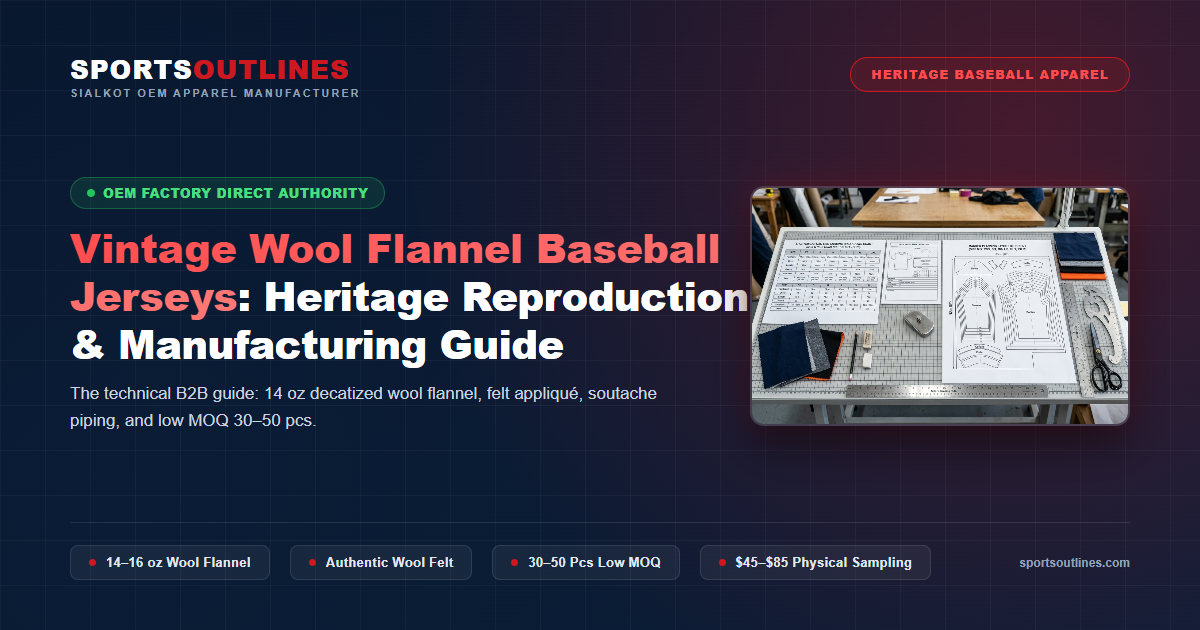
Manufacturing museum-grade authentic vintage wool flannel baseball jerseys (replicating 1900s to 1960s Golden Era aesthetics) requires heavyweight 14 to 16 oz (380–440 GSM) woven wool-blend flannel (typically 70% virgin wool / 30% poly-nylon core or 100% boiled wool) pre-shrunk via decatizing to eliminate post-tailoring shrinkage. Authentic heritage garments reject modern synthetic plastics in favor of 100% wool felt or rayon-cotton appliqué lettering, single-needle lockstitch borders, hand-guided chainstitch embroidery, custom-dyed woven soutache braid piping (6mm to 12mm), and genuine 4-hole melamine, bone, or horn buttons. Patterned with historical boxy torsos, dropped armholes, and ventilated underarm eyelet grommets, factory direct low MOQ in Sialkot, Pakistan starts at 30 to 50 pieces per style/colorway across Adult S to 4XL. Pre-production physical prototype samples cost $45 to $85 per piece delivered in 7 to 10 business days.
- Heritage Textile: 14–16 oz (380–420 GSM) Woven Athletic Wool Flannel in natural oatmeal, ecru, cream, or pin-striped bases.
- Lettering & Embellishment: Authentic 100% Wool or Rayon Felt Appliqué, laser-cut with single-needle zig-zag or lockstitch perimeter.
- Vintage Trims: Traditional woven soutache piping along placket, collar, and cuffs; authentic horn or resin buttons.
- Historical Patterns: Standup sun collars, zippered front options (Talon-style vintage brass), and underarm ventilation grommets.
- Factory Low MOQ: 30–50 pieces per design across standard adult sizing curves.
- Physical Prototype Sampling: $45–$85 per custom physical prototype in 7–10 days (strict zero credit/refund policy).
- Direct Factory Sourcing: WhatsApp factory direct at +92 316 7932595 or sportsoutlines.com.
There is an enduring reverence in athletic apparel that synthetic double-knit polyester and modern dye sublimation can never replicate: the substantial weight, textured warmth, and artisan soul of a genuine wool flannel baseball jersey. From the roaring 1920s barnstorming circuits and Negro Leagues to the golden mid-century eras of the 1940s and 1950s, baseball was played in pure woven wool.
In today’s global sportswear landscape, heritage baseball apparel has evolved into a high-margin, prestigious market segment. Independent streetwear labels, museum gift shops, vintage base ball leagues (VBBA), and luxury lifestyle brands seek authentic reproductions that capture the exact tactile drape, natural cream hues, felt typography, and historical tailoring details of original archive pieces. However, finding an overseas manufacturer capable of weaving true heavy flannel, sourcing authentic wool felt, and executing vintage needlecraft is exceptionally rare.
At Sports Outlines in Sialkot, Pakistan, our heritage tailoring and bespoke cut-and-sew workshops combine historic textile craftsmanship with precision laser cutting to manufacture authentic 1900s–1960s wool flannel baseball jerseys. This comprehensive technical B2B manufacturing guide breaks down wool-blend fiber chemistry, decatizing pre-shrinkage processes, felt appliqué vs synthetic tackle twill, soutache braid attachment, unit economics, and factory-direct low MOQ sourcing parameters.
1. Textile Chemistry of Authentic Baseball Flannel: Wool Blends vs Pure Virgin Wool
Original baseball flannels of the early 20th century were woven from pure, coarse sheep’s wool. While authentic, 100% unprocessed wool suffered from severe post-laundering shrinkage, felt heavy and scratchy against bare skin, and took days to dry after rain delays. In modern heritage reproduction manufacturing, apparel engineers balance historic authenticity with modern dimensional stability:
For professional heritage brands, our 14–15 oz (70/25/5 Wool/Poly/Nylon) blend is the global benchmark. The wool provides the unmistakable earthy drape, natural lanolin odor resistance, and tactile warmth of golden-era uniforms, while the texturized polyester and nylon core filaments provide high tensile strength and prevent the fabric from warping or stretching out under heavy embroidery.
2. Decatizing & Pre-Shrinkage Protocols: Preventing Flannel Distortion
Wool is a living, hydro-reactive protein fiber that exhibits natural dimensional instability. If raw woven wool flannel is cut and sewn directly from the bolt without pre-stabilization, subsequent steaming or dry cleaning will cause the wool shell to shrink while the synthetic thread and felt lettering remain stable, resulting in disastrous front-panel puckering and warped button plackets.
At Sports Outlines, all wool flannel bolts undergo our institutional Decatizing & Sponging Finishing Protocol prior to cutting:
- High-Pressure Steam Decatizing: Fabric rolls are fed through an industrial decatizing cylinder where superheated steam (115°C) penetrates the wool yarns under controlled mechanical tension. This releases residual spinning and weaving stresses within the fibers.
- Vacuum Cooling & Dimensional Setting: Powerful vacuum blowers instantly extract moisture and drop the fabric temperature, permanently setting the wool’s crystalline structure and locking in the fabric density.
- Relaxation Rest Period: Decatized fabric bolts are unrolled and laid flat on cutting tables in a climate-controlled room for a mandatory 24-hour relaxation period before pattern chalking. This guarantees that residual shrinkage in the finished garment is strictly held below 1.5%.
3. Embellishment Mechanics: 100% Wool Felt vs Modern Synthetic Tackle Twill
The single quickest giveaway of a cheap, low-grade reproduction is the use of shiny synthetic polyester tackle twill on a wool jersey. In the golden era, tackle twill did not exist. Letters and numbers were handcrafted from pressed wool or rayon felt:
At Sports Outlines, we cut authentic felt letters using precision CNC CO2 lasers. The laser produces clean, razor-sharp edges without singeing or burning the wool fibers. Each letter is positioned manually by master craftsmen and stitched onto the flannel using a dedicated single-needle vintage lockstitch inset exactly 1.5mm from the border, reproducing the hand-sewn craftsmanship of pre-war team tailors.
4. Heritage Hardware & Trims: Soutache Piping, Horn Buttons & Underarm Grommets
True vintage authenticity is achieved through exacting trim details:
- Woven Soutache Braid Piping: Vintage flannels feature narrow woven braids (typically 6mm to 10mm width) running down the button placket, circling the neck collar, and trimming the sleeve cuffs. Unlike printed stripes, genuine soutache is a flat, braided cord sewn with specialized twin-needle walking-foot sewing machines fitted with custom folder attachments that track curves without pulling or puckering.
- Authentic 4-Hole Buttons: Modern jerseys use cheap white plastic buttons. Vintage flannels demand authenticity: we supply custom-carved natural buffalo horn buttons, matte-finish melamine resin buttons in off-white/cream or team colors, and vintage cat’s-eye button silhouettes.
- Metal Eyelet Grommets: Because wool flannel is naturally warm, historical jerseys featured embroidered or enameled metal ventilation grommets (2 to 4 grommets per underarm) to allow body heat to escape from the armpit area. We install brass or enameled metal eyelets backed with reinforced inner twill tape.
- Zipper Front Closures (1930s–1940s Period): For teams replicating the iconic late-1930s look (such as the Chicago Cubs or Detroit Tigers who pioneered zipper fronts), we source custom antique brass or nickel Talon-style metal zippers with period-correct pull tabs and reinforced storm flaps.
5. Historical Collar Architectures: Standup Sun Collars vs Mandarin Bands
Depending on the specific decade being reproduced, the neckline construction varies substantially:
- The 1900s–1910s Standup Sun Collar: A high, folded-over collar that players could flip up to protect their necks from sunburn during scorching afternoon games before stadium roofs existed. Patterned with an interior collar stand and stiffened with canvas buckram.
- The 1920s–1930s Mandarin / Cadet Band: A clean, 25mm to 30mm vertical band collar that frames the neck without folding over. Often trimmed with contrasting soutache braid around the upper perimeter.
- The 1940s–1960s Classic V-Neckline: The collarless, scoop-neck placket that formed the foundation for modern baseball uniforms. Features a smooth, continuous curvature lined with soft cotton sateen neck facing to eliminate wool neck scratchiness.
6. Product Specifications Comparison Table
Compare technical factory engineering metrics across our vintage baseball jersey reproduction tiers:
7. Sizing & Pattern Drape: Historic Boxy Fits vs Modern Tailoring
Original flannels were cut with extreme roominess. Players wore heavy wool undershirts and long-sleeve sweatshirts underneath, resulting in broad chest measurements, deeply dropped armholes, and elongated sleeve lengths reaching past the elbow. For modern commercial reproduction, we offer two distinct pattern master blocks:
- Block A: The True Archival Vintage Cut: Patterned with an authentic 1930s boxy drape: +5 to +7 inches chest ease allowance, dropped shoulder seams, wide sleeve openings (22 cm flat), and full body length designed to be tucked into high-waisted wool knickers.
- Block B: The Modern Heritage Streetwear Cut: Tailored for contemporary casual and lifestyle wear: standard chest proportions (+3 to +4 inches ease), refined armhole height to prevent underarm bunching when worn over a t-shirt, and slightly shortened torso with a subtle curved shirttail hem suitable for untucked wear.
8. Industrial Manufacturing SOP & Artisan Craftsmanship Protocols
At Sports Outlines in Sialkot, our vintage flannel workshop follows an 8-stage artisanal manufacturing protocol to ensure authentic historical fidelity:
- Raw Wool Inspection & Decatizing: Inbound wool flannel rolls are inspected for yarn slubs, shade variation, and weaving irregularities. Rolls pass through our steam decatizer to permanently lock fiber dimension before cutting.
- Pattern Drafting & Manual Hand Cutting: Patterns are marked on decatized flannel with attention to pinstripe alignment. Master cutters hand-cut panels using high-speed Eastman straight knives to preserve the natural weave direction.
- Neck Placket & Cotton Facing Assembly: The collar and interior front plackets are lined with 100% preshrunk cotton sateen or muslin facing. This prevents the raw wool edge from irritating the wearer’s neck.
- Laser Cutting of Wool Felt Appliqué: Team scripts, city names, numbers, and sleeve patches are laser-cut from 100% wool or rayon felt sheets, yielding crisp edges without singeing.
- Manual Appliqué Sewing: Felt elements are pinned to the front panels and stitched using artisan single-needle lockstitch machines. Seamstresses follow historical typography spacing precisely.
- Soutache Braid Attachment: Woven piping braid is fed through dedicated twin-needle guide attachments, joining the placket edge with balanced stitch tension.
- Buttonhole & Button Attachment: Keyhole buttonholes are cut and bound with heavy corded thread. Genuine horn or melamine buttons are cross-stitched with 24-stitch security locks.
- Hand Ironing & Vintage Packaging: Garments are hand-pressed using heavy tailor’s irons, labeled with custom vintage-style woven damask labels, and packaged in premium garment bags.
9. Historical Barnstorming & Negro League Design Case Studies
Some of the most artistically daring, historically significant baseball uniforms ever created originated outside Major League Baseball—specifically within the Negro Leagues and independent barnstorming teams of the 1920s through the 1950s (such as the Kansas City Monarchs, Homestead Grays, and Pittsburgh Crawfords).
Because barnstorming teams traveled by bus through small towns and county fairs, their uniforms functioned as moving promotional billboards. They featured vibrant color palettes, multi-tone felt patchwork, and distinctive typographic treatments that defined athletic showmanship:
- Two-Tone Raglan Sleeves & Contrasting Flannel Panels: Barnstorming clubs frequently paired cream or natural oatmeal body panels with deep scarlet or royal blue wool sleeves, trimmed with triple-stripe soutache piping. Recreating these patterns requires careful grainline cutting to ensure wool shrinkage rates match across both panels.
- Hand-Guided Chainstitch Chenille Crests: Left-sleeve patches and cap monograms often featured looping chainstitch embroidery executed on vintage Cornely-style manual handle-operated embroidery machines. We replicate this textural chain loop stitching with precision computerized heads that emulate hand-loomed artisan thread flow.
- Split-Color Placket Scripting: In teams like the Monarchs, cursive script typography arched across the button placket, with letters split vertically down the center. When buttoned, the script aligns with zero visible seam break. At Sports Outlines, our laser alignment tables ensure that split script letters mate with ±0.5 mm accuracy across the placket.
10. Factory Sourcing Economics: Unit Costs, Physical Sampling & Low MOQ Rules
Vintage wool baseball jerseys command elite retail pricing in high-end lifestyle boutiques, museum collections, and collector stores, regularly retailing between $120.00 and $250.00 USD. Sourcing factory direct from our Sialkot production lines yields commanding 70%+ gross margins:
Rigid Physical Sampling & Low MOQ Invariants
To protect operational integrity and deliver dependable timelines, Sports Outlines enforces straightforward, non-negotiable production parameters:
- Physical Prototype Samples ($45 to $85 per piece): Every vintage flannel prototype requires pattern digitization, decatizing of sample wool yardage, laser cutting of multi-layer felt, and manual artisan needlecraft. We deliver fully functional physical prototypes within 7 to 10 business days via DHL/FedEx Express. Sample fees cover artisan labor and express courier transit and are non-refundable with zero sample credits.
- Factory Direct Low MOQ (30 to 50 pieces): Unlike heritage woolen mills requiring 300+ units, our agile artisan lines accommodate orders as small as 30 to 50 pieces per style/colorway, enabling boutique brands and museums to launch authentic collections without excessive capital risk.
- Mixed Sizing Distribution: You can distribute your order across any combination of Adult Small through Adult 3XL sizes.
11. Frequently Asked Questions (FAQ) & Technical Troubleshooting
Q1: How do you prevent wool flannel baseball jerseys from shrinking or warping after cleaning?
We subject all wool flannel bolts to our industrial steam decatizing process before cutting, locking in fiber dimensions and reducing residual shrinkage below 1.5%. Furthermore, all internal plackets are lined with preshrunk cotton facing. We recommend dry cleaning or cold hand washing followed by flat drying to preserve the garment’s heirloom lifespan.
Q2: Can you replicate rare historical baseball typography and sleeve patches accurately?
Yes. Our graphic division specializes in historical vector digitization from archive photographs, original game-worn garments, and baseball Hall of Fame documentation. We reproduce exact letterform kerning, distressed chainstitch textures, and period-correct felt color palettes.
Q3: Does the wool fabric feel itchy or uncomfortable against modern skin?
We engineer our 14 oz wool blend using fine, brushed merino-grade wool fibers combined with polyester, and we line the entire neckband, collar, and inner front placket with soft, preshrunk 100% cotton sateen facing. This creates a soft, luxurious hand-feel that prevents skin friction even when worn over a short-sleeve tee.
Q4: What is the sample prototype turnaround time for custom flannel jerseys?
Custom physical prototype samples cost between $45 and $85, completed and delivered within 7 to 10 business days via express courier. This allows brand founders to physically inspect the wool weight, felt stitching, and drape before committing to production.
12. The Semantic Silo Mesh & Direct Factory Production Funnel
Vintage wool flannel jerseys represent the pinnacle of diamond craftsmanship. Explore our companion technical manufacturing guides to build an entire heritage baseball program:
- Review modern varsity construction in our Custom Full-Button Baseball Jerseys Guide.
- Explore vintage hosiery pairings in our Custom Baseball Stirrups & 2-in-1 Socks Guide.
- Pair with heavy 320 GSM knickers via our Custom Baseball Pants & Knickers Manufacturing Guide.
- Equip players for cold dugouts via our Baseball Dugout Jackets & Batting Cage Pullovers Guide.
- Source institutional bulk orders across North America via our Sportswear Manufacturer USA Sourcing Portal.
- Browse full commercial team uniform lines in our Custom Sportswear Wholesale Catalog.
Manufacture Authentic Vintage Wool Flannel Jerseys with Sports Outlines
From 14 oz preshrunk wool flannel and laser-cut felt lettering to hand-placed soutache braid piping and horn buttons, we deliver heirloom craftsmanship, low 30–50 piece MOQs, and 7–10 day prototype physical sampling.