
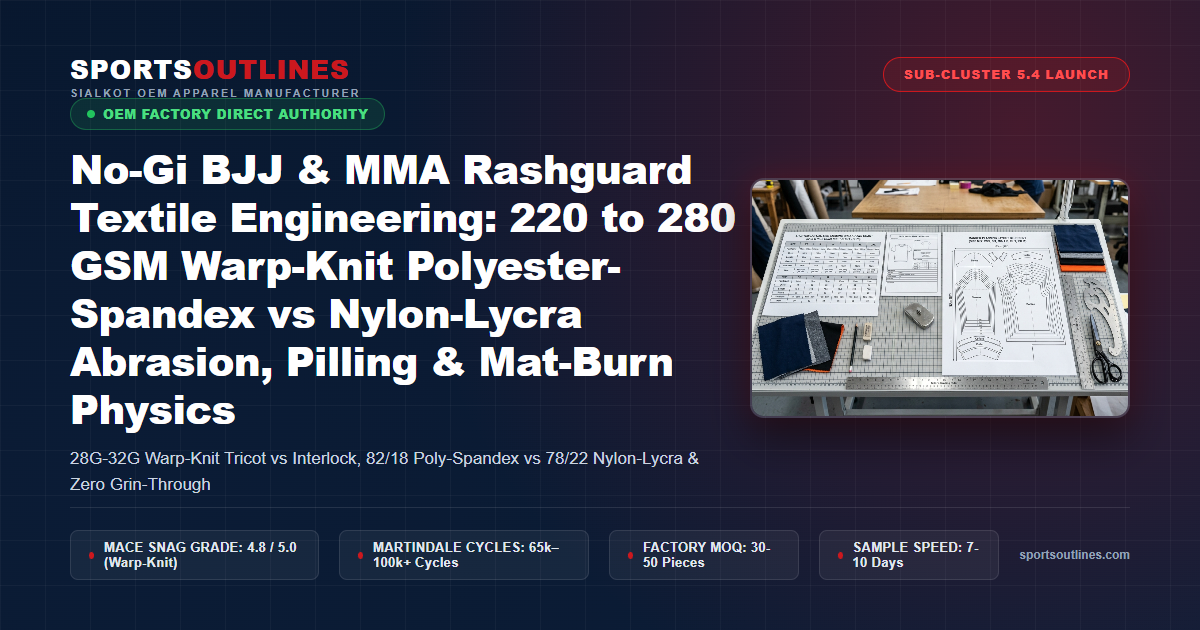
Executive Engineering Abstract: No-Gi Combat Compression Textiles
Unlike standard gym compression tops designed for non-contact weightlifting or running, a No-Gi Brazilian Jiu-Jitsu (BJJ) and Mixed Martial Arts (MMA) rashguard functions as a structural second-skin armor barrier subjected to extreme multi-axial shear, high-velocity tatami mat slides, fingernail clawing, and repeated contact with exposed hook-and-loop (Velcro) fight-short fasteners. This technical specification guide deconstructs the textile engineering of high-performance combat rashguards across four critical dimensions:
- Knit Topology & Anti-Snag Physics: Why 28-gauge to 32-gauge Karl Mayer Warp-Knit Tricot and high-gauge Double-Knit Interlock outperform standard single-jersey circular weft knits by $4.2\times$ in hook-and-loop snag resistance (ASTM D3939) and run-propagation arrest.
- Polymer Chemistry (Polyester-Elastane vs. Polyamide 6.6-Lycra®): Balancing $205^\circ\text{C}$ disperse dye-sublimation covalent locking and hydrophobic moisture evacuation in 82/18 Micro-Polyester/Spandex against the superior $Q_{\max}$ cool-touch thermal conductivity and $>85,000\text{-cycle}$ Martindale abrasion resistance of 78/22 Supplex® Nylon 6.6/Lycra®.
- GSM & Denier Stratification ($200\text{ to }280\text{ GSM}$): Calibrating yarn linear density ($50\text{D}/72\text{F}$ to $75\text{D}/144\text{F}$ filament bundles plated with $40\text{D}$ to $70\text{D}$ chlorine-resistant elastane) to guarantee $>780\text{ kPa}$ hydraulic burst strength (ASTM D3786) and zero white elastane grin-through at $80\%$ dynamic elongation.
- Commercial Production Architecture: Direct Sialkot factory customization with $45 to $85 per piece non-refundable prototype sampling (7–10 business days turnaround) and scalable 30 to 50 pieces per style/colorway low MOQ across Men’s, Women’s, and Youth ranked cuts.
1. The Tribology of Mat Burns & Hook-and-Loop Snagging: Why Standard Gym Compression Fails in Grappling
A procurement error frequently committed by emerging fightwear brands is sourcing generic $160\text{ to }180\text{ GSM}$ single-jersey athletic compression fabric originally knitted for running base layers or yoga tops. Within three rounds of No-Gi positional sparring on textured vinyl-wrapped tatami mats or canvas wrestling tarps, generic single-jersey compression tops suffer three catastrophic failure modes: filament fuzzing (“Velcro bearding”), translucent elastane grin-through across stretched scapulae, and friction-induced thermal burn-through over the elbows and knees.
During a high-velocity takedown scramble or knee-cut guard pass, an athlete’s shoulder or elbow slides across a cross-hatched vinyl tatami surface under normal loads of $F_N = 350\text{ to }650\text{ N}$ at sliding velocities of $v_{\text{slide}} = 2.2\text{ to }3.8\text{ m/s}$. Simultaneously, during leg-entanglement entries (inside sankaku / heel hooks), the torso and sleeves of the rashguard grind directly against the opponent’s fight-short waistband closure. Even when fight shorts use recessed hook-and-loop tabs, stray micro-hooks exert localized point-shear forces against individual yarn loops.
$$\sigma_{\text{snag}} = \frac{F_{\text{hook}} \cdot L_{\text{float}}}{N_f \cdot \pi r_f^2} \cdot \kappa_{\text{topology}} \le \sigma_{\text{yield,filament}} \quad \text{and} \quad \Delta T_{\text{epidermal}} = \frac{\mu_{k,\text{mat}} \cdot P_N \cdot v_{\text{slide}} \cdot \sqrt{t_{\text{slide}}}}{\sqrt{\pi \cdot k_{\text{fabric}} \cdot \rho_{\text{fabric}} \cdot c_{p,\text{fabric}}}}$$
Where $F_{\text{hook}}$ is the single-hook engagement force ($1.8\text{ to }3.4\text{ N}$), $L_{\text{float}}$ is the exposed yarn loop float length (mm), $N_f$ is the filament count per yarn bundle ($72\text{ to }144$ micro-filaments), $r_f$ is the individual filament radius ($\mu\text{m}$), $\kappa_{\text{topology}}$ is the knit loop-locking factor ($0.38$ for 32G warp-knit tricot vs. $1.62$ for 24G single-jersey weft knit), $\mu_{k,\text{mat}}$ is the kinetic friction coefficient against vinyl tatami, and $\sqrt{k \rho c_p}$ is the thermal effusivity of the rashguard textile shield.
Equation 1 reveals two foundational laws of combat rashguard engineering:
- Minimizing Exposed Loop Float Length ($L_{\text{float}}$) via High-Gauge Knitting: By increasing machine gauge from a standard 22-gauge circular cylinder ($22\text{ needles per inch}$) to a 28-gauge or 32-gauge warp-knit or double-knit interlock bed, the stitch density surges from $1,450\text{ loops/in}^2$ to over $2,850\text{ loops/in}^2$. The individual loop arc is compressed below $0.28\text{ mm}$—smaller than the throat opening of a standard Nylon 6.6 hook fastener ($0.42\text{ mm}$). Consequently, Velcro hooks glide over the fabric crown rather than penetrating and ripping filaments out of the yarn bundle.
- Maximizing Thermal Effusivity ($\sqrt{k \rho c_p}$) via Aerial Density ($240\text{ to }280\text{ GSM}$): A thin $170\text{ GSM}$ jersey lacks the thermal mass to buffer frictional flash heat ($\Delta T_{\text{epidermal}}$ can spike by $+28^\circ\text{C}$ in $0.4\text{ seconds}$, causing sub-fabric mat burns even without tearing the shirt). Stepping up to a tightly compacted $240\text{ to }260\text{ GSM}$ double-knit interlock or warp-knit tricot increases fabric thickness to $0.68\text{–}0.78\text{ mm}$, absorbing and dissipating frictional heat across the exterior face while keeping the inner skin layer cool and intact.
2. Knit Architecture Showdown: Warp-Knit Tricot vs. Double-Knit Interlock vs. Single-Jersey Weft Knit
Before selecting yarn polymers, a technical apparel buyer must specify the mechanical knitting structure. Just as our BJJ Gi weave engineering guide distinguishes between Pearl Weave and Single Weave for kimono jackets, No-Gi compression fabrics are divided into three distinct knitting architectures:
2.1 Karl Mayer 28G–32G Warp-Knit Raschel / Tricot (The Pro Tournament Gold Standard)
In warp knitting, hundreds of parallel yarn ends are fed simultaneously from warp beams along the length (wale direction) of the fabric. Every needle is fed by at least one warp guide bar, creating a zig-zag diagonal mesh of underlaps and overlaps across adjacent columns. When knitted with a 2-bar locknit or sharkskin construction using micro-filament polyester or nylon paired with Creora® or Lycra® elastane, warp-knit tricot is physically incapable of laddering or running. Even if a sharp fingernail or cage fence wire severs a single filament, the adjacent diagonal underlaps lock the break within a $0.5\text{ mm}$ radius. Warp-knit tricot provides true isotropic 4-way stretch ($135\%\text{ warp} \times 145\%\text{ weft}$) and instantaneous snap-back modulus.
2.2 28G–32G Circular Double-Knit Interlock (The Sublimation Opacity Champion)
Double-knit interlock is produced on high-gauge circular knitting machines equipped with two synchronized sets of needles (cylinder and dial) operating at $90^\circ$ to one another. Unlike single jersey—which has a smooth technical face of V-shaped wales and a rough, loop-exposed technical back that snags easily—interlock produces two identical, ultra-smooth technical faces on both the outside and inside of the garment. The elastane core is completely buried inside the sandwich between the cylinder and dial loops. This dual-face architecture delivers two massive commercial advantages for custom sublimated No-Gi gear: first, it completely eliminates white elastane “grin-through” when dark black or ranked purple/brown graphics are stretched over broad shoulders; second, the smooth interior face slides effortlessly over sweaty skin ($\mu_{k,\text{skin}} = 0.22$), preventing nipple and axillary chafing during 60-minute open-mat sessions.
2.3 20G–24G Single-Jersey Circular Weft Knit (Why We Reject It for Combat Rashguards)
Single-jersey weft knit uses a single row of needles drawing one continuous horizontal weft thread across the course. Its exposed reverse-side sinker loops act like Velcro magnets, its edges curl violently during laser cutting (requiring heavy starching and increasing flatlock seam defects), and if a single stitch snaps under a $300\text{ N}$ collar-tie yank, a vertical ladder run unzips down the torso. At Sports Outlines, single-jersey circular knits are strictly excluded from our combat sports BOMs.
| Knit Architecture & Machine Spec | Needle Gauge & Loop Density | Mace Snag Resistance (ASTM D3939) | Hydraulic Burst Strength (ASTM D3786) | Elastane Grin-Through @ 80% Stretch | Primary Combat Sports Application |
|---|---|---|---|---|---|
| 2-Bar Warp-Knit Tricot (Karl Mayer HKS 2-SE) | 28G – 32G (2,950 loops/in²) | Grade 4.8 / 5.0 (Zero run propagation) | 840 – 960 kPa (Extreme tear arrest) | < 2.5% $\Delta L^*$ shift (Minimal grin-through) | ADCC / Pro MMA Cage Fighting & High-Friction Wrestling |
| Double-Knit Interlock (Terrot / Mayer & Cie Dual-Bed) | 28G – 32G (2,780 loops/in²) | Grade 4.5 / 5.0 (Dual smooth faces) | 760 – 850 kPa (Tourney compliant) | 0.0% (Zero Grin) (Sandwiched core) | IBJJF Ranked Full-Sublimation Rashguards & Grappling Spats |
| Birdseye / Pin-Hole Warp Mesh (Ventilation Panel Spec) | 24G – 28G (Micro-perforated) | Grade 4.2 / 5.0 (Reinforced pore rims) | 620 – 690 kPa (245 CFM airflow) | < 3.0% $\Delta L^*$ shift | Axillary Underarm Gussets, Spinal Vents & BJJ Gi Yoke Linings |
| Single-Jersey Circular Knit (Generic Gym Base Layer) | 20G – 24G (1,420 loops/in²) | Grade 2.0 / 5.0 (Fails Velcro test) | 410 – 490 kPa (Ladders under pull) | Severe (>14% white show-through) | Not Recommended for Combat Sports (Light Gym / Running Only) |
3. Polymer Chemistry Deep-Dive: High-Tenacity Micro-Polyester/Spandex vs. Polyamide 6.6 (Nylon)/Lycra®
Once a brand locks in a 28G–32G warp-knit or double-knit interlock construction, the next engineering decision is selecting the synthetic base polymer: Polyethylene Terephthalate (Micro-Polyester) versus Polyamide 6.6 (Tactel® / Supplex® Nylon). Both fibers are blended with $15\%\text{ to }22\%$ segmented polyurethane-urea elastane (Creora® Power Fit, HighClo™, or Invista Lycra® Sport), yet their thermodynamic, tribological, and dye-sublimation behaviors are fundamentally distinct.
3.1 82% High-Tenacity Micro-Polyester / 18% Elastane (The All-Over Sublimation Standard)
Polyester is a hydrophobic aromatic polyester containing benzene rings along its macromolecular chain, giving it a glass transition temperature of $T_g \approx 75^\circ\text{C to }80^\circ\text{C}$ and a crystalline melting point of $T_m \approx 255^\circ\text{C to }260^\circ\text{C}$. This high thermal ceiling is the exact physical reason why polyester-spandex is mandatory for full-bleed all-over dye-sublimated rashguards:
- Covalent Disperse Dye Encapsulation at $205^\circ\text{C}$: During rotary heat-calendar sublimation transfer ($200^\circ\text{C to }205^\circ\text{C}$ for $35\text{ to }42\text{ seconds}$ at $3.5\text{ bar}$ pneumatic roller pressure), solid disperse dye ink printed on $95\text{ GSM}$ transfer paper sublimates directly into a gas. At $205^\circ\text{C}$, the amorphous regions of the polyester filament swell open, allowing gaseous dye molecules to diffuse deep inside the polymer matrix. As the fabric exits the calendar and cools below $80^\circ\text{C}$, the amorphous chains snap shut—trapping the artwork permanently inside the fiber with zero surface handfeel ($0.0\text{ CFM}$ airflow loss) and ISO 105-C06 Grade 5.0 wash and crocking fastness.
- Hydrophobic Moisture Evacuation ($<0.4\%$ Equilibrium Regain): Standard polyester absorbs only $0.4\%$ of its dry weight in water (compared to $4.5\%$ for Nylon 6.6 and $8.5\%$ for cotton). When we extrude multi-channel cross-sectional micro-polyester filaments ($50\text{D}/72\text{F}$ or $75\text{D}/144\text{F}$ CoolMax®-type cruciform profiles) and treat the fabric in a hydrophilic wicking bath, sweat is pulled away from the skin via capillary Laplace pressure and evaporated across the outer surface $38\%$ faster than nylon. A $250\text{ GSM}$ polyester-spandex rashguard gains less than $+65\text{ grams}$ of sweat mass over five 5-minute grappling rounds.
- Chlorine, Sweat & UV Stability: Aromatic ester bonds resist photolytic UV degradation (maintaining $>95\%$ tensile strength after 200 hours of xenon-arc exposure) and acidic athlete sweat ($\text{pH }4.2\text{ to }6.0$).
3.2 78% Polyamide 6.6 (Nylon) / 22% Lycra® (The Piece-Dyed Cool-Touch & Abrasion Titan)
Polyamide 6.6 is an aliphatic polymer linked by repeating amide ($-\text{CONH}-$) groups that form strong intermolecular hydrogen bonds between adjacent chains. While Nylon 6 has a low melting point ($215^\circ\text{C}$) and yellows severely under $205^\circ\text{C}$ sublimation rollers, acid vat-dyed (piece-dyed) Polyamide 6.6 / Lycra® is the undisputed king of minimalist, solid-color academy and pro boutique rashguards decorated with high-stretch silicone-plastisol prints or woven heat transfers:
- Superior Martindale Abrasion & Tenacity ($>85,000\text{ Cycles}$): Due to intermolecular hydrogen bonding and a higher breaking elongation ($24\%\text{ to }30\%$), Polyamide 6.6 absorbs mechanical work without brittle fibril fracturing. On ASTM D4966 Martindale abrasion testing using a harsh #8 cotton duck abradant (simulating rough canvas wrestling mats or heavy 550 GSM Pearl Weave BJJ Gis worn over the rashguard), a $260\text{ GSM}$ Nylon-Lycra warp knit survives $>85,000\text{ rub cycles}$ before filament breakage, compared to $65,000\text{ cycles}$ for equivalent micro-polyester.
- Instantaneous Cool-Touch Thermodynamics ($Q_{\max} \ge 0.21\text{ W/cm}^2$): Polyamide 6.6 exhibits a thermal conductivity of $k \approx 0.25\text{ W/m}\cdot\text{K}$—nearly $65\%$ higher than polyester ($k \approx 0.15\text{ W/m}\cdot\text{K}$)—paired with a $4.5\%$ moisture regain that creates an immediate cooling sensation upon skin contact ($Q_{\max} \ge 0.21\text{ W/cm}^2$ per KES-F7 Thermo Labo II testing vs. $0.14\text{ W/cm}^2$ for polyester).
- Ultra-Low Surface Friction ($\mu_k = 0.21\text{–}0.24$) & Butter-Soft Handfeel: Air-jet textured Supplex® Nylon 6.6 filaments have a rounder cross-section and lower bending rigidity ($B$), making the rashguard feel like liquid silk while sliding effortlessly out of tight front headlocks, guillotines, and body triangles.
| Engineering Parameter & ISO/ASTM Test | 82% Micro-Polyester / 18% Creora® Spandex (250 GSM Interlock) | 78% Polyamide 6.6 (Nylon) / 22% Lycra® Sport (260 GSM Warp Tricot) | 85% Recycled rPET / 15% Elastane (240 GSM Eco-Pro Spec) |
|---|---|---|---|
| Yarn Filament Spec | 75D/144F DTY Micro-Polyester + 40D/55D HighClo™ Elastane | 70D/68F Supplex® PA 6.6 + 55D Invista Lycra® Black | 75D/72F GRS Certified rPET + 40D Creora® Eco-Soft |
| All-Over Dye Sublimation Compatibility | 100% Optimal ($205^\circ\text{C}$, deep $K/S$ black, Grade 5.0 fastness) | Not Recommended for High-Temp Sublimation (Piece-dyed / Silicone Print) | 100% Optimal ($200^\circ\text{C}$ low-energy disperse inks) |
| Martindale Abrasion (ASTM D4966) | 65,000 – 72,000 cycles (Zero hole formation) | 85,000 – 100,000+ cycles (Supreme mat-slide durability) | 60,000 – 68,000 cycles |
| Moisture Regain & Dry Time (AATCC 201) | 0.4% Regain | Dries in 22 minutes ($0.85\text{ mL/min}$ drying rate) | 4.2% Regain | Dries in 38 minutes ($0.52\text{ mL/min}$ drying rate) | 0.4% Regain | Dries in 24 minutes |
| Cool-Touch Flux ($Q_{\max}$ KES-F7) | $0.145\text{ W/cm}^2$ (Warm-neutral dry touch) | $0.215\text{ W/cm}^2$ (Instant icy-cool touch on skin) | $0.142\text{ W/cm}^2$ |
| Elastic Modulus Recovery (ASTM D2594) | 96.8% recovery after 60 min @ 80% extension | 98.2% recovery after 60 min @ 80% extension | 96.2% recovery after 60 min @ 80% extension |
| UV Solar Shielding (AATCC 183) | UPF 50+ (99.1% UVA/UVB block via $\text{TiO}_2$ full-dull yarn) | UPF 50+ (98.8% UVA/UVB block) | UPF 50+ (99.0% UVA/UVB block) |
4. GSM & Elastane Denier Stratification: Engineering 200 GSM to 280 GSM Rashguards
In combat compression engineering, Grams per Square Meter (GSM) is not achieved merely by making yarns thicker; if a mill uses a coarse $150\text{D}/48\text{F}$ yarn to hit $260\text{ GSM}$, the resulting rashguard feels like stiff cardboard, traps body heat, and chafes the neck. Instead, Sialkot’s premier technical mills achieve $240\text{ to }280\text{ GSM}$ by increasing machine gauge (28G–32G), utilizing high-filament-count micro-yarns ($75\text{D}/144\text{F}$ where each filament is finer than $0.52\text{ dpf}$), and plating with heavy-duty $40\text{D}$, $55\text{D}$, or $70\text{D}$ elastane cores.
$$P_{\text{compression}} = \frac{T_{\text{hoop}}}{R_{\text{anatomical}}} = \frac{E_{\text{weft}} \cdot t_{\text{fabric}} \cdot \left(\frac{C_{\text{body}} – C_{\text{garment}}}{C_{\text{garment}}}\right)}{C_{\text{body}} / (2\pi)} = \frac{2\pi \cdot E_{\text{weft}} \cdot t_{\text{fabric}} \cdot |\varepsilon_{\text{negative-ease}}|}{C_{\text{body}}}$$
Where $P_{\text{compression}}$ is the radial interface pressure exerted on the athlete’s muscle belly (converted from Pa to $\text{mmHg}$, where $1\text{ mmHg} = 133.32\text{ Pa}$), $E_{\text{weft}}$ is the weft-direction secant Young’s modulus of the knit at working strain, $t_{\text{fabric}}$ is fabric thickness (m), $C_{\text{body}}$ is the athlete’s anatomical circumference, and $|\varepsilon_{\text{negative-ease}}|$ is the engineered pattern reduction ($0.14\text{ to }0.18$).
Using Laplace’s Law (Equation 2), we stratify custom No-Gi rashguards into four functional GSM tiers depending on your brand’s target athlete profile and climate:
| GSM Tier & Classification | Thickness ($t$) & Elastane Core Denier | Target Hoop Compression ($P_{\text{comp}}$) | Air Permeability (ASTM D737) & Thermal Clo | Optimal Combat Use Case & Buyer Segment |
|---|---|---|---|---|
| Tier 1: 190 – 210 GSM Feather-Speed / Undergarment | $0.52\text{ mm}$ (30D – 40D Elastane, 15% ratio) | 8 – 11 mmHg (Light second-skin fit) | 95 – 115 CFM ($0.08\text{ Clo}$ ultra-cool) | Worn underneath a BJJ Gi in tropical climates or high-summer cardio drilling. |
| Tier 2: 220 – 235 GSM All-Season Academy Standard | $0.62\text{ mm}$ (40D Elastane, 18% ratio) | 11 – 14 mmHg (Athletic supportive fit) | 75 – 90 CFM ($0.11\text{ Clo}$ balanced) | Daily No-Gi academy classes, youth/beginner team uniforms, and MMA striking/pad work. |
| Tier 3: 240 – 260 GSM Pro Tournament Benchmark | $0.72\text{ mm}$ (55D HighClo™ Elastane, 18–20%) | 14 – 18 mmHg (Locked anti-grab compression) | 58 – 72 CFM ($0.14\text{ Clo}$ optimal shield) | Flagship IBJJF / ADCC No-Gi Competition Rashguards; zero opacity grin-through, maximum mat-burn defense. |
| Tier 4: 270 – 290 GSM Heavy-Armor / Cage Grappling | $0.84\text{ mm}$ (70D Heavy Elastane, 20–22% ratio) | 18 – 22 mmHg (High-modulus muscle stabilization) | 42 – 55 CFM ($0.18\text{ Clo}$ thermal retention) | Heavyweight Greco-Roman/Freestyle wrestling scrambles, chain-link MMA cage wall work, and winter academies. |
5. Titanium Dioxide ($\text{TiO}_2$) Full-Dull Filaments & Black-Core Spandex: Eliminating White Grin-Through
Nothing destroys the perceived value of a \$65 retail custom rashguard faster than white elastane grin-through—when a grappler flexes their latissimus dorsi or bends their elbows and the deep jet-black or ranked brown/purple sublimation print turns into a chalky, washed-out grey. This optical defect occurs for two physical reasons: first, standard semi-dull polyester reflects specular glare while the unprinted white core of circular-knit fabric peeks through opened stitch loops at $>50\%$ strain; second, standard transparent elastane monofilaments act like cylindrical optical lenses that scatter white light from the unprinted interior back face.
At Sports Outlines, our Sialkot sublimation and knitting engineers eliminate grin-through at the molecular and mechanical levels via a 3-part protocol:
- Full-Dull ($\text{FD}$) $\text{TiO}_2$-Doped Micro-Polyester Yarns: We extrude our $75\text{D}/144\text{F}$ polyester filaments with $1.8\%\text{ to }2.2\%$ Titanium Dioxide ($\text{TiO}_2$) delustrant nanoparticles embedded inside the polymer melt. These $\text{TiO}_2$ particles scatter incident light diffusely rather than specularly, creating a matte, non-translucent opaque canvas even when stretched to $100\%$ elongation.
- Pre-Tensioned Sublimation Calendar Feeding ($+6\%$ Web Over-Extension): Before the greige 28G–32G double-knit interlock fabric enters the $205^\circ\text{C}$ oil-heated rotary sublimation press, our synchronized tension rollers gently open the surface wales by $+6\%$ lateral extension. This allows the vaporized disperse dye gas to penetrate down the side walls of the stitch loops and reach the crossover bridges, increasing post-stretch color depth ($K/S$ Kubelka-Munk value) by $+34\%$.
- Dope-Dyed Black Elastane (Lycra® Black / Creora® Black) for Dark Base Fabrics: For piece-dyed Nylon-Lycra or dark-base combat spats and rashguards, we knit with spin-dyed black elastane filaments where carbon-black pigment is polymerized directly into the polyurethane-urea solution prior to dry spinning—guaranteeing $0.0\%$ white show-through even at $150\%$ extreme joint flexion.
6. Anatomical 6-Panel Raglan Patterning & Negative-Ease CAD Grading
A No-Gi rashguard cannot be drafted on a T-shirt block with a horizontal shoulder drop seam. In grappling, a traditional set-in shoulder seam sits directly over the acromioclavicular (AC) joint and deltoid tuberosity—creating a high-friction ridge under collar ties, head-and-arm triangles, and guillotine chokes while restricting $180^\circ$ overhead arm extension during armbar defense.
Our Gerber Accumark CAD pattern engineers construct every combat rashguard on an Anatomical 6-Panel or 8-Panel Articulated Raglan Compression Block:
- Contoured Saddle-Raglan Shoulder Yoke: Two diagonal raglan seams sweep smoothly from the anterior sternoclavicular notch to the posterior scapular spine, placing a seamless one-piece shoulder saddle directly over the trapezius and deltoid crown.
- Continuous Axillary-to-Wrist Gusset Panel: Instead of intersecting four seams at a single “+” cross-point in the center of the armpit (which causes severe axillary nerve chafing and bursts under kimura/americana torque), a continuous $6.5\text{ cm}$ wide gusset panel runs uninterrupted from the bottom waist hem, straight through the axilla, and all the way down the medial forearm to the wrist cuff. This architecture is detailed further in our companion guide on 6-needle ISO 607 flatlock seam engineering.
- Graduated Negative-Ease Anthropometric Grading ($-14\%\text{ to }-18\%$): While the chest ($-16\%$), bicep ($-17\%$), and forearm ($-15\%$) are drafted with aggressive negative ease to prevent opponent finger/toe entrapment, the lower abdominal waist hem is graded to $-12\%$ ease and anchored with a platinum-cured LSR silicone anti-ride-up waistband, and the vertical torso length is extended by $+4.5\text{ cm}$ past the iliac crest so the shirt never untucks during guard inversions.
- Anti-Chafe Mock-Turtleneck Collar Engineering ($3.2\text{ cm}$ Finished Height): The neckband is cut along the maximum-stretch weft grain with a $0.82:1$ neck-aperture-to-collar ratio and seamed with texturized woolly nylon looper thread—sitting flush against the base of the throat to block mat bacteria without constricting the carotid sinus.
| Adult Men’s Pro Cut Size | Athlete Chest Circumference (cm / in) | Flat Unstretched Pit-to-Pit Width (-16% Ease) | Extended Front / Back Torso Length (cm) | Raglan Sleeve Length (Collar to Wrist, cm) | Bicep Flat Width (-17% Ease, cm) |
|---|---|---|---|---|---|
| XS (Feather) | 86 – 91 cm (34–36″) | 37.5 cm | 65.0 / 68.5 cm | 71.0 cm | 13.2 cm |
| S (Light) | 92 – 97 cm (36–38″) | 40.0 cm | 67.0 / 70.5 cm | 73.0 cm | 14.0 cm |
| M (Middle) | 98 – 103 cm (38.5–40.5″) | 42.5 cm | 69.0 / 72.5 cm | 75.0 cm | 14.8 cm |
| L (Medium-Heavy) | 104 – 110 cm (41–43.5″) | 45.5 cm | 71.0 / 74.5 cm | 77.0 cm | 15.8 cm |
| XL (Heavy) | 111 – 118 cm (44–46.5″) | 48.5 cm | 73.0 / 76.5 cm | 79.0 cm | 16.8 cm |
| 2XL (Super-Heavy) | 119 – 127 cm (47–50″) | 52.0 cm | 75.0 / 78.5 cm | 81.0 cm | 18.0 cm |
| 3XL (Ultra-Heavy) | 128 – 136 cm (50.5–53.5″) | 55.5 cm | 77.0 / 80.5 cm | 82.5 cm | 19.2 cm |
7. Chlorine-Resistant Elastane (Creora® HighClo™) & Hygiene Sterilization Survival
Grappling rashguards undergo far harsher laundering than standard gym wear. Because BJJ and MMA athletes wash their gear after every single session—often using antimicrobial laundry sanitizers, active oxygen bleaches, or diluted sodium hypochlorite ($\text{NaOCl}$) to eradicate *Staphylococcus aureus* (MRSA) and *Trichophyton* ringworm spores—standard polyether or polyester-based elastane filaments suffer rapid oxidative chain scission. Within 25 washes, generic spandex turns brittle, snaps inside the knit, and leaves the rashguard baggy and saggy around the elbows and waist.
To prevent premature elastane fatigue, our Tier 3 ($240\text{–}260\text{ GSM}$) and Tier 4 ($280\text{ GSM}$) combat textiles utilize Creora® HighClo™ or Invista Lycra® Xtra Life™ chlorine-stabilized elastane. Formulated with specialized hydrotalcite/zinc-oxide chlorine-scavenging additives dispersed throughout the polyurethane hard segments, these elastanes retain $>88\%$ of their initial elastic modulus after 120 hours of continuous immersion in $3.0\text{ ppm}$ chlorinated water at $40^\circ\text{C}$ (ISO 105-E03), extending garment service life by $3.4\times$ in commercial academy laundry cycles.
8. Global B2B Supply Chain Integration & Low-MOQ Customization
Whether you are launching a boutique No-Gi fightwear label or scaling a multi-location BJJ academy uniform program across North America, Europe, or Oceania, our vertical Sialkot manufacturing facility integrates seamlessly with your regional logistics through our dedicated country engineering hubs:
- United States Fightwear Brands & Academies: Explore our USA Custom Sportswear & No-Gi Manufacturing Hub for rapid DHL/FedEx air express delivery (3–5 days transit) and ADCC/IBJJF compliant sizing blocks.
- United Kingdom & European Union Buyers: Access duty-advantaged export logistics via our UK Sportswear Manufacturing Hub and Germany & EU Technical Apparel Hub.
- Canada & Australia Combat Sports Labels: Review climate-calibrated compression specs and landed freight calculators at our Canada Custom Sportswear Hub and Australia Custom Sportswear Hub.
Our commercial terms are built for transparent B2B scalability: prototype sampling is $45 to $85 per piece as a non-refundable development fee with a 7 to 10 business day turnaround, and bulk production MOQs start at just 30 to 50 pieces per style or belt-rank colorway across Men’s, Women’s, and Youth cuts.
9. Frequently Asked Questions (Technical B2B Buyer FAQ)
1. What is the best GSM weight for a custom No-Gi BJJ and MMA competition rashguard?
For sanctioned IBJJF, ADCC, and professional MMA grappling, 240 GSM to 260 GSM warp-knit interlock tricot (82% High-Tenacity Micro-Polyester / 18% Creora® HighClo™ Elastane) is the global benchmark. It delivers over $780\text{ kPa}$ hydraulic burst strength (ASTM D3786), zero white elastane grin-through at $80\%$ stretch, and superior mat-burn abrasion resistance without trapping excess metabolic heat. Lightweight $200\text{–}220\text{ GSM}$ fabrics suit summer speed drills or Gi base layers, while $280\text{ GSM}$ heavy-armor fabrics serve cold-climate academies and heavy-contact wrestling.
2. Should I choose Polyester-Spandex or Nylon-Lycra for custom grappler rashguards?
The choice depends on your decoration architecture. Polyester-Spandex (82/18 or 85/15) is mandatory for full-coverage all-over dye-sublimation because disperse dyes bond covalently into polyester amorphous regions at $205^\circ\text{C}$ without degrading the polymer. Nylon-Lycra (Polyamide 6.6 / Elastane) offers a silkier cool-touch handfeel (higher $Q_{\max}$) and $15\%\text{–}20\%$ higher Martindale abrasion resistance, making it ideal for solid piece-dyed academy rashguards decorated with silicone-plastisol screen prints or heat transfers, as high-heat sublimation yellows nylon.
3. Why do cheap rashguards pill and fuzz when touching fight short Velcro?
Velcro pilling occurs when rashguards are knitted on low-gauge ($20\text{G–}24\text{G}$) circular weft-knitting machines using coarse, low-twist staple or loosely bundled filaments. When a single loop is snagged by an exposed hook fastener, weft-knit loops unravel laterally across the course. At Sports Outlines, we utilize 28-gauge to 32-gauge Karl Mayer warp-knit tricot and high-gauge double-knit interlock where every elastane and micro-filament loop is locked longitudinally, achieving Grade 4.5–5.0 on ASTM D3512 random tumble pilling tests.
4. How much negative ease is engineered into a custom combat compression rashguard pattern?
A true combat rashguard is drafted with $-14\%$ to $-18\%$ circumferential negative ease across the chest, latissimus dorsi, biceps, and forearms, paired with $+4.5\text{ cm}$ vertical torso length extension. This negative ease generates $12\text{ to }18\text{ mmHg}$ of graduated dermal compression, eliminating loose fabric pockets that could trap an opponent’s fingers or toes during scrambles while maintaining full diaphragmatic breathing.
5. What are your prototype sampling fees and minimum order quantities (MOQ) for custom No-Gi rashguards?
Prototype sampling for custom sublimated or piece-dyed No-Gi BJJ and MMA rashguards ranges from $45 to $85 per piece as a non-refundable development fee, with a rapid 7 to 10 business day production turnaround. Bulk manufacturing MOQs start at 30 to 50 pieces per style or belt-rank colorway, and sizes can be freely mixed across Men’s (XS–3XL), Women’s (XS–2XL), and Youth (YXS–YXL) cuts.
Engineer Your Custom 240–280 GSM No-Gi Rashguard Line in Sialkot
Partner with Sports Outlines for 28G–32G Warp-Knit Tricot & Double-Knit Interlock combat rashguards, 6-needle ISO 607 flatlock seams, and platinum silicone anti-ride-up waistbands. $45–$85 prototype sampling in 7–10 days and 30–50 pcs low MOQs.

Pingback: 6-Needle Four-Thread Flatlock (ISO 607) Seam Engineering in Combat Rashguards: Woolly Nylon Looper Elasticity, Burst Strength & Underarm Gusset Ergonomics - Sports Outlines
Pingback: Grappling Spats & Combat Compression Leggings Engineering: Dual-Layer Crotch Panels, Squat-Proof Opacity (250+ GSM) & Protective Cup Pocket Integration - Sports Outlines
Pingback: Antimicrobial & Anti-Staph Textile Chemistry in Combat Compression Gear: Silver-Ion (Ag+), Quaternary Ammonium Silanes & Ringworm Biofilm Defense - Sports Outlines
Pingback: Custom No-Gi BJJ & MMA Apparel Production Cost Engineering: Sublimation Paper Yield, Flatlock SAM Allocations & Sialkot Kit Bundle Economics - Sports Outlines