Why Unstructured Apparel Sampling Bleeds Capital: Engineering First-Time-Right Tech Packs, Eliminating the $3,000 Revision Loop & Maximizing 30–50 Piece Split-Size MOQ ROI
Over 68% of independent activewear, streetwear, and combat sports startups burn through 40% to 60% of their initial launch capital before a single bulk garment ever reaches their online store. The culprit is rarely the unit cost of bulk manufacturing; rather, it is the “$3,000 Prototype Revision Loop”—an endless cycle of vague moodboards, guessed measurements, incompatible fabric pairings, four to five rounds of corrective sampling across a 5-SKU capsule, accumulated DHL air-courier bills, and missed seasonal retail windows.
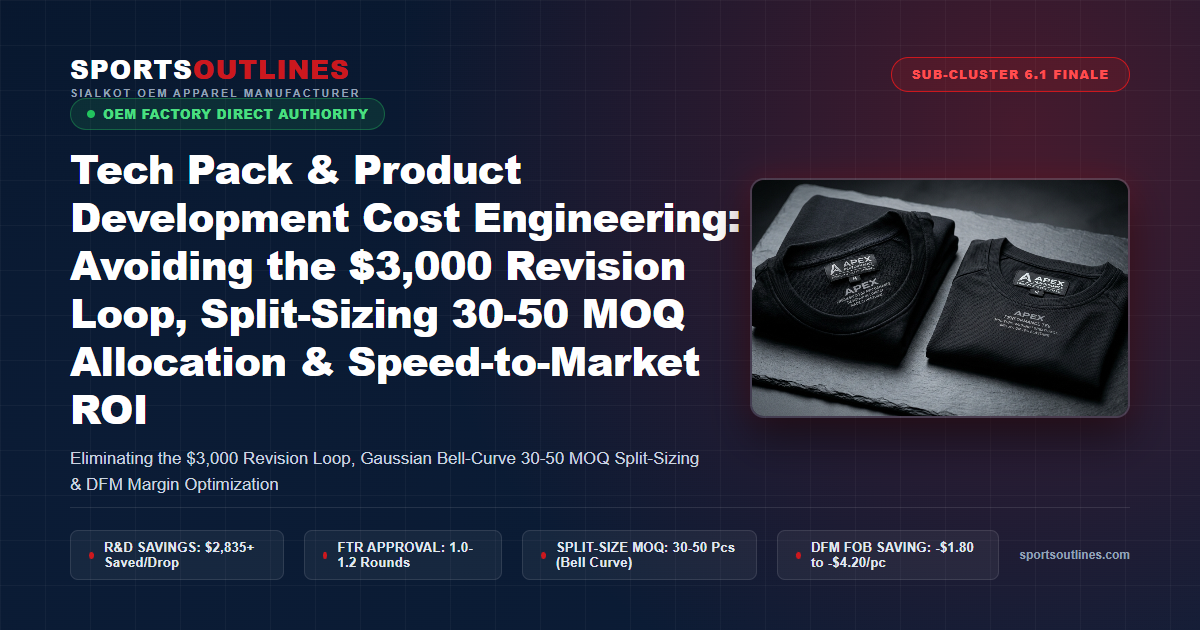
Key Engineering Takeaways (Sub-Cluster 6.1 Capstone): Audit the complete financial mathematics of First-Time-Right (FTR) Tech Pack engineering vs. iterative trial-and-error sampling; discover how sharing a common Core Pattern Block & Master Fabric Platform across multiple capsule SKUs cuts R&D expenses by 55%; learn the exact Gaussian bell-curve mathematics for split-sizing 30–50 piece low-MOQ production orders across S–2XL without deadstock; and integrate all 10 pillars of Sub-Cluster 6.1 into a deterministic product launch blueprint.
📋 Complete Technical Blueprint Navigation
- Anatomy of the “$3,000 Revision Loop”: How Vague Specifications Destroy Launch Capital
- First-Time-Right (FTR) Tech Pack ROI: Compressing Prototyping from 4 Rounds to 1.2 Rounds
- Modular Block & Fabric Platform Engineering: Building a 5-SKU Capsule on Shared DNA
- Split-Sizing Mathematics: How to Allocate a 30–50 Piece MOQ Across XS–3XL Without Deadstock
- Design-for-Manufacturing (DFM) Cost Engineering: Trimming $1.80–$4.20/Unit in Bulk Sewing
- Speed-to-Market & Inventory Velocity: Calculating Opportunity Cost in Seasonal Drops
- The Sub-Cluster 6.1 Master Synthesis: The 10-Gate Pre-Production Engineering Checklist
- Frequently Asked Questions (FAQ) on Product Development Cost Engineering & MOQ Allocation
1. Anatomy of the “$3,000 Revision Loop”: How Vague Specifications Destroy Launch Capital
When a founder approaches a garment factory with nothing more than a front-view Instagram screenshot, a rough Canva mockup, and a verbal note saying “make it fit like a boxy vintage heavyweight hoodie in sage green,” the factory’s sample master is forced to guess at more than 45 distinct engineering variables. What is the exact half-chest width in centimeters? What is the shoulder drop angle? Is the fleece 360 GSM 80/20 Cotton/Poly brushed back or 480 GSM 100% Cotton diagonal loopback French Terry? Is the hood lined or double-layered self-fabric? Which Pantone FHI TCX code defines “sage green”?
Because our physical pre-production prototyping operates on transparent industrial unit economics—$45–$85 per piece/pair/set as a non-refundable development fee with a 7–10 business day turnaround, as detailed in our Sialkot sample room routing blueprint—every time a brand guesses wrong and orders a new round of samples across a 5-piece collection, hard development costs compound rapidly alongside international DHL/FedEx air freight and lost calendar months.
| Cost & Timeline Dimension (5-SKU Capsule Launch) | Unstructured “Screenshot & Guesswork” Workflow (4 Sample Rounds) | Deterministic Tech Pack Engineering Workflow (1 Proto + Digital PPS Lock) | Net Capital & Time Saved |
|---|---|---|---|
| Physical Prototype Fees ($45–$85/pc avg $65 × 5 SKUs) | 4 Rounds × 5 SKUs = 20 samples → $1,300 | 1 Round × 5 SKUs (+1 revised SKU) = 6 samples → $390 | +$910 Direct Sampling Savings |
| International Express Air Courier (DHL/FedEx Dispatch) | 4 Separate Courier Shipments + Import Duties → $580 | 1 Consolidated Sample Shipment → $145 | +$435 Freight & Duty Savings |
| CAD Re-Drafting, Screen Re-Burning & Trim Re-Tooling | 3 Screen/Mold Resets + Custom Lab-Dip Re-dyes → $640 | Locked on 1st Pass via Pantone TCX & Vector Callouts → $0 Penalty | +$640 Tooling Rework Saved |
| Wasted Bulk Rework / Fit Return Allowances | 8%–14% customer sizing return rate from ungraded POMs → $850+ | <2% defect/fit discrepancy via ±0.5 cm POM & Golden Sample lock → $0 | +$850+ Margin Protection |
| TOTAL R&D CASH BURN & CALENDAR TIME TO BULK | $3,370+ Total Cost | 11–14 Weeks Before Bulk Starts | $535 Total Cost | 2.5–3.5 Weeks to Bulk Cut | $2,835+ Saved & 9 Weeks Faster Launch |
2. First-Time-Right (FTR) Tech Pack ROI: Compressing Prototyping from 4 Rounds to 1.2 Rounds
In industrial manufacturing engineering, the metric that separates profitable apparel brands from struggling startups is the First-Time-Right (FTR) Prototype Approval Rate. When a brand submits a comprehensive blueprint built on the standards established in our complete sportswear tech pack architecture guide, the first physical prototype hits within 96% to 100% of the target commercial specification on the very first attempt.
Even if a minor 1.0 cm sleeve taper adjustment or a 1.5 cm chest logo elevation shift is identified during live-model fit sample evaluation and pattern redlining, a minor redline adjustment of `≤ 1.5 cm` does not require paying for and waiting on a second couriered development sample. Instead, that exact dimensional delta is programmed directly into the 2D CAD pattern block and verified on the Pre-Production Sample (PPS) and Sealed Golden Sample prior to bulk cutting—achieving an average of 1.0 to 1.2 physical prototype rounds per SKU across our USA sportswear manufacturer and UK activewear production client portfolios.
3. Modular Block & Fabric Platform Engineering: Building a 5-SKU Capsule on Shared DNA
How do major global athletic brands launch 20-piece seasonal capsules with minimal R&D overhead and lightning-fast factory turnaround? They use Modular Block & Fabric Platform Engineering (the exact same chassis-sharing principle used by automotive manufacturers).
Instead of specifying five completely unrelated fabrics, five distinct neck label sizes, and five disconnected fit blocks for a 5-SKU startup launch, high-ROI product developers consolidate their Apparel Bill of Materials (BOM) and pattern blocks into a unified technical platform:
- Shared Master Chassis Blocks: Once you perfect and approve your signature “Oversized Drop-Shoulder Block” on a Heavyweight Hoodie (SKU #1), you immediately port those exact approved shoulder slope, chest width, armhole depth, and body length Points of Measure (POM) coordinates to your Heavyweight Crewneck Sweatshirt (SKU #2) and Zip-Up Track Hoodie (SKU #3). You only prototype the collar/zipper front differential rather than paying to re-engineer the entire torso fit from scratch.
- Shared Base Fabric Roll Consolidation: By engineering your Hoodie, Crewneck, and Sweatpant around the exact same 450 GSM 100% Combed Cotton French Terry base fabric in two core Pantone TCX colorways (`19-4007 TCX Anthracite` and `16-0213 TCX Desert Sage`), the factory aggregates total fabric consumption across all three styles. This unlocks volume fabric mill pricing, requires only two Pantone D65 lab-dip approvals instead of six, and guarantees zero dye-lot shade variation between tops and matching bottoms.
- Standardized Trim & Hardware Architecture: Using a single custom-molded matte black YKK #5 zipper puller, a single custom aglet cord-tip mold, and a universal heat-transfer neck label layout across the entire capsule eliminates redundant mold setup fees (`$80–$150 per custom metal mold saved`).
4. Split-Sizing Mathematics: How to Allocate a 30–50 Piece MOQ Across XS–3XL Without Deadstock
Once your Tech Pack and Golden Sample are locked, the next critical financial decision is Size Curve Allocation across your bulk order. At Sports Outlines, our low factory MOQ is strictly 30–50 pieces/pairs/sets per style/colorway, and we allow flexible split-sizing across your size range within that 30–50 piece minimum so emerging brands never have to order 50 pieces of a single size.
However, a fatal mistake many founders make on a 50-piece bulk order is dividing the quantity equally across five sizes (`10 Small, 10 Medium, 10 Large, 10 XL, 10 2XL`). Human anthropometric distribution follows a Gaussian Bell Curve centered around Medium and Large (or Small and Medium in women’s core activewear). Ordering an flat `10-10-10-10-10` split guarantees that your Mediums and Larges sell out in 72 hours—halting your ad campaign momentum—while 70% of your 2XL and Small units sit unsold in your warehouse for six months.
Combining our CAD pattern grading & marker efficiency rules with real-world e-commerce sell-through data from our Canadian, German/EU, and Australian brand partners, the table below provides the exact mathematical size-split models for 30-piece, 50-piece, and 100-piece production runs.
| Apparel Category & Demographic | Standard Ratio Curve | 30-Piece Low-MOQ Split (4 Sizes) | 50-Piece Standard MOQ Split (5 Sizes) | 100-Piece Scale Split (6 Sizes) |
|---|---|---|---|---|
| Men’s / Unisex Streetwear & Gymwear (Oversized / Boxy Fit) | 1 : 3 : 3 : 2 : 1(S : M : L : XL : 2XL) | S: 5 pcs | M: 10 pcs L: 10 pcs | XL: 5 pcs (Total = 30 pcs) | S: 6 pcs | M: 15 pcs L: 15 pcs | XL: 9 pcs 2XL: 5 pcs (Total = 50 pcs) | XS: 5 | S: 12 | M: 28 L: 28 | XL: 18 | 2XL: 9 (Total = 100 pcs) |
| Men’s Performance Compression, MMA / BJJ & Cycling (Athletic Fit) | 1 : 2.5 : 3.5 : 2 : 1(S : M : L : XL : 2XL) | S: 4 pcs | M: 9 pcs L: 11 pcs | XL: 6 pcs (Total = 30 pcs) | S: 5 pcs | M: 13 pcs L: 17 pcs | XL: 10 pcs 2XL: 5 pcs (Total = 50 pcs) | S: 10 | M: 25 | L: 34 XL: 18 | 2XL: 9 | 3XL: 4 (Total = 100 pcs) |
| Women’s Sculpting Leggings, Sports Bras & Tennis Skirts | 1.5 : 3.5 : 3 : 1.5 : 0.5(XS : S : M : L : XL) | XS: 5 pcs | S: 11 pcs M: 9 pcs | L: 5 pcs (Total = 30 pcs) | XS: 7 pcs | S: 17 pcs M: 15 pcs | L: 7 pcs XL: 4 pcs (Total = 50 pcs) | XXS: 5 | XS: 15 | S: 32 M: 28 | L: 14 | XL: 6 (Total = 100 pcs) |
| Team Roster & Club Uniform Orders (Soccer, Basketball, Ice Hockey) | Exact Player Roster + 10% Bench Buffer | 26 Named/Numbered Roster Kits + 4 Blank Reserve Kits (2×M, 2×L) | 44 Named/Numbered Roster Kits + 6 Blank Reserve Kits (2×M, 2×L, 2×XL) | 90 Named/Numbered Club Kits + 10 Blank Reserve Kits across S–2XL |
💡 Cutting-Table Ply Height Rule for 30–50 Piece Split-Size Orders
Why do we recommend limiting a 30-piece order to 4 core sizes (e.g., S, M, L, XL) and a 50-piece order to 5 sizes (e.g., XS–XL or S–2XL)? On an industrial cutting table, if a factory spreads 5 fabric plies deep and nests a 2-way stepped marker (pairing 1×S + 1×XL + 2×M + 2×L on the same fabric layer), all 30 garments are cut in a single precision pass with 84%+ marker fabric utilization. If a buyer attempts to split 30 pieces across 8 sizes (`XXS to 4XL`, ordering only 2 or 3 pieces of extreme sizes), the cutting room cannot stack plies efficiently, driving fabric waste up by 9% to 14%. Concentrating 30–50 piece initial test drops into 4–5 core bell-curve sizes maximizes both factory cutting efficiency and e-commerce sell-through velocity.
5. Design-for-Manufacturing (DFM) Cost Engineering: Trimming $1.80–$4.20/Unit in Bulk Sewing
Smart Tech Pack cost engineering does not stop at prototyping fees; it directly lowers your recurring FOB bulk unit cost without sacrificing perceived luxury retail value. In apparel production, unit labor cost is calculated in Standard Allowed Minutes (SAM)—the exact number of minutes and seconds required to cut, sew, press, and pack one garment, multiplied by the factory’s line-minute overhead rate.
Frequently, graphic designers draw arbitrary decorative seams or specify non-functional construction details on a Tech Pack that add 8 to 14 Standard Allowed Minutes (and $1.80 to $4.20 per garment in bulk cost) while adding zero consumer value. Applying Design-for-Manufacturing (DFM) value engineering during the Tech Pack phase captures massive gross-margin expansion:
| Garment Engineering Feature | High-Cost Over-Engineered Spec | DFM Cost-Engineered Alternative (Zero Quality Loss) | Bulk Unit Cost Savings (FOB) |
|---|---|---|---|
| Interior Seam Construction (Training Tops & Joggers) | Specify 4-Needle 6-Thread Flatlock (`ISO 607`) on every non-load-bearing decorative yoke and pocket bag seam. | Deploy `ISO 607` Flatlock strategically on high-friction skin-contact zones (crotch gusset, raglan armholes) and use high-speed `ISO 514` 4-thread overlock on pocket bags. | -$0.65 to -$1.15 / unit |
| Multi-Color Chest & Back Graphics (50-Piece Streetwear Run) | 9-color separated plastisol screen print requiring 9 individual rotary mesh screens ($225 screen setup amortized over 50 pcs = $4.50/pc). | 4-color simulated process screen print OR industrial matte cold-peel hybrid plastisol transfer / high-density silicone crest. | -$1.40 to -$2.20 / unit (on 30–50 MOQ) |
| Pattern Panel Geometry & Fabric Consumption Yield | 1-piece continuous flared side-leg panel with deep concave curve that prevents tight marker nesting (71% marker efficiency). | Introduce an ergonomic knee articulation seam splitting the long curved panel into two interlocking geometric blocks (85.5% marker efficiency). | -$0.85 to -$1.50 / unit in saved fabric |
| Main Neck Branding & Size Care Labeling | Separate woven main label + separate woven size tab + separate satin care label (3 separate bar-tack sewing operations + 5,000-pc label MOQs). | Unified custom tear-away HD elastane-stretch heat-seal neck transfer containing brand logo, size, fiber composition, and ISO wash icons in 1 press cycle. | -$0.45 to -$0.75 / unit + zero scratchy neck |
6. Speed-to-Market & Inventory Velocity: Calculating Opportunity Cost in Seasonal Drops
In retail apparel economics, time is inventory velocity. Suppose an activewear or streetwear brand plans a Q4 Autumn/Winter heavyweight fleece drop targeted for October 15th to capture full-price holiday buying through Black Friday / Cyber Monday (BFCM).
- Scenario A (The 12-Week Revision Loop Trap): Because the brand starts in August without a structured Tech Pack, they spend 10 weeks bouncing through four rounds of corrective prototypes. Bulk production does not ship until December 12th—missing Black Friday, Cyber Monday, and early holiday gifting entirely. The brand is forced to liquidate the inventory in January at a 35% clearance discount, destroying gross margin.
- Scenario B (The 21-Day Fast-Track Tech Pack + 30–50 MOQ Velocity Model): By submitting a complete Tech Pack on Day 1, receiving a First-Time-Right prototype within 7–10 business days ($45–$85 sample fee), locking a Fast-Track Digital PPS, and launching an initial 50-piece split-size bulk order that finishes production in 18–22 business days, the brand goes live on October 1st. Better yet, when two hero colorways sell out in the first 10 days of October, the factory already holds the locked CAD graded markers and Sealed Golden Sample on file—allowing an immediate 150-piece re-order turnaround in just 14–16 business days before Black Friday hits.
Furthermore, disciplined founders track their True Amortized Development Cost Per Bulk Unit (`ADC`) across the first 12 months of a garment’s lifecycle. When an unstructured brand spends `$750` in repeated sample rounds and courier fees to launch a single SKU and only orders `50 units` that suffer slow sell-through due to poor sizing splits, their amortized R&D burden is a staggering `$15.00 per bulk garment` (`$750 ÷ 50 units`), wiping out their wholesale margin entirely. Conversely, when a brand engineers a First-Time-Right Tech Pack, approves a single `$65` prototype on Round 1, validates market demand with an initial `50-piece` bell-curve drop, and immediately re-orders `250 units` on the locked CAD block (`300 cumulative units sold across the season`), the amortized development overhead drops to just `$0.21 per garment` (`$65 ÷ 300 units`). That `$14.79 per unit` structural cost advantage flows 100% into net operating profit and paid customer acquisition scale.
7. The Sub-Cluster 6.1 Master Synthesis: The 10-Gate Pre-Production Engineering Checklist
As the capstone guide concluding Sub-Cluster 6.1 (Blogs #431 to #440), the master matrix below synthesizes all ten technical disciplines of pre-production apparel engineering into a single operational checklist. Before releasing your next garment collection to the cutting floor, verify that every single gate below is locked:
| Gate # | Engineering Discipline (Sub-Cluster 6.1 Reference) | Mandatory Technical Deliverable | Pass / Lock Threshold |
|---|---|---|---|
| Gate 1 | Vector CAD Flat Sketch Architecture (#431) | 1:1 scale Adobe Illustrator (`.AI`) front, back, side, and inside-out structural callout drawings. | Zero unannotated seams or ambiguous artwork placement drops. |
| Gate 2 | Points of Measure (POM) & Tolerances (#432) | Alpha-numeric POM code matrix (HPS, Half-Chest, Front/Back Rise, Inseam) with explicit `± cm` tolerances. | Primary POMs locked at `±0.5 cm to ±1.0 cm`; cuffs/collars at `±0.3 cm`. |
| Gate 3 | Bill of Materials (BOM) & Yield (#433) | Exact GSM, fiber % blend, knit gauge, Tex thread ticket, YKK zipper gauge, and meters/kg yield per unit. | 100% component line-item accountability including polybag & carton spec. |
| Gate 4 | Multi-Size CAD Pattern Grading (#434) | Non-linear allometric X/Y grading rule table across XS–5XL with graphic screen-break tiers. | Interlocking CAD marker utilization `≥ 82%–86%` across size curve. |
| Gate 5 | ISO 4915 Stitch & Seam Callouts (#435) | Explicit `ISO 4915` stitch class (`301, 406, 514, 607`), `ISO 4916` seam class, SPI density, and seam allowance width. | 10–14 SPI locked; zero seam cracking at 100% elastomeric stretch. |
| Gate 6 | Pantone FHI Lab-Dip & Strike-Offs (#436) | Physical Pantone TCX/TPG/PMS evaluation under D65/TL84/A lightbox + spectrophotometer readout. | CMC (2:1) `Delta-E ≤ 1.0` with zero multi-component metamerism. |
| Gate 7 | Physical Prototyping Economics (#437) | Dedicated Sialkot R&D cell single-piece cutting, custom strike-off integration, and QC pre-audit. | $45–$85/pc non-refundable fee; dispatched in 7–10 business days. |
| Gate 8 | Fit Sample Evaluation & Redlining (#438) | Flat POM audit + live-model biomechanical ROM test + annotated photo redlining (`± cm` vector adjustments). | Zero horizontal/diagonal drag lines; CAD pattern revised to `v2.0`. |
| Gate 9 | PPS & Golden Sample Sealing (#439) | Bulk lot shrinkage test + 100% bulk-material PPS sealed with serialized tamper-evident security loop. | Signed Golden Sample hung on bulk sewing line & logged for AQL 2.5 audit. |
| Gate 10 | Split-Size MOQ & DFM Cost Lock (#440) | Gaussian bell-curve size allocation across 30–50 piece MOQ + DFM SAM labor optimization. | Maximum full-price sell-through velocity & optimal FOB unit margin. |
8. Frequently Asked Questions (FAQ) on Tech Pack Cost Engineering & 30–50 Piece Split-Size MOQs
Q1: How does a professional Tech Pack save over $2,500+ during a 5-SKU apparel launch?
Without a deterministic Tech Pack specifying exact POM measurements, GSM fabric physics, ISO stitch classes, and Pantone TCX color codes, brands typically require 3 to 4 rounds of physical corrective sampling across a 5-SKU capsule. At $45–$85 per sample plus 4 separate international DHL air-courier shipments, screen re-burning fees, and 10+ weeks of lost calendar time, unstructured development easily exceeds $3,000+. A First-Time-Right (FTR) Tech Pack locks 96%–100% of specifications on Round 1, cutting total R&D cash burn by over 75%.
Q2: Can I split a 30–50 piece low-MOQ bulk order across multiple garment sizes?
Yes. Sports Outlines enforces an accessible factory MOQ of 30–50 pieces/pairs/sets per style/colorway with full split-sizing across your size range. For a 30-piece order, we recommend allocating across 4 core sizes following a Gaussian bell curve (e.g., 5 S / 10 M / 10 L / 5 XL for men’s/unisex, or 5 XS / 11 S / 9 M / 5 L for women’s activewear). For a 50-piece order, you can smoothly span 5 sizes (`S through 2XL` or `XS through XL`) without accumulating deadstock.
Q3: What is Modular Block & Fabric Platform Engineering in capsule collections?
Modular platform engineering means building multiple SKUs (such as a Heavyweight Hoodie, Crewneck Sweatshirt, and Zip Track Jacket) on a single approved base torso fit block, sharing the same core fabric GSM and Pantone TCX dye lot, and utilizing standardized custom zipper pullers and heat-transfer neck labels. This eliminates redundant prototyping fees, unlocks higher fabric roll volume pricing, and guarantees 100% color matching across separates.
Q4: How does Design-for-Manufacturing (DFM) reduce bulk FOB unit costs without lowering garment quality?
DFM optimizes Standard Allowed Minutes (SAM) and fabric consumption yield during the Tech Pack stage. For example, introducing an ergonomic knee seam to allow curved pant panels to interlock at 85.5% marker efficiency (instead of 71%), using high-density heat-transfer neck labels instead of three separate sewn woven tags, and reserving 4-needle 6-thread flatlock (`ISO 607`) for true high-friction zones saves $1.80 to $4.20 per garment in bulk production while improving athletic comfort.
Q5: How fast can I re-order a winning SKU once my CAD pattern block and Golden Sample are locked?
Once your first 30–50 piece bulk run has been produced using a locked Gerber/Optitex graded CAD marker and a serialized Golden Sample, zero R&D or sampling time is required for restocks. Repeat bulk production orders in the same fabric and colorway bypass the sample room entirely and proceed straight to fabric relaxation, cutting, sewing, and AQL 2.5 audit—completing in just 14 to 18 business days.
Launch Your Next Sportswear Capsule with First-Time-Right Engineering
Eliminate the $3,000 revision loop. Partner with Sports Outlines for precision CAD pattern engineering, $45–$85 physical pre-production prototyping (7–10 business days turnaround), and high-margin 30–50 piece split-size low-MOQ bulk manufacturing.