
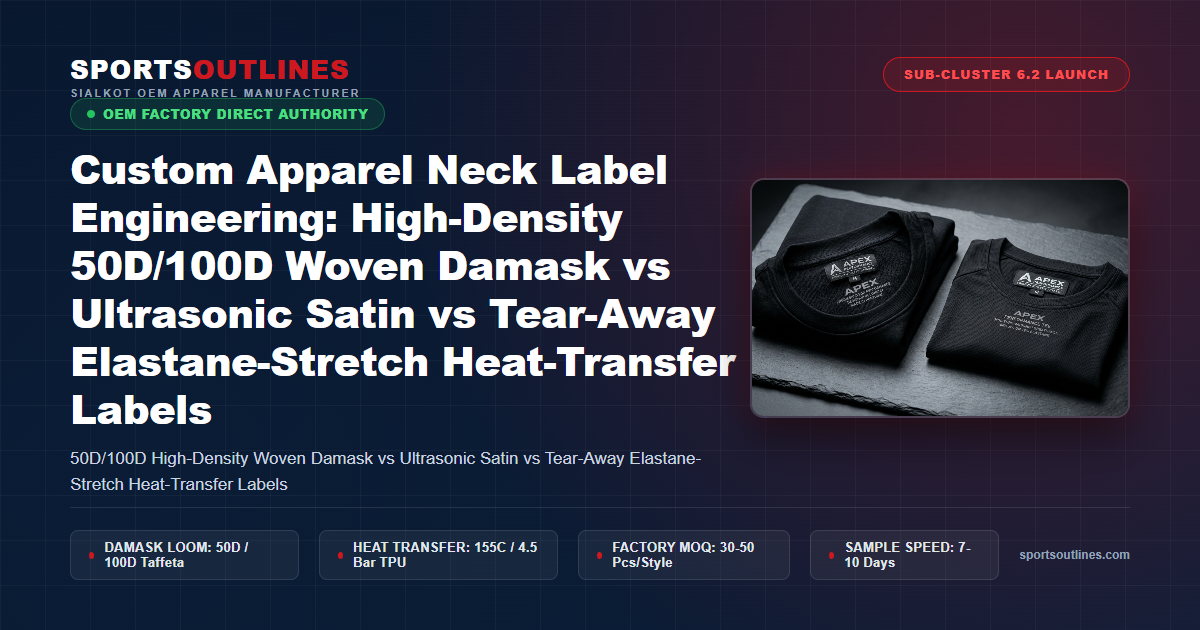
Why a $0.08 Neck Label Dictates whether Your Garment Commands a $95 Retail Price or Triggers an Immediate Customer Return
In custom sportswear, gym activewear, and luxury heavyweight streetwear manufacturing, the inside center-back neck zone is the single highest-contact sensory touchpoint on the human torso. Every time an athlete performs an overhead press, runs a 10K, or pulls on a 480 GSM hoodie, the skin over the C7 cervical vertebra rubs directly against your main neck label. If a factory installs a cheap, hot-wire-cut 150-denier polyester taffeta label with beaded melted edges, the consumer experiences immediate neck irritation and cuts the label out with scissors within five minutes of unboxing—permanently erasing your brand identity from the garment.
Key Engineering Takeaways: Deconstruct the textile physics of 50D High-Definition Woven Damask vs. 100D Standard Damask vs. Ultrasonic-Slit Double-Faced Bridal Satin vs. Elastane-Stretch Polyurethane (PU) & Plastisol Tagless Heat-Transfer Neck Labels; master fold geometries (Manhattan fold, end-fold, center-loop fold, miter fold); eliminate “label show-through” (`stitch ghosting on the exterior back yoke`) via half-moon neck patches; and learn how to amortize 500-to-1,000 piece label loom minimums across 30–50 piece low-MOQ apparel production runs.
📋 Complete Technical Blueprint Navigation
- The 4 Primary Neck Label Architectures: Damask vs. Satin vs. Tagless Heat Transfer vs. Silicone/TPU
- Woven Damask Loom Physics: 50-Denier Ultra-HD vs. 100-Denier Warp/Weft Pick Density
- Why Neck Labels Scratch: Hot-Knife Thermal Slitting vs. Ultrasonic Cold-Shear Edge Engineering
- Tagless Heat-Transfer Neck Labels: Water-Based PU & Silicone Ink Elasticity for 4-Way Stretch Knits
- Woven Label Fold Topologies & Half-Moon Back-Neck Yoke Patch Construction
- Wash Durability, Sublimation Dye-Migration Blocking & OEKO-TEX® Standard 100 Class II Safety
- Trim Inventory Banking: Deploying Custom Neck Labels on 30–50 Piece Low-MOQ Orders
- Frequently Asked Questions (FAQ) on Custom Apparel Neck Label Engineering
1. The 4 Primary Neck Label Architectures: Damask vs. Satin vs. Tagless Heat Transfer vs. Silicone/TPU
Selecting the wrong neck label substrate for a specific garment category is one of the fastest ways to undermine perceived quality. If you sew a rigid woven damask label directly across the back seam of a `210 GSM` 4-way stretch compression rashguard or women’s sculpting sports bra, the non-stretch woven polyester tape creates a rigid mechanical bridge that restricts neckline stretch by `35%`, causing the `ISO 607` flatlock or coverstitch neck seam to pop the first time the athlete pulls the garment over their head. Conversely, applying a flat screen-printed heat transfer inside a `500 GSM` brushed acid-wash streetwear hoodie fails to bond cleanly to the deep three-dimensional fleece loops and looks cheap compared to a heavy high-density woven damask crest.
Building directly on our Sub-Cluster 6.1 foundations—including our 8-sheet master sportswear tech pack architecture and Apparel Bill of Materials (BOM) engineering guide—the master comparison matrix below maps the four industrial neck label systems used across our Sialkot manufacturing lines for USA sportswear brands, UK activewear labels, and global B2B buyers.
| Label Architecture | Yarn / Polymer Physics | Stretch Modulus & Hand-Feel | Minimum Lettering Height | Ideal Sportswear & Outerwear Applications |
|---|---|---|---|---|
| 1. High-Density Woven Damask (50D / 100D) | Jacquard air-jet or rapier loom; `100D` warp × `50D` (`or 50D × 50D`) superfine trilobal polyester yarns. | 0%–2% rigid weave; soft matte tapestry texture when ultrasonic-cut. | 1.2 mm (`50D HD`)1.8 mm (`100D Std`) | Heavyweight hoodies (`380–550 GSM`), track jackets, varsity outerwear, joggers, BJJ Gis, woven shorts. |
| 2. Double-Faced Woven / Printed Bridal Satin | 5-harness warp-float satin weave (`75D` bright filament warp) with woven or rotary-printed ink graphics. | 0% stretch; ultra-slick, silky zero-friction surface (`μ_k = 0.22`). | 1.0 mm (Printed)2.0 mm (Woven) | Luxury women’s loungewear, satin boxing robes, Muay Thai shorts, internal side-seam wash care labels. |
| 3. Elastane-Stretch Tagless Heat Transfer | Water-based Polyurethane (`PU`) or 2-part platinum silicone screen-printed onto `75 μm` cold-peel PET carrier film with TPU hot-melt adhesive. | 120%–180% biaxial elongation with 99% recovery; zero edge profile (`0.08 mm` thin). | 0.8 mm (Crisp vector micro-text & ISO wash icons) | Mandatory for: Compression leggings, sports bras, rashguards, cycling jerseys, seamless knits, performance tees. |
| 4. 3D High-Density Silicone / Satin-Backed TPU Label | Liquid silicone rubber (`LSR`) molded onto a micro-brushed satin or scuba backing tape with a stitched perimeter channel. | Rubberized soft-touch matte relief (`0.8–1.5 mm` raised 3D typography). | 1.5 mm (3D raised mold wall thickness ≥ 0.4 mm) | Technical ski/alpine shells, waterproof seam-sealed rain jackets, golf outerwear, premium tracksuits, gym bags. |
2. Woven Damask Loom Physics: 50-Denier Ultra-HD vs. 100-Denier Warp/Weft Pick Density
Why do some woven neck labels display razor-sharp serif typography and smooth circular crest curves while others look pixelated, staircase-jagged, and blurry? The difference lies in the Yarn Linear Mass Density (Denier) and the Weft Pick Density (`Picks Per Centimeter / PPC`) on the computer-controlled Dornier or Mueller Jacquard loom.
In textile engineering, Denier (`D`) measures the mass in grams per 9,000 meters of continuous filament yarn. Lower denier yarn has a smaller circular cross-sectional diameter, allowing the loom reed to pack dramatically more threads into every square centimeter of the label—acting exactly like higher DPI resolution on a digital display:
- 150D Polyester Taffeta (Commodity Grade — Avoid for Main Neck Labels): Uses coarse `150-denier` warp and weft yarns (`~24 warp ends/cm`). Because the background warp threads are only partially covered by the weft, the reverse color bleeds through the background (“salt-and-pepper show-through”), fine text under `2.5 mm` becomes illegible, and the label feels papery and stiff against the skin.
- 100D Standard High-Density Damask (`100D Warp × 100D Weft`): The workhorse of commercial sportswear and teamwear (`~42 warp ends/cm × 55–65 weft picks/cm`). Delivers solid background opacity, crisp block lettering down to `1.8 mm` height, and high tensile durability for hoodies, joggers, and combat uniforms.
- 50D Ultra-High-Definition (`Ultra-HD`) Micro-Damask (`50D Warp × 50D Weft` or `75D × 50D`): The pinnacle of luxury private-label weaving (`~68–80 warp ends/cm × 90–110 weft picks/cm`). Because a `50D` yarn has half the mass and a `29%` smaller filament diameter than `100D` yarn, Ultra-HD Damask renders intricate crests, micro-serif fonts down to `1.2 mm` height, and photographic tonal gradients with a buttery-soft, cashmere-like drape that flexes effortlessly with the garment collar.
⚠️ The “Dark-on-Light Weft Bleed” Trap in White Woven Damask Labels
When a brand designs a pure optical-white woven damask neck label featuring a Jet Black (`Pantone 19-4007 TCX`) logo, standard single-pick weaving carries the black weft shuttle thread continuously across the back (reverse side) of the white label. Because white polyester yarns are slightly translucent, that black backing thread casts a dull grey shadow through the white face—turning your bright white label into a muddy silver-grey! To prevent this, our Tech Pack specification mandates either: (1) Double-Pick Weft Stuffing (`2-Ply White Face Density`) to block 100% of rear shuttle shadow, or (2) Needle-Loom Woven-Edge (`Selvedge`) Construction with localized shuttle cut-offs.
3. Why Neck Labels Scratch: Hot-Knife Thermal Slitting vs. Ultrasonic Cold-Shear Edge Engineering
Over 90% of woven damask neck labels are woven on wide “broadloom” Jacquard machines as a `120 cm` wide master tapestry containing 20 to 30 parallel label ribbons side-by-side, which must then be slit into individual label strips and cut to length. How the factory slits those polyester ribbons determines whether your neck label feels like silk or like a serrated plastic sawblade:
| Label Slitting & Edge Technology | Physical Cutting Mechanism | Microscopic Edge Profile | Skin Irritation Risk (C7 Cervical Zone) | Sports Outlines Factory Standard |
|---|---|---|---|---|
| 1. Thermal Hot-Knife / Hot-Wire Slitting (Low-Cost Method) | Electrically heated nichrome blade at 320°C–380°C melts through polyester yarns. | Forms a hard, crystalline, glassy melted plastic bead (`0.35 mm` thick) along both edges. | HIGH — Feels sharp and scratchy; causes immediate red skin chafing during workouts. | PROHIBITED on all direct-skin neck & waistband labels. |
| 2. High-Frequency Ultrasonic Slitting (20 kHz Acoustic Horn) | Titanium sonotrode vibrating at 20,000 Hz shears and molecularly seals yarn ends under cold anvil pressure. | Tapered, feather-thin sealed edge (`≤ 0.09 mm`) with zero hard plastic beading or fraying. | ZERO — Smooth, soft, non-abrasive perimeter edge. | MANDATORY BASELINE on all broadloom damask & satin labels. |
| 3. Precision CO2 Laser Die-Cutting | Focused non-contact infrared beam vaporizes custom shield/crest contours. | Cauterized micro-edge capable of cutting complex non-rectangular shield, hexagon, or die-cut shapes. | LOW — Ideal when stitched flat around 360° perimeter on half-moon patches. | Used for exterior hem badges, jock-tags, and stitched back-yoke crests. |
| 4. True Needle-Loom Woven Selvedge (Taffeta / Satin Edge) | Each label is woven individually on a narrow Jakob Müller needle loom; weft yarn loops continuously around the edge without cutting. | 100% natural rounded yarn loop edge (`zero cut or melted fibers along left/right edges`). | ULTRA-LUXURY — Softest possible physical woven edge in the textile industry. | Available for flagship luxury streetwear & boutique athleisure capsules. |
4. Tagless Heat-Transfer Neck Labels: Water-Based PU & Silicone Ink Elasticity for 4-Way Stretch Knits
For modern technical activewear—including squat-proof compression leggings, seamless sports bras, moisture-wicking running tees, cycling jerseys, and BJJ/MMA rashguards supplied to our Canadian, German/EU, and Australian activewear brands—Tagless Elastane-Stretch Heat-Transfer Neck Labels are the undisputed industry standard.
However, not all heat-transfer neck labels are engineered equally. If a printer uses rigid PVC plastisol ink formulated for 100% cotton promotional t-shirts and presses it onto a `78% Nylon / 22% Elastane` compression garment, the neck label will crack into a spiderweb of flakes during the very first workout or delaminate in the washing machine. High-performance activewear demands a 4-Layer Elastomeric Screen-Printed Transfer Architecture:
- Layer 1 — Matte Cold-Peel Release PET Carrier Film (`75–100 Micron`): Coated with a wax-free matte silicone release agent so that when the carrier film is peeled away after cooling, the ink surface displays a sophisticated, non-glare matte finish rather than a shiny plastic glare.
- Layer 2 — High-Elongation Water-Based Polyurethane (`PU`) or Two-Part Platinum Silicone Graphic Ink (`2–3 Passes through 120T Mesh`): Formulated to stretch up to 150% to 180% elongation without micro-cracking, matching the biaxial modulus of warp-knit spandex fabrics.
- Layer 3 — Anti-Sublimation Activated Carbon / Titanium-White Blocker Pass (`Mandatory on Dyed Polyester`): When heat-pressing a white or silver neck transfer onto a black or red disperse-dyed polyester jersey at `150°C`, residual disperse dye molecules gasify and migrate upward into the label ink (“dye bleed”), turning a white neck label pink or grey within 48 hours. An intermediate carbon/blocker screen pass locks dye migration at Grade 4.5–5.0 (`ISO 105-X11`).
- Layer 4 — Low-Melt Aliphatic Thermoplastic Polyurethane (`TPU`) Hot-Melt Adhesive Powder/Paste (`115°C–135°C Activation`): Engineered to melt and interlock mechanically around hydrophobic nylon and spandex filaments at safe low pressing temperatures (`135°C–145°C for 10–12 seconds at 3.5 bar pneumatic pressure`), preventing “heat-press scorch marks” (`rectangular shiny box outlines`) on delicate synthetic knits while surviving 50+ domestic wash-and-dry cycles (`ISO 6330 at 40°C`) without peeling.
5. Woven Label Fold Topologies & Half-Moon Back-Neck Yoke Patch Construction
When specifying a physical woven damask or satin neck label on `Sheet 7 (Trim & Packaging)` of your Tech Pack, you must explicitly call out both the Fold Geometry and the Stitch Attachment Method (`referencing our` ISO 4915 stitch and seam callout standards). If an `ISO 301` single-needle lockstitch line is sewn straight through the back of a garment to hold a woven neck label without a backing yoke, that stitch rectangle will be completely visible on the outside back of the shirt—a cardinal aesthetic flaw in premium apparel!
| Label Fold & Mounting Style | Cut vs. Finished Dimensions (Seam Allowance) | Sewing Operation (`ISO 4915`) | Exterior Stitch Visibility | Best Structural Use Case |
|---|---|---|---|---|
| 1. Left/Right End-Fold (`Book-End Fold`) | Finished 60 × 25 mm requires +7 mm fold-under per side = 74 × 25 mm cut length. | 2 vertical `ISO 301` lockstitch tacks down left & right folded edges (`or 360° perimeter box stitch`). | Visible on exterior unless mounted onto an internal Half-Moon Neck Patch or hood lining. | Premium streetwear hoodies, lined bomber jackets, half-moon yoke tees, BJJ Gi jackets. |
| 2. Center-Fold (`Loop Fold`) | Finished 35 × 40 mm loop requires 35 × 94 mm cut length (`including +7 mm top seam bite`). | Top raw edges are caught directly inside the collar-to-body `ISO 514` overlock + covered by `10 mm` neck binding tape (`ISO 406`). | 100% ZERO exterior stitch show-through (hidden inside collar seam). | Unlined crewnecks, polo shirts, team jerseys, and side-seam wash/care laundry labels. |
| 3. Top-and-Bottom End-Fold + External Size Tab | Main label 55 × 30 mm (`+7 mm` top/bottom fold) with miniature 12 × 12 mm woven size flag tucked under bottom edge. | Top edge caught under back-neck twill tape; bottom edge stitched onto internal half-moon patch. | Hidden by internal half-moon yoke crescent. | Allows 1 universal main brand label across all sizes while swapping only the miniature `XS–3XL` size tab! |
| 4. Manhattan Fold & Hem Clamp Tag (`Jock Tag`) | Wraps `180°` around the bottom rib cuff, sleeve hem, or kangaroo pocket edge (`e.g., 25 × 25 mm` visible face on both sides). | Perimeter `ISO 301` micro-lockstitch (`14 SPI`) with matching `Tex 24` thread. | Intentional external retail branding accent. | Hoodie cuff/hem clamp tags, basketball/football jersey lower-left jock tags, beanie cuff labels. |
Engineering the Internal Half-Moon Back-Neck Yoke Patch (`Crescent Patch`): Whenever a brand wants a large, flat `65 mm × 40 mm` end-fold woven damask label or a 3D silicone crest sewn flat inside the back of an unlined t-shirt, polo, or sweatshirt without any stitch lines showing on the outside back, our pattern masters draft a crescent-shaped self-fabric Half-Moon Patch (`typically 15 cm wide × 7.5 cm deep`). Step 1: The woven main label and miniature size tab are stitched onto the half-moon patch before garment assembly. Step 2: The top curved arc of the half-moon patch is sewn into the back neckline collar seam (`covered by 10 mm twill neck tape`), while its lower curved edge is double-needle coverstitched (`ISO 406`) to the back body panel—turning an interior structural mount into a signature luxury heritage detail on the outside back yoke.
6. Wash Durability, Sublimation Dye-Migration Blocking & OEKO-TEX® Standard 100 Class II Safety
Because neck labels remain in constant contact with warm, sweat-saturated skin (`pH 4.5 to 7.0`), every yarn, dyestuff, polyurethane binder, and hot-melt adhesive used in our neck labels is certified compliant with OEKO-TEX® Standard 100 Product Class II (Direct Skin Contact) and EU REACH Annex XVII:
- Zero Phthalates, Zero PVC & Zero Formaldehyde: All tagless heat-transfer neck labels utilize 100% water-based polyurethane (`PU`) or platinum-cured silicone inks—completely free of ortho-phthalates (`DEHP, DBP, BBP, DINP < 0.01%`), heavy metals (`Lead, Cadmium, Mercury`), and free formaldehyde (`< 75 mg/kg` per ISO 14184-1).
- 50-Cycle ISO 6330 Wash & Tumble-Dry Endurance: Before approving any neck transfer or woven damask lot for bulk production (and locking it onto the Pre-Production Sample (PPS) and Sealed Golden Sample), our Sialkot QA lab subjects a pressed swatch to `5× accelerated 60°C wash cycles` and a `10-cycle cross-hatch tape adhesion pull test (ASTM D3359)` at `100%` manual stretch. Any cracking, edge lifting, or color bleed (`ISO 105-C06 < Grade 4.5`) results in immediate lot rejection.
7. Trim Inventory Banking: Deploying Custom Neck Labels on 30–50 Piece Low-MOQ Orders
One of the most common commercial questions from startup founders ordering at our factory-direct low MOQ of 30–50 pieces/pairs/sets per style/colorway is: “If a Jacquard weaving loom or screen-transfer press requires 500 to 1,000 neck labels per setup, how do I put custom neck labels on a 50-piece garment order without paying exorbitant setup fees on every single size?”
Building on the modular platform principles introduced in our tech pack and product development cost engineering guide, Sports Outlines solves this through Modular Label Architecture & Free Factory Trim Banking:
| Labeling Strategy for 30–50 Piece MOQ | How Size Differentiation Is Handled | Batch Setup & Unit Cost Economics | Factory Trim Vault Storage Benefit |
|---|---|---|---|
| Option A: Universal Woven Damask Main Label + Separate Miniature Woven Size Tabs (`XS–3XL`) | The main 60 × 25 mm woven damask label displays ONLY your brand logo/slogan (zero size text). A tiny 12 × 12 mm woven size flag (`S, M, L, XL, 2XL`) is tucked neatly beneath the bottom center edge during sewing. | Requires only 1 single Jacquard loom setup (`$65–$85` for `500–1,000` main labels = `$0.08/pc`) instead of 6 separate size-specific loom setups (`saving $350+`)! | Remaining `450–950` woven labels are sealed in a barcoded bin in our Sialkot Trim Vault and applied to your next `10+` bulk orders or restocks at `$0` extra label cost. |
| Option B: Multi-Up Gang-Sheet Tagless Heat-Transfer Neck Labels (`S–2XL on 1 Sheet`) | We gang-nest your `XS, S, M, L, XL, and 2XL` neck transfers on a single `48 × 64 cm` master screen-print sheet in exact Gaussian bell-curve ratios (`e.g., 1×S, 3×M, 3×L, 2×XL, 1×2XL per sheet`). | Printing `50 master gang-sheets` yields `500` size-sorted elastomeric neck transfers in a single screen setup (`~$75–$95` total lot cost). | Can be pressed across any colourway of tees, leggings, rashguards, or hoodies sharing the same fiber blend; excess transfers stored in climate-controlled vault for 18 months. |
| Option C: Hybrid Tear-Away Satin Care Label + Tagless Brand Neck Transfer | Brand logo + size are heat-pressed cleanly at the center-back neck (`zero itch`), while multilingual legal fiber/wash care text (`US FTC / EU 1007/2011`) is printed on a soft ultrasonic satin loop label sewn into the lower-left side seam (`10 cm above hem`). | Keeps the neck transfer graphic minimal, clean, and aesthetic while accommodating 4-language legal compliance on the hidden inner hip seam. | Matches the exact retail labeling architecture of Lululemon®, Gymshark®, and Nike® Pro apparel. |
During your initial physical pre-production prototype phase (billed at $45–$85 per piece/pair/set as a non-refundable development fee with a 7–10 business days turnaround, as detailed in our physical pre-production prototyping guide), we can apply a custom digital/DTF neck transfer on `Proto #1` for immediate visual placement verification while simultaneously weaving your `50D/100D` damask label tape for your bulk order and 600–800 GSM luxury hangtag package.
8. Frequently Asked Questions (FAQ) on Custom Apparel Neck Label Engineering
Q1: Should I use a Woven Damask label or a Tagless Heat-Transfer label for gym activewear and compression garments?
For next-to-skin performance activewear—including compression leggings, sports bras, BJJ/MMA rashguards, cycling jerseys, and moisture-wicking training tees—always specify an Elastane-Stretch Tagless Heat-Transfer Neck Label (`water-based PU or silicone ink with 120%–180% stretch`). It eliminates 100% of neck chafing during high-sweat workouts and stretches seamlessly with the collar seam. Reserve 50D/100D Ultrasonic-Cut Woven Damask Labels for heavyweight streetwear hoodies, crewnecks, joggers, track jackets, and woven outerwear.
Q2: What is the difference between 50-Denier (50D) and 100-Denier (100D) woven damask labels?
Denier measures yarn thickness (`grams per 9,000 meters`). A 50-Denier (`50D`) Ultra-HD Woven Damask uses superfine yarns that pack `90–110 weft picks per centimeter`, allowing crisp micro-lettering down to `1.2 mm` height and a noticeably softer, more flexible hand-feel than standard `100D` damask (`1.8 mm` minimum text height).
Q3: How do you prevent woven neck label stitches from showing through on the outside back of a t-shirt or hoodie?
There are two industrial solutions: (1) Use a Center-Fold (`Loop`) Label caught directly inside the collar rib overlock seam and covered with `10 mm` self-fabric or twill neck binding tape (`ISO 406`), resulting in zero exterior stitches; or (2) Mount an End-Fold Damask Label onto an internal crescent-shaped Half-Moon Back-Neck Yoke Patch prior to assembling the garment.
Q4: Why do some white heat-transfer neck labels turn pink or grey on dark polyester garments, and how do you stop it?
Color shifting on polyester garments is caused by Sublimation Dye Migration—heat-press energy (`140°C–150°C`) reactivates disperse dye molecules in the polyester fabric, causing them to gasify and bleed into the neck label ink. We prevent this by screen-printing an Activated Carbon / Anti-Migration Blocker Underbase Layer + low-temperature (`135°C`) aliphatic TPU adhesive, locking color fastness at Grade 4.5–5.0.
Q5: Can I get custom woven damask or tagless heat-transfer neck labels on a 30–50 piece low-MOQ bulk order?
Yes. Through our Modular Size-Tab System (`1 universal woven brand label + miniature XS–3XL size flags`) or Multi-Up Gang-Sheet Heat Transfers, you pay a single low trim setup for `500–1,000` labels (`~$65–$95`). We install the exact quantity needed for your initial 30–50 piece bulk run and store your remaining labels in our climate-controlled Sialkot Trim Vault at zero storage fee for all future drops and restocks.
Elevate Your Private Label Sportswear with Retail-Grade Neck Branding
From 50D ultrasonic-cut woven damask with half-moon yokes to 180%-stretch tagless silicone heat transfers, Sports Outlines engineers complete custom trim packages for 30–50 piece low-MOQ bulk runs, backed by $45–$85 physical pre-production prototyping (7–10 business days turnaround).
Pingback: Global Apparel Care & Fiber Content Labeling Compliance: US FTC RN Numbers, EU Textile Regulation 1007/2011, ISO 3758 Wash Symbols & Country-of-Origin Laws - Sports Outlines
Pingback: Luxury Sportswear Hangtag & Swing-Ticket Engineering: 600-800 GSM Duplex Laminated Cardstock, Spot-UV, Foil Debossing, Bullet String Locks & Safety Pins - Sports Outlines
Pingback: Custom Branded Hardware & Trim Tooling: 3D Molded Silicone/TPU Badges, Zinc-Alloy Die-Cast Zipper Pullers, Engraved Metal Cord Aglets & Grommet Engineering - Sports Outlines
Pingback: Custom Retail Polybag & Sustainable Apparel Packaging Engineering: 80-Micron Frosted CPE/LDPE Zipper Bags, Air-Vent Grommets, Suffocation Warnings & Compostable PLA/PBAT Films - Sports Outlines
Pingback: Apparel Barcode, SKU & 3PL Warehouse Labeling Architecture: GS1 UPC-A / EAN-13, Amazon FBA FNSKU Thermal Stickers, Size Strip Tape & RFID Smart Tags - Sports Outlines
Pingback: Anti-Counterfeit Sportswear Security & Smart Connected Packaging: QR Serialization, NFC Chip Silicone Patches, Woven Micro-Text & Tamper-Evident Seals - Sports Outlines
Pingback: Custom Woven Jacquard Elastic Waistbands & Internal Neck Seam Taping: Needle-Loom Tension Modulus, Brushed Plush Backers & Branded Twill Reinforcement Tapes - Sports Outlines
Pingback: Private Label Trim & Packaging Cost Engineering: Amortizing Label/Mold MOQs Across 30–50 Piece Apparel Runs & Building a "$1.25 Luxury Unboxing" System - Sports Outlines
Pingback: Export Master Carton & Containerization Packaging Engineering: 5-Ply BC-Flute Corrugated Board, Mullen Burst / ECT 48 lb Testing, Poly-Strapping & Palletization - Sports Outlines